Recognition: unknown
Surface-Adsorbed Nanodroplets of Symmetric Diblock Copolymers Form Versatile and Stimuli-Responsive Nanostructures
Pith reviewed 2026-05-09 19:22 UTC · model grok-4.3
The pith
Small surface-adsorbed nanodroplets of symmetric diblock copolymers form multiple nanostructures that switch reversibly when block interactions change.
A machine-rendered reading of the paper's core claim, the machinery that carries it, and where it could break.
Core claim
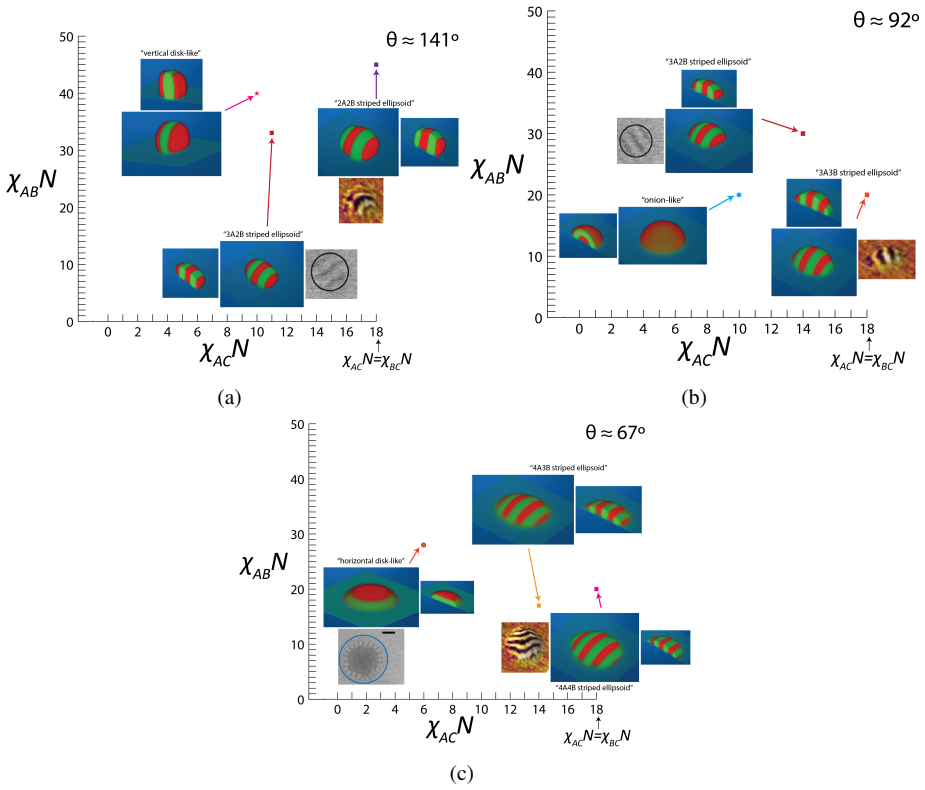
Small (10-100 nm) surface-adsorbed droplets of symmetric diblock copolymers form a multitude of different externally switchable nanostructures. Direct and reversible transitions between different droplet morphologies are possible upon changing the interaction strength between components, which can be tuned externally in experiments by adding surfactants or controlling temperature. A near-equilibrium 4D diagram of morphologies was obtained via self-consistent field theory calculations that locate equilibrium structures without pre-assuming shapes, and surfactant modeling confirmed the switch between nanostructures.
What carries the argument
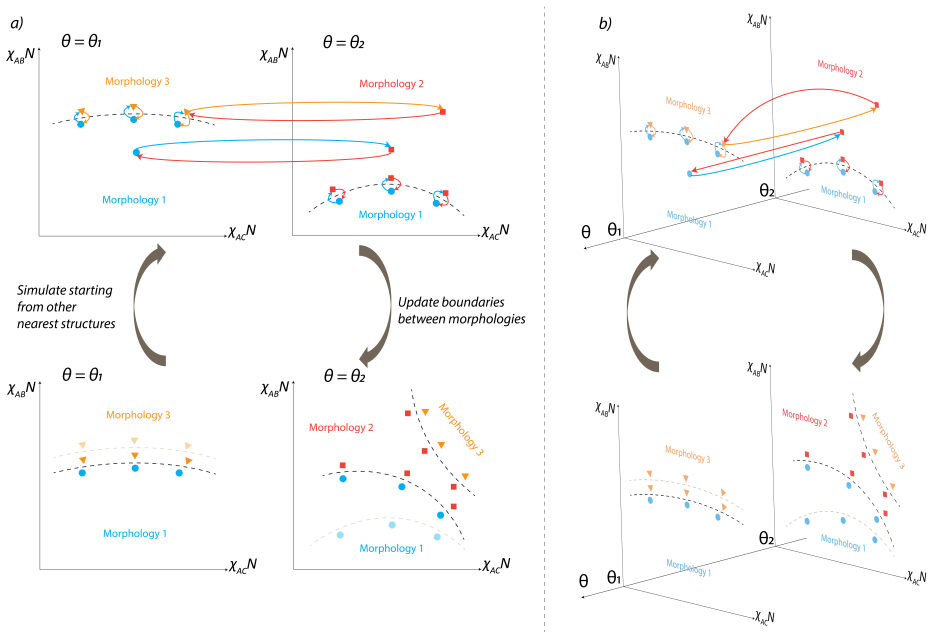
Self-consistent field theory (SCFT) calculations with an algorithm that determines equilibrium droplet morphology without presupposing structures, applied across wetting and phase-separation parameters.
Load-bearing premise
The SCFT simulations find the true global equilibrium morphology for each parameter set and the surfactant model accurately represents experimental tunability.
What would settle it
An experiment in which surfactants are added to real nanodroplets but the predicted morphology switch fails to occur, or a simulation that reveals a lower-energy structure missed by the SCFT approach.
Figures


read the original abstract
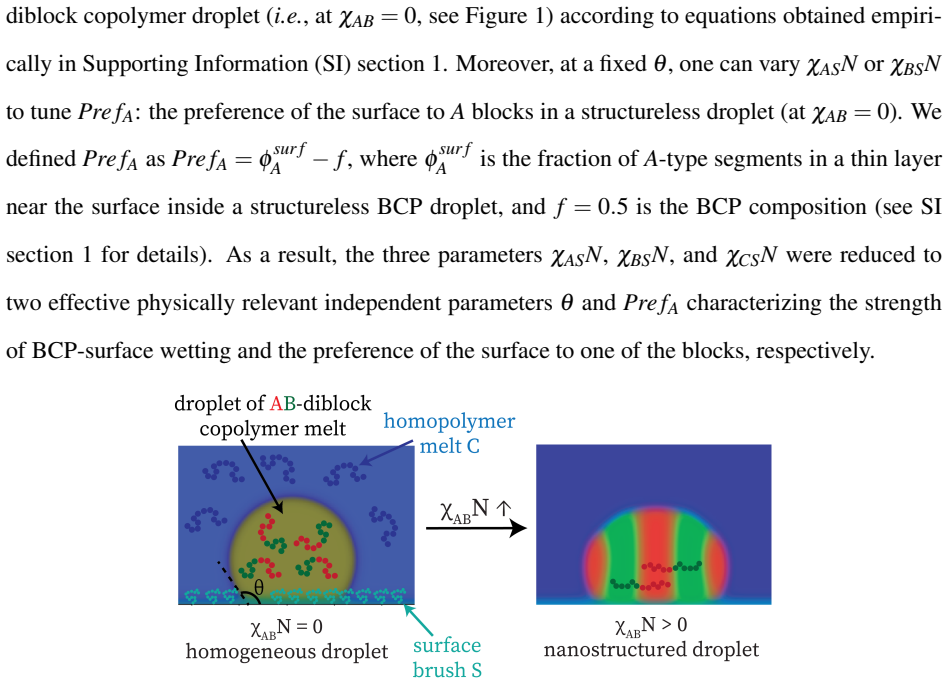
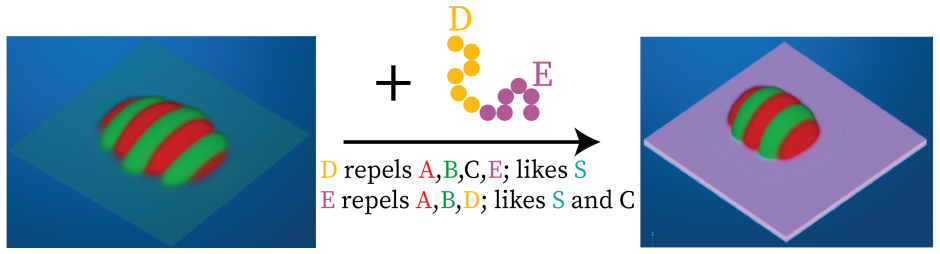
Block copolymers often create droplets when placed on a substrate. Such nanostructured droplets can be arranged into regular microstructured arrays, thereby forming hierarchically organized materials that can be used in microelectronics, plasmonics, sensing, photonics, metamaterials production, and even cryptography. However, it is unclear if such materials can be stimuli-responsive, i.e., be able to change their nanostructure on a single droplet level upon applying external stimuli. In this work, we discovered that small (10-100 nm) surface-adsorbed droplets of symmetric diblock copolymers can form a multitude of different externally switchable nanostructures. We obtained a near-equilibrium, comprehensive 4D diagram of droplet morphologies by performing large-scale self-consistent field theory (SCFT) calculations under various wetting and phase separation conditions. The SCFT modeling was augmented with a computational algorithm that established an equilibrium droplet morphology in a given system without assuming potentially equilibrium structures prior to simulation. The discovered droplet nanostructures agreed excellently with previously published experimental data. Crucially, we showed that direct and reversible transitions between different droplet morphologies are possible upon changing the interaction strength between components, which can be tuned externally in experiments by adding surfactants or controlling temperature. We confirmed experimental realizability of such stimuli-responsiveness by modeling surfactant addition that led to a switch between droplet nanostructures. This work demonstrates that even the simplest symmetric diblock copolymers are able to produce versatile and stimuli-responsive structures on a surface when confined to a small nanodroplet. This opens the possibility to produce smart coatings with externally switchable hierarchical micro- and nanostructures.
Editorial analysis
A structured set of objections, weighed in public.
Referee Report
Summary. The paper uses large-scale self-consistent field theory (SCFT) simulations, augmented by a new algorithm that locates equilibrium morphologies without presupposing structures, to construct a near-equilibrium 4D diagram of nanostructures formed by small (10-100 nm) surface-adsorbed droplets of symmetric diblock copolymers under varying wetting and interaction (chi) conditions. It reports multiple droplet morphologies that agree with prior experiments and demonstrates that direct, reversible transitions between these morphologies can be induced by tuning the block interaction strength, which is modeled as experimentally accessible via surfactant addition or temperature control.
Significance. If the central results hold, the work establishes that even the simplest symmetric diblock copolymers, when confined to nanodroplets on a surface, can produce a rich set of versatile and externally switchable hierarchical nanostructures. This has clear implications for stimuli-responsive coatings and materials. The first-principles SCFT approach, the structure-agnostic algorithm, and the cited experimental agreement are strengths that support the claim of broad applicability.
major comments (2)
- [SCFT algorithm description] In the section describing the computational algorithm for establishing equilibrium droplet morphology without assuming structures (central to the 4D diagram and transition results): no benchmarks are provided against analytically known cases, other SCFT solvers, or particle-based simulations. In 3D SCFT with free surfaces and wetting boundaries, saddle-point searches can trap in metastable states; without such validation, the reported global-minimum morphologies and their surfactant-induced switches cannot be confirmed as reliable.
- [Stimuli-responsive transitions and surfactant modeling] In the results on stimuli-responsiveness and surfactant modeling: the claim that changing interaction strength (via surfactant addition) produces reversible morphology switches relies on an effective-medium parameter tuning. The manuscript provides no quantitative mapping or cross-check against measured changes in chi or interfacial tension, weakening the assertion of direct experimental realizability.
minor comments (2)
- [Methods] Clarify the precise numerical convergence criteria and parameter ranges used in the large-scale SCFT calculations to allow independent assessment of the 4D diagram.
- [Results/Figures] Ensure all panels of the morphology diagram explicitly label the wetting and chi values corresponding to each structure.
Simulated Author's Rebuttal
We thank the referee for their careful reading of our manuscript and for highlighting its potential significance. We address each major comment below with specific responses and indicate where revisions will be made.
read point-by-point responses
-
Referee: In the section describing the computational algorithm for establishing equilibrium droplet morphology without assuming structures (central to the 4D diagram and transition results): no benchmarks are provided against analytically known cases, other SCFT solvers, or particle-based simulations. In 3D SCFT with free surfaces and wetting boundaries, saddle-point searches can trap in metastable states; without such validation, the reported global-minimum morphologies and their surfactant-induced switches cannot be confirmed as reliable.
Authors: We agree that explicit benchmarks would strengthen confidence in the algorithm, particularly given the challenges of 3D SCFT with free surfaces. Although the method extends established SCFT frameworks and we performed internal tests against limiting cases (e.g., known wetting morphologies for homopolymers and bulk lamellar structures), these validations were not reported in the original submission. We will add a dedicated appendix with benchmarks against analytically solvable cases, such as spherical cap droplets, and comparisons to standard SCFT solvers for simpler geometries. This addition will directly address concerns about metastable trapping and confirm the reliability of the reported equilibrium morphologies. revision: yes
-
Referee: In the results on stimuli-responsiveness and surfactant modeling: the claim that changing interaction strength (via surfactant addition) produces reversible morphology switches relies on an effective-medium parameter tuning. The manuscript provides no quantitative mapping or cross-check against measured changes in chi or interfacial tension, weakening the assertion of direct experimental realizability.
Authors: We acknowledge that our modeling of surfactant effects uses an effective chi parameter without a new quantitative experimental mapping. This follows the standard SCFT practice for capturing interaction changes, and we cite prior work showing surfactants modulate block interactions controllably. To address the concern, we will expand the relevant discussion section to include literature-derived ranges for achievable chi shifts via surfactants or temperature, while clarifying that the results demonstrate the principle of reversible, direct transitions rather than a specific quantitative prediction for one system. This revision will better support the claim of experimental realizability without overstating precision. revision: partial
Circularity Check
SCFT morphology diagram generated from first-principles simulations with no reduction of outputs to inputs by construction.
full rationale
The paper derives its 4D droplet morphology diagram and stimuli-responsive transitions directly from large-scale SCFT calculations augmented by an algorithm that locates equilibrium without pre-assuming structures. No load-bearing step fits parameters to target morphologies then renames the output as a prediction, invokes self-citations for uniqueness theorems, or smuggles ansatzes. Agreement with prior experiments is presented as external validation, not a definitional input. The chain remains self-contained and independent of the claimed results.
Axiom & Free-Parameter Ledger
free parameters (1)
- Flory-Huggins interaction parameters (chi)
axioms (1)
- domain assumption Self-consistent field theory provides an accurate mean-field description of block-copolymer phase separation under the length scales and densities considered.
Reference graph
Works this paper leans on
-
[1]
Chemical Society Reviews , volume=
Self-assembly of block copolymers , author=. Chemical Society Reviews , volume=. 2012 , publisher=
2012
-
[2]
ACS Macro Letters , volume=
High --low N block polymers: how far can we go? , author=. ACS Macro Letters , volume=. 2015 , publisher=
2015
-
[3]
Physics Reports , volume=
Block copolymer thin films , author=. Physics Reports , volume=. 2021 , publisher=
2021
-
[4]
Macromolecules , volume=
Solvent vapor annealing of block polymer thin films , author=. Macromolecules , volume=. 2013 , publisher=
2013
-
[5]
Nano letters , volume=
Templated self-assembly of a PS-branch-PDMS bottlebrush copolymer , author=. Nano letters , volume=. 2018 , publisher=
2018
-
[6]
Nano Letters , volume=
Limits of directed self-assembly in block copolymers , author=. Nano Letters , volume=. 2018 , publisher=
2018
-
[7]
Nature communications , volume=
Emergent symmetries in block copolymer epitaxy , author=. Nature communications , volume=. 2019 , publisher=
2019
-
[8]
The Journal of chemical physics , volume=
Dissipative particle dynamics for directed self-assembly of block copolymers , author=. The Journal of chemical physics , volume=. 2019 , publisher=
2019
-
[9]
Microelectronic Engineering , volume=
Directed self-assembly of block copolymers for nanocircuitry fabrication , author=. Microelectronic Engineering , volume=. 2015 , publisher=
2015
-
[10]
Soft matter , volume=
Directed self-assembly of block copolymers: a tutorial review of strategies for enabling nanotechnology with soft matter , author=. Soft matter , volume=. 2014 , publisher=
2014
-
[11]
Materials today , volume=
Directed self-assembly of block copolymers for next generation nanolithography , author=. Materials today , volume=. 2013 , publisher=
2013
-
[12]
The Journal of chemical physics , volume=
Morphologies in solvent-annealed thin films of symmetric diblock copolymer , author=. The Journal of chemical physics , volume=. 2006 , publisher=
2006
-
[13]
Soft Matter , volume=
Nanopatterning of thin polymer films by controlled dewetting on a topographic pre-pattern , author=. Soft Matter , volume=. 2008 , publisher=
2008
-
[14]
Advanced Materials Interfaces , volume=
Nanoscale block copolymer self-assembly and microscale polymer film dewetting: progress in understanding the role of interfacial energies in the formation of hierarchical nanostructures , author=. Advanced Materials Interfaces , volume=. 2020 , publisher=
2020
-
[15]
ACS nano , volume=
Hierarchical order in dewetted block copolymer thin films on chemically patterned surfaces , author=. ACS nano , volume=. 2018 , publisher=
2018
-
[16]
Macromolecules , volume=
Tailored and guided dewetting of block copolymer/homopolymer blends , author=. Macromolecules , volume=. 2020 , publisher=
2020
-
[17]
Advances in Colloid and interface Science , volume=
Block copolymer thin films: pattern formation and phase behavior , author=. Advances in Colloid and interface Science , volume=. 2001 , publisher=
2001
-
[18]
Macromolecules , volume=
Dewetting-induced hierarchical patterns in block copolymer films , author=. Macromolecules , volume=. 2012 , publisher=
2012
-
[19]
ACS nano , volume=
Surface-directed dewetting of a block copolymer for fabricating highly uniform nanostructured microdroplets and concentric nanorings , author=. ACS nano , volume=. 2011 , publisher=
2011
-
[20]
Advanced Materials , volume=
Hierarchical ordering of block copolymer nanostructures by solvent annealing combined with controlled dewetting , author=. Advanced Materials , volume=. 2008 , publisher=
2008
-
[21]
Advanced Materials Interfaces , volume=
Understanding film thickness-dependent block copolymer self-assembly by controlled polymer dewetting on prepatterned surfaces , author=. Advanced Materials Interfaces , volume=. 2020 , publisher=
2020
-
[22]
Polymers , volume=
Dewetting-Induced Hierarchical Self-Assembly of Block Copolymers Templated by Colloidal Crystals , author=. Polymers , volume=. 2023 , publisher=
2023
-
[23]
ACS nano , volume=
Symmetric Diblock Copolymers Form Versatile and Switchable Ultrasmall Nanoparticles , author=. ACS nano , volume=. 2025 , publisher=
2025
-
[24]
Soft Matter , volume=
Droplets of structured fluid on a flat substrate , author=. Soft Matter , volume=. 2009 , publisher=
2009
-
[25]
Physical review letters , volume=
Droplet shape of an anisotropic liquid , author=. Physical review letters , volume=. 2006 , publisher=
2006
-
[26]
ACS applied materials & interfaces , volume=
Physically unclonable surfaces via dewetting of polymer thin films , author=. ACS applied materials & interfaces , volume=. 2021 , publisher=
2021
-
[27]
Chemical Society Reviews , volume=
Nanoscale polymer discs, toroids and platelets: a survey of their syntheses and potential applications , author=. Chemical Society Reviews , volume=. 2024 , publisher=
2024
-
[28]
Angewandte Chemie , volume=
A facile synthesis of dynamic, shape-changing polymer particles , author=. Angewandte Chemie , volume=. 2014 , publisher=
2014
-
[29]
Journal of the American Chemical Society , volume=
Striped, ellipsoidal particles by controlled assembly of diblock copolymers , author=. Journal of the American Chemical Society , volume=. 2013 , publisher=
2013
-
[30]
Macromolecules , volume=
Soft colloidal molecules with tunable geometry by 3D confined assembly of block copolymers , author=. Macromolecules , volume=. 2015 , publisher=
2015
-
[31]
ACS Macro Letters , volume=
Light-enabled reversible shape transformation of block copolymer particles , author=. ACS Macro Letters , volume=. 2021 , publisher=
2021
-
[32]
, author=
Janus nanodisc of diblock copolymers. , author=. Advanced Materials (Deerfield Beach, Fla.) , volume=
-
[33]
The Journal of Physical Chemistry B , volume=
Self-assembly of AB diblock copolymer confined in a soft nano-droplet: a combination study by Monte Carlo simulation and experiment , author=. The Journal of Physical Chemistry B , volume=. 2016 , publisher=
2016
-
[34]
Small , volume=
Transformable colloidal polymer particles with ordered internal structures , author=. Small , volume=. 2021 , publisher=
2021
-
[35]
Langmuir , volume=
Soft confinement-induced morphologies of diblock copolymers , author=. Langmuir , volume=. 2011 , publisher=
2011
-
[36]
Advanced Functional Materials , volume=
Design and Fabrication of Nano-Particles with Customized Properties using Self-Assembly of Block-Copolymers , author=. Advanced Functional Materials , volume=. 2024 , publisher=
2024
-
[37]
Soft Matter , volume=
Phase behavior of symmetric diblock copolymers under 3D soft confinement , author=. Soft Matter , volume=. 2024 , publisher=
2024
-
[38]
Chemical Physics Letters , volume=
Self-assembly behaviors of graft copolymer structured fluid droplets on flat solid surfaces , author=. Chemical Physics Letters , volume=. 2019 , publisher=
2019
-
[39]
Macromolecules , volume=
Interplay of surface energy and bulk thermodynamic forces in ordered block copolymer droplets , author=. Macromolecules , volume=. 2015 , publisher=
2015
-
[40]
Physical Review E—Statistical, Nonlinear, and Soft Matter Physics , volume=
Block copolymer films with free interfaces: Ordering by nanopatterned substrates , author=. Physical Review E—Statistical, Nonlinear, and Soft Matter Physics , volume=. 2012 , publisher=
2012
-
[41]
The European Physical Journal E , volume=
Spreading of diblock copolymer droplets: A probe of polymer micro-rheology , author=. The European Physical Journal E , volume=. 2009 , publisher=
2009
-
[42]
The European Physical Journal E , volume=
Dynamics of interacting edge defects in copolymer lamellae , author=. The European Physical Journal E , volume=. 2011 , publisher=
2011
-
[43]
Physical Review Letters , volume=
Quantized contact angles in the dewetting of a structured liquid , author=. Physical Review Letters , volume=. 2014 , publisher=
2014
-
[44]
Macromolecules , volume=
Interfacial Phenomena of Solvent-Diluted Block Copolymers , author=. Macromolecules , volume=. 2014 , publisher=
2014
-
[45]
Macromolecules , volume=
Micropatterns of hierarchical self-assembled block copolymer droplets with solvent-assisted wetting of brush monolayers , author=. Macromolecules , volume=. 2010 , publisher=
2010
-
[46]
Macromolecules , volume=
Chebyshev collocation in polymer field theory: application to wetting phenomena , author=. Macromolecules , volume=. 2012 , publisher=
2012
-
[47]
Polymer , volume=
Parallel algorithm for numerical self-consistent field theory simulations of block copolymer structure , author=. Polymer , volume=. 2003 , publisher=
2003
-
[48]
Physical Review Letters , volume=
Combinatorial screening of complex block copolymer assembly with self-consistent field theory , author=. Physical Review Letters , volume=. 1999 , publisher=
1999
-
[49]
Macromolecules , volume=
Using particle swarm optimization and self-consistent field theory to discover globally stable morphologies of block copolymers , author=. Macromolecules , volume=. 2022 , publisher=
2022
-
[50]
Journal of Polymer Science Part B: Polymer Physics , volume=
Defects and their removal in block copolymer thin film simulations , author=. Journal of Polymer Science Part B: Polymer Physics , volume=. 2006 , publisher=
2006
-
[51]
Macromolecules , volume=
Interfacial instability-driven morphological transition of prolate block copolymer particles: striped football, larva to sphere , author=. Macromolecules , volume=. 2020 , publisher=
2020
-
[52]
Macromolecules , volume=
Ordered arrays of PS-b-P4VP micelles by fusion and fission process upon solvent annealing , author=. Macromolecules , volume=. 2009 , publisher=
2009
-
[53]
Advanced Optical Materials , volume=
Hyperbolic metamaterials via hierarchical block copolymer nanostructures , author=. Advanced Optical Materials , volume=. 2021 , publisher=
2021
-
[54]
Macromolecules , volume=
Enhancing the potential of block copolymer lithography with polymer self-consistent field theory simulations , author=. Macromolecules , volume=. 2010 , publisher=
2010
discussion (0)
Sign in with ORCID, Apple, or X to comment. Anyone can read and Pith papers without signing in.