Recognition: unknown
Free Energy Surface Sampling via Reduced Flow Matching
Pith reviewed 2026-05-09 20:23 UTC · model grok-4.3
The pith
Training a flow matching model directly in collective variable space allows efficient sampling of free energy surfaces.
A machine-rendered reading of the paper's core claim, the machinery that carries it, and where it could break.
Core claim
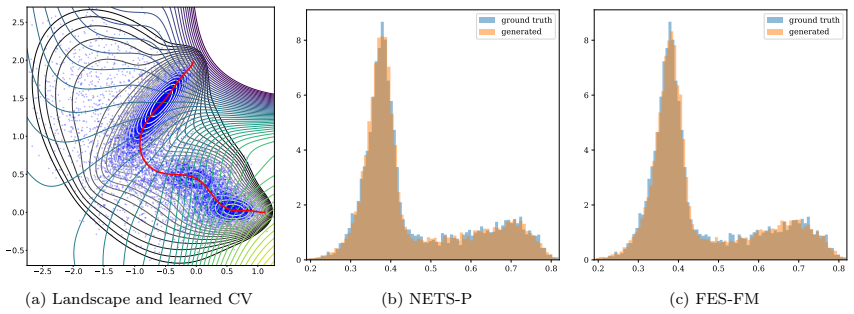
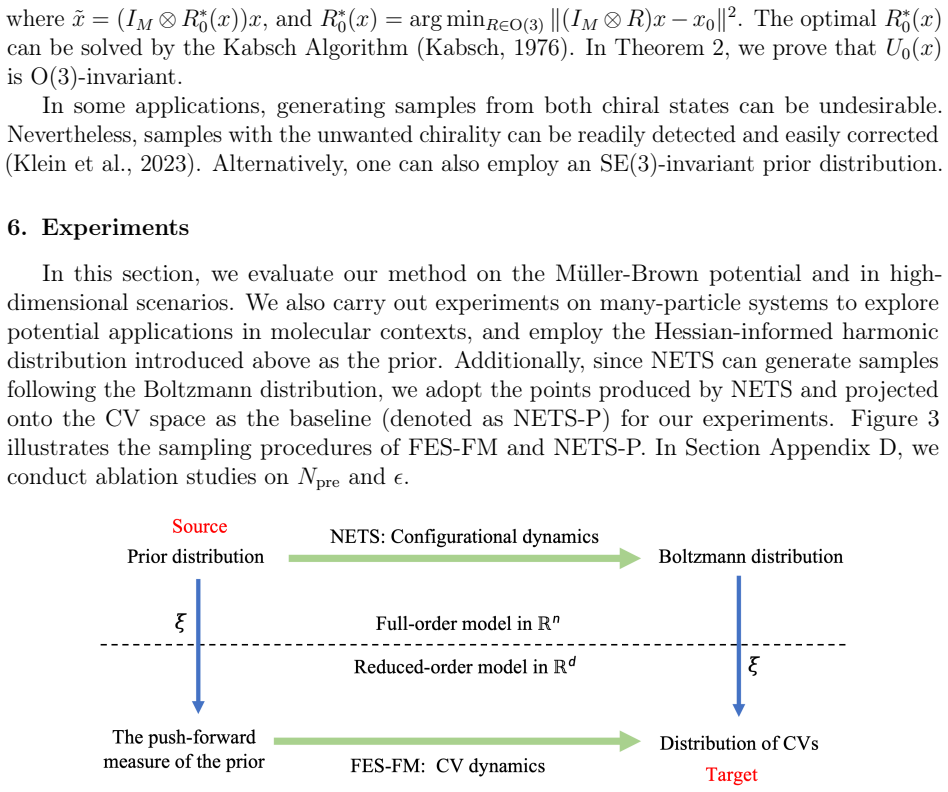
The central claim is that a reduced flow matching procedure, called FES-FM, trains a dynamical transport map solely in collective variable space and, when equipped with a Hessian-based prior for many-particle systems, directly produces samples from the equilibrium free energy distribution, thereby avoiding high-dimensional configuration sampling altogether and achieving lower computational cost together with higher accuracy per unit sampling time across tested potentials and collective variables.
What carries the argument
The dynamical transport map learned by reduced flow matching in collective variable space, augmented by a Hessian-derived prior distribution at a local potential minimum that enforces rotation-translation invariance and physical realism.
If this is right
- Sampling no longer requires generating and storing full high-dimensional trajectories before projection onto collective variables.
- The Hessian prior produces configurations that remain physically valid and symmetry-preserving for systems with many particles.
- Accuracy per unit sampling time exceeds that of conventional high-dimensional methods on the tested range of potentials and collective variables.
- The same trained map can be reused to generate arbitrary numbers of independent samples from the free energy surface at negligible additional cost.
Where Pith is reading between the lines
- The approach could be combined with existing molecular dynamics packages to provide on-the-fly free energy estimates during a simulation.
- If high-dimensional correlations prove important in some systems, hybrid schemes that occasionally inject full-space information into the reduced map may become necessary.
- Similar dimensionality reduction via flow matching might be tested on other equilibrium sampling tasks in statistical mechanics, such as sampling polymer configurations or lattice models.
- The method opens a route to parameter-free derivation of free energy surfaces for systems where the collective variables are known but the full potential remains expensive to evaluate repeatedly.
Load-bearing premise
A transport map trained only in the low-dimensional collective variable space, even when supplied with a Hessian prior, is sufficient to reproduce the correct marginal free energy distribution without omitting important correlations that live in the full configuration space.
What would settle it
Compare the histogram of collective variables obtained from the reduced method against the histogram produced by a converged, long-time molecular dynamics run on the same potential; any systematic deviation in probability mass for rare or correlated states would falsify the claim that the reduced map fully captures the free energy surface.
Figures


read the original abstract
Sampling the free energy surface, namely, the distribution of collective variables (CVs), is a crucial problem in statistical physics, as it underpins a better understanding of chemical reactions and conformational transitions. Traditional methods for free energy surface sampling involve simulation in high-dimensional configuration space and projecting the resulting configurations onto the CV space. To reduce the computational costs of such sampling, we propose FES-FM, a reduced flow matching (FM) method for free energy sampling (FES). We train a dynamical transport map in the CV space, thereby enabling direct sampling of the free energy surface. For many-particle systems, we construct a prior distribution based on the Hessian at a local minimum of the potential, which ensures both rotation-translation invariance and physically meaningful configurations. We evaluate the proposed method across a variety of potential functions and collective variables. Comparative experiments demonstrate that our approach drastically reduces computational costs while delivering superior accuracy per unit sampling time.
Editorial analysis
A structured set of objections, weighed in public.
Referee Report
Summary. The manuscript proposes FES-FM, a reduced flow matching method for sampling free energy surfaces (FES) of collective variables (CVs). It trains a dynamical transport map directly in CV space rather than high-dimensional configuration space, and for many-particle systems constructs a Hessian-based prior at local minima of the potential to enforce rotation-translation invariance and physicality. Comparative experiments are reported to show that the approach drastically reduces computational costs while achieving superior accuracy per unit sampling time relative to traditional high-dimensional sampling followed by projection.
Significance. If the central accuracy claims hold under rigorous validation, the work could provide a practical acceleration for free-energy calculations in statistical physics and molecular dynamics. The explicit construction of a physically motivated prior within a flow-matching framework is a clear technical contribution that distinguishes it from generic dimensionality reduction; credit is due for targeting the sampling-time metric directly rather than only training efficiency.
major comments (3)
- [Abstract / Experiments] Abstract and Experiments section: the headline claim that the method 'drastically reduces computational costs while delivering superior accuracy per unit sampling time' is load-bearing for the contribution, yet the abstract supplies no quantitative metrics, wall-clock timings, free-energy error values, or statistical uncertainties; the results must include explicit tables or figures with these numbers and baseline comparisons (e.g., metadynamics or standard MD) to allow assessment of the per-unit-time superiority.
- [Method (Hessian prior)] Method section on Hessian prior: the quadratic Hessian prior guarantees local invariance near a minimum but is by construction a local harmonic approximation; the manuscript must demonstrate (via a concrete example such as a double-well or anharmonic potential) that the subsequent flow-matching corrections recover correct barrier heights and rare-event statistics beyond the quadratic regime, otherwise the generated marginals in CV space remain biased.
- [Experiments] Experiments / CV choice: the accuracy-per-time comparison rests on the assumption that the chosen collective variables plus the learned corrections fully capture the target free-energy distribution; no ablation study or sensitivity analysis is described that quantifies the effect of missing high-dimensional correlations or incomplete CVs on the sampled distribution, which directly undermines the claimed superiority if such effects are present.
minor comments (2)
- [Method] Notation: define the reduced flow-matching objective explicitly (including the precise form of the velocity field and the conditioning on the Hessian prior) and contrast it with standard flow matching to avoid ambiguity for readers outside the immediate subfield.
- [Figures] Figures: all comparative plots of free-energy surfaces or sampling efficiency should report error bars from multiple independent runs and state the number of samples used for each curve.
Simulated Author's Rebuttal
We thank the referee for the detailed and constructive comments on our manuscript. We address each major comment point by point below and describe the revisions we will implement.
read point-by-point responses
-
Referee: [Abstract / Experiments] Abstract and Experiments section: the headline claim that the method 'drastically reduces computational costs while delivering superior accuracy per unit sampling time' is load-bearing for the contribution, yet the abstract supplies no quantitative metrics, wall-clock timings, free-energy error values, or statistical uncertainties; the results must include explicit tables or figures with these numbers and baseline comparisons (e.g., metadynamics or standard MD) to allow assessment of the per-unit-time superiority.
Authors: We agree that the abstract should include quantitative support for the central claims. In the revised manuscript we will update the abstract to report specific metrics, including wall-clock timings, free-energy errors with statistical uncertainties, and direct numerical comparisons against baselines such as metadynamics and standard MD. We will also add or expand tables in the Experiments section that explicitly tabulate these quantities and per-unit-time accuracy figures. revision: yes
-
Referee: [Method (Hessian prior)] Method section on Hessian prior: the quadratic Hessian prior guarantees local invariance near a minimum but is by construction a local harmonic approximation; the manuscript must demonstrate (via a concrete example such as a double-well or anharmonic potential) that the subsequent flow-matching corrections recover correct barrier heights and rare-event statistics beyond the quadratic regime, otherwise the generated marginals in CV space remain biased.
Authors: The Hessian-derived prior is intentionally local and quadratic to enforce physical invariances at minima; the flow-matching transport is then trained to map samples from this prior onto the target marginal in CV space, which in principle corrects for anharmonicities and barrier crossings. Our existing experiments on several potentials already show that the sampled free-energy surfaces match reference distributions, including across barriers. To make this explicit, we will add a dedicated numerical example on a double-well or anharmonic potential that quantifies recovered barrier heights and rare-event statistics after the flow-matching step. revision: yes
-
Referee: [Experiments] Experiments / CV choice: the accuracy-per-time comparison rests on the assumption that the chosen collective variables plus the learned corrections fully capture the target free-energy distribution; no ablation study or sensitivity analysis is described that quantifies the effect of missing high-dimensional correlations or incomplete CVs on the sampled distribution, which directly undermines the claimed superiority if such effects are present.
Authors: We acknowledge that the reported performance is conditional on the quality of the chosen CVs, a prerequisite shared by all CV-based free-energy methods. The flow-matching corrections are learned to reproduce the correct marginal in the selected CV space. To address the concern directly, we will include an ablation or sensitivity study in the revised Experiments section that perturbs the CV definitions or omits selected correlations and reports the resulting changes in sampled distributions and accuracy-per-time metrics. revision: yes
Circularity Check
No significant circularity in derivation; prior and training are independently constructed
full rationale
The paper constructs a Hessian-based prior directly from the potential at a local minimum to enforce invariance and physicality, then trains a flow-matching transport map in CV space to sample the free-energy marginal. Neither the prior nor the learned map is defined in terms of the target distribution itself, and no equations reduce the output sampling to a fitted input by construction. No load-bearing self-citations, uniqueness theorems, or ansatz smuggling are present in the abstract or described method. The approach extends standard flow matching with an explicit, externally derived prior, satisfying the default expectation of non-circularity.
Axiom & Free-Parameter Ledger
free parameters (1)
- flow matching network parameters
axioms (2)
- standard math Flow matching models can learn invertible transport maps between probability distributions in the reduced CV space.
- domain assumption The Hessian at a local minimum yields a rotation-translation invariant and physically meaningful prior for many-particle systems.
Reference graph
Works this paper leans on
-
[1]
Iterated denoising energy matching for sampling from boltzmann densities
Iterated denoising energy matching for sampling from boltzmann densities. ArXiv abs/2402.06121. Albergo, M.S., Vanden-Eijnden, E.,
-
[2]
Building Normalizing Flows with Stochastic Interpolants
Building normalizing flows with stochastic inter- polants. arXiv preprint arXiv:2209.15571 . Albergo, M.S., Vanden-Eijnden, E.,
work page internal anchor Pith review arXiv
-
[3]
An optimal control perspective on diffusion-based generative modeling. arXiv preprint arXiv:2211.01364 . Bortoli, V.D., Hutchinson, M.J., Wirnsberger, P., Doucet, A.,
-
[4]
arXiv preprint arXiv:2402.08667 (2024)
Target score matching. ArXiv abs/2402.08667. Carbone, D., Hua, M., Coste, S., Vanden-Eijnden, E.,
-
[5]
arXiv preprint arXiv:2410.03282
Neural sampling from boltzmann densities: Fisher-rao curves in the wasserstein geometry. arXiv preprint arXiv:2410.03282 . Chen, J., Richter, L., Berner, J., Blessing, D., Neumann, G., Anandkumar, A.,
-
[6]
arXiv preprint arXiv:2412.07081
Sequential controlled langevin diffusions. arXiv preprint arXiv:2412.07081 . Ciccotti, G., Lelievre, T., Vanden-Eijnden, E.,
-
[7]
Flow Straight and Fast: Learning to Generate and Transfer Data with Rectified Flow
Flow straight and fast: Learning to generate and transfer data with rectified flow. arXiv preprint arXiv:2209.03003 . Liu, Z., Zhang, W., Li, T., 2025b. Improving the euclidean diffusion generation of manifold data by mitigating score function singularity, in: The Thirty-ninth Annual Conference on Neural Information Processing Systems. Liu, Z., Zhang, W.,...
work page internal anchor Pith review arXiv
-
[8]
Mathematical Proceedings of the Cambridge Philosophical Society 51, 406–413
A generalized inverse for matrices. Mathematical Proceedings of the Cambridge Philosophical Society 51, 406–413. doi:10.1017/S0305004100030401. Phillips, A., Dau, H.D., Hutchinson, M.J., Bortoli, V.D., Deligiannidis, G., Doucet, A.,
-
[9]
Particle denoising diffusion sampler. ArXiv abs/2402.06320. Plainer, M., Wu, H., Klein, L., Günnemann, S., Noé, F.,
-
[10]
Consistent sampling and simulation: Molecular dynamics with energy-based diffusion models. ArXiv abs/2506.17139. Raissi, M., Perdikaris, P., Karniadakis, G.E.,
-
[11]
arXiv preprint arXiv:2407.07873
Dynamical measure transport and neural pde solvers for sampling. arXiv preprint arXiv:2407.07873 . Tian, Y., Panda, N., Lin, Y.T.,
-
[12]
Xu, Y., Wang, Y., Luo, S., Gao, K., He, T., Liu, C., He, D.,
Iterated energy-based flow matching for sampling from boltzmann densities.arXiv:2408.16249. Xu, Y., Wang, Y., Luo, S., Gao, K., He, T., Liu, C., He, D.,
- [13]
-
[14]
The 1-Wasserstein distance is computed using 10,000 points sampled from the generated distribution and 10,000 points sampled from the ground-truth distribution
ODE(4) and ODE (13) are solved via the Euler method with a step size of 0.001. The 1-Wasserstein distance is computed using 10,000 points sampled from the generated distribution and 10,000 points sampled from the ground-truth distribution. Remaining hyperparameters are summarized in Table C.4. Detailed experimental setups are provided in the subsections b...
2000
-
[15]
Forthethree-particlesystemin R2, theparametersin (31)arechosenas α1 = 5000/49, α2 = 5000/49, α3 = 50, r1 = 2 , r2 = 2 , r3 = 2 .4, r4 = 3 .1
and those based on alignment with respect to a given reference configuration (Liu et al., 2025b,c). Forthethree-particlesystemin R2, theparametersin (31)arechosenas α1 = 5000/49, α2 = 5000/49, α3 = 50, r1 = 2 , r2 = 2 , r3 = 2 .4, r4 = 3 .1. For the four-particle system inR3, the parameters in (32) are chosen as α1 = α2 = α3 = α4 = α5 = 5000 /49, α6 = 200...
2000
discussion (0)
Sign in with ORCID, Apple, or X to comment. Anyone can read and Pith papers without signing in.