Recognition: 2 theorem links
· Lean TheoremMultiplicative matching of neutral current deep-inelastic scattering processes at next-to-leading order in PYTHIA 8
Pith reviewed 2026-05-13 07:38 UTC · model grok-4.3
The pith
Multiplicative matching incorporates NLO corrections into parton showers for neutral-current deep-inelastic scattering by reweighting Born-level events in Pythia 8.
A machine-rendered reading of the paper's core claim, the machinery that carries it, and where it could break.
Core claim
A multiplicative matching procedure is introduced that reweights leading-order Born-level events for neutral-current deep-inelastic scattering so that the first parton-shower emission is generated according to the real-emission matrix element, thereby incorporating next-to-leading-order corrections in a manner compatible with parton showers in Pythia 8.
What carries the argument
Multiplicative reweighting of leading-order Born-level events that enforces the first parton-shower emission to follow the real matrix-element distribution.
If this is right
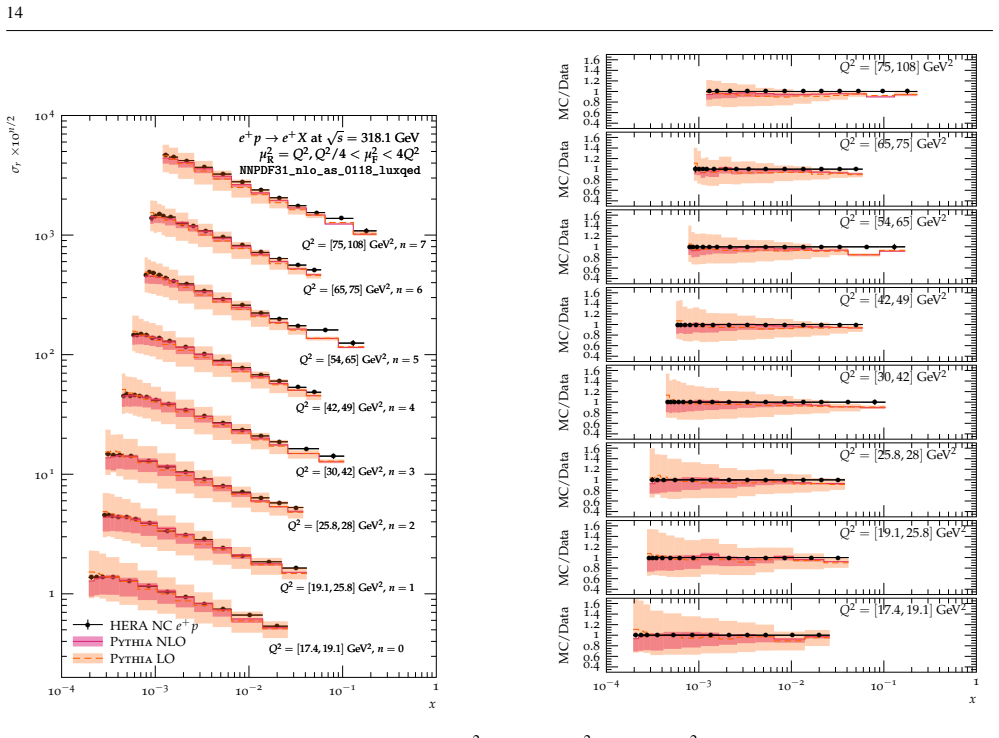
- Improved description of HERA reduced cross-section measurements with smaller uncertainties
- Consistent NLO matching available for both the default Pythia shower and the Vincia algorithm
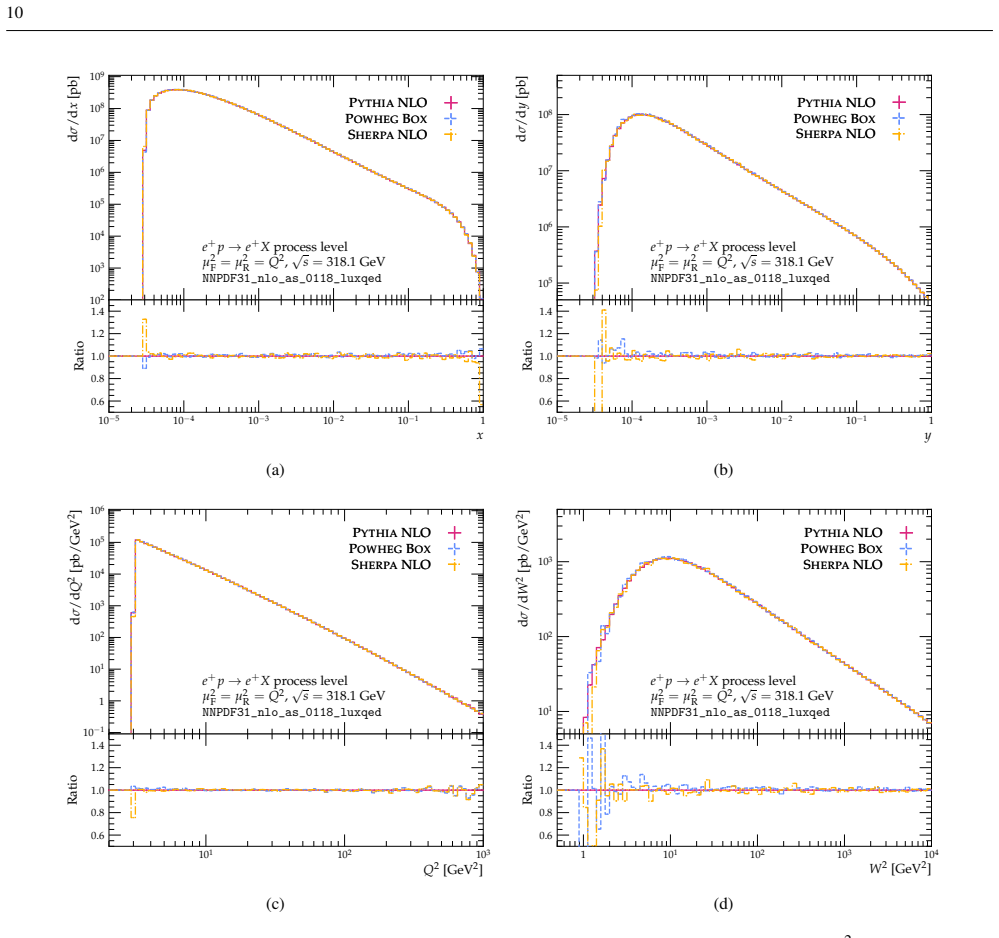
- Validation of the method through comparisons with independent next-to-leading-order simulations
- The approach provides a practical way to include higher-order corrections in Monte Carlo simulations of deep-inelastic scattering
Where Pith is reading between the lines
- The same reweighting logic could be tested on charged-current processes to check consistency across electroweak channels
- Reduced theoretical uncertainties may benefit precision studies at a future electron-ion collider
- The method might be combined with other matching schemes to extend NLO accuracy to additional observables
Load-bearing premise
Reweighting leading-order Born-level events so the first shower emission follows the real matrix element correctly incorporates the next-to-leading-order corrections without introducing artifacts.
What would settle it
Direct numerical comparison of the matched differential cross sections against exact fixed-order next-to-leading-order calculations over a wide kinematic range in Q squared and x would confirm or refute the matching accuracy.
Figures




read the original abstract
We introduce a method for matching the neutral-current deep inelastic scattering process with parton showers at first order in the strong coupling. This multiplicative matching is achieved by reweighting leading-order Born-level events and requires that the first parton-shower emission is distributed according to the real matrix-element. The method is implemented as an internal matching strategy in the Pythia 8 event generator applicable with both currently available parton shower algorithms, the default one and Vincia. The validity of higher-order corrections is verified with comparisons against existing next-to-leading order simulations. The strategy is used to describe reduced cross-sections measured at the HERA collider, and we find better overall agreement and reduced uncertainties with the matching.
Editorial analysis
A structured set of objections, weighed in public.
Referee Report
Summary. The manuscript introduces a multiplicative matching method for neutral-current deep-inelastic scattering at NLO in PYTHIA 8. Leading-order Born events are reweighted so that the first parton-shower emission follows the real matrix element; the scheme is implemented for both the default shower and Vincia. Validity is checked via comparisons to existing NLO simulations, and the matched predictions are applied to HERA reduced cross sections, where improved agreement and smaller uncertainties are reported.
Significance. If the reweighting fully restores NLO accuracy without residual O(α_s) artifacts, the work supplies a practical, generator-internal tool for including higher-order corrections in DIS event generation. Support for two distinct showers and direct comparison to HERA data are concrete strengths that would benefit phenomenological studies at current and future lepton-hadron facilities.
major comments (2)
- [Validation comparisons] Validation comparisons (abstract and § on numerical results): the manuscript states that higher-order corrections are verified against existing NLO simulations, yet it does not show explicit tests that the virtual+real cancellation is preserved for observables sensitive to the collinear/soft boundaries of real-emission phase space in DIS kinematics, where the default and Vincia Sudakov factors and Born-to-emission mappings differ.
- [Matching procedure] Matching procedure (description of reweighting): the claim that enforcing the real matrix element on the first emission automatically incorporates the full NLO correction rests on the assumption that phase-space boundaries and acceptance cuts remain consistent after reweighting; no quantitative demonstration is provided that O(α_s) mismatches do not survive in the reduced cross sections.
minor comments (1)
- [Abstract] The abstract would benefit from naming the specific reduced cross-section observables and the kinematic cuts used in the HERA comparison.
Simulated Author's Rebuttal
We thank the referee for the constructive report and positive assessment of the work. We address each major comment below and have revised the manuscript to incorporate additional validation material and quantitative checks.
read point-by-point responses
-
Referee: [Validation comparisons] Validation comparisons (abstract and § on numerical results): the manuscript states that higher-order corrections are verified against existing NLO simulations, yet it does not show explicit tests that the virtual+real cancellation is preserved for observables sensitive to the collinear/soft boundaries of real-emission phase space in DIS kinematics, where the default and Vincia Sudakov factors and Born-to-emission mappings differ.
Authors: We agree that dedicated tests for the cancellation in soft/collinear-sensitive observables would strengthen the validation section. In the revised manuscript we have added explicit comparisons of the matched predictions against fixed-order NLO results for the lepton transverse-momentum spectrum and the azimuthal decorrelation between the lepton and the leading jet. These observables probe the phase-space boundaries where the Sudakov factors and mappings differ between the default shower and Vincia. The new figures show agreement at the expected level, with residual differences consistent with O(α_s²) effects, thereby confirming that the virtual+real cancellation is preserved. revision: yes
-
Referee: [Matching procedure] Matching procedure (description of reweighting): the claim that enforcing the real matrix element on the first emission automatically incorporates the full NLO correction rests on the assumption that phase-space boundaries and acceptance cuts remain consistent after reweighting; no quantitative demonstration is provided that O(α_s) mismatches do not survive in the reduced cross sections.
Authors: The reweighting factor is evaluated using the identical phase-space generation, acceptance cuts, and Born-to-emission mapping employed by each shower, so consistency is maintained by construction. To supply the requested quantitative demonstration we have added, in the revised matching-procedure section, a direct comparison of the matched reduced cross sections to fixed-order NLO predictions as a function of Q² and x_Bj. The relative differences remain below the percent level across the HERA kinematic range and show no systematic O(α_s) mismatch, supporting that the full NLO correction is recovered for the observables considered. revision: yes
Circularity Check
No significant circularity; method is a standard reweighting implementation verified externally
full rationale
The paper presents a multiplicative matching procedure that reweights LO Born-level events so the first parton-shower emission follows the real matrix element. This is implemented for both default and Vincia showers in Pythia 8. Validity is checked by direct comparison to independent existing NLO simulations, and the approach is then applied to HERA reduced cross-section data. No derivation step reduces by construction to a fitted parameter, self-citation load-bearing premise, or renamed input; the central matching condition is defined from standard real-emission matrix elements external to the paper. The reported improvement in agreement with data is an empirical outcome, not a tautological consequence of the method definition.
Axiom & Free-Parameter Ledger
free parameters (1)
- matching scale
axioms (1)
- domain assumption The real matrix element for the first emission accurately represents the NLO correction.
Lean theorems connected to this paper
-
IndisputableMonolith/Cost/FunctionalEquation.leanwashburn_uniqueness_aczel unclearmultiplicative matching is achieved by reweighting leading-order Born-level events and requires that the first parton-shower emission is distributed according to the real matrix-element
-
IndisputableMonolith/Foundation/AlphaCoordinateFixation.leanJ_uniquely_calibrated_via_higher_derivative unclearThe NLO weight can be calculated for each incoming flavor separately... using the inclusive NC DIS cross section
Reference graph
Works this paper leans on
-
[1]
A. Buckley, et al., Phys. Rept.504, 145 (2011). DOI 10.1016/j.physrep.2011.03.005
-
[2]
R. Brock, et al., Rev. Mod. Phys.67, 157 (1995). DOI 10.1103/RevModPhys.67.157
- [3]
- [4]
- [5]
-
[6]
G. Altarelli, G. Parisi, Nucl. Phys. B126, 298 (1977). DOI 10.1016/0550-3213(77)90384-4
-
[7]
S. Frixione, B.R. Webber, JHEP06, 029 (2002). DOI 10.1088/1126-6708/2002/06/029
-
[8]
P. Nason, JHEP11, 040 (2004). DOI 10.1088/ 1126-6708/2004/11/040
work page 2004
-
[9]
M. Bengtsson, T. Sjöstrand, Phys. Lett. B185, 435 (1987). DOI 10.1016/0370-2693(87)91031-8
-
[10]
G. Miu, T. Sjöstrand, Phys. Lett. B449, 313 (1999). DOI 10.1016/S0370-2693(99)00068-4
-
[11]
S. Hoeche, F. Krauss, M. Schonherr, F. Siegert, JHEP 09, 049 (2012). DOI 10.1007/JHEP09(2012)049
-
[12]
Matching NLO QCD computations with Parton Shower simulations: the POWHEG method
S. Frixione, P. Nason, C. Oleari, JHEP11, 070 (2007). DOI 10.1088/1126-6708/2007/11/070
work page internal anchor Pith review doi:10.1088/1126-6708/2007/11/070 2007
-
[13]
A general framework for implementing NLO calculations in shower Monte Carlo programs: the POWHEG BOX
S. Alioli, P. Nason, C. Oleari, E. Re, JHEP06, 043 (2010). DOI 10.1007/JHEP06(2010)043
work page internal anchor Pith review doi:10.1007/jhep06(2010)043 2010
-
[14]
S. Hoche, F. Krauss, M. Schonherr, F. Siegert, JHEP04, 024 (2011). DOI 10.1007/JHEP04(2011)024
-
[15]
S. Platzer, S. Gieseke, Eur. Phys. J. C72, 2187 (2012). DOI 10.1140/epjc/s10052-012-2187-7
- [16]
-
[17]
R. Abdul Khalek, et al., Nucl. Phys. A1026, 122447 (2022). DOI 10.1016/j.nuclphysa.2022.122447
-
[18]
A. Banfi, S. Ferrario Ravasio, B. Jäger, A. Karlberg, F. Reichenbach, G. Zanderighi, JHEP02, 023 (2024). DOI 10.1007/JHEP02(2024)023
-
[19]
T. Ježo, P. Nason, JHEP12, 065 (2015). DOI 10.1007/ JHEP12(2015)065
work page 2015
- [20]
-
[21]
S. Jadach, A. Kusina, W. Placzek, M. Skrzypek, M. Slawinska, Phys. Rev. D87(3), 034029 (2013). DOI 10.1103/PhysRevD.87.034029
-
[22]
Bothmann, et al., JHEP12, 156 (2024)
E. Bothmann, et al., JHEP12, 156 (2024). DOI 10. 1007/JHEP12(2024)156
work page 2024
-
[23]
S. Höche, S. Kuttimalai, Y . Li, Phys. Rev. D98(11), 114013 (2018). DOI 10.1103/PhysRevD.98.114013
-
[24]
P. Meinzinger, D. Reichelt, F. Silvetti, Phys. Rev. D 112(7), 074039 (2025). DOI 10.1103/1c38-jrb1
-
[25]
Bellm, et al., arXiv:2512.16645 (2025)
J. Bellm, et al., arXiv:2512.16645 (2025)
-
[26]
M. van Beekveld, S. Ferrario Ravasio, JHEP02, 001 (2024). DOI 10.1007/JHEP02(2024)001
-
[27]
M. van Beekveld, S. Ferrario Ravasio, J. Helliwell, A. Karlberg, G.P. Salam, L. Scyboz, A. Soto-Ontoso, G. Soyez, S. Zanoli, JHEP10, 038 (2025). DOI 10.1007/JHEP10(2025)038
-
[28]
Bierlich, et al., SciPost Phys
C. Bierlich, et al., SciPost Phys. Codeb.2022, 8 (2022). DOI 10.21468/SciPostPhysCodeb.8
-
[29]
I. Helenius, J.O. Laulainen, C.T. Preuss, JHEP05, 153 (2025). DOI 10.1007/JHEP05(2025)153
-
[30]
M. Bengtsson, T. Sjöstrand, Nucl. Phys. B289, 810 (1987). DOI 10.1016/0550-3213(87)90407-X
-
[31]
C.T. Preuss, JHEP07, 161 (2024). DOI 10.1007/ JHEP07(2024)161
work page 2024
-
[32]
G. Altarelli, R.K. Ellis, G. Martinelli, Nucl. Phys. B 157, 461 (1979). DOI 10.1016/0550-3213(79)90116-0
-
[33]
W. Furmanski, R. Petronzio, Z. Phys. C11, 293 (1982). DOI 10.1007/BF01578280
-
[34]
M. Gluck, E. Reya, A. V ogt, Z. Phys. C67, 433 (1995). DOI 10.1007/BF01624586
-
[35]
S. Moch, J.A.M. Vermaseren, Nucl. Phys. B573, 853 (2000). DOI 10.1016/S0550-3213(00)00045-6
-
[36]
A. Daleo, T. Gehrmann, D. Maitre, JHEP04, 016 (2007). DOI 10.1088/1126-6708/2007/04/016
-
[37]
S. Navas, et al., Phys. Rev. D110(3), 030001 (2024). DOI 10.1103/PhysRevD.110.030001
-
[38]
S. Catani, M.H. Seymour, Nucl. Phys. B485, 291 (1997). DOI 10.1016/S0550-3213(96)00589-5. [Erra- tum: Nucl.Phys.B 510, 503–504 (1998)]
-
[39]
T. Sjöstrand, P.Z. Skands, Eur. Phys. J. C39, 129 (2005). DOI 10.1140/epjc/s2004-02084-y
-
[40]
H. Brooks, C.T. Preuss, P. Skands, JHEP07, 032 (2020). DOI 10.1007/JHEP07(2020)032
-
[41]
B. Cabouat, T. Sjöstrand, Eur. Phys. J. C78(3), 226 (2018). DOI 10.1140/epjc/s10052-018-5645-z
-
[42]
L. Lönnblad, Comput. Phys. Commun.71, 15 (1992). DOI 10.1016/0010-4655(92)90068-A
-
[43]
T. Plehn, D. Rainwater, P.Z. Skands, Phys. Lett. B645, 217 (2007). DOI 10.1016/j.physletb.2006.12.009
-
[44]
M. Cacciari, F.A. Dreyer, A. Karlberg, G.P. Salam, G. Zanderighi, Phys. Rev. Lett.115(8), 082002 (2015). DOI 10.1103/PhysRevLett.115.082002. [Erratum: Phys.Rev.Lett. 120, 139901 (2018)]
-
[45]
S. Schumann, F. Krauss, JHEP03, 038 (2008). DOI 10.1088/1126-6708/2008/03/038
-
[46]
F. Krauss, R. Kuhn, G. Soff, JHEP02, 044 (2002). DOI 10.1088/1126-6708/2002/02/044
-
[47]
T. Gleisberg, S. Hoeche, JHEP12, 039 (2008). DOI 10.1088/1126-6708/2008/12/039
-
[48]
T. Gleisberg, F. Krauss, Eur. Phys. J. C53, 501 (2008). DOI 10.1140/epjc/s10052-007-0495-0
-
[49]
G.S. Chahal, F. Krauss, SciPost Phys.13(2), 019 (2022). DOI 10.21468/SciPostPhys.13.2.019 18
-
[51]
Parton distributions from high-precision collider data
R.D. Ball, et al., Eur. Phys. J. C77(10), 663 (2017). DOI 10.1140/epjc/s10052-017-5199-5
work page internal anchor Pith review doi:10.1140/epjc/s10052-017-5199-5 2017
-
[52]
DOI 10.1140/epjc/ s10052-022-10942-5
A. Buckley, J. Ferrando, S. Lloyd, K. Nordström, B. Page, M. Rüfenacht, M. Schönherr, G. Watt, Eur. Phys. J. C75, 132 (2015). DOI 10.1140/epjc/ s10052-015-3318-8
-
[53]
H. Abramowicz, et al., Eur. Phys. J. C75(12), 580 (2015). DOI 10.1140/epjc/s10052-015-3710-4
-
[54]
Bierlich, et al., SciPost Phys.8, 026 (2020)
C. Bierlich, et al., SciPost Phys.8, 026 (2020). DOI 10.21468/SciPostPhys.8.2.026
-
[55]
M. Cacciari, G.P. Salam, G. Soyez, Eur. Phys. J. C72, 1896 (2012). DOI 10.1140/epjc/s10052-012-1896-2
-
[56]
T. Carli, T. Gehrmann, S. Hoeche, Eur. Phys. J. C67, 73 (2010). DOI 10.1140/epjc/s10052-010-1261-2
discussion (0)
Sign in with ORCID, Apple, or X to comment. Anyone can read and Pith papers without signing in.