Recognition: unknown
MuDirac 1.3.0: A Sustainable Software Tool for Calculating Ground State Nuclear Properties Using Muonic X-Ray Measurements
Pith reviewed 2026-05-09 15:09 UTC · model grok-4.3
The pith
MuDirac 1.3.0 provides an open software tool to calculate nuclear charge radii from muonic X-ray measurements using a two-parameter Fermi distribution.
A machine-rendered reading of the paper's core claim, the machinery that carries it, and where it could break.
Core claim
With MuDirac (1.3.0), the community will be able to accurately and efficiently estimate nuclear properties, such as the nuclear charge radius, by assuming a 2-parameter Fermi distribution of the nuclear charge. The software is open, publicly available, sustainable and computationally efficient for calculating ground state nuclear properties using muonic X-ray measurements.
What carries the argument
The two-parameter Fermi distribution model of nuclear charge density, which converts measured muonic X-ray transition energies into extracted values for nuclear radii and related ground-state properties.
If this is right
- Researchers gain a ready method to extract nuclear charge radii directly from muonic X-ray data without writing new simulation code.
- The tool supports routine, low-cost computations that fit within standard laboratory workflows.
- Public release of the code enables community inspection, reuse, and incremental improvement of the fitting procedures.
- Ground-state nuclear properties for nuclei accessible to negative muons become easier to obtain and compare across experiments.
Where Pith is reading between the lines
- Adoption of the tool could encourage more uniform reporting standards for nuclear radii derived from muonic data.
- Later versions might add options for alternative charge-density models to handle nuclei where the Fermi form is known to be inadequate.
- Wider use may accelerate cross-checks between muonic results and data from other probes such as laser spectroscopy of muonic atoms.
Load-bearing premise
Modeling the nuclear charge density with a two-parameter Fermi distribution is sufficient to produce accurate nuclear radii from the muonic X-ray transition energies.
What would settle it
A direct comparison in which nuclear charge radii obtained from MuDirac on a set of nuclei differ markedly from independent determinations of the same radii by electron scattering or other established techniques.
Figures







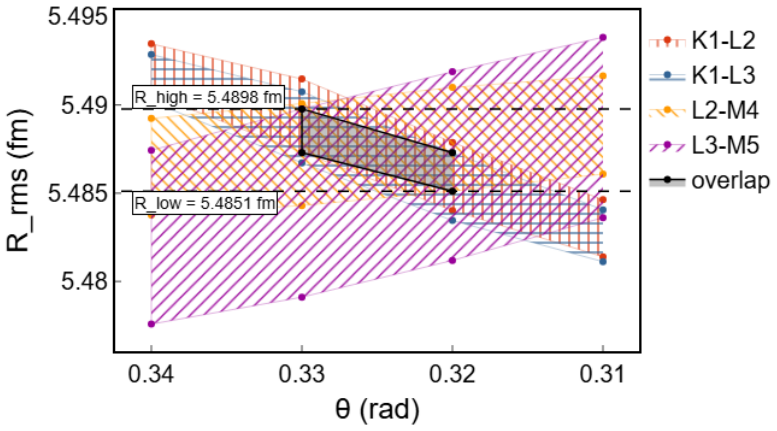
read the original abstract
The nuclear charge radius is one of the most fundamental quantities of the atomic nucleus. It can be deduced from a combination of experimental measurements of muonicX-raytransitionenergieswithmodellingofthoseX-raytransitionenergies. In thisworkwepresentMuDirac (1.3.0), whichisanopen, publiclyavailable, sustainable and computationally efficient software tool that will be at put the disposal of the negative muon community. With MuDirac (1.3.0), the community will be able to accurately and efficiently estimate nuclear properties, such as the nuclear charge radius, by assuming a 2-parameter Fermi distribution of the nuclear charge.
Editorial analysis
A structured set of objections, weighed in public.
Referee Report
Summary. The manuscript presents MuDirac 1.3.0, an open-source software tool for computing ground-state nuclear properties (primarily the nuclear charge radius) from measured muonic X-ray transition energies. It solves the Dirac equation for a two-parameter Fermi nuclear charge distribution and is positioned as a sustainable, publicly available, and computationally efficient resource for the muonic-atom community.
Significance. If the accuracy claim is substantiated, the work would deliver a reusable, open-source implementation of a standard forward-modeling approach, lowering barriers for extracting nuclear radii from muonic data while addressing software sustainability. The emphasis on public availability and efficiency constitutes a concrete contribution to the computational-physics toolkit in this niche.
major comments (2)
- [Abstract] Abstract: the repeated claim that the tool enables 'accurate' estimation of nuclear charge radii (and other properties) is unsupported by any quantitative validation. No comparison of extracted radii to independent electron-scattering values, no benchmark against alternative density models (3-parameter Fermi or otherwise), and no error-propagation analysis for the two free Fermi parameters appear in the manuscript. This directly underpins the central utility assertion.
- [Method/Implementation] Method/Implementation sections: the forward-modeling procedure is standard, yet the manuscript supplies no test cases, tables, or figures demonstrating numerical convergence, sensitivity to the Fermi radius and diffuseness parameters, or reproduction of published muonic radii for even a single nucleus.
minor comments (2)
- [Abstract] Abstract contains typographical and grammatical errors (e.g., 'muonicX-raytransitionenergieswithmodellingofthoseX-raytransitionenergies' and 'will be at put the disposal').
- [Method] Notation for the two Fermi parameters is introduced without an explicit equation or table defining their symbols and units.
Simulated Author's Rebuttal
We thank the referee for the constructive comments, which highlight opportunities to strengthen the manuscript's claims about the tool's utility. We address each major point below and will incorporate revisions to provide the requested validation and demonstrations.
read point-by-point responses
-
Referee: [Abstract] Abstract: the repeated claim that the tool enables 'accurate' estimation of nuclear charge radii (and other properties) is unsupported by any quantitative validation. No comparison of extracted radii to independent electron-scattering values, no benchmark against alternative density models (3-parameter Fermi or otherwise), and no error-propagation analysis for the two free Fermi parameters appear in the manuscript. This directly underpins the central utility assertion.
Authors: We agree that the abstract's assertion of 'accurate' estimation requires substantiation to fully support the tool's claimed utility. The two-parameter Fermi model is a standard choice in muonic-atom literature, and MuDirac implements the established Dirac-equation solution for it, but the current manuscript does not include explicit benchmarks. In the revised version we will add a dedicated validation subsection that (i) compares extracted charge radii for several nuclei against independent electron-scattering values, (ii) briefly contrasts results with a 3-parameter Fermi model where literature data exist, and (iii) includes a short discussion of parameter sensitivity and basic error propagation for the two Fermi parameters. We will also moderate the abstract wording to reflect the added evidence. revision: yes
-
Referee: [Method/Implementation] Method/Implementation sections: the forward-modeling procedure is standard, yet the manuscript supplies no test cases, tables, or figures demonstrating numerical convergence, sensitivity to the Fermi radius and diffuseness parameters, or reproduction of published muonic radii for even a single nucleus.
Authors: We accept that the manuscript would be improved by explicit demonstrations of the implementation's numerical behavior. In the revised manuscript we will insert a new 'Validation and Test Cases' subsection containing: (i) tables or figures showing convergence of transition energies with respect to radial grid size and integration tolerances, (ii) sensitivity plots or tables illustrating how extracted radii vary with the Fermi radius and diffuseness parameters, and (iii) reproduction of published muonic X-ray derived radii for at least two nuclei, with direct comparison to literature values. These additions will be placed in the Methods/Implementation section or as a supplementary results subsection. revision: yes
Circularity Check
No circularity: standard forward-modeling tool with external data dependence
full rationale
The manuscript describes MuDirac as an open software implementation of the Dirac equation solved for a 2-parameter Fermi nuclear charge density to match measured muonic X-ray transition energies and thereby extract the nuclear charge radius. No derivation chain, uniqueness theorem, or fitted parameter is presented that reduces by construction to the paper's own inputs or prior self-citations. The central procedure is a conventional numerical forward model whose outputs are determined by external experimental spectra rather than internal redefinition or ansatz smuggling. The accuracy qualifier is an empirical claim (not demonstrated here) but does not create circularity in the reported method.
Axiom & Free-Parameter Ledger
free parameters (2)
- Fermi radius parameter
- Fermi diffuseness parameter
axioms (1)
- domain assumption The muonic atom can be accurately described by solving the Dirac equation with a static, spherically symmetric nuclear charge distribution given by the two-parameter Fermi form.
Reference graph
Works this paper leans on
-
[1]
High-Energy Electron Scattering from Lithium-6 , author =. Phys. Rev. , volume =. 1958 , month =. doi:10.1103/PhysRev.112.1282 , url =
-
[2]
Precise Measurement of the Muonic X Rays in the Lead Isotopes , author =. Phys. Rev. , volume =. 1969 , month =. doi:10.1103/PhysRev.187.1565 , url =
-
[3]
Hyperfine Effects in Muonic Bi and Pb , author =. Phys. Rev. , volume =. 1968 , month =. doi:10.1103/PhysRev.169.1 , url =
-
[4]
Lee, W. Y. and Bernow, S. and Chen, M. Y. and Cheng, S. C. and Hitlin, D. and Kast, J. W. and Macagno, E. R. and Rushton, A. M. and Wu, C. S. and Budick, B. , journal =. Finite Distributions of Nuclear M1 and E2 Moments in Muonic ^. 1969 , month =. doi:10.1103/PhysRevLett.23.648 , url =
-
[5]
Jenkins, David A. and Powers, R. J. and Kunselman, A. R. Muonic Interactions in Zn-66 and Zn-68. Phys. Rev. C. 1970. doi:10.1103/PhysRevC.2.458
-
[6]
Nucleic Acids Research , author =
The. Nucleic Acids Research , author =. 2022 , pages =. doi:10.1093/nar/gkac247 , abstract =
-
[8]
H.L. Acker and G. Backenstoss and C. Daum and J.C. Sens and S.A. Measurement and analysis of muonic X-ray spectra in spherical nuclei , journal =. 1966 , issn =. doi:https://doi.org/10.1016/0029-5582(66)90355-5 , url =
-
[9]
, title =
Marquardt, Donald W. , title =. Journal of the Society for Industrial and Applied Mathematics , volume =. 1963 , doi =
1963
-
[10]
2023 , month =
Agarwal, Sameer and Mierle, Keir and The Ceres Solver Team , title =. 2023 , month =
2023
-
[11]
and Haberland, Matt and Reddy, Tyler and Cournapeau, David and Burovski, Evgeni and Peterson, Pearu and Weckesser, Warren and Bright, Jonathan and
Virtanen, Pauli and Gommers, Ralf and Oliphant, Travis E. and Haberland, Matt and Reddy, Tyler and Cournapeau, David and Burovski, Evgeni and Peterson, Pearu and Weckesser, Warren and Bright, Jonathan and. Nature Methods , year =
-
[12]
Benchmarking optimization software with performance profiles
Dolan, Elizabeth D and Mor \'e , Jorge J. Benchmarking optimization software with performance profiles. Math. Program
-
[13]
Verbeek, Benjamin , title =
-
[14]
Muon Nuclear Data , doi=
Megumi Niikura and Shinichiro Abe and Shoichiro Kawase and Teiichiro Matsuzaki and Futoshi Minato and Rurie Mizuno and Yukinobu Watanabe and Yuji Yamaguchi , booktitle =. Muon Nuclear Data , doi=
-
[15]
2024 , eprint=
Muon Nuclear Data , author=. 2024 , eprint=
2024
-
[16]
K. A. Beyer and T. E. Cocolios and C. Costache and M. Deseyn and P. Demol and A. Doinaki and O. Eizenberg and M. Gorshteyn and M. Heines and A. Herzáň and P. Indelicato and K. Kirch and A. Knecht and R. Lica and V. Matousek and E. A. Maugeri and B. Ohayon and N. S. Oreshkina and W. W. M. M. Phyo and R. Pohl and S. Rathi and W. Ryssens and A. Turturica and...
-
[17]
R. Mizuno and M. Niikura and T.Y. Saito and T. Matsuzaki and H. Sakurai and A. Amato and S. Asari and S. Biswas and I. Chiu and L. Gerchow and Z. Guguchia and G. Janka and K. Ninomiya and N. Ritjoho and A. Sato and K. Development of wide range photon detection system for muonic X-ray spectroscopy , journal =. 2024 , issn =. doi:https://doi.org/10.1016/j.n...
-
[18]
Muonic x-ray measurement for the nuclear charge distribution: The case of stable palladium isotopes , author =. Phys. Rev. C , volume =. 2025 , month =. doi:10.1103/PhysRevC.111.034313 , url =
-
[19]
The MONUMENT experiment: ordinary muon capture studies for decay , author =. Eur. Phys. J. C , volume =. 2024 , publisher =. doi:https://doi.org/10.1140/epjc/s10052-024-13470-6 , url =
-
[20]
Theoretical prediction of the fine and hyperfine structure of heavy muonic atoms , author =. Phys. Rev. A , volume =. 2017 , month =. doi:10.1103/PhysRevA.96.032510 , url =
-
[21]
, TITLE =
Cataldo, Matteo and Clemenza, Massimiliano and Ishida, Katsuiko and Hillier, Adrian D. , TITLE =. Applied Sciences , VOLUME =. 2022 , NUMBER =
2022
-
[22]
Nuclear Ground State Charge Radii from Electromagnetic Interactions , journal =. 1995 , issn =. doi:https://doi.org/10.1006/adnd.1995.1007 , url =
-
[23]
arXiv: Nuclear Experiment , year=
Electronic catalogue of muonic X-rays , author=. arXiv: Nuclear Experiment , year=
-
[24]
Sturniolo, Simone and Hillier, Adrian , title =. X-Ray Spectrometry , volume =. doi:https://doi.org/10.1002/xrs.3212 , url =. https://analyticalsciencejournals.onlinelibrary.wiley.com/doi/pdf/10.1002/xrs.3212 , year =
-
[25]
Table of experimental nuclear ground state charge radii: An update , journal =. 2013 , issn =. doi:https://doi.org/10.1016/j.adt.2011.12.006 , url =
-
[26]
Prospects for electron scattering on unstable, exotic nuclei , journal =. 2017 , issn =. doi:https://doi.org/10.1016/j.ppnp.2017.04.002 , url =
-
[27]
Charge-distribution parameters, isotope shifts, isomer shifts, and magnetic hyperfine constants from muonic atoms , journal =. 1974 , note =. doi:https://doi.org/10.1016/S0092-640X(74)80003-3 , url =
-
[28]
Mu-Mesonic X-Rays and the Shape of the Nuclear Charge Distribution , author =. Phys. Rev. , volume =. 1954 , month =. doi:10.1103/PhysRev.94.1617 , url =
-
[29]
R C Barrett , title =. 1974 , month =. doi:10.1088/0034-4885/37/1/001 , url =
-
[30]
Model-independent parameters of the nuclear charge distribution from muonic X-rays , journal =. 1970 , issn =. doi:https://doi.org/10.1016/0370-2693(70)90611-8 , url =
-
[31]
Comparison of muonic-atom and electronic x-ray isotope shifts in lead , author =. Phys. Rev. C , volume =. 1974 , month =. doi:10.1103/PhysRevC.9.2444 , url =
-
[32]
Critical evaluation of reference charge radii and applications in mirror nuclei , journal =. 2025 , issn =. doi:https://doi.org/10.1016/j.adt.2025.101732 , url =
discussion (0)
Sign in with ORCID, Apple, or X to comment. Anyone can read and Pith papers without signing in.