Recognition: unknown
Perturbative Analysis of CPT-Odd Lorentz-Violating Scalar QCD
Pith reviewed 2026-05-09 19:19 UTC · model grok-4.3
The pith
All one-loop divergences in CPT-odd Lorentz-violating scalar QCD can be absorbed into classical counterterms.
A machine-rendered reading of the paper's core claim, the machinery that carries it, and where it could break.
Core claim
To first order in the preferred background vector, the ultraviolet divergences in the one-loop corrections to the relevant Green's functions of CPT-odd Lorentz-violating scalar QCD are all absorbable by counterterms allowed by the classical action, establishing multiplicative renormalizability at this order. The gauge sector acquires a divergent Carroll-Field-Jackiw correction (which vanishes in a particular gauge), the scalar sector develops a CPT-odd single-derivative term, and several Lorentz-violating pieces of the three- and four-point functions remain finite. Renormalization constants and one-loop beta functions are obtained for the gauge coupling, the Lorentz-violation parameters, and
What carries the argument
The perturbative insertion of the CPT-odd background vector into the Feynman rules, followed by isolation of divergent Green's functions under dimensional regularization while preserving standard power counting.
If this is right
- The gauge coupling, Lorentz-violation parameters, and scalar self-coupling all possess well-defined one-loop beta functions.
- Multiplicative renormalizability extends to the full set of fields including ghosts.
- Certain Lorentz-violating corrections to three- and four-point vertices are ultraviolet finite.
- Perturbative calculations of the theory remain consistent to this order despite the explicit breaking of Lorentz invariance.
Where Pith is reading between the lines
- If the same absorption pattern holds at two loops and beyond, the model would be renormalizable to all orders.
- The results supply running couplings that could be used in effective descriptions of Lorentz violation in strong-interaction processes.
- The gauge dependence of the divergent Carroll-Field-Jackiw term indicates that specific gauge choices may simplify phenomenological applications.
Load-bearing premise
The Lorentz-violating operators can be treated as perturbative insertions to first order in the background vector without changing the power-counting or regularization scheme of the underlying scalar QCD.
What would settle it
An explicit one-loop diagram contributing to the gauge-boson self-energy that produces a divergent structure not proportional to the classical Carroll-Field-Jackiw operator and therefore not absorbable by any allowed counterterm.
Figures










read the original abstract
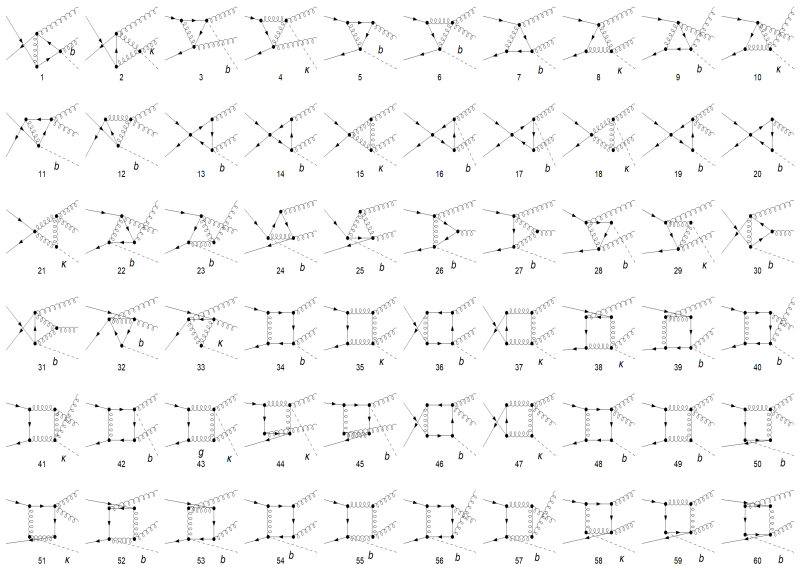
We perform a complete one-loop renormalization analysis of CPT-odd Lorentz-violating scalar quantum chromodynamics with adjoint scalar matter. Working to first order in the preferred background vector and treating the corresponding operators as perturbative insertions, we compute the ultraviolet-divergent parts of the relevant two-, three-, and four-point Green's functions for the gauge, scalar, and ghost fields. We show that the gauge sector develops the expected Carroll-Field-Jackiw-type correction, which generically turns out to be divergent in our theory, although the divergence vanishes in a certain gauge, while the scalar sector displays the corresponding CPT-odd single-derivative term proportional to the background vector. We further demonstrate that several of the Lorentz-violating corrections the three- and four-point function are ultraviolet finite. All one-loop divergences may be absorbed into counterterms already allowed by the classical Lagrangian, providing an explicit proof of the multiplicative renormalizability of the theory at this order. We also obtain the associated renormalization constants and one-loop $\beta$-functions for the gauge coupling, the Lorentz violation parameters, and the scalar self-interaction.
Editorial analysis
A structured set of objections, weighed in public.
Referee Report
Summary. The manuscript performs a complete one-loop renormalization analysis of CPT-odd Lorentz-violating scalar QCD with adjoint scalar matter. Treating the Lorentz-violating operators as perturbative insertions to first order in the background vector, the authors compute the ultraviolet-divergent parts of the relevant two-, three-, and four-point Green's functions for the gauge, scalar, and ghost fields. They show that the gauge sector develops a Carroll-Field-Jackiw-type correction (divergent except in a special gauge), the scalar sector acquires a corresponding CPT-odd single-derivative term, several three- and four-point LV corrections are finite, and all one-loop divergences can be absorbed into counterterms already present in the classical Lagrangian. This establishes multiplicative renormalizability at one loop, with explicit renormalization constants and beta-functions derived for the gauge coupling, LV parameters, and scalar self-interaction.
Significance. If the central claim holds, the work supplies a concrete, explicit example of one-loop renormalizability in a CPT-odd Lorentz-violating gauge theory with matter, supporting the consistency of such extensions as quantum field theories. The derivation of beta-functions for both the gauge coupling and the LV coefficients provides quantitative tools for studying the running of these parameters, which is valuable for phenomenological applications and for comparing with other LV models.
major comments (2)
- [Abstract / gauge sector] Abstract and gauge-sector analysis: the Carroll-Field-Jackiw-type correction is stated to be divergent except in a certain gauge, with the implication that gauge-dependent pieces cancel against scalar-sector counterterms. The specific gauge must be identified and the explicit cancellation demonstrated, because this cancellation is load-bearing for the claim that all divergences remain within the classical operator basis.
- [Loop-integral evaluation / Green's functions] Dimensional regularization with fixed background vector: the insertion of the CPT-odd operator to O(b) breaks the usual Lorentz tensor decomposition of loop integrals. The manuscript must exhibit the explicit divergent contributions to the two-, three-, and four-point functions (including all possible contractions of external momenta with b) to confirm that no new tensor structures appear whose coefficients cannot be absorbed by the classical counterterms. This verification is required for the multiplicative-renormalizability proof.
minor comments (2)
- [Abstract] The abstract refers to 'several of the Lorentz-violating corrections' in the three- and four-point functions being finite; a brief table or list identifying which diagrams remain finite would improve clarity.
- [Notation / Lagrangian] Notation for the background vector and the associated LV coefficient should be introduced once and used uniformly; any redefinition between the classical Lagrangian and the counterterm Lagrangian should be stated explicitly.
Simulated Author's Rebuttal
We thank the referee for the careful reading and constructive comments on our manuscript. We address each major comment point by point below and will incorporate the requested clarifications into a revised version.
read point-by-point responses
-
Referee: [Abstract / gauge sector] Abstract and gauge-sector analysis: the Carroll-Field-Jackiw-type correction is stated to be divergent except in a certain gauge, with the implication that gauge-dependent pieces cancel against scalar-sector counterterms. The specific gauge must be identified and the explicit cancellation demonstrated, because this cancellation is load-bearing for the claim that all divergences remain within the classical operator basis.
Authors: We agree that identifying the specific gauge and explicitly demonstrating the cancellation is necessary for a complete substantiation of the renormalizability result. In the revised manuscript we will specify the gauge in which the Carroll-Field-Jackiw-type divergence vanishes and supply the detailed decomposition of the gauge-sector counterterms, showing their explicit cancellation against the corresponding scalar-sector contributions. This material will be added to the section on two-point functions. revision: yes
-
Referee: [Loop-integral evaluation / Green's functions] Dimensional regularization with fixed background vector: the insertion of the CPT-odd operator to O(b) breaks the usual Lorentz tensor decomposition of loop integrals. The manuscript must exhibit the explicit divergent contributions to the two-, three-, and four-point functions (including all possible contractions of external momenta with b) to confirm that no new tensor structures appear whose coefficients cannot be absorbed by the classical counterterms. This verification is required for the multiplicative-renormalizability proof.
Authors: We recognize the value of a more explicit display of the loop-integral results. Although the original manuscript already evaluates the divergent parts of the relevant Green's functions and verifies that they lie within the classical operator basis, we will expand the presentation in the revised version by tabulating the explicit divergent contributions, including all contractions of external momenta with the background vector b. This will be placed in the main text or an appendix so that readers can directly confirm the absence of new tensor structures. revision: yes
Circularity Check
No circularity: explicit one-loop diagram computation and counterterm matching
full rationale
The paper conducts a standard perturbative renormalization analysis by computing the divergent parts of two-, three-, and four-point Green's functions to first order in the background vector, then verifying that all divergences match the operator structures already present in the classical Lagrangian. This is a direct Feynman-diagram evaluation followed by counterterm identification, with no reduction of any result to a fitted parameter, self-referential definition, or load-bearing self-citation. The central claim of multiplicative renormalizability at one loop is established by explicit calculation rather than by construction or imported uniqueness theorems. The derivation remains self-contained against external benchmarks such as dimensional regularization and power-counting rules.
Axiom & Free-Parameter Ledger
free parameters (1)
- background vector magnitude
axioms (2)
- standard math Standard dimensional regularization and minimal subtraction apply to the Lorentz-violating operators.
- domain assumption The underlying scalar QCD without violation is multiplicatively renormalizable.
Reference graph
Works this paper leans on
-
[1]
CPT Violation and the Standard Model
D. Colladay and V. A. Kosteleck´ y, Phys. Rev. D55, 6760 (1997) [arXiv:hep-ph/9703464]
work page Pith review arXiv 1997
-
[2]
Lorentz-violating extensio n of the standard model
D. Colladay and V. A. Kosteleck´ y, Phys. Rev. D58, 116002 (1998) [arXiv:hep-ph/9809521]
-
[3]
V. A. Kosteleck´ y, Phys. Rev. D69, 105009 (2004) [arXiv:hep-th/0312310]
work page Pith review arXiv 2004
-
[4]
R. Jackiw, Int. J. Mod. Phys. B14, 2011 (2000) [arXiv:hep-th/9903044]
-
[5]
R. Jackiw and V. A. Kosteleck´ y, Phys. Rev. Lett.82, 3572 (1999) [arXiv:hep-ph/9901358]
-
[6]
M. P´ erez-Victoria, J. High Energ. Phys04, 032 (2001) [hep-th/0102021]
-
[7]
B. Altschul, Phys. Rev. D99, 125009 (2019) [arXiv:1903.10100(hep-th)]
- [8]
- [9]
- [10]
-
[11]
One-loop renormalization of pure Yang-Mills with Lorentz violation,
D. Colladay and P. McDonald, “One-loop renormalization of pure Yang-Mills with Lorentz violation,” Phys. Rev. D,75105002 (2007) [arXiv:hep-ph/0609084]
-
[12]
One-Loop Renormalization of QCD with Lorentz Violation,
D. Colladay and P. McDonald, “One-Loop Renormalization of QCD with Lorentz Violation,” Phys. Rev. D77, 085006 (2008) [arXiv:0712.2055(hep-ph)]
-
[13]
One-loop renormalization of the electroweak sector with Lorentz violation,
D. Colladay and P. McDonald, “One-loop renormalization of the electroweak sector with Lorentz violation,” Phys. Rev. D,79125019 (2009) [arXiv:0904.1219(hep- ph)]
- [14]
-
[15]
B. Altschul, Phys. Rev. D86, 045008 (2012) [arXiv:1202.5993(hep-th)]
- [16]
- [17]
- [18]
-
[19]
B. Altschul, L. C. T. Brito, J. C. C. Felipe, S. Karki, A. C. Lehum, and A. Yu. Petrov, Phys. Rev. D107, 045005 (2023) [arXiv:2211.11399(hep-th)]
-
[20]
B. Altschul, L. C. T. Brito, J. C. C. Felipe, S. Karki, A. C. Lehum, and A. Yu. Petrov, Phys. Rev. D107, 115002 (2023) [arXiv:2304.03025(hep-th)]
- [21]
- [22]
- [23]
-
[24]
Mertig, M
R. Mertig, M. B¨ ohm, and A. Denner, Comput. Phys. Commun.64, 345 (1991)
1991
-
[25]
T. Hahn and M. P´ erez-Victoria, Comput. Phys. Commun.118, 153 (1999) [arXiv:hep-ph/9807565(hep-ph)]
-
[26]
Generating Feynman Diagrams and Amplitudes with FeynArts 3
T. Hahn, Comput. Phys. Commun.140, 418 (2001) [arXiv:hep-ph/0012260(hep- ph)]
work page Pith review arXiv 2001
-
[27]
New Developments in FeynCalc 9.0
V. Shtabovenko, R. Mertig, and F. Orellana, Comput. Phys. Commun.207, 345 (2016) [arXiv:1601.01167(hep-ph)]. 31
work page Pith review arXiv 2016
-
[28]
FeynCalc 10: Do multiloop integrals dream of computer codes?,
V. Shtabovenko, R. Mertig, and F. Orellana Comput. Phys. Commun.306, 109357 (2024) [arXiv:2312.14089(hep-ph)]
-
[29]
S. Coleman and E. Weinberg, Phys. Rev. D7, 1888 (1973); see also E. J. Weinberg, hep-th/0507214
work page internal anchor Pith review arXiv 1973
- [30]
- [31]
- [32]
discussion (0)
Sign in with ORCID, Apple, or X to comment. Anyone can read and Pith papers without signing in.