Recognition: unknown
Quantum corrections to the Josephson dynamics: a population-imbalance approach
Pith reviewed 2026-05-09 14:52 UTC · model grok-4.3
The pith
Treating population imbalance as the sole variable yields quantum corrections to Josephson frequency that match exact solutions better than phase-only methods in weak interactions.
A machine-rendered reading of the paper's core claim, the machinery that carries it, and where it could break.
Core claim
The central claim is that the imbalance-only Lagrangian with position-dependent mass, when quantized and corrected at one loop via the covariant background-field method, supplies explicit expressions for an effective potential and effective mass. These yield a quantum-corrected Josephson frequency whose numerical values agree more closely with exact diagonalization of the two-site Bose-Hubbard model than the phase-only treatment does, in the weak-interaction regime that defines the natural domain of the imbalance description.
What carries the argument
The imbalance-only Lagrangian with coordinate-dependent mass, quantized by symmetric operator ordering and corrected at one loop by a covariant background-field method that accounts for the mass's position dependence.
If this is right
- Explicit formulas for the effective potential and effective mass allow direct computation of the quantum-corrected Josephson frequency.
- The imbalance-only formulation agrees better with exact diagonalization than the phase-only formulation when interactions are weak.
- The covariant background-field method fully incorporates the coordinate dependence of the mass into the quantum corrections.
- The approach is restricted to the weak-interaction regime where population imbalance is the natural dynamical variable.
Where Pith is reading between the lines
- The same reduction and one-loop procedure could be tested on Josephson junctions realized with ultracold atoms in optical lattices having more than two sites.
- If the imbalance variable continues to dominate in other tunneling geometries, the method might supply improved quantum corrections without solving the full many-body Schrödinger equation.
- Higher-order loop corrections or alternative operator orderings could be examined to determine the radius of convergence of the present one-loop results.
Load-bearing premise
That the population imbalance can be treated as the sole dynamical variable while still capturing the leading quantum corrections, an assumption whose validity is asserted only for weak interactions.
What would settle it
Exact diagonalization of the two-site Bose-Hubbard model in the weak-interaction regime that produces Josephson frequencies differing substantially from the one-loop corrected imbalance-only prediction would falsify the claimed improvement.
Figures


read the original abstract
We investigate quantum corrections to the Josephson dynamics of two weakly coupled Bose-Einstein condensates using the population imbalance as the sole dynamical variable. Starting from the two-variable action, we derive the imbalance-only Lagrangian with a position-dependent mass and quantize it via symmetric operator ordering. The leading quantum corrections to the classical potential and mass are computed via the one-loop quantum effective action, using a covariant background-field method that fully accounts for the coordinate dependence of the mass. This yields explicit expressions for the effective potential and the effective mass, from which we derive the quantum-corrected Josephson frequency. Numerical comparison with exact diagonalization of the two-site Bose-Hubbard model shows that the imbalance-only formulation outperforms the complementary phase-only approach in the regime of weak interactions, which is the natural domain of validity of the population-imbalance description.
Editorial analysis
A structured set of objections, weighed in public.
Referee Report
Summary. The manuscript derives quantum corrections to the Josephson dynamics of two weakly coupled Bose-Einstein condensates by treating the population imbalance as the only dynamical variable. It obtains an effective Lagrangian with a coordinate-dependent mass, quantizes it using symmetric ordering, computes one-loop corrections with a covariant background-field method, and extracts a quantum-corrected Josephson frequency. This is benchmarked against exact diagonalization of the two-site Bose-Hubbard model, with the claim that the imbalance-only approach performs better than the phase-only one in the weak-interaction regime.
Significance. If the central construction holds, the work supplies a practical effective theory for leading quantum corrections in the natural regime of the imbalance description. The direct numerical comparison to exact diagonalization of the Bose-Hubbard model is a clear strength, as is the covariant treatment of the mass dependence in the background-field expansion. This could be useful for analyzing quantum effects in ultracold-atom Josephson systems where population imbalance is the observable of interest.
major comments (2)
- [Quantization of the imbalance-only Lagrangian] The quantization step adopts symmetric (Weyl) operator ordering for the kinetic term with z-dependent mass without deriving it from the underlying two-site Bose-Hubbard Hamiltonian. Different orderings differ by O(ħ²) terms, so this choice directly affects the one-loop corrections to the frequency and the reported numerical superiority over the phase-only route. A projection from the many-body dynamics or explicit matching to the ħ expansion of the exact spectrum is needed to establish that the improvement is not an artifact of the ordering.
- [Numerical comparison with exact diagonalization] The claim that the imbalance-only formulation outperforms the phase-only approach is anchored in the numerical benchmark, but the manuscript does not report quantitative error measures (e.g., relative deviation in frequency) or show results across a continuous range of interaction strengths. This makes it difficult to assess how robust the outperformance is within the asserted weak-interaction domain of validity.
minor comments (1)
- The abstract and introduction would benefit from an explicit statement of the interaction-strength window (e.g., U/J < X) in which the improvement is observed.
Simulated Author's Rebuttal
We thank the referee for the careful reading and constructive comments on our manuscript. We address each major comment below and indicate the revisions we will make to strengthen the presentation and address the concerns raised.
read point-by-point responses
-
Referee: The quantization step adopts symmetric (Weyl) operator ordering for the kinetic term with z-dependent mass without deriving it from the underlying two-site Bose-Hubbard Hamiltonian. Different orderings differ by O(ħ²) terms, so this choice directly affects the one-loop corrections to the frequency and the reported numerical superiority over the phase-only route. A projection from the many-body dynamics or explicit matching to the ħ expansion of the exact spectrum is needed to establish that the improvement is not an artifact of the ordering.
Authors: We acknowledge that the manuscript adopts symmetric ordering without an explicit derivation or projection from the Bose-Hubbard Hamiltonian. This choice follows the standard Weyl quantization for effective Lagrangians with coordinate-dependent mass, ensuring the correct classical limit. While a full many-body matching lies outside the scope of the present effective-theory work, we will revise the text to include a dedicated paragraph justifying the ordering on the basis of its semiclassical consistency and to note explicitly that alternative orderings would contribute additional O(ħ²) terms beyond the one-loop approximation employed here. The numerical superiority is presented as an empirical observation within the weak-interaction regime. revision: partial
-
Referee: The claim that the imbalance-only formulation outperforms the phase-only approach is anchored in the numerical benchmark, but the manuscript does not report quantitative error measures (e.g., relative deviation in frequency) or show results across a continuous range of interaction strengths. This makes it difficult to assess how robust the outperformance is within the asserted weak-interaction domain of validity.
Authors: We agree that quantitative error measures and a continuous parameter scan would improve the clarity of the benchmark. In the revised manuscript we will add a new figure (or table) showing the relative deviation of the quantum-corrected Josephson frequency from exact diagonalization results for both the imbalance-only and phase-only formulations, plotted versus interaction strength U/J over a continuous interval in the weak-coupling regime (e.g., 0 < U/J < 1). This will allow a direct, quantitative assessment of the robustness of the reported outperformance. revision: yes
Circularity Check
No significant circularity; derivation uses independent microscopic benchmark
full rationale
The paper starts from the classical two-variable action, eliminates the phase to obtain an imbalance-only Lagrangian with coordinate-dependent mass, selects symmetric ordering for quantization, and applies the standard one-loop covariant background-field expansion to compute corrections. These steps are explicit choices and standard techniques rather than reductions to the target frequency by construction. The claimed superiority is tested against exact diagonalization of the two-site Bose-Hubbard model, which is an external, non-derived numerical reference and not a fitted or self-referential input. No load-bearing self-citations, ansatzes smuggled via prior work, or fitted parameters renamed as predictions appear in the derivation chain. The result therefore retains independent content.
Axiom & Free-Parameter Ledger
axioms (2)
- domain assumption Symmetric operator ordering is the appropriate quantization prescription for the position-dependent-mass Lagrangian.
- domain assumption The one-loop truncation of the quantum effective action captures the leading quantum corrections.
Reference graph
Works this paper leans on
-
[1]
Frontiere Quantistiche
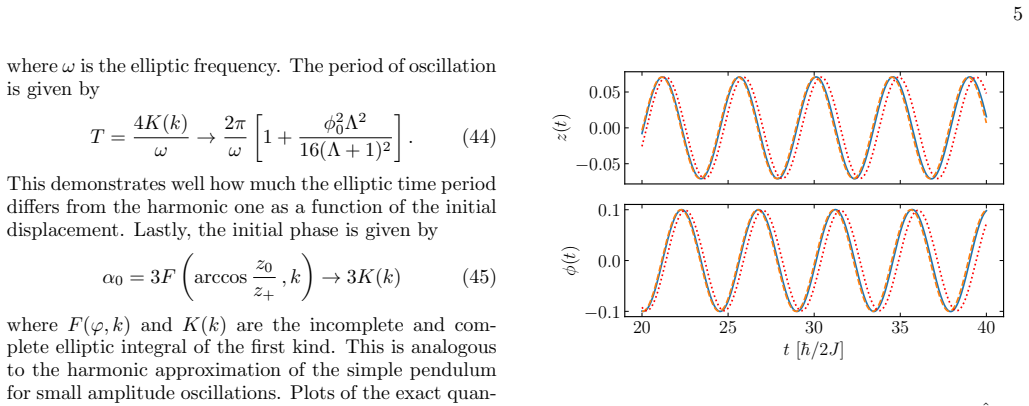
In the region of parameter space where the mean-field solution is a good description of the quantum dynam- ics (z, ϕ≪1), thez-only quantum effective mean-field does improve the standard mean-field (Fig. 1). Whereas, in the only phase approach, the anharmonicity was too large for the quantum effective mean-field to give a mean- ingful improvement for Λ≲10 ...
-
[2]
Josephson, Possible new effects in superconductive tunnelling, Phys
B.D. Josephson, Possible new effects in superconductive tunnelling, Phys. Lett.1, 251 (1962)
1962
-
[3]
Albiez, R
M. Albiez, R. Gati, J. F¨ olling, S. Hunsmann, M. Cris- tiani, and M. K. Oberthaler, Direct observation of tunnel- ing and nonlinear self-trapping in a single bosonic Joseph- son junction, Phys. Rev. Lett.95, 010402 (2005)
2005
-
[4]
Spagnolli, G
G. Spagnolli, G. Semeghini, L. Masi, G. Ferioli, A. Trenkwalder, S. Coop, M. Landini, L. Pezz` e, G. Mod- ugno, M. Inguscio, A. Smerzi, and M. Fattori, Crossing over from attractive to repulsive interactions in a tunnel- ing bosonic Josephson junction, Phys. Rev. Lett.118, 230403 (2017)
2017
-
[5]
Smerzi, S
A. Smerzi, S. Fantoni, S. Giovanazzi, and S. R. Shenoy, Quantum coherent atomic tunneling between two trapped Bose-Einstein condensates, Phys. Rev. Lett. 79, 4950 (1997)
1997
-
[6]
Coleman and E
S. Coleman and E. Weinberg, Radiative corrections as the origin of spontaneous symmetry breaking, Phys. Rev. D7, 1888 (1973)
1973
-
[7]
Furutani, J
K. Furutani, J. Tempere, and L. Salasnich, Quantum ef- fective action for the bosonic Josephson junction, Phys. Rev. B105, 134510 (2022)
2022
-
[8]
Vianello, S
C. Vianello, S. Salvatore, and L. Salasnich, Quantum ac- tion of the Josephson dynamics, Int. J. Theor. Phys.64, 315 (2025)
2025
-
[9]
Kleinert and A
H. Kleinert and A. Chervyakov, Covariant effective ac- tion for quantum particle with coordinate-dependent mass, Phys. Lett. A299, 319 (2002)
2002
-
[10]
Enrico Fermi
F. Cametti, G. Jona-Lasinio, C. Presilla, and F. Toninelli, Comparison between quantum and classical dynamics in the effective action formalism, Proceedings of the International School of Physics “Enrico Fermi” Course CXLIII, IOS Press (2000)
2000
-
[11]
Ehrenfest, Bemerkung ¨ uber die angen¨ aherte G¨ ultigkeit der klassischen Mechanik innerhalb der Quanten- mechanik, Z
P. Ehrenfest, Bemerkung ¨ uber die angen¨ aherte G¨ ultigkeit der klassischen Mechanik innerhalb der Quanten- mechanik, Z. Phys.45, 455 (1927)
1927
-
[12]
Sakurai and J
J.J. Sakurai and J. Napolitano,Modern Quantum Me- chanics(Cambridge Univ. Press, 2020)
2020
-
[13]
Franzosi and V
R. Franzosi and V. Penna, Chaotic behavior, collective modes and self-trapping in the dynamics of three cou- pled Bose-Einstein condensates, Phys. Rev. E67, 046227 (2003)
2003
-
[14]
Ferrini, A
G. Ferrini, A. Minguzzi, and F. W. Hekking, Num- ber squeezing, quantum fluctuations, and oscillations in 7 mesoscopic Bose Josephson junctions, Phys. Rev. A78, 023606 (2008)
2008
discussion (0)
Sign in with ORCID, Apple, or X to comment. Anyone can read and Pith papers without signing in.