Recognition: unknown
Long range proximity effects in planar structures involving the halfmetal ferromagnet La0.7Sr0.3MnO3 and Pt interlayers
Pith reviewed 2026-05-09 18:35 UTC · model grok-4.3
The pith
Pt interlayers enable zero-resistance states at 2 micrometer distances in LSMO-based planar Josephson junctions
A machine-rendered reading of the paper's core claim, the machinery that carries it, and where it could break.
Core claim
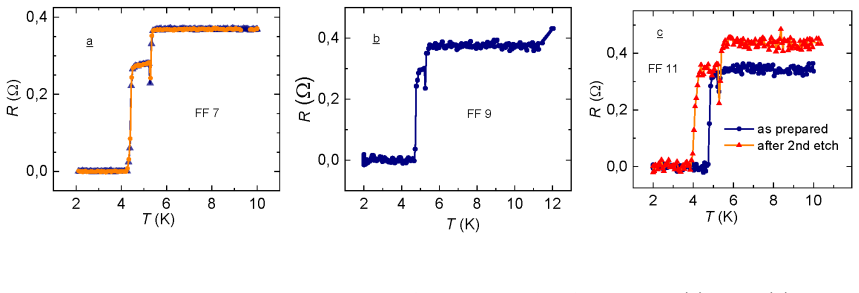
When a Pt interlayer is placed between the LSMO film and the NbTi electrodes, the resulting planar junctions display sharp superconducting transitions and reach a zero-resistance state at an electrode distance of 2 micrometers, with evidence that even larger distances should be accessible.
What carries the argument
The Pt interlayer at the LSMO/NbTi interface, which promotes conversion to triplet correlations that propagate through the half-metallic LSMO over micrometer-scale distances.
If this is right
- Triplet supercurrents can be sustained across LSMO lengths of at least 2 micrometers when a Pt interlayer is used.
- The absence of simple length or width scaling in the nanostrip devices points to insufficient control over interface or material parameters during fabrication.
- The trend observed with Pt interlayers suggests that electrode separations substantially larger than 2 micrometers remain experimentally reachable.
- The Pt layer improves interface transparency or spin-mixing compared with direct NbTi-LSMO contacts.
Where Pith is reading between the lines
- If the supercurrent is confirmed to be triplet and fully spin-polarized, the platform could be used to test superconducting spin valves or long-range spin transport in hybrid devices.
- Systematic variation of Pt thickness or substitution of other interlayers would help isolate which interface property controls the triplet generation efficiency.
- Mapping the temperature and magnetic-field dependence of the critical current across many devices would provide a quantitative test of the proximity-effect decay length inside the LSMO.
Load-bearing premise
The measured zero-resistance states arise from triplet supercurrent flowing through the LSMO rather than from fabrication shorts, unintended interface paths, or other artifacts.
What would settle it
Fabricating and measuring control devices in which the LSMO layer is absent or replaced by a normal metal while keeping the Pt/NbTi electrode geometry identical, and checking whether the zero-resistance state at 2 micrometers disappears.
Figures




read the original abstract
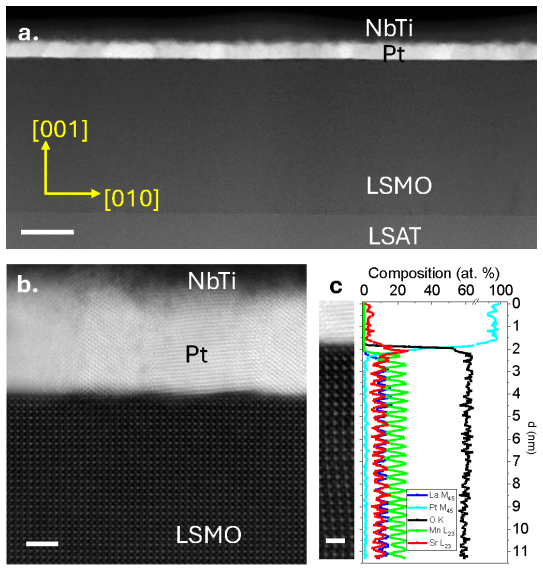
Over the last decade, there has been steady research on superconducting junctions with a ferromagnet as the weak link, and where triplet correlations can transport supercurrents over a substantial distances. Of particular interest are halfmetallic ferromagnets, in which only one spin band is present, so that, presumably, the induced supercurrent is fully spin-polarized. We have earlier reported on a study of triplet transport in planar La0.7Sr0.3MnO3(LSMO) nanostrip Josephson junctions with NbTi superconducting contacts, where we found high values for the supercurrents, and large junction lengths (up to 1.3 {\mu}m). Here, we extend that work by studying the dependence of the critical current Ic on the length of the nanostrip between the contacts and the width of the strip. All junctions show strong supercurrents, but we do not observe simple systematics. Apparently, the fabrication process does not allow sufficient control over some of its parameters. To gain more insight in the mechanism for triplet generation at the LSMO/NbTi interface, we also studied the effect of Pt as an interlayer between the LSMO and the NbTi. For this, we etched a NbTi/Pt electrode structure on a full film of LSMO. The results are highly promising, showing sharp superconducting transitions and zero-resistance states being reached at an electrode distance of 2 {\mu}m, with indications that larger distances should be feasible.
Editorial analysis
A structured set of objections, weighed in public.
Referee Report
Summary. The manuscript extends prior work on triplet supercurrent in planar LSMO nanostrip Josephson junctions with NbTi contacts by examining Ic dependence on nanostrip length and width, noting absence of simple systematics due to fabrication variability. It further investigates Pt interlayers between LSMO and NbTi, reporting sharp superconducting transitions and zero-resistance states at 2 μm electrode spacing, with indications that larger distances may be feasible via long-range triplet proximity effects in the half-metal.
Significance. If the zero-resistance states are unambiguously due to spin-polarized triplet supercurrents through LSMO (rather than artifacts), the results would meaningfully extend the demonstrated range of triplet proximity in half-metals beyond the prior 1.3 μm and highlight Pt as an effective interlayer for interface engineering. This would be of interest for superconducting spintronics, though the acknowledged fabrication limitations and lack of quantitative controls temper the immediate impact.
major comments (2)
- [Abstract and experimental results on Pt interlayers] Abstract and Pt interlayer results: The central claim that zero-resistance at 2 μm electrode distance arises from triplet supercurrent propagating through the LSMO channel requires explicit exclusion of fabrication artifacts. The text notes that 'the fabrication process does not allow sufficient control over some of its parameters' but provides no description of control devices (e.g., without LSMO channel), cross-sectional imaging, or resistance mapping to rule out micro-shorts, pinholes, or unintended Pt/LSMO paths. This is load-bearing for attributing the effect to the intended mechanism.
- [Abstract] Abstract: The report of 'strong supercurrents' and 'zero-resistance states being reached at an electrode distance of 2 μm' lacks accompanying quantitative Ic vs. length data, error bars, number of devices measured, or statistical analysis. Without these, the claim that 'larger distances should be feasible' remains qualitative and cannot be rigorously evaluated against the skeptic concern of unintended conduction paths.
minor comments (1)
- [Abstract] The abstract would be strengthened by specifying the number of junctions tested and typical Ic values or transition widths to provide context for the 'highly promising' results.
Simulated Author's Rebuttal
We thank the referee for the careful reading and constructive comments on our manuscript. We address each major point below and indicate where revisions will be made to strengthen the presentation of the Pt interlayer results and the abstract claims.
read point-by-point responses
-
Referee: Abstract and experimental results on Pt interlayers: The central claim that zero-resistance at 2 μm electrode distance arises from triplet supercurrent propagating through the LSMO channel requires explicit exclusion of fabrication artifacts. The text notes that 'the fabrication process does not allow sufficient control over some of its parameters' but provides no description of control devices (e.g., without LSMO channel), cross-sectional imaging, or resistance mapping to rule out micro-shorts, pinholes, or unintended Pt/LSMO paths. This is load-bearing for attributing the effect to the intended mechanism.
Authors: We agree that explicit exclusion of fabrication artifacts is important for confidently attributing the zero-resistance states to triplet supercurrents through the LSMO. The manuscript acknowledges fabrication variability but does not describe control devices or imaging. In the revised version we will add a paragraph discussing potential artifacts, noting that the sharp superconducting transitions and the extension beyond our prior 1.3 μm results are inconsistent with random micro-shorts or pinholes, which would not produce such consistent behavior. We will also reference additional SEM images of the electrode structures already obtained during fabrication to confirm the intended geometry and separation. Comprehensive resistance mapping of every device was not performed, but the reproducibility across the measured devices supports the channel-mediated mechanism. revision: partial
-
Referee: Abstract: The report of 'strong supercurrents' and 'zero-resistance states being reached at an electrode distance of 2 μm' lacks accompanying quantitative Ic vs. length data, error bars, number of devices measured, or statistical analysis. Without these, the claim that 'larger distances should be feasible' remains qualitative and cannot be rigorously evaluated against the skeptic concern of unintended conduction paths.
Authors: We agree that the abstract would benefit from greater quantitative detail to support the claims and allow rigorous evaluation. The main text already presents Ic data versus nanostrip length and width, although without simple systematics owing to fabrication variability. In the revised manuscript we will update the abstract to include specific quantitative information drawn from the reported measurements, such as the range of observed critical currents at 2 μm spacing and the number of devices exhibiting zero-resistance states. This will make the statement that larger distances should be feasible more concrete while still acknowledging the variability. revision: yes
Circularity Check
Purely experimental report with no derivations or fitted predictions
full rationale
This manuscript is a purely experimental study reporting measurements of supercurrents, critical currents, superconducting transitions, and zero-resistance states in LSMO nanostrip junctions with and without Pt interlayers. No equations, derivations, ansatzes, or parameter fittings appear in the text; all claims rest on direct fabrication and transport data. Self-citations to prior work by the authors are present but are not load-bearing for any derivation chain, as no such chain exists. The results are therefore self-contained against external benchmarks with no possibility of circular reduction.
Axiom & Free-Parameter Ledger
axioms (1)
- domain assumption Triplet superconducting correlations can be generated at superconductor/half-metal interfaces and propagate over long distances.
Reference graph
Works this paper leans on
-
[1]
S Keizer, S
R. S Keizer, S. T. B. G¨ onnenwein, T. M. Klapwijk, G. Miao, G. Xiao, and A. Gupta. A spin triplet supercurrent through the half- metallic ferromagnet CrO 2. Nature, 439 (7078):825–827, 2006
2006
-
[2]
M. S. Anwar, F. Czeschka, M. Hesselberth, M. Porcu, and J. Aarts. Long-range super- currents through half-metallic ferromagnetic CrO2. Physical Review B, 82(10):100501, 2010
2010
-
[3]
M. S. Anwar and J. Aarts. Inducing super- currents in thin films of ferromagnetic CrO 2. Superconductor Science and Technology, 24 (2):024016, 2011
2011
-
[4]
Singh, C
A. Singh, C. Jansen, K. Lahabi, and J. Aarts. High-quality CrO2 nanowires for dissipation- less spintronics. Physical Review X, 6(4): 041012, 2016
2016
-
[5]
Sanchez-Manzano, S
D. Sanchez-Manzano, S. Mesoraca, F. A. Cuellar, M. Cabero, V. Rouco, G. Or- fila, X. Palermo, A. Balan, L. Marcano, A. Sander, et al. Extremely long-range, high- temperature Josephson coupling across a half-metallic ferromagnet. Nature Materials, 21(2):188–194, 2022
2022
-
[6]
Sanchez-Manzano, S
D. Sanchez-Manzano, S. Mesoraca, S. Rodriguez-Corvillo, A. Lagarrigue, F. Gallego, F. A. Cuellar, A. Sander, A. Rivera-Calzada, S. Valencia, E. Ville- gas, C. Leon, and J. Santamaria. Long- range superconducting proximity effect in YBa2Cu3O7/La0.7Ca0.3MnO3 weak link arrays. Applied Physics Letters, 124:222603, 2024
2024
-
[7]
APL Photonics 6(7), 070804 (2021) https://doi.org/10.1063/5
Y. Junxiang and J. Aarts. Triplet supercur- rents in lateral Josephson junctions with a half-metallic ferromagnet. Applied Physics Letters, 124:202601, 2024. doi: 10.1063/5. 0210842
work page doi:10.1063/5 2024
-
[8]
Junxiang, R
Y. Junxiang, R. Fermin, M. Cabero, K. La- habi, and J. Aarts. Fabrication of planar halfmetallic ferromagnetic Josephson junc- tions with long range coupling. Physical Review Research, 6:043114, 2024. doi: 10. 1103/PhysRevResearch.6.043114
2024
-
[9]
F. Chiodi, M. Ferrier, S. Gu´ eron, J. C. Cuevas, G. Montambaux, F. Fortuna, A. Ka- sumov, and H. Bouchiat. Geometry-related magnetic interference patterns in long sns Josephson junctions. Physical Review B, 86: 064510, 2012. doi: 10.1103/PhysRevB.86. 064510
-
[10]
F. S. Bergeret and I. V. Tokatly. Singlet- triplet conversion and the long-range prox- imity effect in superconductor-ferromagnet structures with generic spin dependent fields. Physical Review Letters, 110:117003, 2013. doi: 10.1103/PhysRevLett.110.117003
-
[11]
F. S. Bergeret and I. V. Tokatly. Spin- orbit coupling as a source of long-range triplet proximity effect in superconductor- ferromagnet hybrid structures. Physical Review B, 89:134517, 2014. doi: 10.1103/ PhysRevB.89.134517
2014
-
[12]
S. H. Jacobsen, I. Kulagina, and J. Lin- der. Controlling superconducting spin flow with spin-flip immunity using a single homo- geneous ferromagnet. Scientific Reports, 6: 23926, 2016. doi: 10.1038/srep23926(2016)
-
[13]
J. R. Eskilt, M. Amundsen, N. Banerjee, and J. Linder. Long-ranged triplet supercurrent in a single in-plane ferromagnet with spin- orbit coupled contacts to superconductors. Physical Review B, 100:224519, 2019. doi: 10.1103/PhysRevB.100.224519
-
[15]
A. T. Bregazzi; J. A. Ouassou; A. G. T. Coveney ; N. A. Stelmashenko; A. Child; A. T. N’Diaye; J. W. A. Robinson ; F. K. De- jene ; J. Linder ; N. Banerjee. Enhanced con- trollable triplet proximity effect in supercon- ducting spin–orbit coupled spin valves with modified superconductor/ferromagnet inter- faces. Applied Physics Letters, 124:162602,
-
[16]
doi: 10.1063/5.0209305
-
[17]
N. Satchell and N. O. Birge. Supercurrent in ferromagnetic Josephson junctions with heavy metal interlayers. Physical Review B, 97:214509, 2018. doi: 10.1103/PhysRevB.97. 214509. 8
discussion (0)
Sign in with ORCID, Apple, or X to comment. Anyone can read and Pith papers without signing in.