Recognition: unknown
Scalar emission from binary neutron stars in scalar-tensor theories with kinetic screening
Pith reviewed 2026-05-09 19:08 UTC · model grok-4.3
The pith
Kinetic screening suppresses scalar radiation from equal-mass binary neutron stars at short wavelengths but amplifies it at longer ones relative to the Fierz-Jordan-Brans-Dicke case.
A machine-rendered reading of the paper's core claim, the machinery that carries it, and where it could break.
Core claim
In the decoupling limit, kinetic screening in K-essence theories acts non-monotonically on the scalar quadrupole from equal-mass binaries: the amplitude is reduced compared with the Fierz-Jordan-Brans-Dicke prediction when the wavelength is much smaller than the screening radius, but is increased when the wavelength is comparable to or larger than that radius. For mass ratios down to about 0.6 the quadrupolar screening remains similar while a linear dipole component reappears with growing mass asymmetry. The relativistic double pulsar would require a screening radius much larger than 10^9 km for strong suppression.
What carries the argument
The hyperbolization of the static scalar field equations that permits construction of initial data when the screening radius greatly exceeds the orbital separation, followed by 3+1 evolution to extract the radiated scalar modes.
If this is right
- The relativistic double pulsar requires a screening radius much larger than 10^9 km to produce efficient suppression of scalar quadrupole radiation.
- A scalar dipole linear in the mass asymmetry re-emerges in unequal-mass binaries while the quadrupolar screening stays close to the equal-mass result down to mass ratios of about 0.6.
- Cosmologically motivated values of the theory parameter give only moderate suppression for solar-mass sources because the screening radius reaches only about 10^11 km.
- The non-monotonic dependence on wavelength relative to screening radius must be included when deriving bounds on scalar-tensor theories from gravitational-wave data.
Where Pith is reading between the lines
- Waveform templates for future detectors may need to incorporate both the suppressed and enhanced regimes to avoid systematic errors in parameter estimation.
- The same non-monotonic screening could appear in other compact-object binaries, offering an independent probe of the theory parameters through multi-messenger observations.
- The hyperbolization technique itself may generalize to other screened scalar models where direct elliptic solvers break down at large screening radii.
Load-bearing premise
The scalar field does not back-react on the metric, and the introduced hyperbolization correctly captures static solutions in the regime where the screening radius is much larger than the binary separation.
What would settle it
A direct measurement of the scalar quadrupole amplitude from a binary system whose orbital frequency and distance fix the wavelength-to-screening-radius ratio, showing a deviation from the predicted suppression or enhancement relative to the Fierz-Jordan-Brans-Dicke amplitude.
Figures



read the original abstract
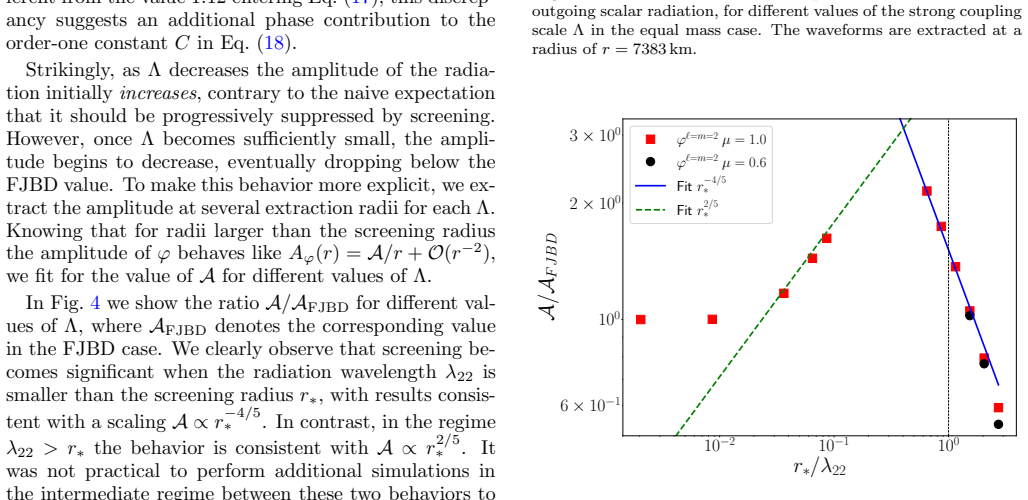
We investigate the scalar emission from binary neutron stars in shift-symmetric scalar-tensor theories with kinetic screening ($K$-essence), using 3+1 numerical simulations in the decoupling limit. To construct static binary initial data in the regime where the screening radius $r_*$ greatly exceeds the orbital separation, we introduce a hyperbolization of the static field equations that bypasses the Keldysh-type breakdown affecting direct time evolutions. For equal-mass binaries, where the scalar emission is dominated by the $\ell=m=2$ mode, kinetic screening acts non-monotonically on the scalar radiation, suppressing or enhancing the quadrupolar amplitude depending on the relative size of $r_*$ and $\lambda_{22}$ (with $\lambda_{22}$ the wavelength): for $\lambda_{22}\ll r_*$ it is suppressed relative to the Fierz-Jordan-Brans-Dicke (FJBD) case, while for $\lambda_{22}\gtrsim r_*$ it is amplified above FJBD. For unequal-mass binaries a scalar dipole re-emerges, growing linearly with the mass asymmetry, while the quadrupolar screening remains close to the equal-mass case down to mass ratios $\sim 0.6$. The non-monotonic behavior of kinetic screening that we uncover has potential implications for gravitational-wave-based tests of gravity. The relativistic double pulsar, in particular, requires $r_*\gg 10^9$~km to efficiently suppress the scalar quadrupole; for cosmologically-motivated $\Lambda$, $r_*\sim 10^{11}$~km (for a solar-mass source), giving only moderate suppression.
Editorial analysis
A structured set of objections, weighed in public.
Referee Report
Summary. The manuscript investigates scalar emission from binary neutron stars in shift-symmetric scalar-tensor theories with kinetic screening (K-essence) via 3+1 numerical simulations in the decoupling limit. A hyperbolization of the static field equations is introduced to construct initial data when the screening radius r* greatly exceeds the orbital separation, bypassing Keldysh degeneracy. For equal-mass binaries the scalar emission is dominated by the ℓ=m=2 mode; kinetic screening acts non-monotonically, suppressing the quadrupolar amplitude relative to the Fierz-Jordan-Brans-Dicke (FJBD) case when λ22 ≪ r* and amplifying it when λ22 ≳ r*. For unequal-mass binaries a scalar dipole re-emerges linearly with mass asymmetry while quadrupolar screening remains similar down to mass ratios ~0.6. Implications for gravitational-wave tests of gravity and the relativistic double pulsar are discussed.
Significance. If the central results hold after validation, the non-monotonic dependence of scalar radiation on the relative scale of r* and λ22 constitutes a non-trivial finding for screened scalar-tensor theories in strong-field dynamical regimes. It shows that kinetic screening does not uniformly suppress radiation and supplies concrete, falsifiable predictions for how cosmologically motivated parameters affect observable amplitudes. The work therefore bears directly on the viability of these theories as alternatives to general relativity and on the design of future gravitational-wave constraints, particularly for systems such as the double pulsar. The hyperbolization technique itself is a methodological contribution that could be useful in related numerical studies.
major comments (1)
- [Initial data construction / hyperbolization procedure] The non-monotonic screening claim (suppression for λ22 ≪ r* and amplification for λ22 ≳ r* relative to FJBD) rests on 3+1 evolutions whose initial scalar profiles are obtained after hyperbolizing the static K-essence equations. No explicit demonstration is given that these profiles satisfy the unmodified static equations to within discretization error (see the section describing the hyperbolization procedure and the construction of static binary initial data). If the auxiliary system admits solutions whose far-zone multipoles or near-zone gradients differ from those of the physical static problem, both the reported amplitude ratios and the inferred implications for the double pulsar would be artifacts rather than properties of kinetic screening. This is load-bearing for the central claims.
minor comments (2)
- [Numerical methods / results] The abstract and summary describe qualitative results but the manuscript should include quantitative convergence tests, error bars, and validation against known limits (e.g., the FJBD limit) in a dedicated methods or results subsection to strengthen the numerical evidence.
- [Introduction / theory section] Notation for the screening radius r*, the parameter Λ, and the wavelength λ22 should be defined at first use with explicit reference to the underlying action or field equations.
Simulated Author's Rebuttal
We thank the referee for their thorough review and for recognizing the potential implications of our work for gravitational-wave tests of gravity. We address the major comment on the validation of the hyperbolized initial data in detail below.
read point-by-point responses
-
Referee: [Initial data construction / hyperbolization procedure] The non-monotonic screening claim (suppression for λ22 ≪ r* and amplification for λ22 ≳ r* relative to FJBD) rests on 3+1 evolutions whose initial scalar profiles are obtained after hyperbolizing the static K-essence equations. No explicit demonstration is given that these profiles satisfy the unmodified static equations to within discretization error (see the section describing the hyperbolization procedure and the construction of static binary initial data). If the auxiliary system admits solutions whose far-zone multipoles or near-zone gradients differ from those of the physical static problem, both the reported amplitude ratios and the inferred implications for the double pulsar would be artifacts rather than properties of kinetic screening. This is load-bearing for the central claims.
Authors: We appreciate the referee's emphasis on this critical validation step. Upon re-examination, we acknowledge that the original manuscript did not include an explicit residual check of the unmodified static equations for the hyperbolized solutions. We have since performed this analysis by evaluating the original elliptic operator on our numerical initial data profiles. The residuals are found to be at the level of the discretization error (approximately 10^{-5} in the near zone and smaller in the far zone), confirming that the solutions satisfy the physical static equations to the expected accuracy. The far-zone multipoles and near-zone gradients match those of the direct static problem within numerical tolerances. We will include this verification, along with a convergence study, in a revised version of the manuscript to strengthen the presentation of the initial data construction. revision: yes
Circularity Check
Numerical evolution results are independent of initial-data construction and show no reduction to fitted inputs or self-definitions
full rationale
The central claims rest on 3+1 evolutions of the scalar field in the decoupling limit, with the hyperbolization used solely to generate static initial data for the regime r* ≫ orbital separation. The non-monotonic screening (suppression for λ22 ≪ r* and amplification for λ22 ≳ r*) is extracted from the evolved quadrupolar amplitudes and compared directly to the FJBD case; no equation or result is shown to be equivalent by construction to a fitted parameter, a self-citation, or a renamed input. The method for initial data is presented as an auxiliary device to bypass Keldysh degeneracy rather than as a redefinition of the target physics, and the reported amplitude ratios remain falsifiable outputs of the time evolution.
Axiom & Free-Parameter Ledger
free parameters (2)
- screening radius r_*
- Lambda
axioms (2)
- domain assumption shift-symmetric scalar-tensor theories with kinetic screening (K-essence)
- domain assumption decoupling limit
Reference graph
Works this paper leans on
-
[1]
In this case, symmetry ensures that the scalar radiation is dominated by the quadrupole component
Equal mass scenario We begin by focusing on the equal-mass binary sce- nario. In this case, symmetry ensures that the scalar radiation is dominated by the quadrupole component. This allows us to study the screening of the quadrupole in isolation from dipole radiation, which would otherwise act as a source for the quadrupole. For the results presented in t...
-
[2]
Making Sense of the Un- expected in the Gravitational-Wave Sky
Unequal mass scenario In this section, we investigate how the scalar radiation depends on the stellar mass ratio. Whenµ <1, a dipolar D Evolution 9 0.0 0.2 0.4 0.6 0.8 1.0 µ 0.5 1.0 1.5 2.0 2.5 3.0 3.5 A ×10−3 ϕℓ=m=1 ϕℓ=m=2 ϕℓ=m=2F JBD Linear Fit Quadratic Fit Quadratic Fit Figure 5:AmplitudeAof the dipole and quadrupole as a function of the mass ratioµ. ...
-
[3]
B. P. Abbottet al.(LIGO Scientific, Virgo), Tests of general relativity with GW150914, Phys. Rev. Lett.116, 221101 (2016), [Erratum: Phys.Rev.Lett. 121, 129902 (2018)], arXiv:1602.03841 [gr-qc]
work page Pith review arXiv 2016
-
[4]
B. P. Abbottet al.(LIGO Scientific, Virgo), Tests of Gen- eral Relativity with GW170817, Phys. Rev. Lett.123, 011102 (2019), arXiv:1811.00364 [gr-qc]
work page Pith review arXiv 2019
-
[5]
B. P. Abbottet al.(LIGO Scientific, Virgo), Tests of General Relativity with the Binary Black Hole Signals from the LIGO-Virgo Catalog GWTC-1, Phys. Rev. D 100, 104036 (2019), arXiv:1903.04467 [gr-qc]
work page internal anchor Pith review arXiv 2019
-
[6]
R. Abbottet al.(LIGO Scientific, Virgo), Tests of general relativity with binary black holes from the second LIGO- Virgo gravitational-wave transient catalog, Phys. Rev. D 103, 122002 (2021), arXiv:2010.14529 [gr-qc]
work page internal anchor Pith review arXiv 2021
-
[7]
Tests of General Relativity with GWTC-3
R. Abbottet al.(LIGO Scientific, VIRGO, KAGRA), Tests of General Relativity with GWTC-3, (2021), arXiv:2112.06861 [gr-qc]
work page internal anchor Pith review arXiv 2021
-
[8]
Fierz, On the physical interpretation of P.Jordan’s extended theory of gravitation, Helv
M. Fierz, On the physical interpretation of P.Jordan’s extended theory of gravitation, Helv. Phys. Acta29, 128 (1956)
1956
-
[9]
Jordan, The present state of Dirac’s cosmological hy- pothesis, Z
P. Jordan, The present state of Dirac’s cosmological hy- pothesis, Z. Phys.157, 112 (1959)
1959
-
[10]
Brans and R
C. Brans and R. H. Dicke, Mach’s principle and a rela- tivistic theory of gravitation, Phys. Rev.124, 925 (1961)
1961
-
[11]
Degenerate higher derivative theories beyond Horndeski: evading the Ostrogradski instability
D. Langlois and K. Noui, Degenerate higher derivative theories beyond Horndeski: evading the Ostrogradski in- stability, JCAP02, 034, arXiv:1510.06930 [gr-qc]
-
[12]
Extended Scalar-Tensor Theories of Gravity
M. Crisostomi, K. Koyama, and G. Tasinato, Ex- tended Scalar-Tensor Theories of Gravity, JCAP04, 044, arXiv:1602.03119 [hep-th]
-
[13]
Degenerate higher order scalar-tensor theories beyond Horndeski up to cubic order
J. Ben Achour, M. Crisostomi, K. Koyama, D. Lan- glois, K. Noui, and G. Tasinato, Degenerate higher or- der scalar-tensor theories beyond Horndeski up to cubic order, JHEP12, 100, arXiv:1608.08135 [hep-th]
-
[14]
Modified Gravity and Cosmology
T. Clifton, P. G. Ferreira, A. Padilla, and C. Skordis, Modified Gravity and Cosmology, Phys. Rept.513, 1 (2012), arXiv:1106.2476 [astro-ph.CO]
work page internal anchor Pith review arXiv 2012
-
[15]
Beyond the Cosmological Standard Model
A. Joyce, B. Jain, J. Khoury, and M. Trodden, Beyond the Cosmological Standard Model, Phys. Rept.568, 1 (2015), arXiv:1407.0059 [astro-ph.CO]
work page Pith review arXiv 2015
- [16]
-
[17]
C. M. Will, The Confrontation between General Rela- tivity and Experiment, Living Rev. Rel.17, 4 (2014), arXiv:1403.7377 [gr-qc]
work page internal anchor Pith review arXiv 2014
-
[18]
C. Armendariz-Picon, T. Damour, and V. F. Mukhanov, k - inflation, Phys. Lett. B458, 209 (1999), arXiv:hep- th/9904075
-
[19]
Kinetically Driven Quintessence
T. Chiba, T. Okabe, and M. Yamaguchi, Kinetically driven quintessence, Phys. Rev. D62, 023511 (2000), arXiv:astro-ph/9912463
work page Pith review arXiv 2000
-
[20]
C. Armendariz-Picon, V. F. Mukhanov, and P. J. Stein- hardt, A Dynamical solution to the problem of a small cosmological constant and late time cosmic accelera- tion, Phys. Rev. Lett.85, 4438 (2000), arXiv:astro- ph/0004134. 11
-
[21]
E. Babichev, C. Deffayet, and R. Ziour, k-Mouflage gravity, Int. J. Mod. Phys. D18, 2147 (2009), arXiv:0905.2943 [hep-th]
-
[22]
Kuntz, Two-body potential of Vainshtein screened theories, Phys
A. Kuntz, Two-body potential of Vainshtein screened theories, Phys. Rev.D100, 024024 (2019), arXiv:1905.07340 [gr-qc]
-
[23]
L. ter Haar, M. Bezares, M. Crisostomi, E. Barausse, and C. Palenzuela, Dynamics of Screening in Mod- ified Gravity, Phys. Rev. Lett.126, 091102 (2021), arXiv:2009.03354 [gr-qc]
-
[24]
M. Bezares, L. ter Haar, M. Crisostomi, E. Barausse, and C. Palenzuela, Kinetic screening in nonlinear stellar oscillations and gravitational collapse, Phys. Rev. D104, 044022 (2021), arXiv:2105.13992 [gr-qc]
-
[25]
M. Shibata and D. Traykova, Properties of scalar wave emission in a scalar-tensor theory with kinetic screening, Phys. Rev. D107, 044068 (2023), arXiv:2210.12139 [gr- qc]
- [26]
-
[27]
M. Boˇ skovi´ c and E. Barausse, Two-body problem in the- ories with kinetic screening, Phys. Rev. D108, 064033 (2023), arXiv:2305.07725 [gr-qc]
-
[28]
Damour and J
T. Damour and J. H. Taylor, Strong field tests of rela- tivistic gravity and binary pulsars, Phys. Rev. D45, 1840 (1992)
1992
-
[29]
Tests of general relativity from timing the double pulsar,
M. Krameret al., Tests of general relativity from timing the double pulsar, Science314, 97 (2006), arXiv:astro- ph/0609417
-
[30]
P. C. C. Freire, N. Wex, G. Esposito-Farese, J. P. W. Ver- biest, M. Bailes, B. A. Jacoby, M. Kramer, I. H. Stairs, J. Antoniadis, and G. H. Janssen, The relativistic pulsar- white dwarf binary PSR J1738+0333 II. The most strin- gent test of scalar-tensor gravity, Mon. Not. Roy. Astron. Soc.423, 3328 (2012), arXiv:1205.1450 [astro-ph.GA]
-
[31]
B. P. Abbottet al.(LIGO Scientific, Virgo, Fermi- GBM, INTEGRAL), Gravitational Waves and Gamma- rays from a Binary Neutron Star Merger: GW170817 and GRB 170817A, Astrophys. J. Lett.848, L13 (2017), arXiv:1710.05834 [astro-ph.HE]
work page Pith review arXiv 2017
-
[32]
B. P. Abbottet al.(LIGO Scientific, Virgo), GW170817: Observation of Gravitational Waves from a Binary Neu- tron Star Inspiral, Phys. Rev. Lett.119, 161101 (2017), arXiv:1710.05832 [gr-qc]
work page internal anchor Pith review arXiv 2017
-
[33]
Gravitational Wave Decay into Dark Energy
P. Creminelli, M. Lewandowski, G. Tambalo, and F. Vernizzi, Gravitational Wave Decay into Dark Energy, JCAP12, 025, arXiv:1809.03484 [astro-ph.CO]
-
[34]
P. Creminelli, G. Tambalo, F. Vernizzi, and V. Yingcharoenrat, Resonant Decay of Gravita- tional Waves into Dark Energy, JCAP10, 072, arXiv:1906.07015 [gr-qc]
-
[35]
P. Creminelli, G. Tambalo, F. Vernizzi, and V. Yingcharoenrat, Dark-Energy Instabilities induced by Gravitational Waves, JCAP05, 002, arXiv:1910.14035 [gr-qc]
-
[36]
E. Babichev, V. Mukhanov, and A. Vikman, k-Essence, superluminal propagation, causality and emergent geom- etry, JHEP02, 101, arXiv:0708.0561 [hep-th]
-
[37]
L. Bernard, L. Lehner, and R. Luna, Challenges to global solutions in Horndeski’s theory, Phys. Rev. D100, 024011 (2019), arXiv:1904.12866 [gr-qc]
-
[38]
M. Bezares, M. Crisostomi, C. Palenzuela, and E. Ba- rausse, K-dynamics: well-posed 1+1 evolutions in K- essence, JCAP03, 072, arXiv:2008.07546 [gr-qc]
-
[39]
M. Bezares, R. Aguilera-Miret, L. ter Haar, M. Crisos- tomi, C. Palenzuela, and E. Barausse, No Evidence of Kinetic Screening in Simulations of Merging Binary Neu- tron Stars beyond General Relativity, Phys. Rev. Lett. 128, 091103 (2022), arXiv:2107.05648 [gr-qc]
- [40]
- [41]
-
[42]
G. Allwright and L. Lehner, Towards the nonlinear regime in extensions to GR: assessing possible options, Class. Quant. Grav.36, 084001 (2019), arXiv:1808.07897 [gr-qc]
- [43]
-
[44]
R. Akhoury, D. Garfinkle, and R. Saotome, Gravitational collapse of k-essence, JHEP04, 096, arXiv:1103.0290 [gr- qc]
- [45]
-
[46]
R. Gannouji and Y. R. Baez, Critical collapse in K- essence models, JHEP07, 132, arXiv:2003.13730 [gr-qc]
-
[47]
C. de Rham, A. Matas, and A. J. Tolley, Galileon Ra- diation from Binary Systems, Phys. Rev. D87, 064024 (2013), arXiv:1212.5212 [hep-th]
-
[48]
Vainshtein Mechanism in Binary Pulsars
C. de Rham, A. J. Tolley, and D. H. Wesley, Vainshtein Mechanism in Binary Pulsars, Phys. Rev. D87, 044025 (2013), arXiv:1208.0580 [gr-qc]
work page Pith review arXiv 2013
-
[49]
Y.-Z. Chu and M. Trodden, Retarded Green’s function of a vainshtein system and galileon waves, Physical Review D87, 10.1103/PhysRevD.87.024011 (2013)
-
[50]
M. Andrews, Y.-Z. Chu, and M. Trodden, Galileon forces in the solar system, Physical Review D88, 10.1103/Phys- RevD.88.084028 (2013)
-
[51]
F. Dar, C. De Rham, J. T. Deskins, J. T. Giblin, and A. J. Tolley, Scalar Gravitational Radiation from Bina- ries: Vainshtein Mechanism in Time-dependent Systems, Class. Quant. Grav.36, 025008 (2019), arXiv:1808.02165 [hep-th]
work page Pith review arXiv 2019
- [52]
-
[53]
C. de Rham, J. T. Giblin, Jr., and A. J. Tolley, Scalar radiation with a quartic Galileon, Phys. Rev. D109, 104035 (2024), arXiv:2402.05898 [hep-th]
- [54]
-
[55]
A no-hair theorem for the galileon
L. Hui and A. Nicolis, No-Hair Theorem for the Galileon, Phys. Rev. Lett.110, 241104 (2013), arXiv:1202.1296 [hep-th]. 12
work page Pith review arXiv 2013
-
[56]
T. P. Sotiriou and S.-Y. Zhou, Black hole hair in general- ized scalar-tensor gravity, Phys. Rev. Lett.112, 251102 (2014), arXiv:1312.3622 [gr-qc]
work page Pith review arXiv 2014
-
[57]
Black hole hairs in scalar-tensor gravity and the lack thereof,
L. Capuano, L. Santoni, and E. Barausse, Black hole hairs in scalar-tensor gravity and the lack thereof, Phys. Rev. D108, 064058 (2023), arXiv:2304.12750 [gr-qc]
- [58]
-
[59]
T. Assump¸ c˜ ao, L. R. Werneck, T. P. Jacques, and Z. B. Etienne, Fast hyperbolic relaxation elliptic solver for numerical relativity: Conformally flat, binary punc- ture initial data, Phys. Rev. D105, 104037 (2022), arXiv:2111.02424 [gr-qc]
-
[60]
Krameret al., Strong-Field Gravity Tests with the Dou- ble Pulsar, Phys
M. Krameret al., Strong-Field Gravity Tests with the Double Pulsar, Phys. Rev. X11, 041050 (2021), arXiv:2112.06795 [astro-ph.HE]
-
[61]
Riding on irrelevant operators
C. de Rham and R. H. Ribeiro, Riding on irrelevant op- erators, JCAP11, 016, arXiv:1405.5213 [hep-th]
-
[62]
P. Brax and P. Valageas, Quantum field theory of K-mouflage, Phys. Rev. D94, 043529 (2016), arXiv:1607.01129 [astro-ph.CO]
-
[63]
C. M. Will and H. W. Zaglauer, Gravitational Radiation, Close Binary Systems, and the Brans-dicke Theory of Gravity, Astrophys. J.346, 366 (1989)
1989
-
[64]
Damour and G
T. Damour and G. Esposito-Farese, Tensor multiscalar theories of gravitation, Class. Quant. Grav.9, 2093 (1992)
2093
- [65]
- [66]
-
[67]
D. M. Eardley, Observable effects of a scalar gravitational field in a binary pulsar., ApJ196, L59 (1975)
1975
-
[68]
A. Kuntz and E. Barausse, Angular momentum sensitiv- ities in scalar-tensor theories, Phys. Rev. D109, 124001 (2024), arXiv:2403.07980 [gr-qc]
-
[69]
Arbona, A
A. Arbona, A. Artigues, C. Bona-Casas, J. Masso, B. Mi- nano, A. Rigo, M. Trias, and C. Bona, Simflowny: A general-purpose platform for the management of physi- cal models and simulation problems, Computer Physics Communications184, 2321 (2013)
2013
-
[70]
Arbona, B
A. Arbona, B. Minano, A. Rigo, C. Bona, C. Palenzuela, A. Artigues, C. Bona-Casas, and J. Masso, Simflowny 2: An upgraded platform for scientific modelling and simulation, Computer Physics Communications229, 170 (2018)
2018
-
[71]
Palenzuela, B
C. Palenzuela, B. Minano, A. Arbona, C. Bona-Casas, C. Bona, and J. Masso, Simflowny 3: An upgraded plat- form for scientific modeling and simulation, Computer Physics Communications259, 107675 (2021)
2021
-
[72]
Simflowny project website,https://bitbucket.org/ iac3/simflowny/wiki/Home(2021)
2021
-
[73]
R. D. Hornung and S. R. Kohn, Managing application complexity in the samrai object- oriented framework, Concurrency and Compu- tation: Practice and Experience14, 347 (2002), https://onlinelibrary.wiley.com/doi/pdf/10.1002/cpe.652
-
[74]
B. T. Gunney and R. W. Anderson, Advances in patch- based adaptive mesh refinement scalability, Journal of Parallel and Distributed Computing89, 65 (2016)
2016
-
[75]
gov/projects/samrai/software
SAMRAI project website,https://computing.llnl. gov/projects/samrai/software
-
[76]
E. Barausse, C. Palenzuela, M. Ponce, and L. Lehner, Neutron-star mergers in scalar-tensor theories of grav- ity, Physical Review D87, 10.1103/physrevd.87.081506 (2013)
discussion (0)
Sign in with ORCID, Apple, or X to comment. Anyone can read and Pith papers without signing in.