Recognition: unknown
Atomic Interferometry with Spin-Orbit-Coupled Spin-1 Condensates
Pith reviewed 2026-05-09 14:48 UTC · model grok-4.3
The pith
Raman-dressed spin-1 Bose gases create an effective spinor system for tunable entanglement-enhanced interferometry with density-based phase readout.
A machine-rendered reading of the paper's core claim, the machinery that carries it, and where it could break.
Core claim
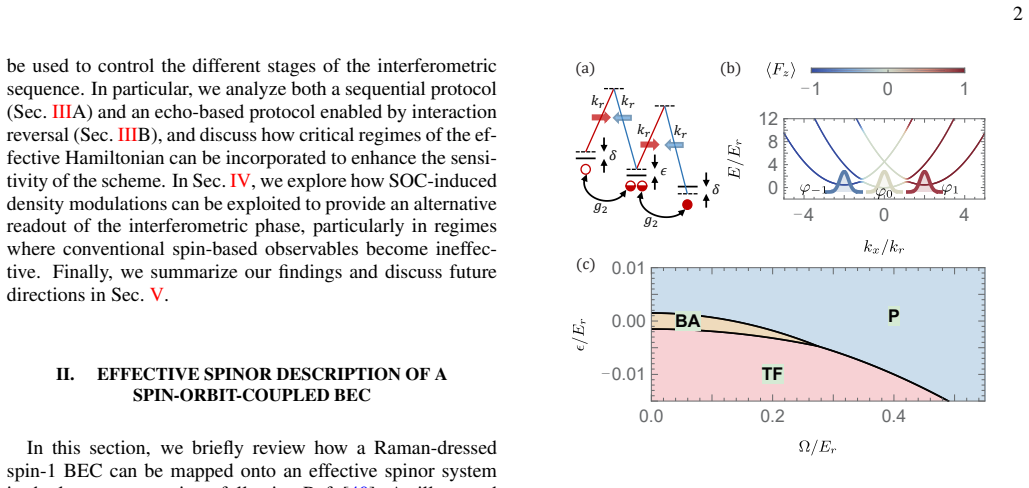
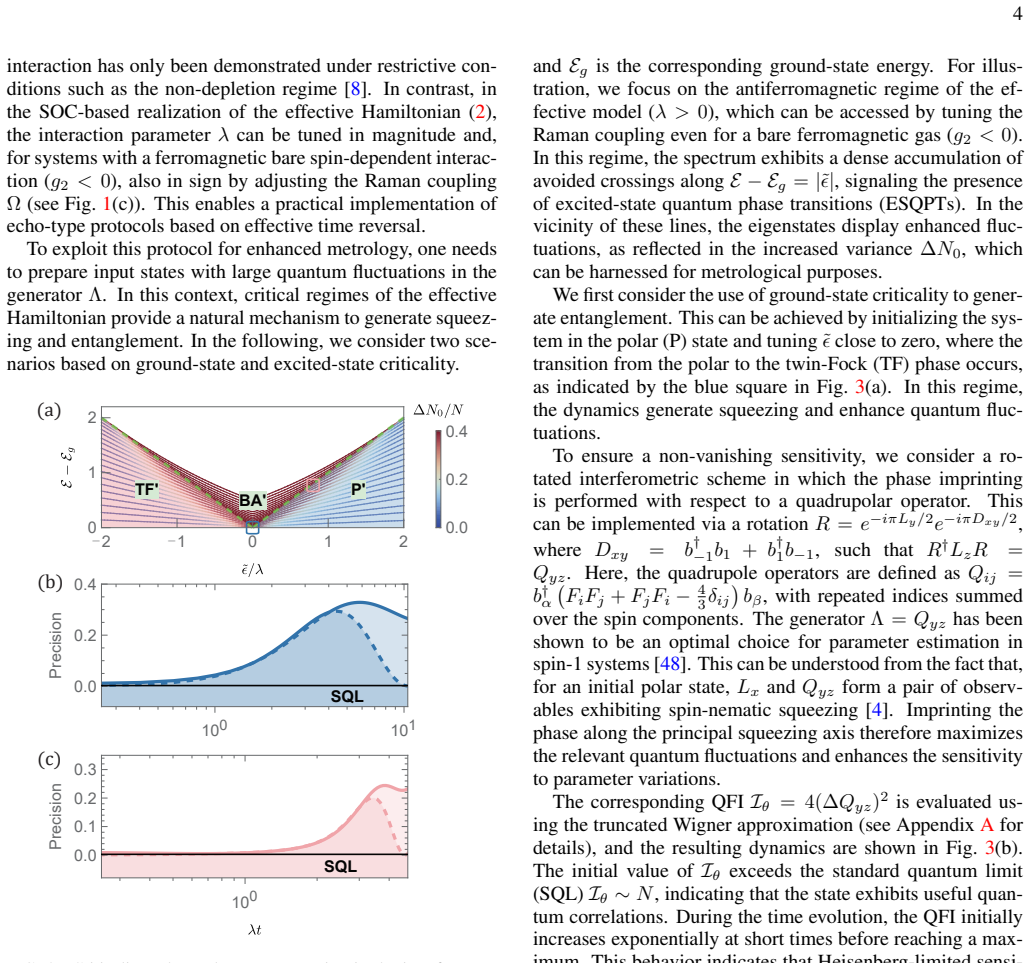
In the low-energy regime the atom-light coupling gives rise to an effective spinor condensate whose spin-mixing interaction can be tuned independently of the atomic density. Critical regimes of this effective Hamiltonian generate entanglement and enhance interferometric sensitivity beyond the standard quantum limit, while the spin-momentum locking of the dressed modes supplies spatial density modulations that serve as an alternative readout of the interferometric phase.
What carries the argument
The effective spinor Hamiltonian obtained from Raman-dressed spin-orbit-coupled spin-1 condensates, whose tunable spin-mixing term enables separation of state preparation from phase imprinting.
If this is right
- Entanglement generated near critical points of the effective Hamiltonian improves interferometric sensitivity beyond the standard quantum limit.
- Echo-type protocols become accessible through effective time reversal of the spinor dynamics.
- Phase information can be recovered from the displacement of spin-orbit-induced density stripes even when spin observables are insensitive.
- State preparation and phase imprinting can be performed in separate stages because spin-mixing is controllable independently of density.
Where Pith is reading between the lines
- The same Raman-dressing approach might be extended to other spin values or lattice geometries to obtain different families of tunable nonlinear Hamiltonians.
- Density-stripe readout could reduce the need for spin-selective imaging hardware in future devices.
- Validating the predicted independence of spin-mixing from density would confirm that preparation and readout stages can be optimized separately.
Load-bearing premise
The atom-light coupling in the low-energy regime produces an effective spinor condensate in which the spin-mixing interaction can be tuned independently of atomic density.
What would settle it
An experiment that measures whether the phase sensitivity exceeds the standard quantum limit precisely when the effective Hamiltonian is tuned through its predicted critical point, or that records the predicted displacement of density stripes when conventional spin observables remain flat.
Figures


read the original abstract
We propose and analyze a quantum interferometry scheme based on a Raman-dressed Bose gas with spin-orbit coupling. In this system, the atom-light coupling mixes spin and momentum degrees of freedom, giving rise, in the low-energy regime, to an effective spinor condensate whose spin-mixing interaction can be tuned independently of the atomic density. This controllability enables a separation between state preparation and phase imprinting, and provides a natural route to echo-type protocols based on effective time reversal. Within this framework, critical regimes of the effective spinor Hamiltonian can be used to generate entanglement and enhance interferometric sensitivity beyond the standard quantum limit. In addition, the spin-momentum locking of the dressed modes gives access to spatial density modulations that provide an alternative readout of the interferometric phase. In particular, phase information can be extracted from the displacement of spin-orbit-induced density stripes even when conventional spin observables are insensitive within the effective spinor description. Our results identify Raman-dressed spinor gases as a flexible platform for nonlinear atomic interferometry, combining controllable spin-mixing dynamics with spatially resolved phase readout.
Editorial analysis
A structured set of objections, weighed in public.
Referee Report
Summary. The manuscript proposes a quantum interferometry scheme based on a Raman-dressed Bose gas with spin-orbit coupling in spin-1 condensates. In the low-energy regime, the atom-light coupling produces an effective spinor condensate whose spin-mixing interaction is tunable independently of density. This enables separation of state preparation and phase imprinting, echo-type protocols, use of critical regimes of the effective spinor Hamiltonian to generate entanglement and surpass the standard quantum limit, and an alternative phase readout via spatial density modulations arising from spin-momentum locking of the dressed modes.
Significance. If the low-energy effective model remains valid, the proposal identifies Raman-dressed spinor gases as a flexible platform for nonlinear atomic interferometry. It combines controllable spin-mixing dynamics with spatially resolved phase readout from density stripes, even when conventional spin observables are insensitive. The work leverages standard Raman-dressing and spinor-BEC techniques but offers a concrete route to entanglement-enhanced sensitivity and alternative readout, which would be of interest for precision metrology in quantum gases.
major comments (1)
- [Abstract / effective Hamiltonian section] Abstract and the derivation of the effective Hamiltonian: The central claim that critical regimes of the effective spinor Hamiltonian can be accessed to generate entanglement beyond the SQL requires the low-energy approximation to hold near these points. Near criticality the spinor gap closes and density fluctuations grow, which can populate momentum components outside the dressed-mode subspace and violate the projection onto the effective spinor model. The manuscript should supply a quantitative bound (e.g., showing that the critical spin-mixing strength remains much smaller than the Raman gap and recoil energy) or numerical checks confirming the regime of validity; without this the support for the stated performance gains is limited.
minor comments (1)
- [Abstract] Clarify whether the effective model is strictly two-component or retains three components for spin-1, and specify the precise mapping from the Raman-dressed states to the spinor basis used in the critical-regime analysis.
Simulated Author's Rebuttal
We thank the referee for the careful reading of our manuscript and the constructive comment on the validity of the low-energy approximation. We address the point below and will revise the manuscript to incorporate additional quantitative analysis.
read point-by-point responses
-
Referee: [Abstract / effective Hamiltonian section] Abstract and the derivation of the effective Hamiltonian: The central claim that critical regimes of the effective spinor Hamiltonian can be accessed to generate entanglement beyond the SQL requires the low-energy approximation to hold near these points. Near criticality the spinor gap closes and density fluctuations grow, which can populate momentum components outside the dressed-mode subspace and violate the projection onto the effective spinor model. The manuscript should supply a quantitative bound (e.g., showing that the critical spin-mixing strength remains much smaller than the Raman gap and recoil energy) or numerical checks confirming the regime of validity; without this the support for the stated performance gains is limited.
Authors: We agree that the low-energy projection must be carefully validated near criticality, where the spinor gap closes. The original manuscript derives the effective spinor model but does not include an explicit bound on its regime of validity. In the revised manuscript we will add a quantitative analysis in the effective Hamiltonian section. We will show that, for the experimentally accessible parameters we consider, the critical spin-mixing strength remains at least an order of magnitude smaller than both the Raman gap and the recoil energy. This scale separation keeps the population of higher-momentum states negligible even when density fluctuations grow. We will also provide a brief numerical check of the full Raman-dressed spin-1 Hamiltonian confirming that leakage out of the dressed subspace stays below a few percent near the critical point. These additions will directly support the entanglement-generation claims while preserving the separation of state preparation and phase imprinting. revision: yes
Circularity Check
No circularity: effective spinor model derived from standard low-energy projection
full rationale
The paper's derivation begins from the Raman-dressed Hamiltonian for a spin-1 Bose gas with spin-orbit coupling and projects onto the low-energy dressed-mode subspace to obtain an effective spinor condensate with tunable, density-independent spin-mixing. This projection is a standard adiabatic elimination step whose validity is controlled by the Raman gap and recoil energy; the resulting effective Hamiltonian is not defined in terms of its own predictions, nor are any interferometric sensitivities or entanglement measures fitted to data and then re-labeled as outputs. Critical regimes are invoked as an application of the tunable parameters rather than as a self-consistent fixed point. No self-citation chain, ansatz smuggling, or renaming of known results is required to close the central claims. The scheme therefore remains self-contained against external benchmarks of Raman dressing and spinor BEC theory.
Axiom & Free-Parameter Ledger
axioms (2)
- domain assumption Low-energy effective spinor Hamiltonian obtained from Raman dressing
- domain assumption Mean-field treatment of the spin-1 condensate
Reference graph
Works this paper leans on
-
[1]
D. M. Stamper-Kurn and M. Ueda, Rev. Mod. Phys.85, 1191 (2013)
2013
-
[2]
Pu and P
H. Pu and P. Meystre, Phys. Rev. Lett.85, 3987 (2000)
2000
-
[3]
L.-M. Duan, A. Sørensen, J. I. Cirac, and P. Zoller, Phys. Rev. Lett.85, 3991 (2000)
2000
-
[4]
C. D. Hamley, C. S. Gerving, T. M. Hoang, E. M. Bookjans, and M. S. Chapman, Nat. Phys.8, 305 (2012)
2012
-
[5]
Luo, Y .-Q
X.-Y . Luo, Y .-Q. Zou, L.-N. Wu, Q. Liu, M.-F. Han, M. K. Tey, and L. You, Science355, 620 (2017)
2017
-
[6]
Hudelist, J
F. Hudelist, J. Kong, C. Liu, J. Jing, Z. Y . Ou, and W. Zhang, Nat. Commun.5, 3049 (2014)
2014
-
[7]
Gabbrielli, L
M. Gabbrielli, L. Pezz `e, and A. Smerzi, Phys. Rev. Lett.115, 163002 (2015)
2015
-
[8]
Linnemann, H
D. Linnemann, H. Strobel, W. Muessel, J. Schulz, R. J. Lewis- Swan, K. V . Kheruntsyan, and M. K. Oberthaler, Phys. Rev. Lett.117, 013001 (2016)
2016
-
[9]
J. P. Wrubel, A. Schwettmann, D. P. Fahey, Z. Glassman, H. K. Pechkis, P. F. Griffin, R. Barnett, E. Tiesinga, and P. D. Lett, Phys. Rev. A98, 023620 (2018)
2018
-
[10]
A. Qu, B. Evrard, J. Dalibard, and F. Gerbier, Phys. Rev. Lett. 125, 033401 (2020)
2020
-
[11]
C. K. Law, H. Pu, and N. P. Bigelow, Phys. Rev. Lett.81, 5257 (1998)
1998
-
[12]
Liu, L.-N
Q. Liu, L.-N. Wu, J.-H. Cao, T.-W. Mao, X.-W. Li, S.-F. Guo, M. K. Tey, and L. You, Nat. Phys.18, 167 (2022)
2022
-
[13]
Zanardi, M
P. Zanardi, M. G. A. Paris, and L. Campos Venuti, Phys. Rev. A78, 042105 (2008)
2008
-
[14]
Macieszczak, M
K. Macieszczak, M. Gut ¸˘a, I. Lesanovsky, and J. P. Garrahan, Phys. Rev. A93, 022103 (2016)
2016
-
[15]
Garbe, M
L. Garbe, M. Bina, A. Keller, M. G. A. Paris, and S. Felicetti, Phys. Rev. Lett.124, 120504 (2020)
2020
-
[16]
Y . Chu, S. Zhang, B. Yu, and J. Cai, Phys. Rev. Lett.126, 010502 (2021)
2021
-
[17]
Ding, Z.-K
D.-S. Ding, Z.-K. Liu, B.-S. Shi, G.-C. Guo, K. Mølmer, and C. S. Adams, Nat. Phys.18, 1447 (2022)
2022
-
[18]
Ilias, D
T. Ilias, D. Yang, S. F. Huelga, and M. B. Plenio, PRX Quantum 3, 010354 (2022)
2022
-
[19]
Garbe, O
L. Garbe, O. Abah, S. Felicetti, and R. Puebla, Quantum Sci. Technol.7, 035010 (2022)
2022
-
[20]
Gietka, L
K. Gietka, L. Ruks, and T. Busch, Quantum6, 700 (2022)
2022
-
[21]
Aybar, A
E. Aybar, A. Niezgoda, S. S. Mirkhalaf, M. W. Mitchell, D. Benedicto Orenes, and E. Witkowska, Quantum6, 808 (2022)
2022
-
[22]
Guan and R
Q. Guan and R. J. Lewis-Swan, Phys. Rev. Res.3, 033199 (2021)
2021
-
[23]
Wang and U
Q. Wang and U. Marzolino, SciPost Phys.17, 043 (2024)
2024
-
[24]
M. Xue, L. Zhou, G.-M. Huang, and G.-x. Li, Phys. Rev. A 113, 013736 (2026)
2026
-
[25]
L. Zhou, J. Kong, Z. Lan, and W. Zhang, Phys. Rev. Res.5, 013087 (2023)
2023
-
[26]
Meyer-Hoppe, F
B. Meyer-Hoppe, F. Anders, P. Feldmann, L. Santos, and C. Klempt, Phys. Rev. Lett.131, 243402 (2023)
2023
-
[27]
Control of dynamical phase transitions and non-ergodic relaxation via spinor phases
J. O. Austin-Harris, P. Sigdel, C. Binegar, S. E. Begg, T. Bilitewski, and Y . Liu, “Observation of phase mem- ory and dynamical phase transitions in spinor gases,” arXiv:2511.03720
work page internal anchor Pith review Pith/arXiv arXiv
-
[28]
Y .-J. Lin, R. L. Compton, K. Jim´enez-Garc´ıa, J. V . Porto, and I. B. Spielman, Nature462, 628 (2009)
2009
-
[29]
Y .-J. Lin, K. Jim´enez-Garc´ıa, and I. B. Spielman, Nature471, 83 (2011)
2011
-
[30]
Dalibard, F
J. Dalibard, F. Gerbier, G. Juzeli¯unas, and P. ¨Ohberg, Rev. Mod. Phys.83, 1523 (2011)
2011
-
[31]
Goldman, G
N. Goldman, G. Juzeli ¯unas, P. ¨Ohberg, and I. B. Spielman, Rep. Prog. Phys.77, 126401 (2014)
2014
-
[32]
Zhai, Rep
H. Zhai, Rep. Prog. Phys.78, 026001 (2015)
2015
-
[33]
Zhang, M
Y . Zhang, M. E. Mossman, T. Busch, P. Engels, and C. Zhang, Front. Phys.11, 118103 (2016)
2016
-
[34]
B. M. Anderson, J. M. Taylor, and V . M. Galitski, Phys. Rev. A83, 031602 (2011)
2011
-
[35]
Jacob, P
A. Jacob, P. ¨Ohberg, G. Juzeli¯unas, and L. Santos, Appl. Phys. B89, 439 (2007)
2007
-
[36]
Osterloh, M
K. Osterloh, M. Baig, L. Santos, P. Zoller, and M. Lewenstein, Phys. Rev. Lett.95, 010403 (2005)
2005
-
[37]
A. J. Olson, D. B. Blasing, C. Qu, C.-H. Li, R. J. Niffenegger, C. Zhang, and Y . P. Chen, Phys. Rev. A95, 043623 (2017)
2017
-
[38]
Liang, Z.-C
S. Liang, Z.-C. Li, W. Zhang, L. Zhou, and Z. Lan, Phys. Rev. A102, 033332 (2020)
2020
-
[39]
Gietka and H
K. Gietka and H. Ritsch, Phys. Rev. Lett.130, 090802 (2023)
2023
-
[40]
Cabedo, J
J. Cabedo, J. Claramunt, and A. Celi, Phys. Rev. A104, L031305 (2021)
2021
-
[41]
Cabedo and A
J. Cabedo and A. Celi, Phys. Rev. Res.3, 043215 (2021)
2021
-
[42]
Lan and P
Z. Lan and P. ¨Ohberg, Phys. Rev. A89, 023630 (2014). 8
2014
-
[43]
D. L. Campbell, R. M. Price, A. Putra, A. Vald ´es-Curiel, D. Trypogeorgos, and I. B. Spielman, Nat. Commun.7, 10897 (2016)
2016
-
[44]
Gerbier, A
F. Gerbier, A. Widera, S. F ¨olling, O. Mandel, and I. Bloch, Phys. Rev. A73, 041602 (2006)
2006
-
[45]
S. R. Leslie, J. Guzman, M. Vengalattore, J. D. Sau, M. L. Co- hen, and D. M. Stamper-Kurn, Phys. Rev. A79, 043631 (2009)
2009
-
[46]
L. E. Sadler, J. M. Higbie, S. R. Leslie, M. Vengalattore, and D. M. Stamper-Kurn, Nature443, 312 (2006)
2006
-
[47]
Murata, H
K. Murata, H. Saito, and M. Ueda, Phys. Rev. A75, 013607 (2007)
2007
-
[48]
Niezgoda, D
A. Niezgoda, D. Kajtoch, J. Dzieka ´nska, and E. Witkowska, New J. Phys.21, 093037 (2019)
2019
-
[49]
Kajtoch, K
D. Kajtoch, K. Pawłowski, and E. Witkowska, Phys. Rev. A 97, 023616 (2018)
2018
-
[50]
Davis, G
E. Davis, G. Bentsen, and M. Schleier-Smith, Phys. Rev. Lett. 116, 053601 (2016)
2016
-
[51]
Ravisankar, D
R. Ravisankar, D. Vudragovi ´c, P. Muruganandam, A. Bala ˇz, and S. K. Adhikari, Comput. Phys. Commun.259, 107657 (2021)
2021
discussion (0)
Sign in with ORCID, Apple, or X to comment. Anyone can read and Pith papers without signing in.