Recognition: unknown
The L-H transition in tokamaks: power threshold, density minimum and toroidal-field asymmetry
Pith reviewed 2026-05-09 18:38 UTC · model grok-4.3
The pith
Three-dimensional simulations reveal that electromagnetic drift-wave turbulence spontaneously generates the sheared flow suppressing transport in the L-H transition, with the toroidal-field asymmetry arising from finite collisionality.
A machine-rendered reading of the paper's core claim, the machinery that carries it, and where it could break.
Core claim
Three-dimensional flux-driven two-fluid simulations in a diverted geometry exhibit a confinement transition at lower power in the favourable toroidal-field configuration. The simulations show that electromagnetic drift-wave turbulence spontaneously generates a sheared E times B flow responsible for transport suppression. The toroidal-field-direction asymmetry arises from time-reversal symmetry breaking by finite collisionality, as demonstrated by a quasilinear calculation of the turbulent momentum flux. First-principles scaling laws are derived for the L-H power threshold in both density branches, the density minimum, and the minimum power, all matching or surpassing existing empirical scal
What carries the argument
The quasilinear turbulent momentum flux generated by electromagnetic drift-wave turbulence within the two-fluid model, which produces the sheared E times B flow that suppresses transport and sets the power threshold.
If this is right
- The power required to reach H-mode can be calculated from first principles for both low- and high-density branches rather than fitted empirically.
- The location of the density minimum and the value of minimum power follow directly from the balance between turbulent drive and collisional damping.
- The favourable and unfavourable toroidal-field directions differ in power threshold because collisionality selects the sign of the turbulent momentum flux.
- Transport suppression occurs once the self-generated flow shear exceeds the level set by the underlying drift-wave turbulence.
Where Pith is reading between the lines
- If the derived scalings prove robust, they can be used to optimize the operating point of future devices to minimize the auxiliary power needed for H-mode access.
- The explicit dependence on collisionality suggests that the asymmetry may weaken or reverse in very low-collisionality regimes not yet reached in the simulations.
- The same turbulent momentum flux mechanism may operate in other magnetic confinement configurations such as stellarators, where similar flow generation could influence confinement transitions.
Load-bearing premise
The two-fluid model and quasilinear approximation for the turbulent momentum flux accurately capture the essential physics of flow generation and transport suppression in the L-H transition.
What would settle it
Direct comparison of the derived first-principles scaling laws for power threshold and density minimum against a broad set of experimental data from multiple tokamaks; systematic deviation would falsify the central mechanism.
Figures


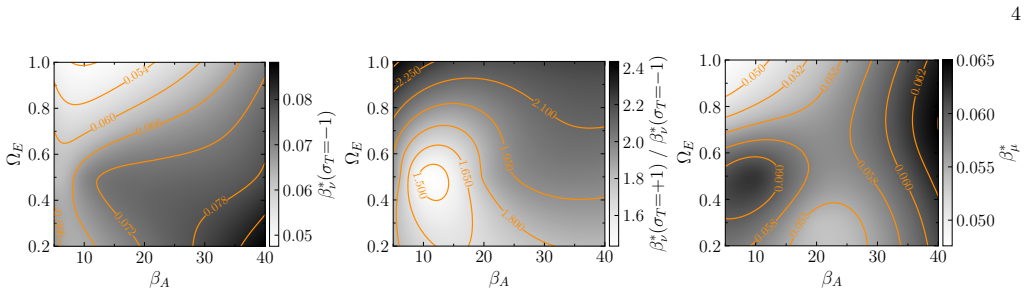

read the original abstract
The physical mechanism underlying the L--H transition in tokamaks has remained an open problem for over forty years. We present three-dimensional flux-driven two-fluid simulations in a diverted geometry that exhibit a confinement transition at lower power in the favourable toroidal-field configuration. The simulations show that electromagnetic drift-wave turbulence spontaneously generates a sheared $\bm{E}\times \bm{B}$ flow responsible for transport suppression. The toroidal-field-direction asymmetry arises from time-reversal symmetry breaking by finite collisionality, as demonstrated by a quasilinear calculation of the turbulent momentum flux. First-principles scaling laws are derived for the L--H power threshold in both density branches, the density minimum, and the minimum power, all matching or surpassing existing empirical scalings.
Editorial analysis
A structured set of objections, weighed in public.
Referee Report
Summary. The manuscript presents three-dimensional flux-driven two-fluid simulations in diverted tokamak geometry that exhibit the L-H confinement transition at lower input power in the favorable toroidal-field direction. Electromagnetic drift-wave turbulence is shown to spontaneously generate a sheared E×B flow that suppresses transport. A quasilinear calculation of the turbulent momentum flux is used to explain the toroidal-field asymmetry as arising from finite-collisionality breaking of time-reversal symmetry. First-principles scaling laws are derived for the L-H power threshold in both density branches, the density minimum, and the minimum power; these scalings are reported to match or surpass existing empirical scalings.
Significance. If the central claims hold, the work would constitute a notable advance by supplying a first-principles mechanism and predictive scalings for the long-standing L-H transition problem. The use of realistic diverted geometry and the extraction of scaling relations directly from the simulations (rather than post-hoc fitting) are strengths that could improve predictive modeling for tokamak operation.
major comments (2)
- [quasilinear momentum flux section] The quasilinear momentum flux calculation (used to explain the toroidal-field asymmetry) is presented as independent of the final scalings, yet no quantitative comparison is shown between the quasilinear momentum transport and the net momentum flux measured in the 3D nonlinear simulations near the transition threshold. Quasilinear closures commonly omit higher-order nonlinear advection and self-consistent profile evolution that can alter net momentum transport near marginality; without this benchmark the asymmetry explanation and the derived scalings rest on an unverified approximation.
- [simulation results and scaling derivation] The extraction of the two density branches, the density minimum, and the minimum power from the simulation data is not described with sufficient detail (including how thresholds are identified, error bars, and sensitivity to numerical resolution or domain size). This information is required to assess whether the first-principles scalings are robustly supported by the runs rather than being sensitive to post-processing choices.
minor comments (1)
- Notation for the electromagnetic drift-wave turbulence and the E×B flow shear should be defined consistently between the simulation diagnostics and the quasilinear expressions.
Simulated Author's Rebuttal
We thank the referee for the constructive comments, which help improve the clarity and robustness of the manuscript. We address each major comment below.
read point-by-point responses
-
Referee: [quasilinear momentum flux section] The quasilinear momentum flux calculation (used to explain the toroidal-field asymmetry) is presented as independent of the final scalings, yet no quantitative comparison is shown between the quasilinear momentum transport and the net momentum flux measured in the 3D nonlinear simulations near the transition threshold. Quasilinear closures commonly omit higher-order nonlinear advection and self-consistent profile evolution that can alter net momentum transport near marginality; without this benchmark the asymmetry explanation and the derived scalings rest on an unverified approximation.
Authors: We agree that a direct quantitative benchmark would strengthen the presentation of the asymmetry mechanism. In the revised manuscript we will add a comparison of the quasilinear momentum flux (including its toroidal-field dependence) against the net momentum transport extracted from the 3D nonlinear runs near the L-H threshold. This will show that the quasilinear closure captures the dominant collisionality-induced asymmetry. We note, however, that the first-principles scaling laws for power threshold, density minimum and minimum power are obtained directly from the nonlinear simulation data and do not depend on the quasilinear model; the latter is used only to interpret the origin of the observed asymmetry. revision: yes
-
Referee: [simulation results and scaling derivation] The extraction of the two density branches, the density minimum, and the minimum power from the simulation data is not described with sufficient detail (including how thresholds are identified, error bars, and sensitivity to numerical resolution or domain size). This information is required to assess whether the first-principles scalings are robustly supported by the runs rather than being sensitive to post-processing choices.
Authors: We accept that additional methodological detail is required. The revised manuscript will expand the relevant section to specify: (i) the precise criteria used to identify the L-H transition (transport suppression accompanied by strong E×B shear), (ii) how error bars on the extracted thresholds are obtained from multiple runs and statistical fluctuations, and (iii) the results of resolution and domain-size convergence tests confirming that the reported scalings for both density branches, the density minimum and the minimum power remain unchanged within the quoted uncertainties. revision: yes
Circularity Check
No circularity: scalings extracted from independent simulations and quasilinear analysis
full rationale
The derivation begins with 3D flux-driven two-fluid simulations in diverted geometry that spontaneously produce sheared E×B flow and a confinement transition. Scaling laws for power threshold (both density branches), density minimum, and minimum power are obtained directly from these simulation outcomes. The toroidal-field asymmetry is addressed via a separate quasilinear calculation of turbulent momentum flux that invokes finite-collisionality breaking of time-reversal symmetry. No equation or step equates the final scalings to fitted parameters, self-citations, or ansatzes by construction; the results remain independent of the empirical targets they are later compared against. The model assumptions (two-fluid, quasilinear closure) are stated explicitly and do not embed the target scalings.
Axiom & Free-Parameter Ledger
Reference graph
Works this paper leans on
-
[1]
Wagneret al., Phys
F. Wagneret al., Phys. Rev. Lett.49, 1408 (1982)
1982
-
[2]
Doyleet al., Nuclear Fusion47, S18 (2007)
E. Doyleet al., Nuclear Fusion47, S18 (2007)
2007
-
[3]
A. J. Creelyet al., Journal of Plasma Physics86, 6 865860502 (2020)
2020
-
[4]
O. P. Pogutseet al., inProceedings of the 24th European Conference on Controlled Fusion and Plasma Physics (Berchtesgaden, 1997) p. 1041
1997
-
[5]
B. N. Rogers, J. F. Drake, and A. Zeiler, Phys. Rev. Lett. 81, 4396 (1998)
1998
-
[6]
P. N. Guzdaret al., Phys. Rev. Lett.87, 015001 (2001)
2001
-
[7]
Kim and P
E. Kim and P. H. Diamond, Phys. Rev. Lett.90, 185006 (2003)
2003
-
[8]
Fundamenskiet al., Nucl
W. Fundamenskiet al., Nucl. Fusion52, 062003 (2012)
2012
-
[9]
Ryteret al., Nuclear Fusion54, 083003 (2014)
F. Ryteret al., Nuclear Fusion54, 083003 (2014)
2014
-
[10]
T. Eich, P. Manz, and the ASDEX Upgrade team, Nucl. Fusion61, 086017 (2021)
2021
-
[11]
S. J. Fieldinget al., Plasma Physics and Controlled Fu- sion38, 1091 (1996)
1996
-
[12]
Fusion29, 1959 (1989)
ASDEX Team, Nucl. Fusion29, 1959 (1989)
1959
-
[13]
Takizuka and ITPA H-mode Power Threshold Database Working Group, Plasma Phys
T. Takizuka and ITPA H-mode Power Threshold Database Working Group, Plasma Phys. Control. Fusion 46, A227 (2004)
2004
-
[14]
Y. R. Martin, T. Takizuka, and ITPA CDBM H-mode Threshold Database Working Group, J. Phys.: Conf. Ser. 123, 012033 (2008)
2008
-
[15]
C. S. Changet al., Phys. Rev. Lett.118, 175001 (2017)
2017
-
[16]
Giacomin and P
M. Giacomin and P. Ricci, Journal of Plasma Physics86, 905860502 (2020)
2020
-
[17]
Zholobenkoet al., Phys
W. Zholobenkoet al., Phys. Rev. Lett.136, 075101 (2026)
2026
-
[18]
Ricciet al., Plasma Phys
P. Ricciet al., Plasma Phys. Control. Fusion54, 124047 (2012)
2012
-
[19]
Giacominet al., J
M. Giacominet al., J. Comput. Phys.463, 111294 (2022)
2022
-
[20]
Duvalet al., Nuclear Fusion64, 112023 (2024)
B. Duvalet al., Nuclear Fusion64, 112023 (2024)
2024
-
[21]
B. N. Rogers and W. Dorland, Phys. Plasmas12, 062511 (2005)
2005
-
[22]
Mosettoet al., Phys
A. Mosettoet al., Phys. Plasmas19, 112103 (2012)
2012
-
[23]
B. J. Freiet al., Phys. Rev. Lett. (2025), submitted
2025
-
[24]
R. J. Groebner, K. H. Burrell, and R. P. Seraydarian, Phys. Rev. Lett.64, 3015 (1990)
1990
-
[25]
Cziegleret al., Phys
I. Cziegleret al., Phys. Rev. Lett.118, 105003 (2017)
2017
-
[26]
F. L. Waelbroeck and L. Chen, Phys. Fluids B3, 601 (1991)
1991
-
[27]
S. L. Newton, S. C. Cowley, and N. F. Loureiro, Plasma Phys. Control. Fusion52, 125001 (2010)
2010
-
[28]
P. N. Guzdaret al., Physics of Plasmas8, 3907 (2001)
2001
-
[29]
Ricci and B
P. Ricci and B. N. Rogers, Phys. Rev. Lett.104, 145001 (2010)
2010
-
[30]
Biglari, P
H. Biglari, P. H. Diamond, and P. W. Terry, Phys. Fluids B2, 1 (1990)
1990
-
[31]
Ricci and B
P. Ricci and B. N. Rogers, Phys. Plasmas16, 062303 (2009)
2009
-
[32]
Tecchiolliet al., Physics of Plasmas32, 102303 (2025)
Z. Tecchiolliet al., Physics of Plasmas32, 102303 (2025)
2025
-
[33]
P. C. Stangeby,The Plasma Boundary of Magnetic Fu- sion Devices, 1st ed. (CRC Press, 2000)
2000
-
[34]
Piraset al.(TCV Team), Phys
F. Piraset al.(TCV Team), Phys. Rev. Lett.105, 155003 (2010)
2010
-
[35]
Ryteret al., Nucl
F. Ryteret al., Nucl. Fusion53, 113003 (2013)
2013
-
[36]
Delabieet al., Nuclear Fusion66, 036016 (2026)
E. Delabieet al., Nuclear Fusion66, 036016 (2026)
2026
-
[37]
Birkenmeieret al., Nuclear Fusion66, 026024 (2026)
G. Birkenmeieret al., Nuclear Fusion66, 026024 (2026)
2026
-
[38]
C. F. Maggiet al., Nucl. Fusion54, 023007 (2014)
2014
-
[39]
Cavedonet al., Nuclear Fusion65, 106007 (2025)
M. Cavedonet al., Nuclear Fusion65, 106007 (2025)
2025
-
[40]
Loarteet al., Plasma Phys
A. Loarteet al., Plasma Phys. Control. Fusion67, 065023 (2025)
2025
-
[41]
Hugheset al., Nuclear Fusion65, 052001 (2025)
J. Hugheset al., Nuclear Fusion65, 052001 (2025)
2025
discussion (0)
Sign in with ORCID, Apple, or X to comment. Anyone can read and Pith papers without signing in.