Recognition: unknown
Class Angular Distortion Index for Dimensionality Reduction
Pith reviewed 2026-05-09 20:25 UTC · model grok-4.3
The pith
The Class Angular Distortion Index measures how faithfully dimensionality reduction projections preserve cluster organization by computing internal angles from point triples.
A machine-rendered reading of the paper's core claim, the machinery that carries it, and where it could break.
Core claim
The authors claim that the relative organization of clusters in a projection can be assessed by tracking how internal angles among point triples change from the original space. They formalize this idea as the Class Angular Distortion Index and show that it returns interpretable values on data sets where existing separability or shape-based metrics do not. The same angle foundation makes the index differentiable, allowing it to guide optimization of dimensionality reduction directly toward better cluster arrangements.
What carries the argument
The Class Angular Distortion Index (CADI), which quantifies distortion of internal angles formed by point triples to judge cluster arrangement faithfulness in a projection.
If this is right
- Projections can be optimized directly against CADI to reduce misleading cluster placements.
- The index supplies concrete, interpretable feedback on which inter-cluster angles are most distorted.
- Evaluation of existing methods such as t-SNE and UMAP becomes possible even when clusters are non-spherical or unevenly dense.
- A new dimensionality reduction algorithm that minimizes CADI is presented as a working example.
Where Pith is reading between the lines
- CADI could be added to routine DR evaluation toolkits alongside neighborhood-preservation scores.
- Its differentiability opens the possibility of hybrid objectives that balance local structure with global cluster geometry.
- Different strategies for choosing which point triples to measure may affect sensitivity to particular types of distortion.
Load-bearing premise
Angles computed from point triples in the projected space reliably reflect the true relative organization of clusters in the original data.
What would settle it
A controlled synthetic data set whose ground-truth clusters are rotated or reordered in the projection; CADI should report high distortion while visual inspection or label comparison confirms the change.
Figures





read the original abstract
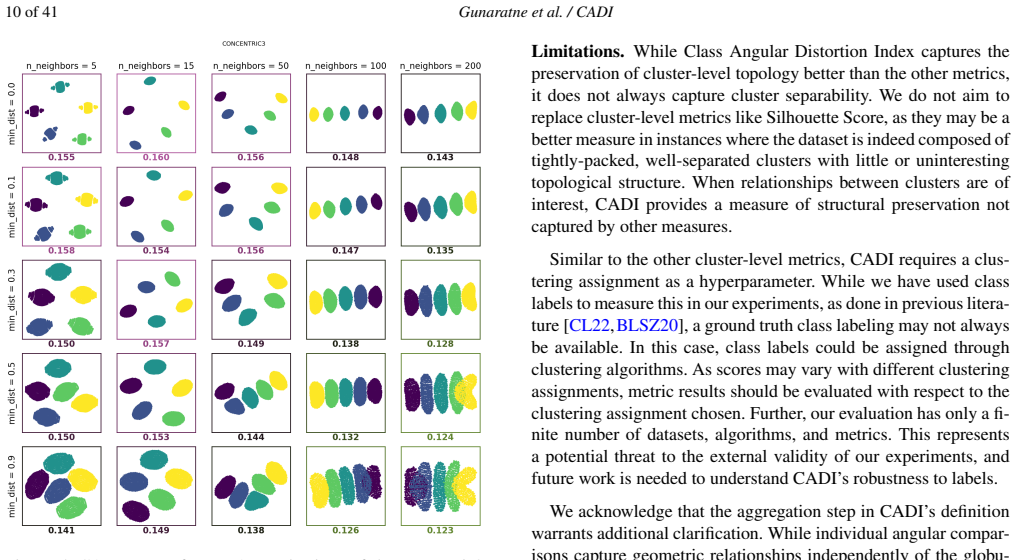
Dimensionality reduction (DR) techniques are often characterized by whether they preserve global, high-level structures in the data or local, neighborhood structures. This distinction matters in visualization: global methods can obscure clusters while local methods can over-emphasize them. Yet, even when clusters appear distinct, their relative arrangement in the projection may be arbitrary or misleading, a common issue in techniques such as t-SNE and UMAP. Existing cluster quality metrics either only measure cluster separability or assume spherical, globular clusters in the original space. We introduce the Class Angular Distortion Index (CADI), a metric that uses internal angles among point triples to determine the faithfulness of cluster organization in a projection. We show cases on both real and synthetic data where existing cluster metrics fail, but CADI provides an interpretable result. Since it relies on computing angles, CADI is also differentiable, enabling optimization. We demonstrate this with a CADI-based DR technique.
Editorial analysis
A structured set of objections, weighed in public.
Referee Report
Summary. The manuscript introduces the Class Angular Distortion Index (CADI), a metric that computes internal angles among point triples in a low-dimensional projection to assess the faithfulness of cluster organization. The authors claim CADI succeeds on real and synthetic data where existing cluster metrics fail (due to assumptions of spherical clusters or focus only on separability), requires no assumptions on cluster shape, density, or triple selection, is differentiable (enabling optimization), and is demonstrated via a CADI-optimized DR technique.
Significance. If the central claims hold, CADI would provide a useful, interpretable addition to DR evaluation tools by addressing limitations of metrics like silhouette score or Davies-Bouldin index for non-globular clusters. The differentiability property is a concrete strength that could support new optimization-based DR methods, and the empirical cases where standard metrics fail illustrate potential practical value.
major comments (2)
- [Abstract and §3] Abstract and §3 (definition of CADI): the claim that CADI 'works without needing assumptions about cluster shape, density, or the specific choice of point triples' is load-bearing but unsupported. The metric is defined from angles on point triples, yet no explicit, parameter-free rule for selecting or averaging over the triple set is given; random, nearest-neighbor, or density-biased sampling would systematically affect results for elongated, non-convex, or varying-density clusters—the exact regimes highlighted as failures of prior metrics.
- [§4] §4 (differentiability and optimization): the assertion that CADI is differentiable and enables a new DR technique is central to the contribution, but no explicit derivative, gradient expression, or verification that the angle-based formulation remains well-defined under projection is supplied, leaving the optimization demonstration unverifiable.
minor comments (2)
- [§3] Notation for the angle computation and the final CADI formula is introduced without a clear preliminary definition or diagram, making the geometric construction harder to follow on first reading.
- [Abstract] The abstract states the metric 'exists and is differentiable' but supplies no equations; moving a concise definition or key formula to the abstract would improve accessibility.
Simulated Author's Rebuttal
We thank the referee for the constructive and detailed review. The two major comments identify areas where the manuscript would benefit from greater explicitness. We address each point below and will revise the manuscript to incorporate the requested clarifications and mathematical details.
read point-by-point responses
-
Referee: [Abstract and §3] Abstract and §3 (definition of CADI): the claim that CADI 'works without needing assumptions about cluster shape, density, or the specific choice of point triples' is load-bearing but unsupported. The metric is defined from angles on point triples, yet no explicit, parameter-free rule for selecting or averaging over the triple set is given; random, nearest-neighbor, or density-biased sampling would systematically affect results for elongated, non-convex, or varying-density clusters—the exact regimes highlighted as failures of prior metrics.
Authors: We agree that the current text does not supply an explicit rule for triple selection and averaging. We will revise the abstract and §3 to state that CADI is defined by averaging the absolute difference between the original-space and projection-space angles over all possible triples of points that belong to the same class. This choice is parameter-free and does not rely on cluster shape, density, or any sampling heuristic. We will also add a short robustness subsection demonstrating that the resulting index remains stable under moderate subsampling for the non-globular and varying-density cases already shown in the experiments. revision: yes
-
Referee: [§4] §4 (differentiability and optimization): the assertion that CADI is differentiable and enables a new DR technique is central to the contribution, but no explicit derivative, gradient expression, or verification that the angle-based formulation remains well-defined under projection is supplied, leaving the optimization demonstration unverifiable.
Authors: We acknowledge that §4 currently asserts differentiability without supplying the gradient. In the revision we will insert the explicit gradient of CADI with respect to the low-dimensional coordinates, obtained by differentiating the arccos expression for each triple angle via the chain rule on vector dot products and norms. We will also note the measure-zero set of configurations where points are collinear (where the derivative is undefined) and describe how the optimization procedure handles these cases. A brief verification that the gradient is well-defined for generic projections will be included. revision: yes
Circularity Check
CADI is introduced as a direct geometric definition with no reduction to fitted inputs or self-citations.
full rationale
The paper defines the Class Angular Distortion Index explicitly from internal angles computed on point triples in the projection. This is a first-principles construction using standard Euclidean geometry rather than any fitted parameter, renamed empirical pattern, or load-bearing self-citation. No equations or claims in the abstract reduce the metric to its own inputs by construction; the differentiability claim follows immediately from the angle formula. The paper contrasts CADI with existing metrics on real and synthetic data without invoking prior author work as a uniqueness theorem or ansatz. The derivation chain is therefore self-contained as a new index definition.
Axiom & Free-Parameter Ledger
axioms (1)
- domain assumption Euclidean angles computed from point coordinates capture the intended notion of cluster angular organization.
invented entities (1)
-
Class Angular Distortion Index (CADI)
no independent evidence
Reference graph
Works this paper leans on
-
[1]
Alpaydin E., Alimoglu F. : Pen-Based Recognition of Handwritten Digits . UCI Machine Learning Repository, 1996. https://doi.org/10.24432/C5MG6K doi:10.24432/C5MG6K
-
[2]
Borg I., Groenen P. J. : Modern multidimensional scaling: Theory and applications. Springer, 2005. https://doi.org/10.1007/0-387-28981-X doi:10.1007/0-387-28981-X
-
[3]
Bae J., Jeon H., Seo J. : Metric design != metric behavior: Improving metric selection for the unbiased evaluation of dimensionality reduction. In 2025 IEEE Visualization and Visual Analytics (VIS) (2025), IEEE, pp. 46--50. https://doi.org/10.1109/VIS60296.2025.00014 doi:10.1109/VIS60296.2025.00014
-
[4]
: Robust dimensionality reduction for data visualization with deep neural networks
Becker M., Lippel J., Stuhlsatz A., Zielke T. : Robust dimensionality reduction for data visualization with deep neural networks. Graphical Models 108 (2020), 101060. https://doi.org/https://doi.org/10.1016/j.gmod.2020.101060 doi:https://doi.org/10.1016/j.gmod.2020.101060
-
[5]
Belkin M., Niyogi P. : Laplacian eigenmaps for dimensionality reduction and data representation. Neural computation 15, 6 (2003), 1373--1396. https://doi.org/10.1162/089976603321780317 doi:10.1162/089976603321780317
-
[6]
: Dimensionality reduction for data visualization and exploratory analysis of ceramic assemblages
Cardarelli L., Lapadula A. : Dimensionality reduction for data visualization and exploratory analysis of ceramic assemblages. Archeologia e Calcolatori 33 (2022), 33--52. Licensed under CC BY-NC-ND 4.0. https://doi.org/10.19282/ac.33.2.2022.03 doi:10.19282/ac.33.2.2022.03
-
[7]
IEEE Transactions on Pattern Analysis and Machine Intelligence PAMI-1(2), 224-227 (1979)
Davies D. L., Bouldin D. W. : A cluster separation measure. IEEE Transactions on Pattern Analysis and Machine Intelligence PAMI-1, 2 (1979), 224--227. https://doi.org/10.1109/TPAMI.1979.4766909 doi:10.1109/TPAMI.1979.4766909
-
[8]
: Comparing community structure identification
Danon L., D \'i az- G uilera A., Duch J., Arenas A. : Comparing community structure identification. Journal of Statistical Mechanics: Theory and Experiment, 9 (Sept. 2005), 219--228. https://doi.org/10.1088/1742-5468/2005/09/P09008 doi:10.1088/1742-5468/2005/09/P09008
-
[9]
: Towards scaling-invariant projections for data visualization
Dierkes J., Stelter D., R \"o ssl C., Theisel H. : Towards scaling-invariant projections for data visualization. In Computer Graphics Forum (2025), Wiley Online Library, p. e70063. https://doi.org/10.1111/CGF.70063 doi:10.1111/CGF.70063
-
[10]
Espadoto M., Martins R. M., Kerren A., Hirata N. S., Telea A. C. : Toward a quantitative survey of dimension reduction techniques. IEEE Transactions on Visualization and Computer Graphics 27, 3 (2019), 2153--2173. https://doi.org/10.1109/TVCG.2019.2944182 doi:10.1109/TVCG.2019.2944182
-
[11]
Feltes B., Chandelier E. B., Grisci B. I., Dorn M. : Cumida: An extensively curated microarray database for benchmarking and testing of machine learning approaches in cancer research. Journal of Computational Biology 26, 4 (2019), 376--386. https://doi.org/10.1089/cmb.2018.0238 doi:10.1089/cmb.2018.0238
-
[12]
: Sailing in high-dimensional spaces: Low-dimensional embeddings through angle preservation, 2024
Fischer J., Ma R. : Sailing in high-dimensional spaces: Low-dimensional embeddings through angle preservation, 2024. URL: https://arxiv.org/abs/2406.09876, http://arxiv.org/abs/2406.09876 arXiv:2406.09876
-
[13]
Journal of Classification2(1), 193–218 (1985) https://doi.org/10.1007/BF01908075
Hubert L. J., Arabie P. : Comparing partitions. Journal of Classification 2 (1985), 193--218. https://doi.org/10.1007/BF01908075 doi:10.1007/BF01908075
-
[14]
Halkidi M., Batistakis Y., Vazirgiannis M. : On clustering validation techniques. Journal of Intelligent Information Systems 17 (2001), 107--145. https://doi.org/10.1023/A:1012801612483 doi:10.1023/A:1012801612483
-
[15]
Horst A. M., Hill A. P., Gorman K. B. : palmerpenguins: P almer Archipelago ( A ntarctica) penguin data , 2020. R package version 0.1.0. https://doi.org/10.5281/zenodo.3960218 doi:10.5281/zenodo.3960218
-
[16]
I., Huroyan V., Kobourov S., Navarrete R
Hossain M. I., Huroyan V., Kobourov S., Navarrete R. : Multi-perspective, simultaneous embedding. IEEE Transactions on Visualization and Computer Graphics 27, 2 (2020), 1569--1579
2020
-
[17]
: pbmc3k: Raw and Processed Matrices of the PBMC 3k Dataset, 2024
Hoffman P. : pbmc3k: Raw and Processed Matrices of the PBMC 3k Dataset, 2024. R package version 0.1.0. URL: https://github.com/mojaveazure/pbmc3k
2024
-
[18]
Jeon H., Cho A., Jang J., Lee S., Hyun J., Ko H.-K., Jo J., Seo J. : ZADU : A python library for evaluating the reliability of dimensionality reduction embeddings. In 2023 IEEE Visualization and Visual Analytics (VIS) (2023), pp. 196--200. https://doi.org/10.1109/VIS54172.2023.00048 doi:10.1109/VIS54172.2023.00048
-
[19]
Jeon H., Kuo Y.-H., Aupetit M., Ma K.-L., Seo J. : Classes are not clusters: Improving label-based evaluation of dimensionality reduction. IEEE Transactions on Visualization and Computer Graphics 30, 1 (2023), 781--791. https://doi.org/10.1109/TVCG.2023.3327187 doi:10.1109/TVCG.2023.3327187
-
[20]
Jeon H., Ko H.-K., Jo J., Kim Y., Seo J. : Measuring and explaining the inter-cluster reliability of multidimensional projections. IEEE Transactions on Visualization and Computer Graphics 28, 1 (2021), 551--561. https://doi.org/10.1109/TVCG.2021.3114833 doi:10.1109/TVCG.2021.3114833
-
[21]
Jeon H., Ko K., Lee S., Hyun J., Yang T., Go G., Jo J., Seo J. : UMATO : Bridging local and global structures for reliable visual analytics with dimensionality reduction. IEEE Transactions on Visualization and Computer Graphics 31, 12 (2025), 10503--10520. https://doi.org/10.1109/TVCG.2025.3602735 doi:10.1109/TVCG.2025.3602735
-
[22]
Proceedings of the 2025 CHI Conference on Human Factors in Computing Systems , articleno =
Jeon H., Lee H., Kuo Y.-H., Yang T., Archambault D., Ko S., Fujiwara T., Ma K.-L., Seo J. : Unveiling high-dimensional backstage: A survey for reliable visual analytics with dimensionality reduction. In Proceedings of the 2025 CHI Conference on Human Factors in Computing Systems (2025), pp. 1--24. https://doi.org/10.1145/3706598.3713551 doi:10.1145/370659...
-
[23]
Jeon H., Park J., Lee S., Kim D. H., Shin S., Seo J. : Dataset-Adaptive Dimensionality Reduction . IEEE Transactions on Visualization & Computer Graphics, 01 (Nov. 5555), 1--11. https://doi.org/10.1109/TVCG.2025.3634784 doi:10.1109/TVCG.2025.3634784
-
[24]
: Stop misusing t- SNE and UMAP for visual analytics
Jeon H., Park J., Shin S., Seo J. : Stop misusing t- SNE and UMAP for visual analytics. arXiv preprint arXiv:2506.08725 (2025)
-
[25]
Adam: A Method for Stochastic Optimization
Kingma D. P., Ba J. : Adam: A method for stochastic optimization. In 3rd International Conference on Learning Representations, ICLR 2015, San Diego, CA, USA, May 7-9, 2015, Conference Track Proceedings (2015), Bengio Y., LeCun Y., (Eds.). URL: http://arxiv.org/abs/1412.6980
work page internal anchor Pith review Pith/arXiv arXiv 2015
-
[26]
Kaski S., Nikkil \"a J., Oja M., Venna J., T \"o r \"o nen P., Castr \'e n E. : Trustworthiness and metrics in visualizing similarity of gene expression. BMC Bioinformatics 4, 1 (2003), 48. https://doi.org/10.1186/1471-2105-4-48 doi:10.1186/1471-2105-4-48
-
[27]
: Sentiment Labelled Sentences
Kotzias D. : Sentiment Labelled Sentences . UCI Machine Learning Repository, 2015. https://doi.org/10.24432/C57604 doi:10.24432/C57604
-
[28]
: Benchmarking of dimensionality reduction methods to capture drug response in transcriptome data
Kwon Y., Park S., Park S., Lee H. : Benchmarking of dimensionality reduction methods to capture drug response in transcriptome data. Scientific Reports 15 (2025), 32173. https://doi.org/10.1038/s41598-025-12021-7 doi:10.1038/s41598-025-12021-7
-
[29]
Lecun Y., Bottou L., Bengio Y., Haffner P. : Gradient-based learning applied to document recognition. Proceedings of the IEEE 86, 11 (1998), 2278--2324. https://doi.org/10.1109/5.726791 doi:10.1109/5.726791
-
[30]
: Learning question classifiers
Li X., Roth D. : Learning question classifiers. In 19th International Conference on Computational Linguistics, COLING 2002, Howard International House and Academia Sinica, Taipei, Taiwan, August 24 - September 1, 2002 (2002). URL: https://aclanthology.org/C02-1150/
2002
-
[31]
: State of the art of graph visualization in non-euclidean spaces
Miller J., Bhatia D., Kobourov S. : State of the art of graph visualization in non-euclidean spaces. In Computer Graphics Forum (2024), vol. 43, Wiley Online Library, p. e15113
2024
-
[32]
Machado A., Behrisch M., Telea A. : Necessary but not sufficient: Limitations of projection quality metrics. In Computer Graphics Forum (2025), Wiley Online Library, p. e70101. https://doi.org/10.1111/CGF.70101 doi:10.1111/CGF.70101
-
[33]
L., Daly R
Maas A. L., Daly R. E., Pham P. T., Huang D., Ng A. Y., Potts C. : Learning word vectors for sentiment analysis. In Proceedings of the 49th Annual Meeting of the Association for Computational Linguistics: Human Language Technologies (Portland, Oregon, USA, June 2011), Association for Computational Linguistics, pp. 142--150. URL: http://www.aclweb.org/anth...
2011
-
[34]
: Balancing between the local and global structures ( LGS ) in graph embedding
Miller J., Huroyan V., Kobourov S. : Balancing between the local and global structures ( LGS ) in graph embedding. In Graph Drawing and Network Visualization (2023), Springer-Verlag, p. 263–279. https://doi.org/10.1007/978-3-031-49272-3_18 doi:10.1007/978-3-031-49272-3_18
-
[35]
UMAP: Uniform Manifold Approximation and Projection for Dimension Reduction
McInnes L., Healy J., Melville J. : UMAP : Uniform manifold approximation and projection for dimension reduction. In arXiv preprint arXiv:1802.03426 (2018)
work page internal anchor Pith review arXiv 2018
-
[36]
Motta R., Minghim R., de Andrade Lopes A., Oliveira M. C. F. : Graph-based measures to assist user assessment of multidimensional projections. Neurocomputing 150 (2015), 583--598
2015
-
[37]
Nonato L. G., Aupetit M. : Multidimensional projection for visual analytics: Linking techniques with distortions, tasks, and layout enrichment. IEEE Transactions on Visualization and Computer Graphics 25, 8 (2018), 2650--2673. https://doi.org/10.1109/TVCG.2018.2846735 doi:10.1109/TVCG.2018.2846735
-
[38]
A., Nayar S
Nene S. A., Nayar S. K., Murase H. : Columbia Object Image Library (COIL-100). Tech. Rep. CUCS-006-96, Department of Computer Science, Columbia University, February 1996
1996
-
[39]
A., Nayar S
Nene S. A., Nayar S. K., Murase H. : Columbia Object Image Library (COIL-20). Tech. Rep. CUCS-005-96, Department of Computer Science, Columbia University, February 1996
1996
-
[40]
Paulovich F. V., Arleo A., van den Elzen S. : When dimensionality reduction meets graph (drawing) theory: Introducing a common framework, challenges and opportunities. In Computer Graphics Forum (2025), Wiley Online Library, p. e70105. https://doi.org/10.1111/CGF.70105 doi:10.1111/CGF.70105
-
[41]
: Principal components analysis
Pearson K. : Principal components analysis. The London, Edinburgh, and Dublin Philosophical Magazine and Journal of Science 6, 2 (1901), 559
1901
-
[42]
Rousseeuw P. J. : Silhouettes: A graphical aid to the interpretation and validation of cluster analysis. Journal of Computational and Applied Mathematics 20 (1987), 53--65. https://doi.org/https://doi.org/10.1016/0377-0427(87)90125-7 doi:https://doi.org/10.1016/0377-0427(87)90125-7
-
[43]
: How scale breaks `` Normalized Stress '' and KL divergence: Rethinking quality metrics
Smelser K., Gunaratne K., Miller J., Kobourov S. : How scale breaks `` Normalized Stress '' and KL divergence: Rethinking quality metrics. IEEE Transactions on Visualization and Computer Graphics (2026), 1--14. https://doi.org/10.1109/TVCG.2026.3657654 doi:10.1109/TVCG.2026.3657654
-
[44]
: Parameterisation of a stochastic model for human face identification
Samaria F., Harter A. : Parameterisation of a stochastic model for human face identification. In Proceedings of 1994 IEEE Workshop on Applications of Computer Vision (1994), pp. 138--142. https://doi.org/10.1109/ACV.1994.341300 doi:10.1109/ACV.1994.341300
-
[45]
Shepard R. N. : The analysis of proximities: Multidimensional scaling with an unknown distance function. i. Psychometrika 27, 2 (1962), 125–140. https://doi.org/10.1007/BF02289630 doi:10.1007/BF02289630
-
[46]
CARER : Contextualized Affect Representations for Emotion Recognition
Saravia E., Liu H.-C. T., Huang Y.-H., Wu J., Chen Y.-S. : CARER : Contextualized affect representations for emotion recognition. In Proceedings of the 2018 Conference on Empirical Methods in Natural Language Processing (Brussels, Belgium, Oct.-Nov. 2018), Association for Computational Linguistics, pp. 3687--3697. https://doi.org/10.18653/v1/D18-1404 doi:...
-
[47]
Sainburg T., McInnes L., Gentner T. Q. : Parametric UMAP embeddings for representation and semisupervised learning. Neural Computation 33, 11 (10 2021), 2881--2907. http://arxiv.org/abs/https://direct.mit.edu/neco/article-pdf/33/11/2881/1966656/neco_a_01434.pdf arXiv:https://direct.mit.edu/neco/article-pdf/33/11/2881/1966656/neco_a_01434.pdf , https://doi...
-
[48]
Computer Graphics Forum29(2), 419–428 (2010) https://doi.org/10.1111/j.1467-8659.2009.01611.x
Sips M., Neubert B., Lewis J., Hanrahan P. : Selecting good views of high-dimensional data using class consistency. Computer Graphics Forum (2009). https://doi.org/10.1111/j.1467-8659.2009.01467.x doi:10.1111/j.1467-8659.2009.01467.x
-
[49]
Sun S., Zhu J., Ma Y., Zhou X. : Accuracy, robustness and scalability of dimensionality reduction methods for single-cell rna-seq analysis. Genome Biology 20 (12 2019). https://doi.org/10.1186/s13059-019-1898-6 doi:10.1186/s13059-019-1898-6
-
[50]
: Learning a parametric embedding by preserving local structure
van der Maaten L. : Learning a parametric embedding by preserving local structure. In Proceedings of the Twelfth International Conference on Artificial Intelligence and Statistics (Hilton Clearwater Beach Resort, Clearwater Beach, Florida USA, 16--18 Apr 2009), van Dyk D., Welling M., (Eds.), vol. 5 of Proceedings of Machine Learning Research, PMLR, pp. 3...
2009
-
[51]
: Visualizing data using t- SNE
van der Maaten L., Hinton G. : Visualizing data using t- SNE . In Journal of Machine Learning Research (2008)
2008
-
[52]
: Information retrieval perspective to nonlinear dimensionality reduction for data visualization
Venna J., Peltonen J., Nybo K., Aidos H., Kaski S. : Information retrieval perspective to nonlinear dimensionality reduction for data visualization. Journal of Machine Learning Research 11 (Mar. 2010), 451–490
2010
-
[53]
: Understanding how dimension reduction tools work: an empirical approach to deciphering t- SNE , UMAP , tri M ap, and PaCMAP for data visualization
Wang Y., Huang H., Rudin C., Shaposhnik Y. : Understanding how dimension reduction tools work: an empirical approach to deciphering t- SNE , UMAP , tri M ap, and PaCMAP for data visualization. JMLR 22, 1 (Jan. 2021). URL: http://jmlr.org/papers/v22/20-1061.html
2021
-
[54]
: How to use t- SNE effectively
Wattenberg M., Vi \'e gas F., Johnson I. : How to use t- SNE effectively. Distill 1, 10 (2016), e2
2016
-
[55]
: Deep metric learning with angular loss
Wang J., Zhou F., Wen S., Liu X., Lin Y. : Deep metric learning with angular loss. In Proceedings of the IEEE Conference on Computer Vision and Pattern Recognition (2017)
2017
-
[56]
Fashion-MNIST: a Novel Image Dataset for Benchmarking Machine Learning Algorithms
Xiao H., Rasul K., Vollgraf R. : Fashion- MNIST : a novel image dataset for benchmarking machine learning algorithms, 2017. URL: https://arxiv.org/abs/1708.07747, http://arxiv.org/abs/1708.07747 arXiv:1708.07747
work page internal anchor Pith review arXiv 2017
-
[57]
Yang Y., Sun H., Zhang Y., Zhang T., Gong J., Wei Y., Duan Y.-G., Shu M., Yang Y., Wu D., Yu D. : Dimensionality reduction by UMAP reinforces sample heterogeneity analysis in bulk transcriptomic data. Cell Reports 36, 4 (2021), 109442. https://doi.org/https://doi.org/10.1016/j.celrep.2021.109442 doi:https://doi.org/10.1016/j.celrep.2021.109442
-
[58]
: Silhouette-based evaluation of PCA , Isomap , and t- SNE on linear and nonlinear data structures
Zahed M., Skafyan M. : Silhouette-based evaluation of PCA , Isomap , and t- SNE on linear and nonlinear data structures. Stats 8, 4 (2025). https://doi.org/10.3390/stats8040105 doi:10.3390/stats8040105
discussion (0)
Sign in with ORCID, Apple, or X to comment. Anyone can read and Pith papers without signing in.