Recognition: unknown
Entropy transport through a superfluid quantum point contact: A Keldysh field-theory approach
Pith reviewed 2026-05-09 14:34 UTC · model grok-4.3
The pith
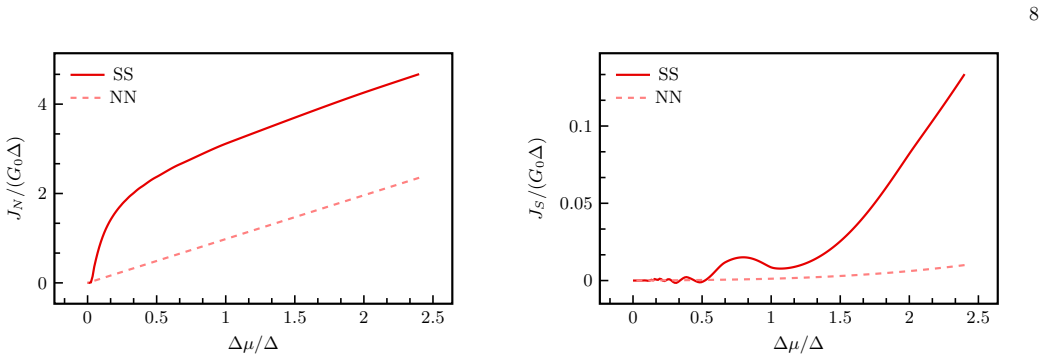
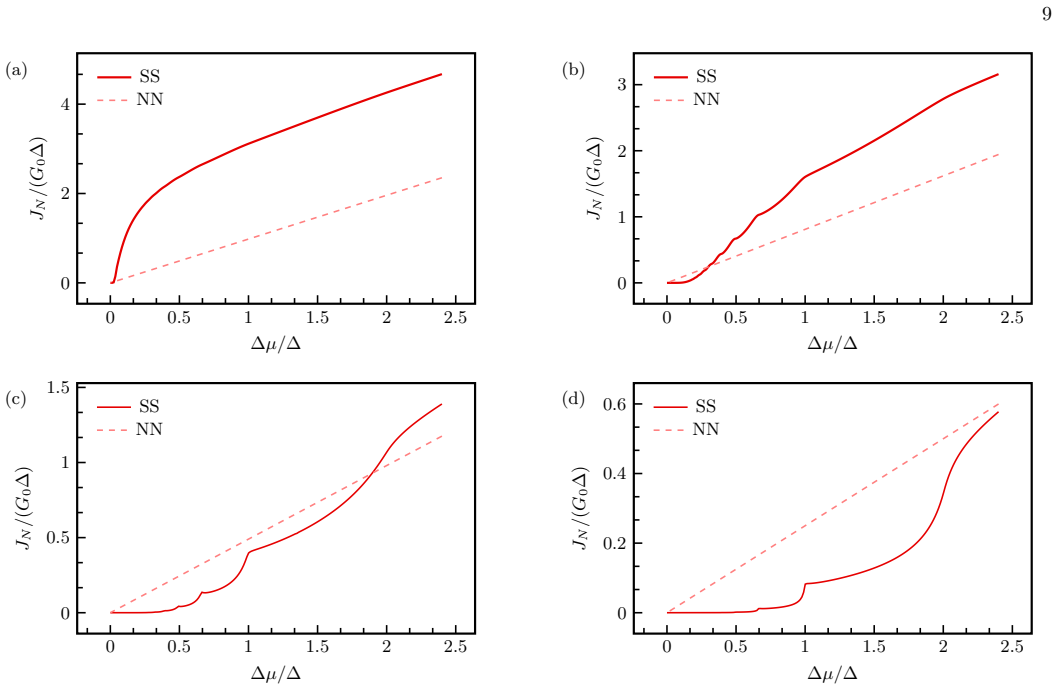
Entropy current through a superfluid quantum point contact oscillates at low voltage in the ballistic limit.
A machine-rendered reading of the paper's core claim, the machinery that carries it, and where it could break.
Core claim
In the ballistic junction limit the entropy current exhibits an oscillatory voltage dependence at low bias, while the particle current retains its known step-like features characteristic of superfluid transport.
What carries the argument
Keldysh contour integration of the tunneling Hamiltonian between two BCS mean-field leads, yielding steady-state expectation values of both particle-number and entropy operators.
Load-bearing premise
The reservoirs are accurately modeled by a simple BCS mean-field theory that remains valid out of equilibrium.
What would settle it
An experiment that measures the entropy current in a ballistic superfluid quantum point contact at low voltage and finds no oscillations would contradict the central prediction.
Figures





read the original abstract
We study the matter and entropy transport between two ultra-cold neutral Fermi-gas reservoirs linked by a quantum point contact under a chemical-potential gradient. We describe the two leads with a BCS mean-field model and derive the current-bias characteristics for both particle and entropy transport. We compute the out of equilibrium steady-state currents by using the Keldysh formalism. In accordance with previous works in the literature, we confirm the well-known behavior for the particle current and extend the computation to the entropy current in the BCS regime. The entropy current shows an oscillatory behavior at low voltage in the ballistic junction limit. We analyze the results for a wide range of values of the junction's transparency. We also compare our findings with experimental results in cold atomic gases in the unitary regime.
Editorial analysis
A structured set of objections, weighed in public.
Referee Report
Summary. The manuscript develops a Keldysh contour calculation of steady-state particle and entropy currents through a quantum point contact linking two BCS mean-field superfluid Fermi-gas reservoirs driven by a chemical-potential bias. It recovers the known particle-current characteristics and reports an additional oscillatory entropy current at low bias in the ballistic limit, examines the dependence on junction transparency, and compares the results to cold-atom experiments performed in the unitary regime.
Significance. If the oscillatory entropy current survives beyond the mean-field approximation, the work supplies a controlled Keldysh framework for entropy transport in out-of-equilibrium superfluid junctions. The explicit confirmation of established particle-current results and the parameter-free character of the derivation within the BCS model are positive features that strengthen the technical contribution.
major comments (1)
- [Abstract] Abstract: the headline claim of oscillatory entropy current at low voltage in the ballistic limit is obtained from the same BCS mean-field Green's functions used for the particle current. The manuscript then compares these oscillations directly to unitary-regime cold-atom experiments. Because BCS mean-field is controlled only in the weak-coupling limit while unitary gases are dominated by pairing fluctuations that modify the low-energy density of states and Andreev processes, the oscillations may be an artifact of the approximation. A concrete test (e.g., comparison with a fluctuation-corrected self-energy or a non-mean-field method) is required to establish whether the low-bias feature is robust.
Simulated Author's Rebuttal
We thank the referee for the careful reading of our manuscript and the constructive comment on the scope of the BCS mean-field approximation. We address the concern in detail below and outline the revisions we will make.
read point-by-point responses
-
Referee: [Abstract] Abstract: the headline claim of oscillatory entropy current at low voltage in the ballistic limit is obtained from the same BCS mean-field Green's functions used for the particle current. The manuscript then compares these oscillations directly to unitary-regime cold-atom experiments. Because BCS mean-field is controlled only in the weak-coupling limit while unitary gases are dominated by pairing fluctuations that modify the low-energy density of states and Andreev processes, the oscillations may be an artifact of the approximation. A concrete test (e.g., comparison with a fluctuation-corrected self-energy or a non-mean-field method) is required to establish whether the low-bias feature is robust.
Authors: We agree that the BCS mean-field description is controlled only in the weak-coupling limit, while the cited cold-atom experiments operate in the unitary regime where pairing fluctuations are important and can alter the low-energy density of states and Andreev processes. Our calculation employs the same mean-field Green's functions for both the particle and entropy currents, thereby recovering the established particle-current characteristics reported in the literature. The low-bias oscillatory entropy current is a direct consequence of the Keldysh contour evaluation within this controlled approximation. We will revise the abstract and add a dedicated paragraph in the discussion section to state explicitly that the oscillatory feature is a prediction of the BCS mean-field theory and that the comparison with unitary-regime data is intended to be qualitative. We note that a concrete test against a fluctuation-corrected self-energy or a non-mean-field method lies outside the present scope. revision: partial
- A concrete test with a fluctuation-corrected self-energy or a non-mean-field method cannot be provided within the current manuscript, as it would require an entirely different theoretical framework.
Circularity Check
Keldysh-BCS derivation of entropy current is self-contained with no circular reductions
full rationale
The paper applies the standard Keldysh formalism to BCS mean-field Green's functions for the leads to compute both particle and entropy currents under a chemical potential bias. The low-voltage oscillatory entropy current in the ballistic limit emerges directly from the contour-ordered integrals over the non-equilibrium distribution functions and the junction transparency parameter; it is not obtained by fitting or redefining any input quantity. Confirmation of the particle current against prior literature is used only for validation and does not carry the entropy result. No self-definitional loops, fitted-input predictions, or load-bearing self-citations appear in the derivation chain. The calculation remains independent of the unitary-regime experiments mentioned for comparison.
Axiom & Free-Parameter Ledger
axioms (2)
- domain assumption BCS mean-field model for the leads
- domain assumption Keldysh formalism computes out-of-equilibrium steady-state currents
Reference graph
Works this paper leans on
-
[1]
Metal For metallic leads, the components of the Green func- tion in momentum and frequency space are [22], GR(ω,k) = lim η→0 1 ω−(ϵ k −µ) +iη , GA(ω,k) = lim η→0 1 ω−(ϵ k −µ)−iη , GK(ω,k) = tanh ω 2T (−2πi)δ((ϵ k −µ)−ω). (18) whereηis a positive infinitesimal introduced to regu- larize the expression and physically representing an in- elastic scattering r...
-
[2]
kmaxp −EF −µ−f(ω) # + p −EF −µ+f(ω) arctan
Superconductor In the superconducting case, the Green function ac- quires a non-trivial matrix structure. Besides the usual normal components associated with spin-up and spin- down sectors, the Nambu spinor formalism introduces the anomalous off-diagonal terms, which capture the spin- pair correlations characteristic of the BCS state, GR/A(ω,k) = 1 (ω±iη)...
-
[3]
Valtolina, A
G. Valtolina, A. Burchianti, A. Amico, E. Neri, K. Xhani, J. A. Seman, A. Trombettoni, A. Smerzi, M. Zaccanti, M. Inguscio, and G. Roati, Science350, 1505–1508 (2015)
2015
-
[4]
Krinner, D
S. Krinner, D. Stadler, D. Husmann, J.-P. Brantut, and T. Esslinger, Nature517, 64–67 (2014)
2014
-
[5]
A. F. Morpurgo, T. M. Klapwijk, and B. J. van Wees, Applied Physics Letters72, 966 (1998)
1998
-
[6]
Del Pace, W
G. Del Pace, W. J. Kwon, M. Zaccanti, G. Roati, and F. Scazza, Phys. Rev. Lett.126, 055301 (2021)
2021
-
[7]
Husmann, S
D. Husmann, S. Uchino, S. Krinner, M. Lebrat, T. Gi- amarchi, T. Esslinger, and J.-P. Brantut, Science (New York, N.Y.)350, 1498—1501 (2015)
2015
-
[8]
Krinner, M
S. Krinner, M. Lebrat, D. Husmann, C. Grenier, J.-P. Brantut, and T. Esslinger, Proceedings of the National Academy of Sciences113, 8144 (2016)
2016
-
[9]
Brantut, C
J.-P. Brantut, C. Grenier, J. Meineke, D. Stadler, S. Krinner, C. Kollath, T. Esslinger, and A. Georges, Science342, 713–715 (2013)
2013
-
[10]
Fabritius, J
P. Fabritius, J. Mohan, M. Talebi, S. Wili, W. Zw- erger, M.-Z. Huang, and T. Esslinger, Nature Physics 20, 1091–1096 (2024)
2024
-
[11]
Husmann, S
D. Husmann, S. Uchino, S. Krinner, M. Lebrat, T. Gi- amarchi, T. Esslinger, and J.-P. Brantut, Science350, 1498–1501 (2015)
2015
-
[12]
L. Corman, P. Fabritius, S. H¨ ausler, J. Mohan, L. H. Dogra, D. Husmann, M. Lebrat, and T. Esslinger, Phy. Rev. A100, 10.1103/PhysRevA.100.053605 (2019)
- [13]
-
[14]
J. C. Cuevas, A. Mart´ ın-Rodero, and A. L. Yeyati, Phys- ical Review B54, 7366–7379 (1996)
1996
-
[15]
Klapwijk, G
T. Klapwijk, G. Blonder, and M. Tinkham, Physica B+C s 109–110(1982). 15
1982
-
[16]
J. C. Cuevas and W. Belzig, Physical Review Letters91, 10.1103/physrevlett.91.187001 (2003)
-
[17]
C. J. Bolech and T. Giamarchi, Phys. Rev. B71, 024517 (2005)
2005
-
[18]
A.-M. Visuri, J. Mohan, S. Uchino, M.-Z. Huang, T. Esslinger, and T. Giamarchi, Physical Review Re- search5, 10.1103/physrevresearch.5.033095 (2023)
-
[19]
Levy Yeyati, A
A. Levy Yeyati, A. Mart´ ın-Rodero, and F. J. Garc´ ıa- Vidal, Physical Review B51, 3743–3753 (1995)
1995
-
[20]
G. D. Mahan,Many-Particle Physics, 3rd ed. (Springer, New York, NY, 2000)
2000
-
[21]
Furutani and Y
K. Furutani and Y. Ohashi, Journal of Low Temperature Physics201, 49 (2020)
2020
-
[22]
Shankar,Principles of Quantum Mechanics, 2nd ed
R. Shankar,Principles of Quantum Mechanics, 2nd ed. (Springer, New York, 1994)
1994
-
[23]
S. Uchino, Physical Review Research3, 10.1103/phys- revresearch.3.043058 (2021)
-
[24]
Kamenev,Field Theory of Non-Equilibrium Systems (Cambridge University Press, 2011)
A. Kamenev,Field Theory of Non-Equilibrium Systems (Cambridge University Press, 2011)
2011
-
[25]
L. M. Sieberer, M. Buchhold, and S. Diehl, Reports on Progress in Physics79, 096001 (2016)
2016
-
[26]
Landauer, (IBM J
R. Landauer, (IBM J. Res. Dev. 1, 233, 1957)
1957
-
[27]
B¨ uttiker, Phys
M. B¨ uttiker, Phys. Rev. Lett.57, 1761 (1986)
1986
-
[28]
Berthod and T
C. Berthod and T. Giamarchi, Physical Review B84, 155414 (2011)
2011
-
[29]
T. N. Todorov, G. A. D. Briggs, and A. P. Sutton, Journal of Physics: Condensed Matter5, 2389 (1993)
1993
-
[30]
Kittel,Introduction to Solid State Physics, 8th ed
C. Kittel,Introduction to Solid State Physics, 8th ed. (John Wiley & Sons, Hoboken, NJ, 2005)
2005
-
[31]
C. J. Bolech and T. Giamarchi, Phys. Rev. Lett.92, 127001 (2004)
2004
-
[32]
G. E. Blonder, M. Tinkham, and T. M. Klapwijk, Phys. Rev. B25, 4515 (1982-04)
1982
-
[33]
J. Yao, B. Liu, M. Sun, and H. Zhai, Physical Review A 98, 10.1103/physreva.98.041601 (2018)
-
[34]
Af- ter this point, their contribution to the current is re- duced, especially in the ballistic limit
When transport mediated by Cooper pairs created in- side the gap is fully suppressed, one can identify a soft upper bound for the eMAR and oMAR processes. Af- ter this point, their contribution to the current is re- duced, especially in the ballistic limit. These bounds are given by ∆µ= 2∆ 2n+2 and ∆µ= 2∆ 2n+3 ,for eMAR and oMAR processes, respectively. I...
-
[35]
In this regime, the transport window for Cooper pairs within the superconducting gap is not reduced, and persists even at ∆µ≫∆
A particularly relevant case is that of a single Andreev re- flection. In this regime, the transport window for Cooper pairs within the superconducting gap is not reduced, and persists even at ∆µ≫∆
-
[36]
T. M. Klapwijk, G. E. Blonder, and M. Tinkham, physica B & C109-110, 1657 (1982)
1982
-
[37]
Child, O
T. Child, O. Sheekey, S. L¨ uscher, S. Fallahi, G. C. Gardner, M. Manfra, A. Mitchell, E. Sela, Y. Klee- orin, Y. Meir, and J. Folk, Phys. Rev. Lett.129, 227702 (2022)
2022
-
[38]
Hartman, C
N. Hartman, C. Olsen, S. L¨ uscher,et al., Nature Physics 14, 1083 (2018)
2018
-
[39]
E. Pyurbeeva, C. Hsu, D. Vogel, C. Wegeberg, M. Mayor, H. van der Zant, J. A. Mol, and P. Gehring, Nano Letters21, 9715 (2021), pMID: 34766782, https://doi.org/10.1021/acs.nanolett.1c03591
-
[40]
C. J. Chen,Introduction to Scanning Tunneling Mi- croscopy, 3rd ed. (Oxford University Press, 2021)
2021
-
[41]
Y. Levi, O. Millo, N. D. Rizzo, D. E. Prober, and L. R. Motowidlo, Acta Physica Polonica A93(1997), proceed- ings of the 1st International Symposium on Scanning Probe Spectroscopy and Related Methods, Pozna´ n 1997
1997
-
[42]
Mohan,Universal particle and entropy transport in strongly interacting Fermi gases far from equilibrium, Doctoral thesis, ETH Zurich (2024)
J. Mohan,Universal particle and entropy transport in strongly interacting Fermi gases far from equilibrium, Doctoral thesis, ETH Zurich (2024)
2024
-
[43]
H. B. Callen,Thermodynamics and an introduction to thermostatistics(Wiley, New York, NY, 1985)
1985
discussion (0)
Sign in with ORCID, Apple, or X to comment. Anyone can read and Pith papers without signing in.