An Error-aware and Adaptive Method for the Estimation of Quantum Observables on Qudit-Based Quantum Computers
Pith reviewed 2026-05-09 19:57 UTC · model grok-4.3
The pith
AQUIRE is the first protocol to estimate both the mean and the uncertainty of an observable on qudit-based quantum computers by using a Bayesian model of generalized Pauli operators that adapts measurements in real time while incorporating,
A machine-rendered reading of the paper's core claim, the machinery that carries it, and where it could break.
Core claim
AQUIRE constructs a Bayesian model to accommodate generalized Pauli operators on qudits, continuously monitors the estimated average and the associated error of the observable, and adjusts the subsequent measurements in real-time while accounting for hardware imperfections and experimental noise.
What carries the argument
The AQUIRE adaptive Bayesian estimation protocol, which models generalized Pauli operators and uses running mean-and-error estimates to schedule the next measurement while folding in device-specific noise.
If this is right
- Accurate estimation of both mean and error becomes possible on qudit hardware where prior methods were limited to qubits.
- The protocol quantifies the noise that affects the estimation during the actual run rather than assuming ideal conditions.
- When applied only to qubits, the method matches or exceeds existing state-of-the-art performance through commutation relations and overlap grouping.
- The same advantage is thereby extended from the qubit case to the higher-dimensional qudit setting.
- Implementation on a trapped-ion qudit processor shows that the real-time adaptation is experimentally feasible.
Where Pith is reading between the lines
- Adaptive Bayesian scheduling could lower the shot overhead in variational quantum algorithms by directing measurements toward the observables that still carry the largest uncertainty.
- The same noise-quantification capability might be combined with existing error-mitigation techniques that rely on similar real-time feedback.
- Because the protocol is device- and experiment-specific, it could be ported to other qudit platforms such as superconducting or photonic systems to test generality beyond trapped ions.
- If the Bayesian update can be performed with negligible classical overhead, the approach might integrate directly into the real-time control layer of larger quantum processors.
Load-bearing premise
That a Bayesian model built around generalized Pauli operators can be updated in real time so that its mean and error estimates converge to accurate values even when the hardware exhibits unknown or time-varying imperfections.
What would settle it
An experiment on a qudit processor in which the final AQUIRE-reported mean and error for a chosen observable differ substantially from the values obtained by exhaustive brute-force sampling of the same observable on the identical device.
Figures



read the original abstract
The accurate estimation of observables is a crucial task in quantum computing. Recent advances have highlighted the need for (a) specialized protocols for qudit-based devices, that include (b) error-aware strategies. Here, we present AQUIRE, the first protocol that can (a) accurately estimate both the mean and the error of an observable on qudit-based quantum computers. AQUIRE achieves this by constructing a Bayesian model to accommodate generalized Pauli operators. It is designed to continuously monitor the estimated average and the associated error of the observable, adjusting the subsequent measurements in real-time. Additionally, AQUIRE is (b) device- and experiment-specific error-aware, and accounts for hardware imperfections and experimental noise during the estimation process. We demonstrate AQUIRE's advantage via numerical simulations and showcase its ability to quantify the noise affecting the estimation by implementing it on a trapped-ion qudit quantum processor. By exploiting general commutation relations and overlap grouping measurements, our protocol is state-of-the-art when restricted to qubit-based quantum computers and extends this advantage to the qudit case.
Editorial analysis
A structured set of objections, weighed in public.
Referee Report
Summary. The manuscript presents AQUIRE, a Bayesian adaptive protocol for estimating both the mean and the associated error of observables on qudit-based quantum computers. It constructs a model over generalized Pauli operators, derives an overlap-grouping strategy from qudit commutation relations, performs real-time adjustment of subsequent measurements based on the running posterior, and incorporates device-specific noise models. The approach is benchmarked in numerical simulations and implemented on a trapped-ion qudit processor, with direct comparisons to non-adaptive baselines showing reduced variance for fixed shot budgets.
Significance. If the central claims hold, the work is significant for extending adaptive, error-aware observable estimation from qubits to qudits. Providing both mean and reliable error estimates while remaining hardware-aware addresses a practical need for near-term qudit devices. The explicit update rules, prior/likelihood forms, and trapped-ion demonstration constitute concrete strengths that support reproducibility and practical utility.
minor comments (3)
- [Abstract] Abstract: the claim that AQUIRE is the 'first protocol' for accurate mean-and-error estimation on qudits would be strengthened by a single sentence contrasting it with prior adaptive qubit methods (e.g., those based on shadow tomography or Bayesian inference on qubits).
- [Section 3] Section 3 (Bayesian construction): the posterior update rule is stated but the explicit form of the likelihood for generalized Pauli measurements on qudits is not written out; adding Eq. (X) for the likelihood would improve clarity for readers.
- [Figure 4] Figure 4 (trapped-ion results): the plotted variance reduction lacks error bars on the data points; including them would allow readers to assess whether the observed improvement is statistically significant.
Simulated Author's Rebuttal
We thank the referee for their positive assessment of the AQUIRE protocol, its significance for qudit observable estimation, and the recommendation of minor revision. No specific major comments were raised in the report.
Circularity Check
No significant circularity in the derivation chain
full rationale
The paper derives AQUIRE from general qudit commutation relations to define overlap grouping, then supplies explicit Bayesian prior/likelihood forms and real-time update rules for the posterior mean and error. These steps are self-contained: the adaptive sampling strategy follows directly from the modeled likelihood under hardware noise without any fitted parameter being relabeled as a prediction, and no load-bearing uniqueness theorem or ansatz is imported via self-citation. Numerical simulations and trapped-ion experiments serve as independent external checks rather than internal tautologies. The central claim therefore reduces to standard Bayesian inference applied to qudit observables, not to its own inputs by construction.
Axiom & Free-Parameter Ledger
axioms (1)
- domain assumption Generalized Pauli operators exist and can be used to construct a Bayesian model for qudit observables
Reference graph
Works this paper leans on
-
[1]
p” below) and one qutrit (gauge field, “g
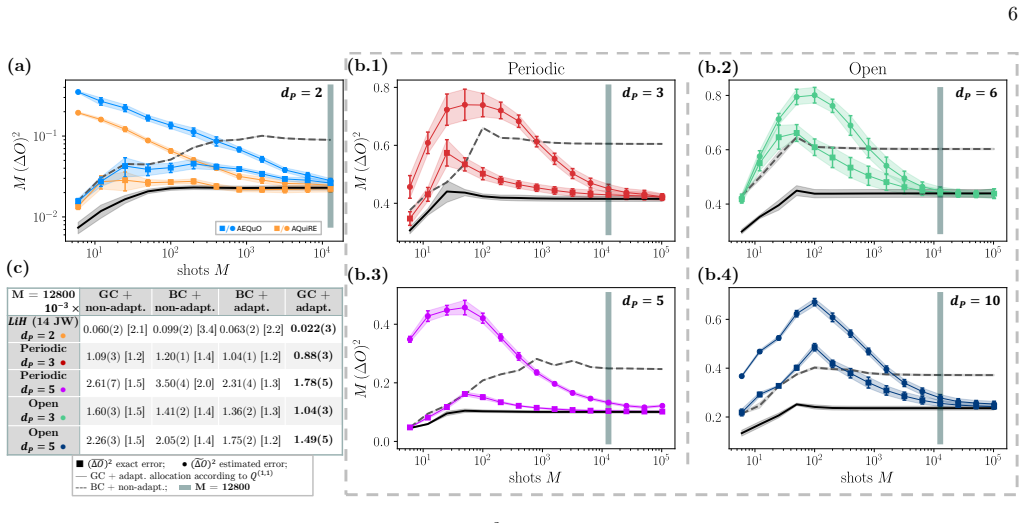
is a complex task that our algorithm addresses, see Sec. IV. Calculating( g∆O)2 in Eq. (3a) such that it correctly reproduces the statistical variance ofeOrequires a model that respects the physical constraints of the measure- ment process. When overlapping cliques [with shared PS, see vertexjin Fig. 1(a)] are measured, there is no well-established proced...
-
[2]
D. Aharonov and M. Ben-Or, Fault-Tolerant Quantum Computation With Constant Error Rate (1999)
work page 1999
-
[3]
A. Y. Kitaev, Fault-tolerant quantum computation by anyons, Annals of Physics303, 2 (2003)
work page 2003
-
[4]
Roffe, Quantum error correction: an introductory guide, Contemporary Physics60, 226 (2019)
J. Roffe, Quantum error correction: an introductory guide, Contemporary Physics60, 226 (2019)
work page 2019
-
[5]
Preskill, Quantum computing 40 years later (2021)
J. Preskill, Quantum computing 40 years later (2021)
work page 2021
-
[6]
P. W. Shor, Polynomial-Time Algorithms for Prime Fac- torization and Discrete Logarithms on a Quantum Com- puter, SIAM Journal on Computing26, 1484 (1997)
work page 1997
-
[7]
T. Paul, Quantum computation and quantum informa- tion, Mathematical Structures in Computer Science17, 10.1017/s0960129507006317 (2007)
-
[8]
M. A. Nielsen and I. L. Chuang,Quantum Computation and Quantum Information: 10th Anniversary Edition (Cambridge University Press, 2012)
work page 2012
-
[9]
Preskill, Quantum Computing in the NISQ era and beyond, Quantum2, 79 (2018)
J. Preskill, Quantum Computing in the NISQ era and beyond, Quantum2, 79 (2018)
work page 2018
-
[10]
A. Acín, I. Bloch, H. Buhrman, T. Calarco, C. Eichler, J. Eisert, D. Esteve, N. Gisin, S. J. Glaser, F. Jelezko, S. Kuhr, M. Lewenstein, M. F. Riedel, P. O. Schmidt, R. Thew, A. Wallraff, I. Walmsley, and F. K. Wilhelm, The quantum technologies roadmap: a European com- munity view, New Journal of Physics20, 080201 (2018)
work page 2018
-
[11]
S. Chakrabarti, R. Krishnakumar, G. Mazzola, N. Stam- atopoulos, S. Woerner, and W. J. Zeng, A Threshold for Quantum Advantage in Derivative Pricing, Quantum5, 463 (2021)
work page 2021
- [12]
-
[13]
E. X. Huber, B. Y. L. Tan, P. R. Griffin, and D. G. An- gelakis, Exponential qubit reduction in optimization for financial transaction settlement, EPJ Quantum Technol- ogy11, 10.1140/epjqt/s40507-024-00262-w (2024)
-
[14]
F. Martini, D. L. Bosco, C. Barbanera, S. Bernar- dini, G. Ranieri, F. Cibrario, D. Corbelletto, G. Bruno, A. Di Pierro, and L. Dellantonio, Securities Transaction Settlement Optimization on superconducting quantum devices (2025)
work page 2025
-
[15]
E. G. Rieffel, D. Venturelli, B. O’Gorman, M. B. Do, E. M. Prystay, and V. N. Smelyanskiy, A case study in programming a quantum annealer for hard operational planning problems, Quantum Information Processing14, 1 (2014)
work page 2014
-
[16]
G. Rosenberg, P. Haghnegahdar, P. Goddard, P. Carr, K. Wu, and M. L. de Prado, Solving the Optimal Trading Trajectory Problem Using a Quantum Annealer, IEEE Journal of Selected Topics in Signal Processing10, 1053 (2016)
work page 2016
-
[17]
S. Feld, C. Roch, T. Gabor, C. Seidel, F. Neukart, I. Gal- ter, W. Mauerer, and C. Linnhoff-Popien, A Hybrid Solu- tion Method for the Capacitated Vehicle Routing Prob- lem Using a Quantum Annealer, Frontiers in ICT6, 10.3389/fict.2019.00013 (2019)
-
[18]
F. Phillipson, Quantum Computing in Logistics and Supply Chain Management an Overview (2024), arXiv:2402.17520 [quant-ph]
-
[19]
Y. Cao, J. Romero, and A. Aspuru-Guzik, Potential of quantum computing for drug discovery, IBM Journal of Research and Development62, 6:1 (2018)
work page 2018
-
[20]
Y. Cao, J. Romero, J. P. Olson, M. Degroote, P. D. John- son, M. Kieferová, I. D. Kivlichan, T. Menke, B. Per- opadre, N. P. D. Sawaya, S. Sim, L. Veis, and A. Aspuru- Guzik,QuantumChemistryintheAgeofQuantumCom- puting, Chemical Reviews119, 10856 (2019)
work page 2019
-
[21]
M. Motta and J. E. Rice, Emerging quantum comput- ing algorithms for quantum chemistry, WIREs Computa- tional Molecular Science12, 10.1002/wcms.1580 (2021)
-
[22]
R. V. Mishmash, T. P. Gujarati, M. Motta, H. Zhai, G. K.-L. Chan, and A. Mezzacapo, Hierarchical Clifford Transformations to Reduce Entanglement in Quantum 11 Chemistry Wave Functions, Journal of Chemical Theory and Computation19, 3194 (2023)
work page 2023
-
[23]
P. Richerme, M. C. Revelle, C. G. Yale, D. Lobser, A. D. Burch, S. M. Clark, D. Saha, M. A. Lopez-Ruiz, A. Dwivedi, J. M. Smith, S. A. Norrell, A. Sabry, and S. S. Iyengar, Quantum Computation of Hydrogen Bond Dynamics and Vibrational Spectra, The Journal of Phys- ical Chemistry Letters14, 7256 (2023)
work page 2023
-
[24]
A. Maurizio and G. Mazzola, Quantum computing for ge- nomics: conceptual challenges and practical perspectives (2025), arXiv:2507.04111 [quant-ph]
- [25]
-
[26]
H. Ma, M. Govoni, and G. Galli, Quantum simulations of materials on near-term quantum computers, npj Compu- tational Materials6, 10.1038/s41524-020-00353-z (2020)
-
[27]
B. Camino, J. Buckeridge, P. A. Warburton, V. Kendon, and S. M. Woodley, Quantum computing and materials science: Apracticalguidetoapplyingquantumannealing to the configurational analysis of materials, Journal of Applied Physics133, 10.1063/5.0151346 (2023)
-
[28]
Y. Alexeev, M. Amsler, M. A. Barroca, S. Bassini, T. Battelle, D. Camps, D. Casanova, Y. J. Choi, F. T. Chong, C. Chung, C. Codella, A. D. Córcoles, J. Cruise, A. Di Meglio, I. Duran, T. Eckl, S. Economou, S. Ei- denbenz, B. Elmegreen, C. Fare, I. Faro, C. S. Fernán- dez, R. N. B. Ferreira, K. Fuji, B. Fuller, L. Gagliardi, G. Galli, J. R. Glick, I. Gobbi...
work page 2024
-
[29]
M. C. Bañuls, R. Blatt, J. Catani, A. Celi, J. I. Cirac, M. Dalmonte, L. Fallani, K. Jansen, M. Lewen- stein, S. Montangero, C. A. Muschik, B. Reznik, E. Rico, L. Tagliacozzo, K. Van Acoleyen, F. Ver- straete, U.-J. Wiese, M. Wingate, J. Zakrzewski, and P. Zoller, Simulating lattice gauge theories within quan- tum technologies, The European Physical Journ...
-
[30]
J. F. Haase, L. Dellantonio, A. Celi, D. Paulson, A. Kan, K. Jansen, and C. A. Muschik, A resource efficient ap- proach for quantum and classical simulations of gauge theories in particle physics, Quantum5, 393 (2021)
work page 2021
-
[31]
D. Paulson, L. Dellantonio, J. F. Haase, A. Celi, A. Kan, A. Jena, C. Kokail, R. van Bijnen, K. Jansen, P. Zoller, and C. A. Muschik, Simulating 2D Effects in Lattice Gauge Theories on a Quantum Computer, PRX Quan- tum2, 030334 (2021)
work page 2021
-
[32]
M. Meth, J. F. Haase, J. Zhang, C. Edmunds, L. Postler, A. Steiner, A. J. Jena, L. Dellantonio, R. Blatt, P. Zoller, T. Monz, P. Schindler, C. Muschik, and M. Ringbauer, Simulating 2d lattice gauge theories on a qudit quantum computer (2023)
work page 2023
-
[33]
M. Ringbauer, M. Meth, L. Postler, R. Stricker, R. Blatt, P. Schindler, and T. Monz, A universal qudit quantum processor with trapped ions, Nature Physics18, 1053 (2022)
work page 2022
-
[34]
Y. Chi, J. Huang, Z. Zhang, J. Mao, Z. Zhou, X. Chen, C. Zhai, J. Bao, T. Dai, H. Yuan,et al., A programmable qudit-based quantum processor, Nature communications 13, 1166 (2022)
work page 2022
-
[35]
P. J. Low, B. White, and C. Senko, Control and readout of a 13-level trapped ion qudit, npj Quantum Information 11, 85 (2025)
work page 2025
-
[36]
Y. Kim, A. Eddins, S. Anand, K. X. Wei, E. Van Den Berg, S. Rosenblatt, H. Nayfeh, Y. Wu, M. Zale- tel, K. Temme,et al., Evidence for the utility of quan- tum computing before fault tolerance, Nature618, 500 (2023)
work page 2023
- [37]
-
[38]
A. D. King, A. Nocera, M. M. Rams, J. Dziarmaga, R. Wiersema, W. Bernoudy, J. Raymond, N. Kaushal, N. Heinsdorf, R. Harris, K. Boothby, F. Altomare, M. Asad, A. J. Berkley, M. Boschnak, K. Chern, H. Christiani, S. Cibere, J. Connor, M. H. Dehn, R. Deshpande, S. Ejtemaee, P. Farre, K. Hamer, E. Hoskinson, S. Huang, M. W. Johnson, S. Kortas, E. Ladizinsky, ...
-
[39]
H.-S. Zhong, H. Wang, Y.-H. Deng, M.-C. Chen, L.-C. Peng, Y.-H. Luo, J. Qin, D. Wu, X. Ding, Y. Hu, P. Hu, X.-Y. Yang, W.-J. Zhang, H. Li, Y. Li, X. Jiang, L. Gan, G. Yang, L. You, Z. Wang, L. Li, N.-L. Liu, C.-Y. Lu, and J.-W. Pan, Quantum computational advantage using photons, Science370, 1460 (2020), https://www.science.org/doi/pdf/10.1126/science.abe8770
-
[40]
Lloyd, Universal Quantum Simulators, Science273, 1073 (1996)
S. Lloyd, Universal Quantum Simulators, Science273, 1073 (1996)
work page 1996
-
[41]
I. M. Georgescu, S. Ashhab, and F. Nori, Quantum sim- ulation, Reviews of Modern Physics86, 153 (2014). 12
work page 2014
-
[42]
A.J.Daley, I.Bloch, C.Kokail, S.Flannigan, N.Pearson, M. Troyer, and P. Zoller, Practical quantum advantage in quantum simulation, Nature607, 667 (2022)
work page 2022
-
[43]
D. Bluvstein, S. J. Evered, A. A. Geim, S. H. Li, H. Zhou, T. Manovitz, S. Ebadi, M. Cain, M. Kalinowski, D. Hangleiter,et al., Logical quantum processor based on reconfigurable atom arrays, Nature626, 58 (2024)
work page 2024
- [44]
-
[45]
M. Qiao, G. Emperauger, C. Chen, L. Homeier, S. Hol- lerith, G. Bornet, R. Martin, B. Gély, L. Klein, D. Barredo, S. Geier, N.-C. Chiu, F. Grusdt, A. Bohrdt, T. Lahaye, and A. Browaeys, Realization of a doped quantum antiferromagnet with dipolar tunnelings in a rydberg tweezer array (2025), arXiv:2501.08233 [quant- ph]
-
[46]
R. D. Delaney, L. R. Sletten, M. J. Cich, B. Estey, M. I. Fabrikant, D. Hayes, I. M. Hoffman, J. Hostet- ter, C. Langer, S. A. Moses, A. R. Perry, T. A. Peter- son, A. Schaffer, C. Volin, G. Vittorini, and W. C. Bur- ton, Scalable multispecies ion transport in a grid-based surface-electrode trap, Phys. Rev. X14, 041028 (2024)
work page 2024
-
[47]
Y. Meng, M. L. Chan, R. B. Nielsen, M. H. Appel, Z. Liu, Y. Wang, N. Bart, A. D. Wieck, A. Ludwig, L. Midolo, et al., Deterministic photon source of genuine three-qubit entanglement, Nature Communications15, 7774 (2024)
work page 2024
-
[48]
M. Neeley, R. C. Bialczak, M. Lenander, E. Lucero, M. Mariantoni, A. D. O’Connell, D. Sank, H. Wang, M. Weides, J. Wenner, Y. Yin, T. Yamamoto, A. N. Cleland, and J. M. Martinis, Generation of three-qubit entangled states using superconducting phase qubits, Na- ture467, 570 (2010)
work page 2010
-
[49]
R. C. Bialczak, M. Ansmann, M. Hofheinz, E. Lucero, M. Neeley, A. D. O’Connell, D. Sank, H. Wang, J. Wen- ner, M. Steffen, A. N. Cleland, and J. M. Martinis, Quantum process tomography of a universal entangling gate implemented with josephson phase qubits, Nature Physics6, 409 (2010)
work page 2010
-
[50]
S. A Rahman, R. Lewis, E. Mendicelli, and S. Powell, Self-mitigating Trotter circuits for SU(2) lattice gauge theory on a quantum computer, Physical Review D106, 074502 (2022)
work page 2022
-
[51]
Y. Y. Atas, J. F. Haase, J. Zhang, V. Wei, S. M. L. Pfaendler, R. Lewis, and C. A. Muschik, Simulating one-dimensional quantum chromodynamics on a quan- tum computer: Real-time evolutions of tetra- and pen- taquarks (2022)
work page 2022
-
[52]
J. R. McClean, J. Romero, R. Babbush, and A. Aspuru- Guzik, The theory of variational hybrid quantum- classical algorithms, New Journal of Physics18, 023023 (2016)
work page 2016
- [53]
-
[54]
R. R. Ferguson, L. Dellantonio, A. A. Balushi, K. Jansen, W. Dür, and C. A. Muschik, Measurement-Based Vari- ational Quantum Eigensolver, Physical Review Letters 126, 220501 (2021)
work page 2021
-
[55]
Kruschke,Doing Bayesian Data Analysis: A Tutorial with R, JAGS, and Stan(Academic Press, 2014)
J. Kruschke,Doing Bayesian Data Analysis: A Tutorial with R, JAGS, and Stan(Academic Press, 2014)
work page 2014
- [56]
-
[57]
A. Shlosberg, A. J. Jena, P. Mukhopadhyay, J. F. Haase, F. Leditzky, and L. Dellantonio, Adaptive estimation of quantum observables, Quantum7, 906 (2023)
work page 2023
-
[58]
M. Mosca, Quantum algorithms (2008), arXiv:0808.0369 [quant-ph]
work page Pith review arXiv 2008
-
[59]
Gottesman, Theory of fault-tolerant quantum compu- tation, Phys
D. Gottesman, Theory of fault-tolerant quantum compu- tation, Phys. Rev. A57, 127 (1998)
work page 1998
-
[60]
A. Kerzner, V. Gheorghiu, M. Mosca, T. Guilbaud, F. Carminati, F. Fracas, and L. Dellantonio, A square- root speedup for finding the smallest eigenvalue, Quan- tum Science and Technology9, 045025 (2024)
work page 2024
- [61]
-
[62]
T.-C. Yen, A. Ganeshram, and A. F. Izmaylov, Deter- ministic improvements of quantum measurements with grouping of compatible operators, non-local transforma- tions, and covariance estimates, npj Quantum Informa- tion9, 14 (2023)
work page 2023
- [63]
-
[64]
D.Gottesman,Fault-tolerantquantumcomputationwith higher-dimensional systems,inNASA International Con- ference on Quantum Computing and Quantum Commu- nications(Springer, 1998) pp. 302–313
work page 1998
-
[65]
D. Gottesman, A. Kitaev, and J. Preskill, Encoding a qubit in an oscillator, Phys. Rev. A64, 012310 (2001)
work page 2001
-
[66]
A. Jena, S. Genin, and M. Mosca, Pauli partitioning with respect to gate sets (2019), arXiv:1907.07859 [quant-ph]
work page Pith review arXiv 2019
-
[67]
W. K. Hastings, Monte carlo sampling methods using markov chains and their applications, Biometrika57, 97 (1970)
work page 1970
-
[68]
M.E.J.NewmanandG.T.Barkema,Monte Carlo Meth- ods in Statistical Physics(Clarendon Press, 1999)
work page 1999
-
[69]
N. L. Johnson, S. Kotz, and N. Balakrishnan, Dirichlet and inverted dirichlet distributions, inContinuous multi- variate distributions, volume 1, Wiley Series in Probabil- ity and Statistics (John Wiley & Sons, 2000) Chap. 49, 2nd ed
work page 2000
-
[70]
J. Geweke, Evaluating the accuracy of sampling-based approaches to the calculation of posterior moments, in Bayesian Statistics 4(Oxford University PressOxford,
-
[71]
A. Gelman and D. B. Rubin, Inference from iterative sim- ulation using multiple sequences, Stat. Sci.7, 457 (1992)
work page 1992
-
[72]
S. Aaronson and D. Gottesman, Improved simulation of stabilizer circuits, Phys. Rev. A70, 052328 (2004)
work page 2004
-
[73]
A. Chan, Z. Shi, L. Dellantonio, W. Dür, and C. A. Muschik, Measurement-based infused circuits for vari- ational quantum eigensolvers, Phys. Rev. Lett.132, 240601 (2024)
work page 2024
-
[74]
M. Meth, V. Kuzmin, R. van Bijnen, L. Postler, R. Stricker, R. Blatt, M. Ringbauer, T. Monz, P. Silvi, and P. Schindler, Probing phases of quantum matter with an ion-trap tensor-network quantum eigensolver, Phys. Rev. X12, 041035 (2022). 13
work page 2022
-
[75]
J. Miguel-Ramiro, Z. Shi, L. Dellantonio, A. Chan, C. A. Muschik, and W. Dür, Enhancing quantum computation via superposition of quantum gates, Phys. Rev. A108, 062604 (2023)
work page 2023
-
[76]
In this work, we employ the Hadamard, S, and sum gate as defined in [63]; see App. E
-
[77]
A. Sørensen and K. Mølmer, Quantum computation with ions in thermal motion, Phys. Rev. Lett.82, 1971 (1999)
work page 1971
-
[78]
A. Sørensen and K. Mølmer, Entanglement and quantum computation with ions in thermal motion, Phys. Rev. A 62, 022311 (2000). Appendix A: Spin-Operators in Higher Dimensions In this work we use the following definitions ofdS di- mensional spin operators: ˆSx = dS −2X µ=0 (|µ+ 1⟩ ⟨µ|+|µ⟩ ⟨µ+ 1|)σ µ,(A1a) ˆSy = i dS −2X µ=0 (|µ+ 1⟩ ⟨µ| − |µ⟩ ⟨µ+ 1|)σ µ,(A1b)...
work page 2000
discussion (0)
Sign in with ORCID, Apple, or X to comment. Anyone can read and Pith papers without signing in.