Recognition: unknown
The Rocky Planet Picture Show: Implementation of Surface Reflection and Emission in texttt{POSEIDON} with Application to and Interpretation of JWST Data
Pith reviewed 2026-05-09 18:17 UTC · model grok-4.3
The pith
Joint atmosphere and surface retrievals on JWST data distinguish tenuous from thick atmospheres on rocky exoplanets.
A machine-rendered reading of the paper's core claim, the machinery that carries it, and where it could break.
Core claim
By implementing surface reflection and emission in POSEIDON v1.4 using lab-derived directional-hemispherical reflectances, the code can now retrieve both atmospheric parameters and surface geology from mid-infrared emission spectra, as demonstrated by distinguishing tenuous from thick atmospheres in published JWST data for TOI-1685b and 55 Cancri e, and distinguishing granite-like from basaltic surfaces in synthetic datasets with sufficient signal-to-noise.
What carries the argument
The updated POSEIDON retrieval model that combines an emitting and reflecting planetary surface with an overlying absorbing and scattering atmosphere, using wavelength-dependent albedos from laboratory rock samples.
If this is right
- Current JWST spectral data suffice to distinguish atmospheres with surface pressures of 1 bar or less from those of 0.1 bar or more on TOI-1685b and 55 Cancri e.
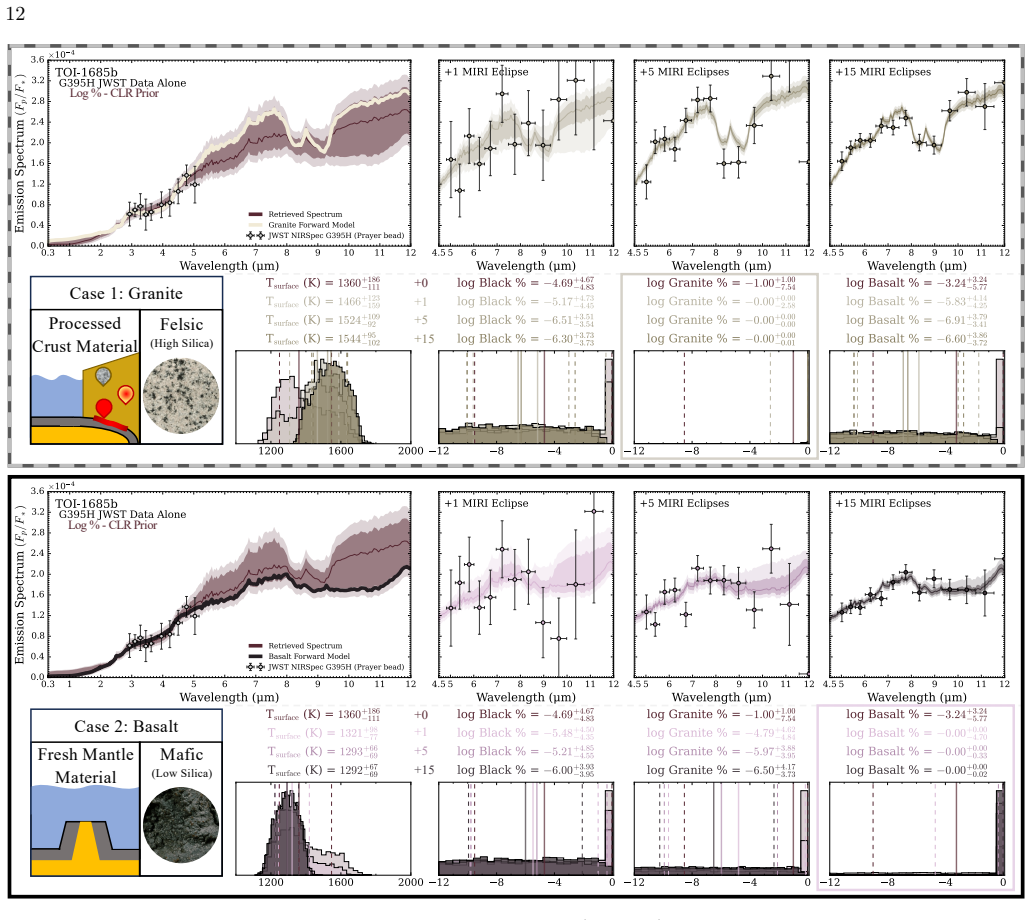
- JWST MIRI LRS observations with sufficient signal-to-noise can differentiate granite-like from basaltic surfaces on rocky worlds.
- Surface albedos imprint diagnostic mid-infrared absorption features, pseudo-features from transparency windows, and flipped absorption-to-emission lines via surface-atmosphere pseudo-temperature inversions.
- An open-source database of lab-derived surface albedos organized by geologic type is now available to support further work.
Where Pith is reading between the lines
- The same retrieval approach can be applied to additional rocky exoplanets observed by JWST to test for surface diversity across different stellar environments.
- Combining these surface constraints with atmospheric chemistry retrievals could reveal links between surface geology and atmospheric composition on terrestrial worlds.
- Future higher-resolution spectra from the Habitable Worlds Observatory would extend this method to smaller planets and lower surface pressures.
Load-bearing premise
Laboratory directional-hemispherical reflectances of rock samples accurately represent exoplanet surfaces and retrievals can separate surface and atmospheric signals without major degeneracies.
What would settle it
Retrievals applied to JWST MIRI LRS observations of 55 Cancri e that fail to show a statistical preference between granite-like and basaltic surface models at the claimed signal-to-noise levels would falsify the surface geology constraint.
Figures


read the original abstract
The surface characterization of rocky exoplanets via emission spectroscopy represents a frontier of current (JWST) and future (HWO) observational efforts. Here, we implement new features in the open-source retrieval code $\texttt{POSEIDON (v1.4)}$ to fully account for an emitting and reflecting planetary surface and an overlying absorbing and scattering atmosphere. We show that realistic rocky surfaces (with wavelength-dependent albedos derived from laboratory measurements) affect emission spectra by imparting mid-infrared diagnostic absorption features, imprinting pseudo-features due to atmospheric transparency windows, and flipping absorption features to emission via surface-atmosphere interface pseudo-temperature inversions. We demonstrate that current JWST spectral data can distinguish between tenuous (low surface pressure, $\leq$ 1 bar) and thick (high surface pressures, $\geq$ 0.1 bar) atmospheres by performing atmosphere + surface retrievals on published JWST emission data of the rocky worlds TOI-1685b and 55 Cancri e. We then explore JWST MIRI LRS's capability to constrain surface geology of rocky worlds, finding that with sufficient SNR retrievals can distinguish between granite-like and basaltic surfaces for synthetic datasets. Finally, we provide an open-source database of lab-derived surface albedos (in the form of directional-hemispherical reflectances), organized by geologic classification and include supplemental tables developed to foster future collaboration between geology and exoplanet science. Our atmosphere + surface retrieval technique provides a pathway to probe geologic processes on rocky exoplanets, showing that upcoming JWST data for terrestrial worlds will enable a deeper exploration of rocky surfaces beyond our Solar System.
Editorial analysis
A structured set of objections, weighed in public.
Referee Report
Summary. The manuscript implements emitting and reflecting surfaces with wavelength-dependent albedos (from laboratory directional-hemispherical reflectance measurements) into the POSEIDON v1.4 radiative-transfer and retrieval framework. It shows that such surfaces imprint diagnostic mid-IR absorption features, pseudo-features in atmospheric windows, and emission flips via surface-atmosphere pseudo-inversions. Atmosphere-plus-surface retrievals on published JWST emission spectra of TOI-1685b and 55 Cancri e are used to distinguish tenuous (P_s ≤ 1 bar) from thick (P_s ≥ 0.1 bar) atmospheres. Synthetic MIRI LRS tests demonstrate that granite-like versus basaltic surfaces can be separated at sufficient SNR. An open database of lab-derived albedos organized by geologic type is released.
Significance. If the retrieval distinctions hold, the work supplies a practical, open-source pathway for extracting geologic information from rocky-exoplanet emission spectra with existing JWST data and future facilities. The reusable lab-albedo database and supplemental tables constitute a concrete, interdisciplinary contribution that lowers the barrier for future surface-modeling studies. The explicit posterior comparisons for the two real targets and the SNR-threshold demonstration for synthetics provide falsifiable benchmarks for the community.
major comments (2)
- §4 (application to TOI-1685b and 55 Cancri e): the claim that current JWST data distinguish tenuous versus thick atmospheres rests on the posterior overlap (or lack thereof) between the two pressure regimes; the manuscript should report the quantitative evidence ratio or nested-sampling log-evidence difference between the thin-atmosphere and thick-atmosphere models to make the distinction statistically rigorous rather than visual.
- §5 (synthetic MIRI LRS tests): the statement that 'with sufficient SNR retrievals can distinguish' granite-like from basaltic surfaces requires an explicit SNR threshold (or range) at which the two surface classes become separable at >3σ, together with the corresponding corner-plot or table entry; without this number the capability claim remains qualitative.
minor comments (4)
- The abstract and §2 should cite the exact laboratory references (or database DOI) for the directional-hemispherical reflectance spectra used for granite and basalt so that readers can immediately locate the input data.
- Figure captions for the synthetic retrieval corner plots should state the exact SNR value(s) and wavelength coverage assumed for the MIRI LRS simulation.
- Notation: the surface-pressure symbol P_s is introduced without an explicit definition in the text preceding the first retrieval figure; add a short sentence in §3.1.
- The open database release should include a README or table that maps each geologic class to the specific mineralogical samples and measurement conditions (incidence angle, etc.) to facilitate reuse.
Simulated Author's Rebuttal
We thank the referee for their positive assessment of our manuscript and for the constructive comments that will enhance the statistical rigor of our results. We address each major comment point by point below.
read point-by-point responses
-
Referee: §4 (application to TOI-1685b and 55 Cancri e): the claim that current JWST data distinguish tenuous versus thick atmospheres rests on the posterior overlap (or lack thereof) between the two pressure regimes; the manuscript should report the quantitative evidence ratio or nested-sampling log-evidence difference between the thin-atmosphere and thick-atmosphere models to make the distinction statistically rigorous rather than visual.
Authors: We agree that quantitative evidence ratios are necessary to make the distinction between thin and thick atmospheres statistically rigorous rather than visual. We have conducted additional nested-sampling retrievals to compute the log-evidence differences between the thin-atmosphere (P_s ≤ 1 bar) and thick-atmosphere (P_s ≥ 0.1 bar) models for both targets. For TOI-1685b the thin-atmosphere model is preferred with ΔlogZ ≈ 4.8 (Bayes factor ~120), while for 55 Cancri e the preference is weaker (ΔlogZ ≈ 1.2). We will add these values, the corresponding Bayes factors, and a short discussion to the revised §4. revision: yes
-
Referee: §5 (synthetic MIRI LRS tests): the statement that 'with sufficient SNR retrievals can distinguish' granite-like from basaltic surfaces requires an explicit SNR threshold (or range) at which the two surface classes become separable at >3σ, together with the corresponding corner-plot or table entry; without this number the capability claim remains qualitative.
Authors: We acknowledge that the separability claim in §5 would be strengthened by an explicit SNR threshold. Re-analysis of the synthetic MIRI LRS retrievals shows that granite-like and basaltic surfaces become distinguishable at >3σ for SNR ≥ 15 per resolution element. We will insert this threshold into the text of §5, add a supplementary table listing retrieval precision versus SNR, and explicitly reference the relevant corner plots already present in the supplementary material. revision: yes
Circularity Check
No significant circularity: standard RT implementation applied to external data
full rationale
The paper extends the existing POSEIDON radiative transfer code with surface emission/reflection using laboratory directional-hemispherical reflectances as external inputs. It performs retrievals on published JWST emission spectra of TOI-1685b and 55 Cancri e (external data) and tests surface geology constraints on synthetic datasets generated independently. No equations reduce claimed distinctions (tenuous vs. thick atmospheres, granite vs. basaltic surfaces) to quantities defined by the fit itself. The open lab-albedo database is a separate reusable contribution. Self-citation of prior POSEIDON versions is present but not load-bearing for the new results.
Axiom & Free-Parameter Ledger
axioms (1)
- standard math Radiative transfer equations and scattering treatment in POSEIDON
Reference graph
Works this paper leans on
-
[1]
Adams Redai, J., Wogan, N., Wallack, N. L., et al. 2025, AJ, 170, 219, doi: 10.3847/1538-3881/adee92
-
[2]
H., Espinoza, N., Diamond-Lowe, H., et al
Allen, N. H., Espinoza, N., Diamond-Lowe, H., et al. 2025, AJ, 170, 240, doi: 10.3847/1538-3881/adfc51
-
[3]
August, P. C., Buchhave, L. A., Diamond-Lowe, H., et al. 2025, A&A, 695, A171, doi: 10.1051/0004-6361/202452611
-
[4]
Baldridge, A. M., Hook, S. J., Grove, C. I., & Rivera, G. 2009, Remote Sensing of Environment, 113, 711, doi: 10.1016/j.rse.2008.11.007
-
[5]
Barsukov, V. L., Volkov, V. P., & Khodakovskii, I. L. 1982, Lunar and Planetary Science Conference Proceedings, 87, 3, doi: 10.1029/JB087iS01p000A3
-
[6]
Batalha, N. E., Marley, M. S., Lewis, N. K., & Fortney, J. J. 2019, ApJ, 878, 70, doi: 10.3847/1538-4357/ab1b51
-
[7]
E., Mandell, A., Pontoppidan, K., et al
Batalha, N. E., Mandell, A., Pontoppidan, K., et al. 2017, PASP, 129, 064501, doi: 10.1088/1538-3873/aa65b0 B´ edard, J. H. 2018, Geoscience Frontiers, 9, 19, doi: 10.1016/j.gsf.2017.01.005
-
[8]
Bello-Arufe, A., Damiano, M., Bennett, K. A., et al. 2025, ApJL, 980, L26, doi: 10.3847/2041-8213/adaf22
-
[9]
2012, ApJ, 753, 100, doi: 10.1088/0004-637X/753/2/100
Benneke, B., & Seager, S. 2012, ApJ, 753, 100, doi: 10.1088/0004-637X/753/2/100
-
[10]
2012, Lithos, 153, 3, doi: 10.1016/j.lithos.2012.04.007
Bonin, B. 2012, Lithos, 153, 3, doi: 10.1016/j.lithos.2012.04.007
-
[11]
Bramble, M. S., & Hand, K. P. 2024, Scientific Reports, 14, 5503, doi: 10.1038/s41598-024-55979-6
-
[12]
Breuer, D., Hamilton, C. W., & Khurana, K. 2022, Elements, 18, 385, doi: 10.2138/gselements.18.6.385
-
[13]
Brugman, K., Phillips, M. G., & Till, C. B. 2021, Journal of Geophysical Research (Planets), 126, e06731, doi: 10.1029/2020JE00673110.31223/x5wg7z
-
[14]
Cadieux, C., Doyon, R., MacDonald, R. J., et al. 2024, ApJL, 970, L2, doi: 10.3847/2041-8213/ad5afa
-
[15]
2024, Planetary and Space Science, 253, 105983, doi: https://doi.org/10.1016/j.pss.2024.105983
Cambianica, P., Simioni, E., Cremonese, G., et al. 2024, Planetary and Space Science, 253, 105983, doi: https://doi.org/10.1016/j.pss.2024.105983
-
[16]
Cambioni, S., Weiss, B. P., Asphaug, E., et al. 2025, A&A, 696, A174, doi: 10.1051/0004-6361/202450128 Carri´ on-Gonz´ alez,´O., Garc´ ıa Mu˜ noz, A., Cabrera, J., et al. 2020, A&A, 640, A136, doi: 10.1051/0004-6361/202038101
-
[17]
Carter, L. M., Gilmore, M. S., Ghail, R. C., et al. 2023, SSRv, 219, 85, doi: 10.1007/s11214-023-01033-2
-
[18]
2021, Chemie der Erde / Geochemistry, 81, 125735, doi: 10.1016/j.chemer.2020.125735
Chao, K.-H., deGraffenried, R., Lach, M., et al. 2021, Chemie der Erde / Geochemistry, 81, 125735, doi: 10.1016/j.chemer.2020.125735
-
[19]
C., Pieters, C
Cheek, L. C., Pieters, C. M., Dyar, M. D., & Milam, K. A. 2009, in 40th Annual Lunar and Planetary Science
2009
-
[20]
Conference, Lunar and Planetary Science Conference, 1928
1928
-
[21]
Condie, K. C. 2022, in Earth as an Evolving Planetary System (Fourth Edition), fourth edition edn., ed. K. C. Condie (Academic Press), 305–352, doi: https://doi.org/10.1016/B978-0-12-819914-5.00009-3
-
[22]
2025, Nature Reviews Earth and Environment, 6, 728, doi: 10.1038/s43017-025-00735-1
Gaillard, F. 2025, Nature Reviews Earth and Environment, 6, 728, doi: 10.1038/s43017-025-00735-1
-
[23]
2023, Nature, 620, 292, doi: 10.1038/s41586-023-06230-1
Coulombe, L.-P., Benneke, B., Challener, R., et al. 2023, Nature, 620, 292, doi: 10.1038/s41586-023-06230-1
-
[24]
Robinson, T. D. 2025, arXiv e-prints, arXiv:2507.03071, doi: 10.48550/arXiv.2507.03071
-
[25]
Coy, B. P., Ih, J., Kite, E. S., et al. 2025, ApJ, 987, 22, doi: 10.3847/1538-4357/add3f7
-
[26]
Dai, L., Titov, D. V., Shao, W. D., et al. 2025, SSRv, 221, 51, doi: 10.1007/s11214-025-01176-4
-
[27]
2024, ApJL, 968, L22, doi: 10.3847/2041-8213/ad5204
Damiano, M., Bello-Arufe, A., Yang, J., & Hu, R. 2024, ApJL, 968, L22, doi: 10.3847/2041-8213/ad5204
-
[28]
2020, AJ, 159, 175, doi: 10.3847/1538-3881/ab79a5
Damiano, M., & Hu, R. 2020, AJ, 159, 175, doi: 10.3847/1538-3881/ab79a5
-
[29]
Deng, J., Du, Z., Karki, B. B., Ghosh, D. B., & Lee, K. K. M. 2020, Nature Communications, 11, 2007, doi: 10.1038/s41467-020-15757-0
-
[30]
Domingue, D. L., Koehn, P. L., Killen, R. M., et al. 2007, SSRv, 131, 161, doi: 10.1007/s11214-007-9260-9
-
[31]
1995, A&A, 300, 503
Mutschke, H. 1995, A&A, 300, 503
1995
-
[32]
Schlichting, H. E. 2019, Science, 366, 356, doi: 10.1126/science.aax3901
-
[33]
2025, A&A, 698, A76, doi: 10.1051/0004-6361/202452016
Drant, T., Tian, M., Carrasco, N., & Heng, K. 2025, A&A, 698, A76, doi: 10.1051/0004-6361/202452016
-
[34]
Driscoll, P. E., & Barnes, R. 2015, Astrobiology, 15, 739, doi: 10.1089/ast.2015.1325
-
[35]
2023, Earth Science Reviews, 243, 104491, doi: 10.1016/j.earscirev.2023.104491
Du, P., Yuan, P., Liu, J., & Ye, B. 2023, Earth Science Reviews, 243, 104491, doi: 10.1016/j.earscirev.2023.104491
-
[36]
2025, Nature Astronomy, 9, 358, doi: 10.1038/s41550-024-02428-z
Ducrot, E., Lagage, P.-O., Min, M., et al. 2025, Nature Astronomy, 9, 358, doi: 10.1038/s41550-024-02428-z
-
[37]
2024, in Society of Photo-Optical Instrumentation Engineers (SPIE) Conference Series, Vol
East, M., Miller, P., Brennan, S., & Lunde, E. 2024, in Society of Photo-Optical Instrumentation Engineers (SPIE) Conference Series, Vol. 13092, Space Telescopes and Instrumentation 2024: Optical, Infrared, and Millimeter Wave, ed. L. E. Coyle, S. Matsuura, & M. D. Perrin, 130921Q, doi: 10.1117/12.3020201 42
-
[38]
Edwards, P. H., Bridges, J. C., Wiens, R., et al. 2017, M&PS, 52, 2931, doi: 10.1111/maps.12953
-
[39]
Egan, W. G., & Hilgeman, T. 1975, AJ, 80, 587, doi: 10.1086/111782
-
[40]
Ehlmann, B. L., & Mustard, J. F. 2012, Geophys. Res. Lett., 39, L11202, doi: 10.1029/2012GL051594
-
[41]
Journal of Geophysical Research: Planets , author =
Elkins-Tanton, L. T., Hess, P. C., & Parmentier, E. M. 2005, Journal of Geophysical Research (Planets), 110, E12S01, doi: 10.1029/2005JE002480
-
[42]
Espinoza, N., Allen, N. H., Glidden, A., et al. 2025, ApJL, 990, L52, doi: 10.3847/2041-8213/adf42e
-
[43]
2001, A&A, 378, 228, doi: 10.1051/0004-6361:20011196
Fabian, D., Henning, T., J¨ ager, C., et al. 2001, A&A, 378, 228, doi: 10.1051/0004-6361:20011196
-
[44]
Fegley, Jr., B., Klingelhoefer, G., Brackett, R. A., et al. 1995, Icarus, 118, 373, doi: 10.1006/icar.1995.1197
-
[45]
Feng, Y. K., Robinson, T. D., Fortney, J. J., et al. 2018, AJ, 155, 200, doi: 10.3847/1538-3881/aab95c
-
[46]
F., Capozziello, S., & Dainotti, M
Feroz, F., Hobson, M. P., & Bridges, M. 2009, MNRAS, 398, 1601, doi: 10.1111/j.1365-2966.2009.14548.x
-
[47]
C., Mishra, I., Gazel, E., et al
First, E. C., Mishra, I., Gazel, E., et al. 2025, Nature Astronomy, 9, 370, doi: 10.1038/s41550-024-02412-7
-
[48]
Fortin, M.-A., Gazel, E., Kaltenegger, L., & Holycross, M. E. 2022, MNRAS, 516, 4569, doi: 10.1093/mnras/stac2198
-
[49]
Fortin, M.-A., Gazel, E., Williams, D. B., et al. 2024, ApJL, 974, L7, doi: 10.3847/2041-8213/ad7d89
-
[50]
Fortune, M., Gibson, N. P., Diamond-Lowe, H., et al. 2025, A&A, 701, A25, doi: 10.1051/0004-6361/202554198
-
[51]
Gaillard, F., Bouhifd, M. A., F¨ uri, E., et al. 2021, SSRv, 217, 22, doi: 10.1007/s11214-021-00802-1
-
[52]
Gazel, E., Hayes, J. L., Hoernle, K., et al. 2015, Nature Geoscience, 8, 321, doi: 10.1038/ngeo2392
-
[53]
2025a, PSJ, 6, 110, doi: 10.3847/PSJ/adcba8 —
Gkouvelis, L. 2025a, PSJ, 6, 110, doi: 10.3847/PSJ/adcba8 —. 2025b, Research Notes of the American Astronomical Society, 9, 320, doi: 10.3847/2515-5172/ae2306
-
[54]
2025, ApJL, 990, L53, doi: 10.3847/2041-8213/adf62e
Glidden, A., Ranjan, S., Seager, S., et al. 2025, ApJL, 990, L53, doi: 10.3847/2041-8213/adf62e Gomez Barrientos, J., Kaltenegger, L., & MacDonald, R. J. 2023a, MNRAS, 524, L5, doi: 10.1093/mnrasl/slad056 Gomez Barrientos, J., MacDonald, R. J., Lewis, N. K., &
-
[55]
2023b, ApJ, 946, 96, doi: 10.3847/1538-4357/acaf59 Goodis Gordon, K
Kaltenegger, L. 2023b, ApJ, 946, 96, doi: 10.3847/1538-4357/acaf59 Goodis Gordon, K. E., Karalidi, T., Bott, K. M., et al. 2025, ApJ, 983, 168, doi: 10.3847/1538-4357/adc09c
-
[56]
Gordon, I. E., Rothman, L. S., Hargreaves, R. J., et al. 2022, JQSRT, 277, 107949, doi: 10.1016/j.jqsrt.2021.107949
-
[57]
Grant, D., Lewis, N. K., Wakeford, H. R., et al. 2023, ApJL, 956, L32, doi: 10.3847/2041-8213/acfc3b10.3847/2041-8213/acfdab
work page doi:10.3847/2041-8213/acfc3b10.3847/2041-8213/acfdab 2023
-
[58]
Greene, T. P., Bell, T. J., Ducrot, E., et al. 2023, Nature, 618, 39, doi: 10.1038/s41586-023-05951-7
-
[59]
2021, AJ, 161, 122, doi: 10.3847/1538-3881/abd54a
Gu, L., Fan, S., Li, J., et al. 2021, AJ, 161, 122, doi: 10.3847/1538-3881/abd54a
-
[60]
doi:10.1093/mnras/stad2486 , keywords =
Guimond, C. M., Shorttle, O., Jordan, S., & Rudge, J. F. 2023, MNRAS, 525, 3703, doi: 10.1093/mnras/stad2486
-
[61]
M., Wang, H., Seidler, F., et al
Guimond, C. M., Wang, H., Seidler, F., et al. 2024, Reviews in Mineralogy and Geochemistry, 90, 259, doi: 10.2138/rmg.2024.90.08
-
[62]
Hale, G. M., & Querry, M. R. 1973, ApOpt, 12, 555, doi: 10.1364/AO.12.000555
-
[63]
Hammond, M., Guimond, C. M., Lichtenberg, T., et al. 2025, ApJL, 978, L40, doi: 10.3847/2041-8213/ada0bc
-
[64]
Hapke, B. 1981, J. Geophys. Res., 86, 3039, doi: 10.1029/JB086iB04p03039 —. 2002, Icarus, 157, 523, doi: 10.1006/icar.2002.6853
-
[65]
2012, Theory of Reflectance and Emittance Spectroscopy, 2nd edn
Hapke, B. 2012, Theory of Reflectance and Emittance Spectroscopy, 2nd edn. (Cambridge University Press)
2012
-
[66]
Harris, C. R., Millman, K. J., van der Walt, S. J., et al. 2020, Nature, 585, 357, doi: 10.1038/s41586-020-2649-2
-
[67]
Hazen, R. M., Downs, R. T., Morrison, S. M., et al. 2023, Journal of Geophysical Research: Planets, 128, e2023JE007865, doi: https://doi.org/10.1029/2023JE007865
-
[68]
He, C., Radke, M., Moran, S. E., et al. 2024, Nature Astronomy, 8, 182, doi: 10.1038/s41550-023-02140-4
-
[69]
Head, J. W., Chapman, C. R., Domingue, D. L., et al. 2007, SSRv, 131, 41, doi: 10.1007/s11214-007-9263-6
-
[70]
Heng, K., Morris, B. M., & Kitzmann, D. 2021, Nature Astronomy, 5, 1001, doi: 10.1038/s41550-021-01444-7
-
[71]
2025, A&A, 699, A67, doi: 10.1051/0004-6361/202453069
Herbort, O., & Sereinig, L. 2025, A&A, 699, A67, doi: 10.1051/0004-6361/202453069
-
[72]
Hinkel, N. R., Timmes, F. X., Young, P. A., Pagano, M. D., & Turnbull, M. C. 2014, AJ, 148, 54, doi: 10.1088/0004-6256/148/3/54
-
[73]
The Astrophysical Journal , author =
Hinkel, N. R., & Unterborn, C. T. 2018, ApJ, 853, 83, doi: 10.3847/1538-4357/aaa5b4
-
[74]
R., Youngblood, A., & Soares-Furtado, M
Hinkel, N. R., Youngblood, A., & Soares-Furtado, M. 2024, Reviews in Mineralogy and Geochemistry, 90, 1, doi: 10.2138/rmg.2024.90.01
-
[75]
1994, Chemical Physics, 179, 533, doi: 10.1016/0301-0104(94)87028-4
Hohm, U. 1994, Chemical Physics, 179, 533, doi: 10.1016/0301-0104(94)87028-4
-
[76]
Holmberg, M., Diamond-Lowe, H., Mendon¸ ca, J. M., et al. 2026, The Astronomical Journal, 171, 251, doi: 10.3847/1538-3881/ae4c45
-
[77]
Hu, R., Ehlmann, B. L., & Seager, S. 2012, ApJ, 752, 7, doi: 10.1088/0004-637X/752/1/7 43
-
[78]
2024, Nature, 10.1038/s41586-024-07432-x
Hu, R., Bello-Arufe, A., Zhang, M., et al. 2024, Nature, 630, 609, doi: 10.1038/s41586-024-07432-x
-
[79]
2025, arXiv e-prints, arXiv:2509.16798, doi: 10.48550/arXiv.2509.16798
Hu, R., Min, M., Millar-Blanchaer, M., et al. 2025, arXiv e-prints, arXiv:2509.16798, doi: 10.48550/arXiv.2509.16798
-
[80]
Hunten, D. M. 1993, Science, 259, 915, doi: 10.1126/science.259.5097.915
discussion (0)
Sign in with ORCID, Apple, or X to comment. Anyone can read and Pith papers without signing in.