All-optical saddle trap as a platform for mesoscopic quantum experiments
Pith reviewed 2026-05-09 19:52 UTC · model grok-4.3
The pith
A rotating saddle-shaped optical trap for levitated nanoparticles supports zepto-Newton force detection along with quantum motional entanglement and squeezing.
A machine-rendered reading of the paper's core claim, the machinery that carries it, and where it could break.
Core claim
The rotating saddle-like optical potential, formed by superposing Gaussian and Laguerre-Gauss modes at detuned frequencies, traps a levitated nanoparticle while suppressing photon-recoil and absorption decoherence, permits large center-of-mass delocalization, supplies particle-recovery protocols, generates motional entanglement and momentum squeezing, and enables force sensing at zepto-Newton sensitivity.
What carries the argument
The rotating saddle-like optical potential created by the superposition of Gaussian and Laguerre-Gauss modes with detuned frequencies; it supplies a time-dependent trap that maintains coherence for mesoscopic quantum control and precision metrology.
If this is right
- Photon-recoil and absorption decoherence drop below levels typical of static optical traps.
- Center-of-mass motion can delocalize over distances much larger than the optical wavelength.
- Motional entanglement and momentum squeezing become accessible in the same apparatus.
- A particle-recovery protocol allows repeated use of the same nanoparticle after release.
- Force detection reaches the zepto-Newton regime as a direct application.
Where Pith is reading between the lines
- The same rotating-potential architecture could be applied to other levitated objects such as atoms or molecules to test analogous quantum effects.
- Zepto-Newton sensitivity would enable direct probing of weak gravitational or Casimir forces between mesoscopic masses.
- Large delocalization combined with recovery protocols might support sequential quantum-non-demolition measurements on a single particle.
- The reduced decoherence channel could relax requirements for cryogenic environments in levitated optomechanics.
Load-bearing premise
The nanoparticle remains stably trapped and coherent inside the rotating saddle potential long enough for the intended quantum operations and force measurements to complete before heating or loss becomes dominant.
What would settle it
An experiment that measures heating rates or particle-loss times high enough to prevent the predicted center-of-mass delocalization or squeezing levels required for zepto-Newton detection would falsify the claimed performance.
Figures


read the original abstract
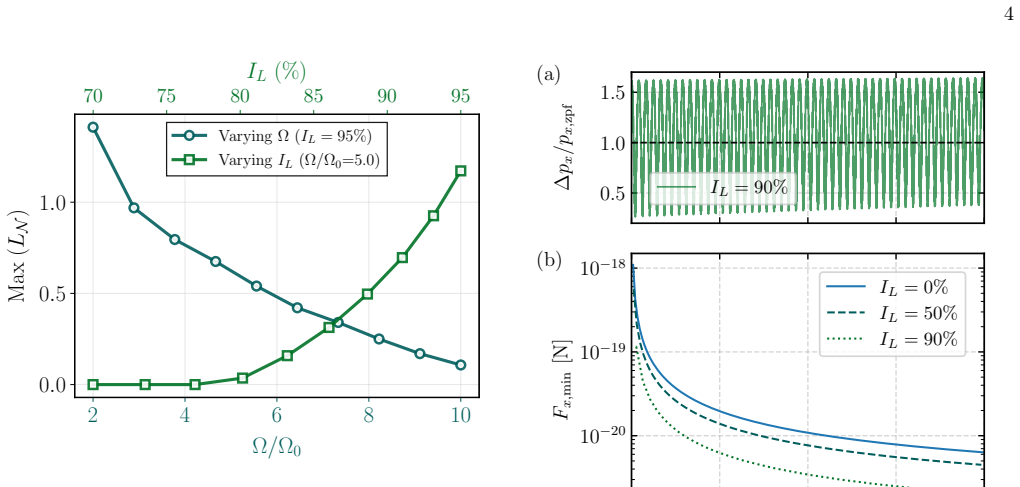
We investigate the quantum dynamics of a levitated nanoparticle in a structured light rotating saddle-like optical potential consisting of a superposition of Gaussian and Laguerre-Gauss modes with detuned frequencies. This rotating saddle trap offers unique opportunities for quantum experiments, such as reduced decoherence due to photon recoil and absorption, the possibility of large delocalization of the particle's center-of-mass motion, particle recovery protocols, the generation of motional entanglement and momentum squeezing. As an application, we show that this saddle-trap architecture enables force detection with sensitivity in the zepto-Newton regime.
Editorial analysis
A structured set of objections, weighed in public.
Referee Report
Summary. The manuscript proposes an all-optical rotating saddle trap for levitated nanoparticles formed by a frequency-detuned superposition of a Gaussian beam and a Laguerre-Gauss mode. It claims this architecture enables reduced photon-recoil and absorption decoherence, large center-of-mass delocalization, particle recovery, motional entanglement, momentum squeezing, and, as an application, force detection at zepto-Newton sensitivity.
Significance. If the quantitative claims on coherence lifetime and heating rates hold, the platform could advance mesoscopic quantum optomechanics by providing an all-optical route to low-decoherence trapping and high-sensitivity force sensing. The concept addresses recoil heating limitations in standard Gaussian traps, but the absence of explicit derivations or simulations in the current version limits its immediate impact.
major comments (2)
- [Application section] Application section: the zepto-Newton force-detection claim rests on reduced recoil heating and large delocalization in the detuned Gaussian + Laguerre-Gauss superposition, yet no scattering-rate calculation, master-equation treatment in the rotating frame, or bound on residual absorption/mode-mismatch heating is supplied. Without these, the required center-of-mass coherence time cannot be verified against the ~10^{-3} quanta/s threshold needed for the sensitivity.
- [Section on quantum dynamics] Section on quantum dynamics: the statements that the rotating saddle potential yields 'reduced decoherence due to photon recoil and absorption' and 'the possibility of large delocalization' are presented qualitatively. No comparison of effective heating rates to conventional optical traps or explicit dependence on detuning and orbital angular momentum appears, making the central advantage unquantified.
minor comments (2)
- [Abstract] The abstract and introduction would benefit from a brief outline of the manuscript structure and a clear statement of which results are derived versus proposed.
- [Introduction] Notation for the superposition amplitudes and frequency detuning should be defined consistently when first introduced to aid readability.
Simulated Author's Rebuttal
We thank the referee for their thorough review and constructive comments. We address the major points below and have revised the manuscript to provide the requested quantitative analysis.
read point-by-point responses
-
Referee: [Application section] Application section: the zepto-Newton force-detection claim rests on reduced recoil heating and large delocalization in the detuned Gaussian + Laguerre-Gauss superposition, yet no scattering-rate calculation, master-equation treatment in the rotating frame, or bound on residual absorption/mode-mismatch heating is supplied. Without these, the required center-of-mass coherence time cannot be verified against the ~10^{-3} quanta/s threshold needed for the sensitivity.
Authors: We agree that the original manuscript presented the zepto-Newton sensitivity claim at a qualitative level. In the revised version we have added explicit scattering-rate calculations for the frequency-detuned Gaussian and Laguerre-Gauss superposition, a master-equation treatment formulated in the rotating frame of the saddle potential, and quantitative bounds on residual heating from absorption and mode mismatch. These derivations confirm that the center-of-mass coherence time can meet the ~10^{-3} quanta/s threshold for the stated force sensitivity under experimentally accessible parameters. revision: yes
-
Referee: [Section on quantum dynamics] Section on quantum dynamics: the statements that the rotating saddle potential yields 'reduced decoherence due to photon recoil and absorption' and 'the possibility of large delocalization' are presented qualitatively. No comparison of effective heating rates to conventional optical traps or explicit dependence on detuning and orbital angular momentum appears, making the central advantage unquantified.
Authors: We accept that the central advantages were stated qualitatively in the submitted version. The revised manuscript now contains a dedicated subsection that derives the effective recoil-heating rate as a function of frequency detuning and Laguerre-Gauss orbital angular momentum, provides analytic expressions for the comparison with standard Gaussian traps, and includes numerical plots demonstrating the reduction in decoherence and the increase in achievable center-of-mass delocalization. revision: yes
Circularity Check
No circularity in derivation chain
full rationale
The provided abstract and manuscript summary contain no equations, derivations, fitted parameters, or self-citations that could be inspected for reduction to inputs by construction. Claims about zepto-Newton sensitivity and reduced decoherence are presented qualitatively as applications of the saddle-trap geometry without any mathematical chain, ansatz smuggling, or uniqueness theorem that loops back on itself. The derivation is therefore self-contained against external benchmarks, with no load-bearing steps that qualify as circular under the enumerated patterns.
Axiom & Free-Parameter Ledger
axioms (2)
- domain assumption Standard quantum mechanics governs the center-of-mass motion of the levitated nanoparticle
- domain assumption The structured light field produces a stable rotating saddle potential that dominates other forces
Reference graph
Works this paper leans on
- [1]
-
[2]
L. Magrini, P. Rosenzweig, C. Bach, A. Deutschmann- Olek, S. G. Hofer, S. Hong, N. Kiesel, A. Kugi, and M. Aspelmeyer, Real-time optimal quantum control of mechanical motion at room temperature, Nature595, 373 (2021)
work page 2021
-
[3]
F. Tebbenjohanns, M. L. Mattana, M. Rossi, M. Frim- mer, and L. Novotny, Quantum control of a nanoparticle optically levitated in cryogenic free space, Nature595, 378 (2021)
work page 2021
-
[4]
A. Ranfagni, K. Børkje, F. Marino, and F. Marin, Two- dimensional quantum motion of a levitated nanosphere, Physical Review Research4, 033051 (2022)
work page 2022
- [5]
-
[6]
J. Piotrowski, D. Windey, J. Vijayan, C. Gonzalez- Ballestero, A.delosRíosSommer, N.Meyer, R.Quidant, O. Romero-Isart, R. Reimann, and L. Novotny, Simulta- neous ground-state cooling of two mechanical modes of a levitated nanoparticle, Nature Physics19, 1009 (2023)
work page 2023
- [7]
-
[8]
R. Muffato, T. Georgescu, J. Homans, T. Guerreiro, Q. Wu, D. Chisholm, M. Carlesso, M. Paternostro, and H. Ulbricht, Generation of classical non-gaussian states by squeezing a thermal state into nonlinear motion of levitated optomechanics, Physical Review Research7, 013171 (2025)
work page 2025
- [9]
- [10]
-
[11]
M. L. Mattana, N. C. Zambon, M. Rossi, E. Bonvin, L. Devaud, M. Frimmer, and L. Novotny, Trap-to-trap free falls with an optically levitated nanoparticle, Physi- cal Review A113, 023510 (2026)
work page 2026
- [12]
-
[13]
J. Vijayan, J. Piotrowski, C. Gonzalez-Ballestero, K. We- ber, O. Romero-Isart, and L. Novotny, Cavity-mediated long-range interactions in levitated optomechanics, Na- ture Physics20, 859 (2024)
work page 2024
-
[14]
Q. Deplano, A. Pontin, A. Ranfagni, F. Marino, and F. Marin, Coulomb coupling between two nanospheres trappedinabichromaticopticaltweezer,Optica11,1773 (2024)
work page 2024
-
[15]
M. Skrabulis, M. C. Sosa, N. C. Zambon, A. Militaru, M. Rossi, M. Frimmer, and L. Novotny, Nanomechani- cal sensor resolving impulsive forces below its zero-point fluctuations, arXiv preprint arXiv:2601.19392 (2026)
-
[16]
G. Marocco, D. C. Moore, and D. Carney, Three- dimensional squeezing of optically levitated nanospheres, arXiv preprint arXiv:2601.22283 (2026)
-
[17]
S. Pedalino, B. E. Ramírez-Galindo, R. Ferstl, K. Horn- berger, M. Arndt, and S. Gerlich, Probing quantum me- chanics with nanoparticle matter-wave interferometry, Nature649, 866 (2026)
work page 2026
-
[18]
N. Aggarwal, G. P. Winstone, M. Teo, M. Baryakhtar, S.L.Larson, V.Kalogera,andA.A.Geraci,Searchingfor new physics with a levitated-sensor-based gravitational- wave detector, Physical review letters128, 111101 (2022)
work page 2022
-
[19]
F. Monteiro, G. Afek, D. Carney, G. Krnjaic, J. Wang, and D. C. Moore, Search for composite dark matter with optically levitated sensors, Physical Review Letters125, 181102 (2020)
work page 2020
-
[20]
M. Aspelmeyer, When zeh meets feynman: how to avoid the appearance of a classical world in gravity experi- ments, inFrom Quantum to Classical: Essays in Honour of H.-Dieter Zeh(Springer, 2022) pp. 85–95
work page 2022
-
[21]
L. Neumeier, M. A. Ciampini, O. Romero-Isart, M. As- pelmeyer, and N. Kiesel, Fast quantum interference of a nanoparticle via optical potential control, Proceedings of the National Academy of Sciences121, e2306953121 (2024). 6
work page 2024
- [22]
-
[23]
S. Bose, I. Fuentes, A. A. Geraci, S. M. Khan, S. Qvar- fort, M. Rademacher, M. Rashid, M. Toroš, H. Ulbricht, and C. C. Wanjura, Massive quantum systems as inter- facesofquantummechanicsandgravity,ReviewsofMod- ern Physics97, 015003 (2025)
work page 2025
-
[24]
M. Rademacher, J. Millen, and Y. L. Li, Quantum sens- ing with nanoparticles for gravimetry: when bigger is better, Advanced Optical Technologies9, 227 (2020)
work page 2020
- [25]
-
[26]
J. Gieseler, J. R. Gomez-Solano, A. Magazzù, I. Pérez Castillo, L. Pérez García, M. Gironella-Torrent, X. Viader-Godoy, F. Ritort, G. Pesce, A. V. Arzola, et al., Optical tweezers—from calibration to applications: a tutorial, Advances in Optics and Photonics13, 74 (2021)
work page 2021
- [27]
-
[28]
A. Ashkin and J. Dziedzic, Optical levitation in high vac- uum, Applied Physics Letters28, 333 (1976)
work page 1976
-
[29]
W. Paul, Electromagnetic traps for charged and neutral particles, Reviews of modern physics62, 531 (1990)
work page 1990
-
[30]
V. Jain, J. Gieseler, C. Moritz, C. Dellago, R. Quidant, and L. Novotny, Direct measurement of photon recoil from a levitated nanoparticle, Physical review letters 116, 243601 (2016)
work page 2016
-
[31]
Arndt, Decoherence of matter waves by thermal emission of radiation, Nature427, 711 (2004)
L.Hackermüller, K.Hornberger, B.Brezger, A.Zeilinger, and M. Arndt, Decoherence of matter waves by thermal emission of radiation, Nature427, 711 (2004)
work page 2004
-
[32]
E. Hebestreit, R. Reimann, M. Frimmer, and L. Novotny, Measuring the internal temperature of a levitated nanoparticle in high vacuum, Physical Review A97, 043803 (2018)
work page 2018
- [33]
- [34]
- [35]
-
[36]
J. F. Clauser, De broglie-wave interference of small rocks and live viruses, Boston Studies in the Philosophy of Sci- ence (forthcoming)
-
[37]
R. Dorn, S. Quabis, and G. Leuchs, Sharper focus for a radially polarized light beam, Physical review letters91, 233901 (2003)
work page 2003
-
[38]
T. Dinter, R. Roberts, T. Volz, M. K. Schmidt, and C. Laplane, Three-dimensional and selective displace- ment sensing of a levitated nanoparticle via spatial mode decomposition, arXiv preprint arXiv:2409.08827 (2024)
work page internal anchor Pith review Pith/arXiv arXiv 2024
-
[39]
I. Gómez-Viloria, E. A. García, J. Olmos-Trigo, Q. P. Stefano, J. Lasa-Alonso, M. Molezuelas-Ferreras, and G. Molina-Terriza, Optical forces, helicity, angular mo- mentumandhowtheyareallintertwined,APLPhotonics 10(2025)
work page 2025
-
[40]
F. Almeida and P. Barker, Levitated optomechanics with cylindrically polarized vortex beams, arXiv preprint arXiv:2510.05384 (2025)
-
[41]
F.Almeida, I.Sousa, O.Kremer, B.P.daSilva, D.Tasca, A.Khoury, G.Temporão,andT.Guerreiro,Trappingmi- croparticles in a structured dark focus, Physical Review Letters131, 163601 (2023)
work page 2023
-
[42]
B. Melo, I. Brandão, B. S. Pinheiro da, R. Rodrigues, A. Khoury, and T. Guerreiro, Optical trapping in a dark focus, Physical Review Applied14, 034069 (2020)
work page 2020
-
[43]
D. Tandeitnik, O. Kremer, F. Almeida, J. A. Zielińska, A. Z. Khoury, and T. Guerreiro, All-optical saddle trap, Physical Review Applied22, 044073 (2024)
work page 2024
-
[44]
M. Roda-Llordes, D. Candoli, P. T. Grochowski, A. Riera-Campeny, T. Agrenius, J. J. García-Ripoll, C. Gonzalez-Ballestero, and O. Romero-Isart, Numeri- cal simulation of large-scale nonlinear open quantum me- chanics, Physical Review Research6, 013262 (2024)
work page 2024
- [45]
-
[46]
T. Seberson and F. Robicheaux, Distribution of laser shot-noise energy delivered to a levitated nanoparticle, Phys. Rev. A102, 033505 (2020)
work page 2020
-
[47]
F.Tebbenjohanns, M.Frimmer,andL.Novotny,Optimal position detection of a dipolar scatterer in a focused field, Physical Review A100, 043821 (2019)
work page 2019
- [48]
-
[49]
C. Latune, B. Escher, R. de Matos Filho, and L. Davi- dovich, Quantum limit for the measurement of a classi- cal force coupled to a noisy quantum-mechanical oscilla- tor, Physical Review A—Atomic, Molecular, and Optical Physics88, 042112 (2013). 7 Supplemental Material S1. QUADRA TIC CONFINEMENT V ALIDITY Throughout this work, we consider the same definit...
work page 2013
discussion (0)
Sign in with ORCID, Apple, or X to comment. Anyone can read and Pith papers without signing in.