Recognition: unknown
Hyperon-nucleon interaction through the K^-dtoπΛ N reaction
Pith reviewed 2026-05-09 18:21 UTC · model grok-4.3
The pith
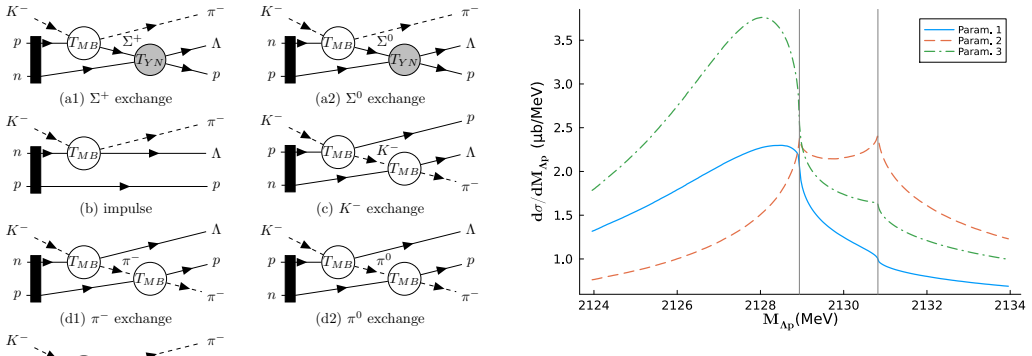
The Λp invariant mass spectrum in the K^-d to π^-Λp reaction shows threshold structures sensitive to the ΛN-ΣN coupled-channel interaction.
A machine-rendered reading of the paper's core claim, the machinery that carries it, and where it could break.
Core claim
The spin-triplet ΣN to Λp conversion amplitude, constructed in the K-matrix formalism from isospin-basis scattering lengths, produces characteristic structures around the ΣN thresholds in the Λp invariant mass spectrum of the K^-d → π^-Λp reaction. These structures vary with the choice of ΣN scattering lengths, especially the sign of the real part of the I=1/2 length, and remain visible after background diagrams are included, making the spectrum a useful observable for constraining the coupled ΛN-ΣN interaction.
What carries the argument
The K-matrix formalism for the spin-triplet ΣN→Λp conversion amplitude parameterized by scattering lengths in the isospin basis, which produces the threshold structures through coupled-channel dynamics.
If this is right
- The shape of the threshold structure is especially sensitive to the sign of the real part of the I=1/2 ΣN scattering length.
- Different choices of the interaction parameters produce visibly different spectra around the ΣN thresholds.
- The Λp invariant mass spectrum can serve as an observable to constrain the coupled-channel ΛN-ΣN interaction.
- Background contributions must be included to interpret the structures correctly.
Where Pith is reading between the lines
- Data from this reaction could supply new experimental bounds on hyperon-nucleon potentials needed for calculations of hypernuclei.
- The same final-state interaction mechanism might appear in other strangeness-production reactions near thresholds.
- Measuring the spectrum with better precision could distinguish between competing models of the YN force.
- If the structures match the predictions, it would confirm that coupled-channel effects dominate near the ΣN opening.
Load-bearing premise
The final-state ΛN-ΣN interaction dominates the threshold structures in the spectrum and the chosen background diagrams accurately capture all non-interacting contributions.
What would settle it
An experimental measurement of the Λp invariant mass spectrum from K^-d → π^-Λp that lacks the predicted threshold structures or shows shapes inconsistent with the model's dependence on the sign of the I=1/2 ΣN scattering length.
Figures

read the original abstract
The hyperon-nucleon interaction is investigated through the final-state interaction in the $K^-d\to\pi^-\Lambda p$ reaction. We focus on the $\Lambda N$-$\Sigma N$ coupled-channel interaction, which produces characteristic structures around the $\Sigma N$ thresholds in the $\Lambda p$ invariant mass spectrum. The spin-triplet $\Sigma N\to\Lambda p$ conversion amplitude is constructed within the $K$-matrix formalism using scattering lengths in the isospin basis. We first examine the dependence of the conversion amplitude on the $\Sigma N$ scattering lengths and find that the threshold structure is particularly sensitive to the sign of the real part of the $I=1/2$ scattering length. We then calculate the $\Lambda p$ invariant mass spectrum of the $K^-d\to\pi^-\Lambda p$ reaction, including the contributions from the background diagrams. The resulting spectra show characteristic structures around the $\Sigma N$ thresholds, whose shapes depend on the choice of the interaction parameters. These results suggest that the $\Lambda p$ invariant mass spectrum can serve as a useful observable for constraining the $\Lambda N$-$\Sigma N$ coupled-channel interaction.
Editorial analysis
A structured set of objections, weighed in public.
Referee Report
Summary. The manuscript claims that the Λp invariant mass spectrum in the K^-d → π^-Λp reaction exhibits characteristic structures around the ΣN thresholds due to the final-state ΛN-ΣN coupled-channel interaction. These structures are computed using a K-matrix formalism for the spin-triplet ΣN→Λp conversion amplitude based on isospin-basis scattering lengths, with inclusion of background diagrams. The spectrum shapes depend on the ΣN scattering lengths, particularly the sign of Re(a_{I=1/2}), suggesting the observable can constrain the interaction.
Significance. If the model's assumptions hold, the work identifies a potentially useful experimental observable for probing the hyperon-nucleon interaction, which remains poorly constrained. The sensitivity analysis to scattering length parameters provides a concrete prediction for how different interaction strengths manifest in the spectrum, contributing to the field of strangeness nuclear physics by linking reaction dynamics to two-body interactions.
major comments (3)
- The background diagrams are included in the spectrum calculation without any systematic study of their variations or associated uncertainties. This is load-bearing for the central claim, as the dominance of FSI in producing the threshold structures assumes these diagrams accurately capture all non-FSI contributions.
- No direct comparison is made to experimental data for the K^-d→π^-Λp reaction or to calculations using more complete coupled-channel potentials beyond the scattering length approximation. This weakens the assertion that the spectrum can serve as a useful constraint.
- The dependence on scattering lengths is explored, but the paper does not quantify potential contributions from higher partial waves or isospin-breaking effects near the thresholds, which could alter the reported sensitivity to the sign of Re(a_{I=1/2}).
minor comments (2)
- Ensure consistent notation for the scattering lengths (e.g., a_{I=1/2}) throughout the text and figures.
- The abstract mentions 'background diagrams' but the main text should provide more explicit description or references to their construction.
Simulated Author's Rebuttal
We thank the referee for the careful reading and valuable comments on our manuscript. We have addressed the major concerns point by point below, making revisions where necessary to strengthen the presentation.
read point-by-point responses
-
Referee: The background diagrams are included in the spectrum calculation without any systematic study of their variations or associated uncertainties. This is load-bearing for the central claim, as the dominance of FSI in producing the threshold structures assumes these diagrams accurately capture all non-FSI contributions.
Authors: We acknowledge that a more detailed uncertainty analysis on the background contributions would be beneficial. The background diagrams are calculated using the impulse approximation with standard meson-exchange vertices, which have been validated in similar reactions. To address this, we have added a new subsection discussing the relative magnitude of background terms and their sensitivity to parameter variations, showing that they do not alter the qualitative threshold structures induced by the FSI. This supports our claim that the observed features are primarily due to the coupled-channel interaction. revision: yes
-
Referee: No direct comparison is made to experimental data for the K^-d→π^-Λp reaction or to calculations using more complete coupled-channel potentials beyond the scattering length approximation. This weakens the assertion that the spectrum can serve as a useful constraint.
Authors: The primary goal of this work is to propose the Λp invariant mass spectrum as a potential observable for constraining the hyperon-nucleon interaction, rather than to perform a full data analysis or benchmark against advanced potentials. Existing experimental data on this reaction is limited and not focused on the threshold region. We have included references to related experimental efforts and discussed how our scattering length approach approximates the low-energy behavior of more complete models, such as those based on chiral effective field theory. This maintains the focus on the novel sensitivity to scattering lengths while noting the approximations. revision: no
-
Referee: The dependence on scattering lengths is explored, but the paper does not quantify potential contributions from higher partial waves or isospin-breaking effects near the thresholds, which could alter the reported sensitivity to the sign of Re(a_{I=1/2}).
Authors: Near threshold, contributions from higher partial waves are kinematically suppressed due to the centrifugal barrier, with p-wave effects estimated to be less than 10% in the relevant energy range based on phase shift analyses. Isospin-breaking effects from electromagnetic interactions and mass differences are small, on the order of a few percent, and do not change the sign dependence of the real part of the I=1/2 scattering length. We have added a paragraph with these estimates in the revised manuscript to quantify their impact. revision: yes
Circularity Check
No circularity: scattering lengths are independent external inputs; spectrum is a forward calculation.
full rationale
The derivation takes isospin-basis scattering lengths as given parameters, builds the K-matrix conversion amplitude from them, and computes the Λp invariant mass spectrum by adding chosen background diagrams. The resulting structures vary with the input parameters, but no quantity is fitted inside the paper, no self-referential definition equates output to input, and no load-bearing step reduces to a self-citation or ansatz smuggled from prior work by the same authors. The claim that the spectrum can constrain the interaction is therefore a genuine prediction rather than a tautology.
Axiom & Free-Parameter Ledger
free parameters (1)
- ΣN scattering lengths (real and imaginary parts, I=1/2 and I=3/2)
axioms (2)
- domain assumption K-matrix formalism provides an accurate description of the coupled-channel ΛN-ΣN interaction near thresholds
- domain assumption Background diagrams can be reliably separated from the final-state interaction contribution
Reference graph
Works this paper leans on
-
[1]
Chatterjee, Debarati, Vidaña, Isaac, Do hyperons exist in the interior of neutron stars?, Eur. Phys. J. A 52 (2) (2016) 29
2016
-
[2]
Nemura, Y
H. Nemura, Y . Akaishi, Y . Suzuki, Ab initio approach to s-shell hypernuclei 3 ΛH, 4 ΛH, 4 ΛHe, and 5 ΛHe with aΛN−ΣN interaction, Phys. Rev. Lett. 89 (2002) 142504
2002
-
[3]
Acharya, et al.,p−p,p−Λ, andΛ−Λcorrelations studied via femtoscopy inppreactions at √s=7 TeV, Phys
S. Acharya, et al.,p−p,p−Λ, andΛ−Λcorrelations studied via femtoscopy inppreactions at √s=7 TeV, Phys. Rev. C 99 (2019) 024001
2019
-
[4]
Acharya, et al., Investigation of thep−Σ 0 interaction via femtoscopy in pp collisions, Physics Letters B 805 (2020) 135419
S. Acharya, et al., Investigation of thep−Σ 0 interaction via femtoscopy in pp collisions, Physics Letters B 805 (2020) 135419
2020
-
[5]
Budzanowski, et al., High resolution study of theλp final state interaction in the reaction p+p→K + +(Λp), Physics Letters B 687 (1) (2010) 31
A. Budzanowski, et al., High resolution study of theλp final state interaction in the reaction p+p→K + +(Λp), Physics Letters B 687 (1) (2010) 31
2010
-
[6]
Iizawa, D
Y . Iizawa, D. Jido, T. Ishikawa,K −d→πΛNreaction for studying charge symmetry breaking in theΛNinteraction, Phys. Rev. C 106 (4) (2022) 045201
2022
-
[7]
Yasunaga, D
S. Yasunaga, D. Jido, T. Ishikawa,K −d→πΛNreaction with in-flight kaons for studying theΛNinteraction, Phys. Rev. C 112 (2025) 015208
2025
-
[8]
Yasunaga, D
S. Yasunaga, D. Jido, Theoretical study of theΣNcusp in theK −d→πΛNreaction, PoS QNP2024 465 (2025) 101
2025
-
[9]
Ichikawa, et al., High resolution spectroscopy of the “ΣN cusp” by using the d(K-,Π−) reaction, EPJ Web Conf
Y . Ichikawa, et al., High resolution spectroscopy of the “ΣN cusp” by using the d(K-,Π−) reaction, EPJ Web Conf. 271 (2022) 02012
2022
-
[10]
Yasunaga, D
S. Yasunaga, D. Jido, in preparation
-
[11]
Kamano, S
H. Kamano, S. X. Nakamura, T.-S. H. Lee, T. Sato, Dy- namical coupled-channels model ofK − preactions: De- termination of partial-wave amplitudes, Phys. Rev. C 90 (2014) 065204
2014
-
[12]
Machleidt, High-precision, charge-dependent Bonn nucleon-nucleon potential, Phys
R. Machleidt, High-precision, charge-dependent Bonn nucleon-nucleon potential, Phys. Rev. C 63 (2) (2001) 024001
2001
-
[13]
Th. A. Rijken, V . G. J. Stoks, Y . Yamamoto, Soft-core hyperon-nucleon potentials, Phys. Rev. C 59 (1) (1999) 21
1999
-
[14]
Haidenbauer, U.-G
J. Haidenbauer, U.-G. Meißner, Jülich hyperon-nucleon model revisited, Phys. Rev. C 72 (4) (2005) 044005
2005
-
[15]
Haidenbauer, U.-G
J. Haidenbauer, U.-G. Meißner, A. Nogga, H. Le, Hy- peron–nucleon interaction in chiral effective field theory at next-to-next-to-leading order, Eur. Phys. J. A 59 (3) (2023) 63. 4
2023
discussion (0)
Sign in with ORCID, Apple, or X to comment. Anyone can read and Pith papers without signing in.