Recognition: unknown
DESI and Gravitational Wave Constraints Challenge Quintessential {α}-Attractor Inflation
Pith reviewed 2026-05-09 18:47 UTC · model grok-4.3
The pith
Quintessential alpha-attractor inflation models are disfavored once DESI dark-energy data are combined with bounds on gravitational-wave contributions to Delta N_eff.
A machine-rendered reading of the paper's core claim, the machinery that carries it, and where it could break.
Core claim
Alpha-attractor quintessential inflation predicts that the kination epoch after inflation produces an enhanced high-frequency gravitational-wave background whose energy density adds to Delta N_eff; enforcing the upper bound on this contribution while fitting the scalar spectral index to CMB data and the dark-energy evolution to DESI observations requires an ns value too small to remain consistent, thereby ruling out the models.
What carries the argument
The kination phase of kinetic-energy domination by the scalar field, whose duration and amplitude determine the high-frequency enhancement of the primordial gravitational-wave spectrum that contributes to Delta N_eff.
Load-bearing premise
The gravitational waves generated during kination contribute directly to Delta N_eff without substantial damping or alteration from reheating physics or other mechanisms.
What would settle it
A future measurement that finds both a scalar spectral index above the value forced by the Delta N_eff bound and a dark-energy equation of state matching DESI data, with no excess relativistic degrees of freedom, would show the models remain viable.
Figures






read the original abstract
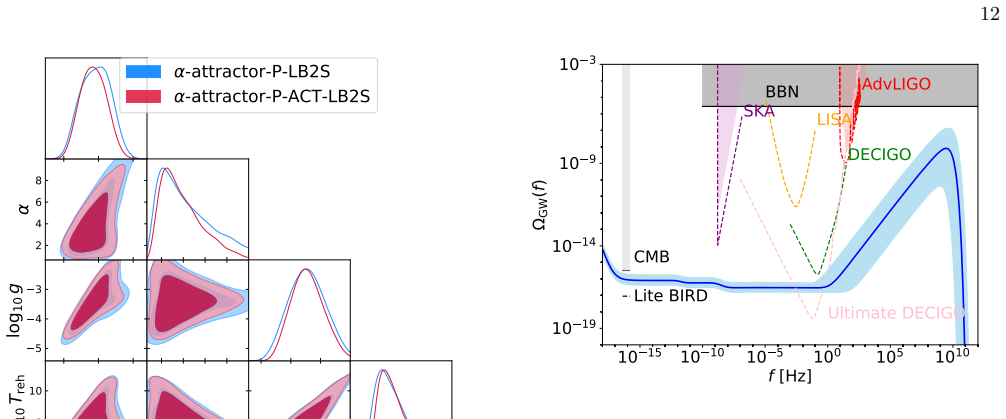
Quintessential inflation models provide a framework that simultaneously describes inflation and dynamical dark energy, the latter of which has recently received growing support from DESI observations. A distinctive feature of these models is the kination phase after inflation, which enhances primordial gravitational waves at high frequencies. In this work, we study a class of alpha-attractor quintessential inflation models using a fully numerical approach that follows the scalar-field evolution from inflation to the dark-energy-dominated era, allowing us to compute with high precision both the dynamics of dark energy and the primordial gravitational wave spectrum. Using the latest observational data, including DESI and ACT, we constrain the model parameters and show that the model becomes disfavored once constraints from the gravitational-wave contribution to the effective number of relativistic degrees of freedom, {\Delta} Neff, are included. This is because the model predicts a scalar spectral index ns that becomes too small to remain consistent with observations when the gravitational-wave abundance is constrained to stay below the {\Delta} Neff bound. Finally, we present the resulting primordial gravitational wave power spectrum computed using our constrained parameter values, which highlights prospects for detection by future CMB B-mode experiments at low frequencies and by gravitational-wave interferometer experiments at high frequencies.
Editorial analysis
A structured set of objections, weighed in public.
Referee Report
Summary. The manuscript numerically evolves α-attractor quintessential inflation models from inflation through a kination phase to dark-energy domination. It combines DESI and ACT constraints on the dark-energy equation of state with bounds on ΔN_eff arising from kination-enhanced primordial gravitational waves, concluding that the resulting scalar spectral index n_s falls below the CMB lower limit, thereby disfavoring the models. The work also presents the predicted GW spectrum for future detection.
Significance. If the numerical mapping from ΔN_eff-constrained kination to the total e-fold count N (and hence n_s) is robust, the result would tighten constraints on quintessential inflation scenarios that unify early- and late-time acceleration. The fully numerical treatment spanning inflation to DE domination is a methodological strength that avoids piecemeal approximations common in the literature.
major comments (2)
- [§3] §3 (numerical evolution of the scalar field): the central claim that ΔN_eff bounds force n_s below the observational lower limit rests on the numerically computed total e-fold number N during kination. No comparison is shown to the known analytic kination solution (constant w=1 with instantaneous transition to radiation domination), leaving open the possibility that integrator or matching errors shift N by O(1) and thereby alter n_s at the level of current CMB uncertainties (~0.004).
- [Results and discussion] Results and discussion (parameter constraints with DESI/ACT + ΔN_eff): the abstract asserts that the model is disfavored once ΔN_eff is included, yet the manuscript provides neither tabulated posterior constraints, χ² differences, nor a quantitative measure of tension between the ΔN_eff-forced n_s and the CMB lower bound. This quantitative gap makes it difficult to judge whether the disfavoring is decisive or merely a mild tension.
minor comments (2)
- [Abstract] The abstract and introduction use “disfavored” without specifying the statistical threshold; a brief clarification of the adopted criterion would improve readability.
- [Figures] Figure captions for the GW spectrum should explicitly state the frequency range and the corresponding experiments (e.g., CMB-S4, LISA) to which each segment is relevant.
Simulated Author's Rebuttal
We are grateful to the referee for their detailed and constructive feedback on our manuscript. We respond to each major comment below and indicate the changes made in the revised version.
read point-by-point responses
-
Referee: [§3] §3 (numerical evolution of the scalar field): the central claim that ΔN_eff bounds force n_s below the observational lower limit rests on the numerically computed total e-fold number N during kination. No comparison is shown to the known analytic kination solution (constant w=1 with instantaneous transition to radiation domination), leaving open the possibility that integrator or matching errors shift N by O(1) and thereby alter n_s at the level of current CMB uncertainties (~0.004).
Authors: We thank the referee for this important observation. Our numerical code has been cross-checked against known analytic limits in the literature for kination phases, but we agree that an explicit comparison in the paper would be beneficial. In the revised manuscript, we have added a new paragraph in §3 that compares the numerically evolved e-fold count during kination to the analytic result for a constant equation of state w=1 with an instantaneous transition to radiation domination. The difference is found to be ΔN ≈ 0.05, which is well below the threshold that would affect n_s at the level of CMB uncertainties. This addition confirms the robustness of our results. revision: yes
-
Referee: [Results and discussion] Results and discussion (parameter constraints with DESI/ACT + ΔN_eff): the abstract asserts that the model is disfavored once ΔN_eff is included, yet the manuscript provides neither tabulated posterior constraints, χ² differences, nor a quantitative measure of tension between the ΔN_eff-forced n_s and the CMB lower bound. This quantitative gap makes it difficult to judge whether the disfavoring is decisive or merely a mild tension.
Authors: We acknowledge that the presentation of our results could be improved by including more quantitative details. In the revised manuscript, we have added a table in the Results section that reports the best-fit parameters and 1σ constraints from the combined DESI+ACT+ΔN_eff dataset, as well as the χ² values for the model with and without the ΔN_eff constraint. Additionally, we have computed and reported the tension between the predicted n_s and the CMB lower limit, finding it to be approximately 3.5σ when ΔN_eff is included. This quantifies the disfavoring and supports the conclusions in the abstract. revision: yes
Circularity Check
No significant circularity; external data constrain model predictions
full rationale
The paper computes ns from the total e-fold number N obtained via numerical integration of the α-attractor scalar field through inflation, kination, and dark-energy domination; it separately computes the GW spectrum amplitude during kination to obtain ΔNeff. These outputs are then compared against independent external datasets (DESI, ACT, Planck, and ΔNeff bounds). No equation or parameter is defined in terms of the target observables, no fitted quantity is relabeled as a prediction, and no load-bearing step reduces to a self-citation or ansatz imported from the authors' prior work. The central claim therefore rests on the mapping from model parameters to observables plus external constraints, which is not circular by construction.
Axiom & Free-Parameter Ledger
free parameters (2)
- alpha
- potential shape parameters
axioms (2)
- standard math Friedmann and Klein-Gordon equations govern the scalar-field evolution
- domain assumption Kination phase after inflation enhances primordial GW without significant damping
Reference graph
Works this paper leans on
-
[1]
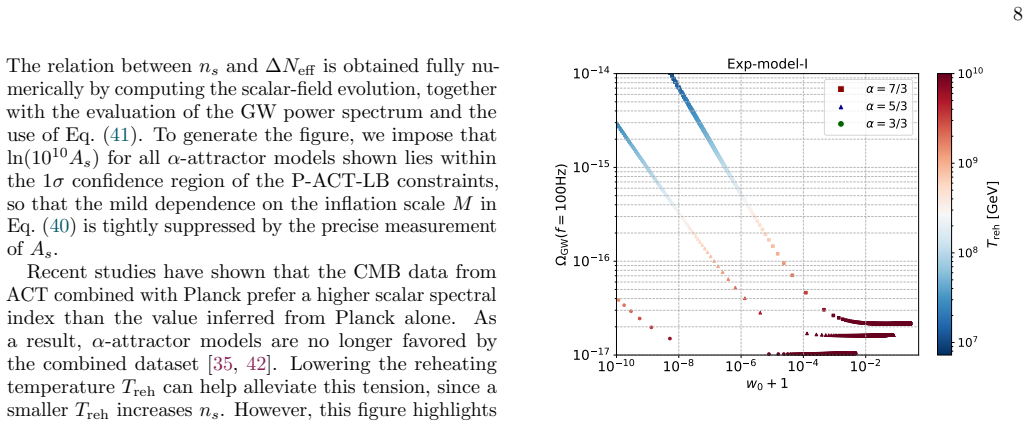
Finally, we obtain ΩGW(k) := 1 ρc dρGW d lnk = k4 3π2M2 PlH2a4 |βk|2.(37) B. Numerical result To compute the GW spectrum Ω GW(k), first, we nu- merically solve Eqs. (19)-(24) to obtain the evolution of the scale factor a(τ). The EOS parameter smoothly transitions from −1 (inflation) to 1 (kination) and then to 1/3 (radiation), with the detailed behavior d...
-
[2]
Planck 2018 results. VI. Cosmological parameters
N. Aghanimet al.(Planck), Astron. Astrophys.641, A6 (2020), [Erratum: Astron.Astrophys. 652, C4 (2021)], arXiv:1807.06209 [astro-ph.CO]
work page internal anchor Pith review arXiv 2020
-
[3]
Perlmutter, G
S. Perlmutter, G. Aldering, G. Goldhaber, R. A. Knop, P. Nugent, P. G. Castro, S. Deustua, S. Fabbro, A. Goo- bar, D. E. Groom, I. M. Hook, A. G. Kim, M. Y. Kim, J. C. Lee, N. J. Nunes, R. Pain, C. R. Pennypacker, R. Quimby, C. Lidman, R. S. Ellis, M. Irwin, R. G. McMahon, P. Ruiz- Lapuente, N. Walton, B. Schaefer, B. J. Boyle, A. V. Filippenko, T. Mathes...
1999
-
[4]
A. G. Riess, A. V. Filippenko, P. Challis, A. Clocchiatti, A. Diercks, P. M. Garnavich, R. L. Gilliland, C. J. Hogan, S. Jha, R. P. Kirshner, B. Leibundgut, M. M. Phillips, D. Reiss, B. P. Schmidt, R. A. Schommer, R. C. Smith, J. Spyromilio, C. Stubbs, N. B. Suntzeff, and J. Tonry, The Astronomical Journal116, 1009–1038 (1998)
1998
-
[5]
L. Perivolaropoulos and F. Skara, New Astron. Rev.95, 101659 (2022), arXiv:2105.05208 [astro-ph.CO]
-
[6]
A. G. Riesset al., Astrophys. J. Lett.934, L7 (2022), arXiv:2112.04510 [astro-ph.CO]
work page internal anchor Pith review arXiv 2022
-
[7]
Heymans, T
C. Heymans, T. Tr¨ oster, M. Asgari, C. Blake, H. Hilde- brandt, B. Joachimi, K. Kuijken, C.-A. Lin, A. G. S´ anchez, J. L. van den Busch, A. H. Wright, A. Amon, M. Bil- icki, J. de Jong, M. Crocce, A. Dvornik, T. Erben, M. C. Fortuna, F. Getman, B. Giblin, K. Glazebrook, H. Hoek- stra, S. Joudaki, A. Kannawadi, F. K¨ ohlinger, C. Lidman, L. Miller, N. R....
2021
-
[8]
A. G. Adameet al.(DESI), (2024), arXiv:2404.03002 [astro-ph.CO]
work page internal anchor Pith review arXiv 2024
-
[9]
M. Abdul Karim and et al. (DESI), Physical Review D 112(2025), 10.1103/tr6y-kpc6
-
[10]
Sasaki, Progress of Theoretical Physics76, 1036 (1986)
M. Sasaki, Progress of Theoretical Physics76, 1036 (1986)
1986
-
[11]
Linde, Phys
A. Linde, Phys. Lett. B108, 389 (1982)
1982
-
[12]
A. H. Guth, Phys. Rev. D23, 347 (1981)
1981
-
[13]
Linde, Phys
A. Linde, Phys. Lett. B129, 177 (1983)
1983
-
[14]
A. R. Liddle, P. Parsons, and J. D. Barrow, Phys. Rev. D50, 7222 (1994)
1994
-
[15]
P. J. E. Peebles and A. Vilenkin, Physical Review D59, 063505 (1999)
1999
-
[16]
Kofman, A
L. Kofman, A. Linde, and A. Starobinsky, Physical Re- view D56, 3258 (1997)
1997
-
[17]
L. Arest´ e Sal´ o, D. Benisty, E. I. Guendelman, and J. de Haro, Phys. Rev. D103, 123535 (2021), arXiv:2103.07892 [astro-ph.CO]
-
[18]
de Haro and L
J. de Haro and L. Areste Salo, Galaxies9, 73 (2021)
2021
- [19]
- [20]
-
[21]
Felder, L
G. Felder, L. Kofman, and A. Linde, Phys. Rev. D59, 123523 (1999)
1999
-
[22]
Dimopoulos, L
K. Dimopoulos, L. D. Wood, and C. Owen, Phys. Rev. D97, 063525 (2018)
2018
-
[23]
Feng and M
B. Feng and M. Li, Physics Letters B564, 169 (2003)
2003
-
[24]
M. Giovannini, Phys. Rev. D58, 083504 (1998), arXiv:hep- ph/9806329
- [25]
-
[26]
M. Giovannini, Phys. Rev. D60, 123511 (1999), arXiv:astro-ph/9903004
-
[27]
M. Giovannini, Class. Quant. Grav.16, 2905 (1999), arXiv:hep-ph/9903263
-
[28]
M. Giovannini, Class. Quant. Grav.26, 045004 (2009), arXiv:0807.4317 [astro-ph]
- [29]
- [30]
-
[31]
H. Tashiro, T. Chiba, and M. Sasaki, Class. Quant. Grav. 21, 1761 (2004), arXiv:gr-qc/0307068
- [32]
- [33]
-
[34]
Akrami, S
Y. Akrami, S. Casas, S. Deng, and V. Vardanyan, Journal of Cosmology and Astroparticle Physics2021, 006 (2021)
2021
-
[35]
S. Bhattacharya, K. Dutta, M. R. Gangopadhyay, and A. Maharana, Phys. Rev. D107, 103530 (2023), arXiv:2212.13363 [astro-ph.CO]
-
[36]
R. Kallosh, A. Linde, and D. Roest, Phys. Rev. Lett. 135, 161001 (2025), arXiv:2503.21030 [hep-th]
-
[37]
R. Kallosh and A. Linde, Gen. Rel. Grav.57, 135 (2025), arXiv:2505.13646 [hep-th]
- [38]
-
[39]
S. Maity, Phys. Lett. B870, 139913 (2025), arXiv:2505.10534 [astro-ph.CO]. 15
work page internal anchor Pith review Pith/arXiv arXiv 2025
- [40]
-
[41]
H. Heidarian, M. Solbi, S. Heydari, and K. Karami, Phys. Lett. B869, 139833 (2025), arXiv:2506.10547 [astro- ph.CO]
- [42]
-
[43]
L. Iacconi, S. Bhattacharya, M. Fasiello, and D. Wands, (2025), arXiv:2511.14673 [astro-ph.CO]
-
[44]
Alestas, M
G. Alestas, M. Caldarola, S. Kuroyanagi, and S. Nesseris, Physical Review D111, 083506 (2025)
2025
-
[45]
M. Wali Hossain, R. Myrzakulov, M. Sami, and E. N. Saridakis, Int. J. Mod. Phys. D24, 1530014 (2015), arXiv:1410.6100 [gr-qc]
-
[46]
K. Dimopoulos and C. Owen, JCAP06, 027 (2017), arXiv:1703.00305 [gr-qc]
- [47]
-
[48]
E. Calabreseet al.(Atacama Cosmology Telescope), JCAP11, 063 (2025), arXiv:2503.14454 [astro-ph.CO]
-
[49]
S. Goldstein and J. C. Hill, (2026), arXiv:2603.13226 [astro-ph.CO]
-
[50]
S. Kuroyanagi, T. Chiba, and N. Sugiyama, Phys. Rev. D79, 103501 (2009), arXiv:0804.3249 [astro-ph]
-
[51]
S. Kuroyanagi and T. Takahashi, JCAP10, 006 (2011), arXiv:1106.3437 [astro-ph.CO]
-
[52]
S. Pi, M. Sasaki, A. Wang, and J. Wang, Phys. Rev. D 110, 103529 (2024)
2024
- [53]
-
[54]
The Atacama Cosmology Telescope: DR6 Power Spectra, Likelihoods and $\Lambda$CDM Parameters
T. Louiset al.(Atacama Cosmology Telescope), JCAP 11, 062 (2025), arXiv:2503.14452 [astro-ph.CO]
work page internal anchor Pith review arXiv 2025
-
[55]
S. Ferrara and R. Kallosh, Phys. Rev. D94, 126015 (2016), arXiv:1610.04163 [hep-th]
-
[56]
R. Kallosh, A. Linde, T. Wrase, and Y. Yamada, JHEP 04, 144 (2017), arXiv:1704.04829 [hep-th]
-
[57]
R. Kallosh, A. Linde, D. Roest, and Y. Yamada, JHEP 07, 057 (2017), arXiv:1705.09247 [hep-th]
-
[58]
Dimopoulos and C
K. Dimopoulos and C. Owen, Journal of Cosmology and Astroparticle Physics2017, 027 (2017)
2017
-
[59]
Kofman, A
L. Kofman, A. Linde, X. Liu, A. Maloney, L. McAllister, and E. Silverstein, J. High Energy Phys.2004, 030 (2004)
2004
-
[60]
T. Zhumabek, M. Denissenya, and E. V. Linder, Journal of Cosmology and Astroparticle Physics2023, 013 (2023), arXiv:2306.03154 [astro-ph]
-
[61]
S. Kuroyanagi, K. Nakayama, and S. Saito, Phys. Rev. D84, 123513 (2011), arXiv:1110.4169 [astro-ph.CO]
-
[62]
N. Seto and J. Yokoyama, J. Phys. Soc. Jap.72, 3082 (2003), arXiv:gr-qc/0305096
-
[63]
S. Weinberg, Phys. Rev. D69, 023503 (2004), arXiv:astro- ph/0306304
-
[64]
Y. Watanabe and E. Komatsu, Phys. Rev. D73, 123515 (2006), arXiv:astro-ph/0604176
- [65]
-
[66]
Caprini and D
C. Caprini and D. G. Figueroa, Classical and Quantum Gravity35, 163001 (2018)
2018
- [67]
- [68]
-
[69]
Lewis, A
A. Lewis, A. Challinor, and A. Lasenby, The Astrophysi- cal Journal538, 473–476 (2000)
2000
-
[70]
Howlett, A
C. Howlett, A. Lewis, A. Hall, and A. Challinor, Journal of Cosmology and Astroparticle Physics2012, 027–027 (2012)
2012
- [71]
-
[72]
Torrado and A
J. Torrado and A. Lewis, Journal of Cosmology and As- troparticle Physics2021, 057 (2021). [72]https://ascl.net/1910.019
2021
-
[73]
A. Heavens, Y. Fantaye, A. Mootoovaloo, H. Eggers, Z. Hosenie, S. Kroon, and E. Sellentin, (2017), arXiv:1704.03472 [stat.CO]
-
[74]
Allyset al.(LiteBIRD), PTEP2023, 042F01 (2023), arXiv:2202.02773 [astro-ph.IM]
E. Allyset al.(LiteBIRD), PTEP2023, 042F01 (2023), arXiv:2202.02773 [astro-ph.IM]
- [75]
-
[76]
S. Kuroyanagi, K. Nakayama, and J. Yokoyama, PTEP 2015, 013E02 (2015), arXiv:1410.6618 [astro-ph.CO]
-
[77]
Berlin, D
A. Berlin, D. Blas, R. T. D’Agnolo, S. A. R. Ellis, R. Harnik, Y. Kahn, and J. Sch¨ utte-Engel, Phys. Rev. D105, 116011 (2022)
2022
-
[78]
K. Dimopoulos and T. Markkanen, Journal of Cos- mology and Astroparticle Physics2018, 021 (2018), arXiv:1803.07399 [gr-qc]
discussion (0)
Sign in with ORCID, Apple, or X to comment. Anyone can read and Pith papers without signing in.