Recognition: unknown
A Resource-Efficient Variational Quantum Framework for the Traveling Salesman Problem
Pith reviewed 2026-05-09 19:44 UTC · model grok-4.3
The pith
A variational quantum framework solves small TSP instances using O(n log n) qubits and divide-and-conquer with up to 100% success rates.
A machine-rendered reading of the paper's core claim, the machinery that carries it, and where it could break.
Core claim
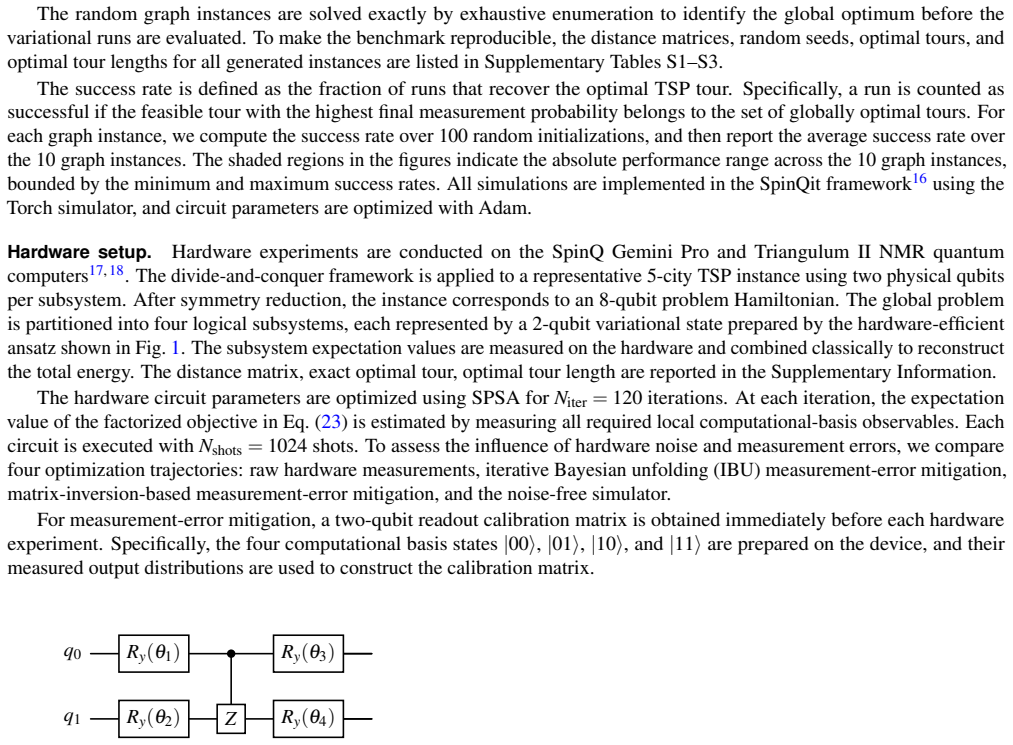
The framework combines compact binary-register encoding to represent permutations efficiently, a permutation-preserving ansatz tailored to the problem, and a divide-and-conquer strategy that decomposes the TSP into local subproblems solved variationally with classical post-processing to assemble the full solution. This setup achieves best average success rates of 100% on 4-city and 5-city TSP instances and 95.5% on 6-city instances in numerical simulations. The divide-and-conquer approximation was implemented locally with two qubits and tested on SpinQ NMR quantum computers for a 5-city instance.
What carries the argument
Compact binary-register encoding of city permutations paired with a permutation-preserving variational ansatz and divide-and-conquer execution that reduces per-run qubit demand to subsystem size.
Load-bearing premise
The permutation-preserving ansatz and divide-and-conquer strategy together preserve enough solution quality that the variational optimizer finds good or optimal tours without major loss from the full-problem encoding.
What would settle it
Executing the method on a 7-city TSP instance and finding that the best average success rate falls below 80% despite extensive optimization would indicate the approach does not maintain high quality as problem size increases.
Figures


read the original abstract
The Traveling Salesman Problem (TSP) is a prototypical combinatorial optimization problem, but its quantum implementation is limited by the O(n^2)-qubit overhead of standard one-hot encodings. Here, we propose a resource-efficient variational quantum framework based on compact binary-register encoding, a permutation-preserving problem-inspired ansatz, and a complementary divide-and-conquer execution strategy. The compact encoding reduces the data-qubit requirement to O(n log n), while the divide-and-conquer formulation lowers the number of qubits required in each local hardware execution to the size of the largest subsystem. Numerical simulations on TSP instances with 4, 5, and 6 cities achieve best average success rates of 100%, 100%, and 95.5%, respectively. A local two-qubit implementation of the divide-and-conquer approximation is further evaluated for a 5-city TSP instance on SpinQ Gemini Pro and SpinQ Triangulum II NMR quantum computers. Taken together, the results indicate how compact encoding and divide-and-conquer execution with classical post-processing can be used to study small combinatorial optimization instances on resource-constrained quantum hardware.
Editorial analysis
A structured set of objections, weighed in public.
Referee Report
Summary. The paper proposes a variational quantum framework for the Traveling Salesman Problem that employs compact binary-register encoding (reducing qubits to O(n log n)), a permutation-preserving problem-inspired ansatz, and a divide-and-conquer execution strategy with classical post-processing. Numerical simulations report best average success rates of 100%, 100%, and 95.5% for TSP instances with 4, 5, and 6 cities, respectively, while a local two-qubit implementation of the divide-and-conquer step is demonstrated on SpinQ Gemini Pro and Triangulum II NMR quantum computers for a 5-city instance.
Significance. If the reported success rates and hardware results hold under detailed scrutiny, the work illustrates a practical route to studying small combinatorial optimization problems on severely resource-constrained near-term hardware by combining compact encoding with subsystem decomposition. The permutation-preserving ansatz and divide-and-conquer approach are strengths that could generalize to other permutation-based problems.
major comments (2)
- [Abstract] Abstract and results section: the reported best average success rates (100%, 100%, 95.5%) lack accompanying details on the number of distinct TSP instances tested per city count, the specific variational optimizer and its hyperparameters, number of optimization runs, convergence criteria, or any statistical measures such as standard deviations or error bars. Without these, it is impossible to determine whether the high rates reflect robust performance or favorable instance selection and exhaustive search in the reduced space.
- [Hardware demonstration] Hardware demonstration section: the two-qubit local implementation on the SpinQ NMR devices for the 5-city divide-and-conquer step provides no information on circuit depth, gate fidelities, noise characterization, or how the classical post-processing reconstructs the global tour from subsystem results. This omission prevents assessment of whether the hardware run meaningfully validates the approximation beyond classical simulation.
minor comments (1)
- [Abstract] The abstract states 'best average success rates' without defining the averaging procedure or the baseline against which 'best' is measured; a brief clarification would improve readability.
Simulated Author's Rebuttal
We thank the referee for the careful reading and constructive major comments. We agree that additional experimental details are required for reproducibility and assessment of robustness. We will revise the manuscript to incorporate the requested information in both the abstract/results and hardware sections. Point-by-point responses follow.
read point-by-point responses
-
Referee: [Abstract] Abstract and results section: the reported best average success rates (100%, 100%, 95.5%) lack accompanying details on the number of distinct TSP instances tested per city count, the specific variational optimizer and its hyperparameters, number of optimization runs, convergence criteria, or any statistical measures such as standard deviations or error bars. Without these, it is impossible to determine whether the high rates reflect robust performance or favorable instance selection and exhaustive search in the reduced space.
Authors: We agree that the current presentation lacks sufficient detail for independent evaluation. In the revised manuscript we will expand the numerical results section (and update the abstract accordingly) to report: the number of distinct random TSP instances evaluated for each city count, the specific classical optimizer and its hyperparameters, the number of independent optimization runs per instance, the convergence tolerance employed, and statistical measures including standard deviations and error bars on the success rates. These additions will demonstrate that the quoted best-average figures are obtained from multiple instances and runs rather than exhaustive enumeration or cherry-picked cases. The variational nature of the approach (as opposed to exhaustive search) will also be emphasized. revision: yes
-
Referee: [Hardware demonstration] Hardware demonstration section: the two-qubit local implementation on the SpinQ NMR devices for the 5-city divide-and-conquer step provides no information on circuit depth, gate fidelities, noise characterization, or how the classical post-processing reconstructs the global tour from subsystem results. This omission prevents assessment of whether the hardware run meaningfully validates the approximation beyond classical simulation.
Authors: We acknowledge that the hardware section is currently too terse. In the revised manuscript we will augment this section with: the explicit circuit depth of the two-qubit divide-and-conquer circuit, the gate fidelities and coherence times reported by the SpinQ devices, a brief noise characterization, and a step-by-step description of the classical post-processing routine that merges the local subsystem solutions into a global tour. These additions will allow readers to judge the extent to which the hardware execution validates the divide-and-conquer approximation beyond pure simulation. revision: yes
Circularity Check
No significant circularity
full rationale
The paper proposes a compact binary encoding, permutation-preserving ansatz, and divide-and-conquer strategy for variational quantum TSP solving. All performance claims rest on explicit numerical simulations for n=4-6 instances and a 2-qubit hardware run, with success rates reported as direct empirical outcomes rather than derived predictions. No equations reduce by construction to fitted parameters renamed as forecasts, no ansatz is defined circularly in terms of the target solution, and no load-bearing uniqueness theorem or result is imported solely via self-citation. The framework is self-contained against external benchmarks (simulation and hardware data), satisfying the criteria for an honest non-finding of circularity.
Axiom & Free-Parameter Ledger
Reference graph
Works this paper leans on
-
[1]
Papadimitriou, C. H. & Steiglitz, K.Combinatorial optimization: algorithms and complexity(Courier Corporation, 1998)
1998
-
[2]
& Karp, R
Held, M. & Karp, R. M. A dynamic programming approach to sequencing problems.J. Soc. for Ind. Appl. mathematics10, 196–210 (1962)
1962
-
[3]
L., Bixby, R
Applegate, D. L., Bixby, R. E., Chvátal, V . & Cook, W. J. The traveling salesman problem: a computational study. InThe traveling salesman problem(Princeton university press, 2011). 4.Preskill, J. Quantum computing in the nisq era and beyond.Quantum2, 79 (2018)
2011
-
[4]
Cerezo, M.et al.Variational quantum algorithms.Nat. Rev. Phys.3, 625–644, DOI: 10.1038/s42254-021-00348-9 (2021)
-
[5]
Bharti, K.et al.Noisy intermediate-scale quantum algorithms.Rev. Mod. Phys.94, 015004, DOI: 10.1103/RevModPhys. 94.015004 (2022)
-
[6]
communications5, 4213 (2014)
Peruzzo, A.et al.A variational eigenvalue solver on a photonic quantum processor.Nat. communications5, 4213 (2014)
2014
-
[7]
A Quantum Approximate Optimization Algorithm
Farhi, E., Goldstone, J. & Gutmann, S. A quantum approximate optimization algorithm.arXiv preprint arXiv:1411.4028 (2014)
work page internal anchor Pith review Pith/arXiv arXiv 2014
-
[8]
Bourreau, E., Fleury, G. & Lacomme, P. Indirect quantum approximate optimization algorithms: application to the tsp. arXiv preprint arXiv:2311.03294(2023)
- [9]
-
[10]
& Bertels, K
Sarkar, A., Al-Ars, Z. & Bertels, K. Quaser: Quantum accelerated de novo dna sequence reconstruction.Plos one16, e0249850 (2021)
2021
-
[11]
PRX Life2, 023006, DOI: 10.1103/PRXLife.2.023006 (2024)
Fang, J.-K.et al.Divide-and-conquer quantum algorithm for hybrid denovo genome assembly of short and long reads. PRX Life2, 023006, DOI: 10.1103/PRXLife.2.023006 (2024). 13.Lucas, A. Ising formulations of many np problems.Front. Phys.2, 5, DOI: 10.3389/fphy.2014.00005 (2014). 11/12
-
[12]
Ramezani, M., Salami, S., Shokhmkar, M., Moradi, M. & Bahrampour, A. Reducing the number of qubits from n2 to nlog 2 n to solve the traveling salesman problem with quantum computers: A proposal for demonstrating quantum supremacy in the nisq era.arXiv preprint arXiv:2402.18530(2024)
-
[13]
Khait, I., Tham, E., Segal, D. & Brodutch, A. Variational quantum eigensolvers in the era of distributed quantum computers. Phys. Rev. A108, L050401, DOI: 10.1103/PhysRevA.108.L050401 (2023). 16.https://github.com/spinqtech/spinqit
-
[14]
8, 1–23 (2021)
Hou, S.-Y .et al.Spinq gemini: a desktop quantum computing platform for education and research.EPJ Quantum Technol. 8, 1–23 (2021)
2021
-
[15]
Mag.16, 20–29 (2022)
Feng, G.et al.Spinq triangulum: A commercial three-qubit desktop quantum computer.IEEE Nanotechnol. Mag.16, 20–29 (2022)
2022
-
[16]
& Yamashita, S
Matsuo, A., Suzuki, Y ., Hamamura, I. & Yamashita, S. Enhancing vqe convergence for optimization problems with problem-specific parameterized quantum circuits.IEICE TRANSACTIONS on Inf. Syst.106, 1772–1782 (2023)
2023
-
[17]
Bauer, W.et al.Scalable measurement error mitigation via iterative bayesian unfolding.Phys. Rev. Res.6, 013187, DOI: 10.1103/PhysRevResearch.6.013187 (2024)
-
[18]
Bravyi, S., Sheldon, S., Kandala, A., Mckay, D. C. & Gambetta, J. M. Mitigating measurement errors in multiqubit experiments.Phys. Rev. A103, 042605, DOI: 10.1103/PhysRevA.103.042605 (2021)
-
[19]
Nature Communications9(1) (2018) https:// doi.org/10.1038/s41467-018-07090-4
McClean, J. R., Boixo, S., Smelyanskiy, V . N., Babbush, R. & Neven, H. Barren plateaus in quantum neural network training landscapes.Nat. Commun.9, 4812, DOI: 10.1038/s41467-018-07090-4 (2018)
-
[20]
Chen, R., Zhou, G., Guo, C., Feng, G. & Hou, S.-Y . Pure quantum gradient descent algorithm and full quantum variational eigensolver.Front. Phys.19, 21202, DOI: 10.1007/s11467-023-1346-7 (2024). 12/12
discussion (0)
Sign in with ORCID, Apple, or X to comment. Anyone can read and Pith papers without signing in.