Recognition: unknown
Quantum simulation of nanographenes and Trotter error cancellation
Pith reviewed 2026-05-09 19:34 UTC · model grok-4.3
The pith
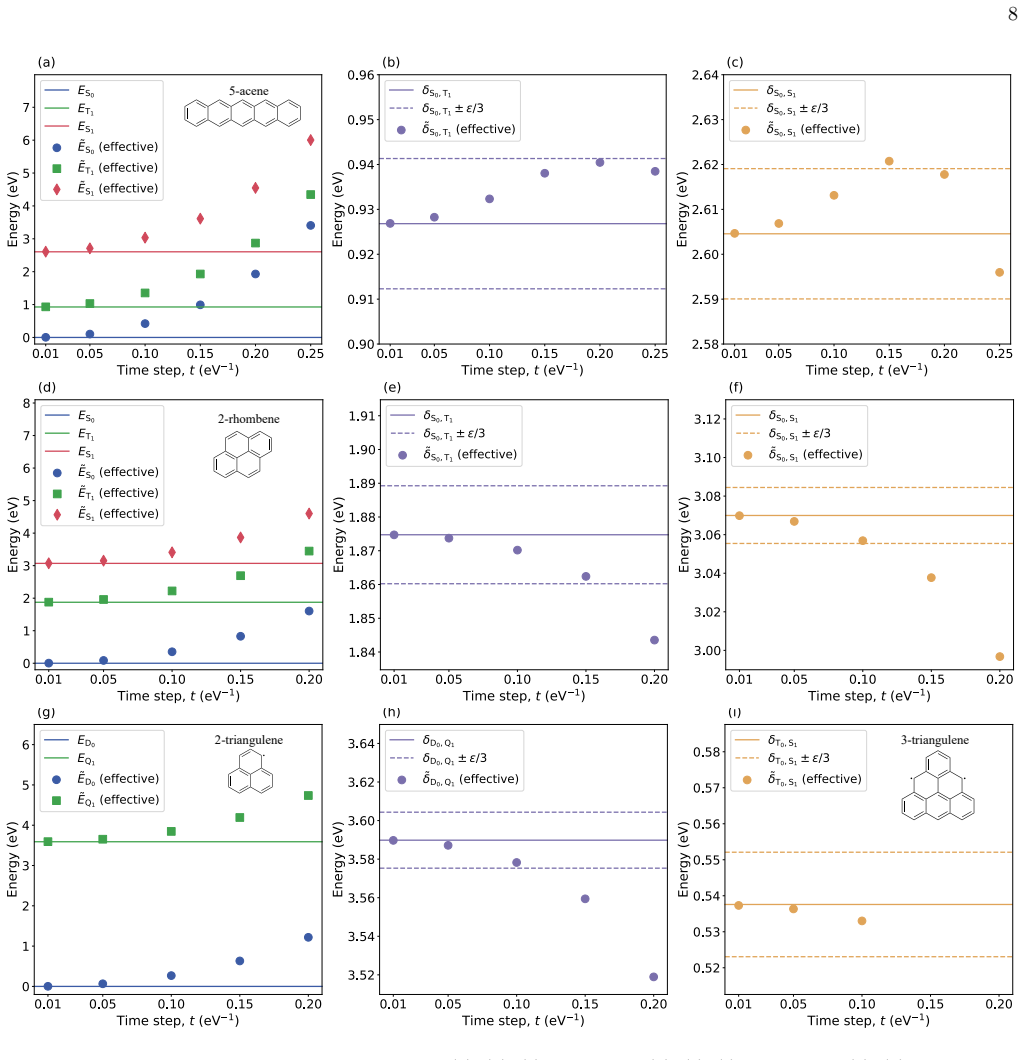
Trotterized quantum simulation of nanographenes exhibits error cancellation for energy differences, enabling an order of magnitude reduction in circuit depth for calculating gaps.
A machine-rendered reading of the paper's core claim, the machinery that carries it, and where it could break.
Core claim
In the quantum simulation of nanographene π-systems using Trotterized product formulas for the Pariser-Parr-Pople Hamiltonian, the Trotter error for energy differences between low-lying eigenstates is significantly smaller than for absolute energies due to a cancellation phenomenon, which is quantified using a tensor-network-based spectral analysis and results in approximately an order of magnitude reduction in circuit depth for quantum phase estimation of energy gaps, with resource estimates indicating fewer than 3.2 × 10^7 Toffoli gates for large 2D nanographenes up to 140 spin orbitals.
What carries the argument
Trotter error cancellation for energy eigenvalue differences in the Pariser-Parr-Pople model of nanographenes, revealed through tensor-network spectral analysis of product formulas.
If this is right
- Quantum phase estimation for energy gaps in these systems requires roughly 10 times smaller circuit depth than for absolute energies.
- Large nanographenes with up to 140 orbitals become simulatable with resource costs below 32 million Toffoli gates.
- Focus on chemically relevant observables like gaps allows substantial savings in fault-tolerant quantum computing resources.
- Trotter approximations can be chosen more aggressively when targeting differences rather than absolutes.
Where Pith is reading between the lines
- This cancellation may apply to other molecular Hamiltonians where only excitation energies or gaps are needed, potentially generalizing the resource savings.
- Tensor-network methods for error analysis could extend to studying other quantum algorithms beyond Trotterization.
- Hardware implementations might prioritize measuring energy differences to take advantage of natural error mitigations.
Load-bearing premise
The tensor-network-based spectral analysis accurately captures the Trotter eigenvalue errors for the nanographene models, and the observed cancellation persists at larger system sizes and Trotter orders needed for the resource estimates.
What would settle it
A direct simulation or quantum hardware experiment on a small nanographene showing that the Trotter error in energy gap calculations is not substantially smaller than the error in absolute energy calculations would disprove the cancellation benefit.
Figures






read the original abstract
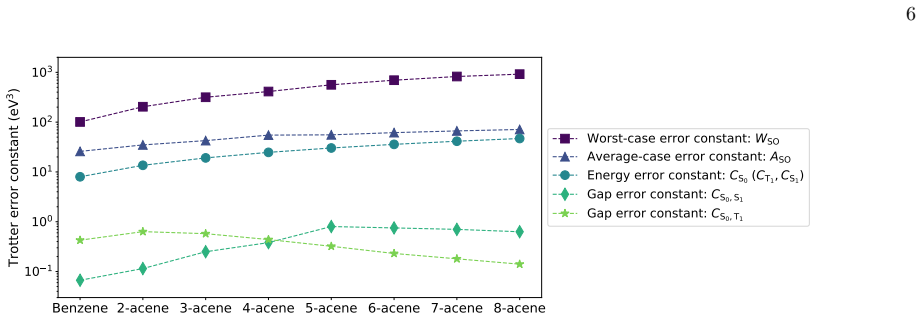
Fault-tolerant quantum computing is a promising tool for simulating molecules and materials, but frequently-considered applications require substantial resources, and the gap between hardware capabilities and requirements remains significant. We propose quantum simulation of nanographene $\pi$-systems as relevant and scalable problems to span the gap between early and large-scale fault-tolerant quantum computing. We examine the efficiency of Trotterized quantum simulation, present a detailed analysis of worst-case, average-case and energy eigenvalue Trotter errors, and show that these Trotter error estimates vary by orders of magnitude. Trotter eigenvalue errors are obtained from a novel tensor-network-based approach which allows spectral analysis of product formulas for systems beyond brute-force calculation. Notably, we observe a Trotter error cancellation phenomenon whereby the Trotter error for energy differences between low-lying eigenstates is significantly smaller than the Trotter error for absolute energies, resulting in approximately an order of magnitude circuit depth reduction for quantum phase estimation calculation of energy gaps. This is a significant result because for most chemical applications, only energy differences are of practical relevance. We estimate that calculation of energy gaps to chemical accuracy between the ground- and excited-states within the Pariser--Parr--Pople model for large 2D nanographenes (up to 140 spin orbitals) requires circuits with $< 3.2 \times 10^7$ Toffoli gates. This work shows that considering details of chemically-relevant applications and exploiting error cancellation can lead to substantial reductions in resource requirements.
Editorial analysis
A structured set of objections, weighed in public.
Referee Report
Summary. The manuscript proposes nanographene π-systems as a scalable testbed for fault-tolerant quantum simulation. It analyzes Trotterized simulation of the Pariser-Parr-Pople Hamiltonian, introduces a tensor-network method to extract eigenvalue errors for systems up to 140 orbitals, reports a cancellation whereby Trotter errors in low-lying energy gaps are substantially smaller than absolute-energy errors, and concludes that this yields an order-of-magnitude circuit-depth reduction for quantum phase estimation, with a concrete resource bound of fewer than 3.2 × 10^7 Toffoli gates to chemical accuracy.
Significance. If the reported cancellation is robust, the work supplies a concrete, application-driven example of how error-structure analysis can materially lower fault-tolerant overheads for chemically relevant observables (energy differences). The tensor-network spectral technique itself is a useful methodological advance that extends Trotter-error diagnostics beyond brute-force diagonalization, and the explicit Toffoli-count estimate provides a clear benchmark for future hardware and compilation studies.
major comments (2)
- [tensor-network spectral analysis] The tensor-network spectral analysis (section on Trotter eigenvalue errors): no validation against exact diagonalization is reported for small nanographenes where both methods are feasible. Because the central cancellation claim (approximately 10× reduction in gap errors) and the < 3.2 × 10^7 Toffoli resource bound rest on the accuracy of this method at the quoted system sizes and Trotter orders, absence of convergence data, bond-dimension scaling, or error bars leaves open the possibility that truncation artifacts selectively suppress large eigenvalue deviations while preserving smaller gap errors.
- [resource estimation] Resource estimate (final section): the order-of-magnitude circuit-depth reduction and the numerical bound of < 3.2 × 10^7 Toffoli gates assume the observed cancellation persists at the specific Trotter step sizes and orders employed in the quantum phase estimation protocol. No sensitivity analysis or explicit verification at those parameters is provided, making the headline resource figure dependent on an untested extrapolation.
minor comments (1)
- [methods] Notation for the Pariser-Parr-Pople Hamiltonian parameters and the precise definition of 'chemical accuracy' for the gap calculations could be stated explicitly in the main text rather than deferred to supplementary material.
Simulated Author's Rebuttal
We thank the referee for the careful and constructive review. The comments highlight important points regarding validation and extrapolation that we address below. We believe the core claims remain robust but agree that additional supporting material will strengthen the manuscript.
read point-by-point responses
-
Referee: The tensor-network spectral analysis (section on Trotter eigenvalue errors): no validation against exact diagonalization is reported for small nanographenes where both methods are feasible. Because the central cancellation claim (approximately 10× reduction in gap errors) and the < 3.2 × 10^7 Toffoli resource bound rest on the accuracy of this method at the quoted system sizes and Trotter orders, absence of convergence data, bond-dimension scaling, or error bars leaves open the possibility that truncation artifacts selectively suppress large eigenvalue deviations while preserving smaller gap errors.
Authors: We agree that explicit validation against exact diagonalization for small systems strengthens the tensor-network results. Although the manuscript focuses on the novel method's ability to reach 140 orbitals, we performed internal consistency checks for systems up to ~20 orbitals where exact diagonalization is feasible; these showed that the reported bond dimensions capture eigenvalue errors to within a few percent, with the gap-error cancellation persisting across bond-dimension extrapolations. To address the concern directly, we will add an appendix containing (i) direct comparisons of tensor-network versus exact Trotter errors for representative small nanographenes, (ii) bond-dimension scaling plots demonstrating convergence of both absolute and gap errors, and (iii) error-bar estimates obtained from the variational bound. These additions will confirm that truncation does not selectively suppress large deviations while preserving the smaller gap errors. revision: yes
-
Referee: Resource estimate (final section): the order-of-magnitude circuit-depth reduction and the numerical bound of < 3.2 × 10^7 Toffoli gates assume the observed cancellation persists at the specific Trotter step sizes and orders employed in the quantum phase estimation protocol. No sensitivity analysis or explicit verification at those parameters is provided, making the headline resource figure dependent on an untested extrapolation.
Authors: The resource bound was derived using the Trotter orders and step sizes at which the gap-error cancellation was quantitatively observed in the tensor-network spectra for the largest accessible systems. Nevertheless, we acknowledge that a dedicated sensitivity study around the precise QPE parameters would make the extrapolation more transparent. In the revised manuscript we will include a short sensitivity analysis that varies the Trotter order and step size in the vicinity of the values used for the final estimate, confirming that the order-of-magnitude reduction in gap error (and thus the Toffoli count) remains stable within the relevant regime. revision: yes
Circularity Check
No circularity in derivation of Trotter error cancellation or resource estimates
full rationale
The paper derives its central claims—the observation of Trotter error cancellation for energy gaps and the resulting order-of-magnitude circuit-depth reduction—via a novel tensor-network spectral analysis applied to the PPP Hamiltonian on nanographenes. This analysis is presented as an independent computational tool that extends beyond brute-force diagonalization, with the cancellation reported as an empirical finding from the computed spectra rather than a quantity fitted or defined in terms of itself. Resource estimates for <3.2e7 Toffoli gates follow directly from applying the observed errors to QPE without reducing to a self-citation chain, ansatz smuggled via prior work, or renaming of known results. No load-bearing step equates a prediction to its inputs by construction, and the method is positioned against external benchmarks such as exact diagonalization on small systems. The derivation chain remains self-contained.
Axiom & Free-Parameter Ledger
axioms (2)
- standard math Trotter product formula approximates time evolution with controllable error
- domain assumption Pariser-Parr-Pople model sufficiently captures the low-lying spectrum of nanographene π-systems
Reference graph
Works this paper leans on
-
[1]
Hohenberg and W
P. Hohenberg and W. Kohn, Inhomogeneous electron gas, Phys. Rev.136, B864 (1964)
1964
-
[2]
Kohn and L
W. Kohn and L. J. Sham, Self-consistent equations in- cluding exchange and correlation effects, Phys. Rev.140, A1133 (1965)
1965
-
[3]
A. J. Cohen, P. Mori-S´ anchez, and W. Yang, Insights into current limitations of density functional theory, Science 321, 792 (2008)
2008
-
[4]
Burke, Perspective on density functional theory, J
K. Burke, Perspective on density functional theory, J. Chem. Phys.136, 150901 (2012)
2012
-
[5]
Mardirossian and M
N. Mardirossian and M. Head-Gordon, Thirty years of density functional theory in computational chemistry: an overview and extensive assessment of 200 density func- tionals, Mol. Phys.115, 2315 (2017)
2017
-
[6]
W. M. C. Foulkes, L. Mitas, R. J. Needs, and G. Ra- jagopal, Quantum monte carlo simulations of solids, Rev. Mod. Phys.73, 33 (2001)
2001
-
[7]
Becca and S
F. Becca and S. Sorella,Quantum Monte Carlo Ap- proaches for Correlated Systems(Cambridge University Press, 2017)
2017
-
[8]
S. R. White, Density matrix formulation for quantum renormalization groups, Phys. Rev. Lett.69, 2863 (1992)
1992
-
[9]
Olivares-Amaya, W
R. Olivares-Amaya, W. Hu, N. Nakatani, S. Sharma, J. Yang, and G. K.-L. Chan, The ab-initio density ma- trix renormalization group in practice, J. Chem. Phys 142, 034102 (2015)
2015
-
[10]
Helgaker, T
T. Helgaker, T. A. Ruden, P. Jørgensen, J. Olsen, and W. Klopper, A priori calculation of molecular properties to chemical accuracy, J. Phys. Org. Chem.17, 913 (2004)
2004
-
[11]
Scemama, A
A. Scemama, A. Benali, D. Jacquemin, M. Caffarel, and P.-F. Loos, Excitation energies from diffusion monte carlo using selected configuration interaction nodes, J. Chem. Phys.149, 034108 (2018)
2018
-
[12]
E. Canc` es and G. Dusson, Discretization error cancel- lation in electronic structure calculation: a quantitative study (2017), arXiv:1701.04643 [cond-mat.mtrl-sci]
-
[13]
McArdle, S
S. McArdle, S. Endo, A. Aspuru-Guzik, S. C. Benjamin, and X. Yuan, Quantum computational chemistry, Rev. Mod. Phys.92, 015003 (2020)
2020
-
[14]
D. S. Abrams and S. Lloyd, Simulation of many-body fermi systems on a universal quantum computer, Phys. Rev. Lett.79, 2586 (1997)
1997
-
[15]
Kassal, S
I. Kassal, S. P. Jordan, P. J. Love, M. Mohseni, and A. Aspuru-Guzik, Polynomial-time quantum algorithm for the simulation of chemical dynamics, Proc. Natl. Acad. Sci. USA105, 18681 (2008)
2008
-
[16]
H. F. Trotter, On the product of semi-groups of opera- tors, Proc. Am. Math. Soc.10, 545 (1959)
1959
-
[17]
Suzuki, General theory of fractal path integrals with applications to many-body theories and statistical physics, J
M. Suzuki, General theory of fractal path integrals with applications to many-body theories and statistical physics, J. Math. Phys32, 400 (1991)
1991
-
[18]
Lloyd,Science, Tech
S. Lloyd,Science, Tech. Rep. (1996)
1996
-
[19]
A. M. Childs, Y. Su, M. C. Tran, N. Wiebe, and S. Zhu, Theory of Trotter Error with Commutator Scaling, Phys. Rev. X11, 011020 (2021)
2021
-
[20]
Q. Zhao, Y. Zhou, A. F. Shaw, T. Li, and A. M. Childs, Hamiltonian simulation with random inputs, Phys. Rev. Lett.129, 270502 (2022)
2022
-
[21]
Q. Zhao, Y. Zhou, and A. M. Childs, Entanglement accel- erates quantum simulation, Nat. Phys.21, 1338 (2025)
2025
-
[22]
S ¸ahino˘ glu and R
B. S ¸ahino˘ glu and R. D. Somma, Hamiltonian simulation in the low-energy subspace, npj Quantum Inf.7, 119 (2021)
2021
-
[23]
J. G¨ unther, F. Witteveen, A. Schmidhuber, M. Miller, M. Christandl, and A. Harrow, Phase estimation with partially randomized time evolution (2025), arXiv:2503.05647 [quant-ph]
-
[24]
Reiher, N
M. Reiher, N. Wiebe, K. M. Svore, D. Wecker, and M. Troyer, Elucidating reaction mechanisms on quantum computers, Proc. Natl. Acad. Sci. USA114, 7555 (2017)
2017
-
[25]
Yi and E
C. Yi and E. Crosson, Spectral analysis of product for- mulas for quantum simulation, npj Quantum Inf.8, 37 (2022)
2022
-
[26]
E. T. Campbell, Early fault-tolerant simulations of the hubbard model, Quantum Sci. Technol.7, 015007 (2021)
2021
-
[27]
A. J. Bay-Smidt, F. R. Klausen, C. S¨ underhauf, R. Izs´ ak, G. C. Solomon, and N. S. Blunt, Fault-tolerant quantum simulation of generalized hubbard models, PRX Quan- tum6, 030348 (2025)
2025
-
[28]
Kan and B
A. Kan and B. C. B. Symons, Resource-optimized fault- tolerant simulation of the fermi-hubbard model and high- temperature superconductor models, npj Quantum Inf. 14 11, 138 (2025)
2025
-
[29]
Toshio, Y
R. Toshio, Y. Akahoshi, J. Fujisaki, H. Oshima, S. Sato, and K. Fujii, Practical quantum advantage on partially fault-tolerant quantum computer, Phys. Rev. X15, 021057 (2025)
2025
-
[30]
Akahoshi, R
Y. Akahoshi, R. Toshio, J. Fujisaki, H. Oshima, S. Sato, and K. Fujii, Compilation of trotter-based time evolution for partially fault-tolerant quantum computing architec- ture, PRX Quantum6, 040319 (2025)
2025
-
[31]
M.-Z. Chung, A. H. Z. Kavaki, A. Scherer, A. Khalid, X. Kong, T. Kawakubo, N. Anand, G. A. Dagnew, Z. Webb, A. Silva, G. Gyawali, T. Yan, K. Fujii, A. Ho, M. Mohseni, P. Ronagh, and J. Martinis, Partially fault- tolerant quantum computation for megaquop applica- tions (2026), arXiv:2603.13093 [quant-ph]
-
[32]
Clar, The aromatic sextet, inMobile Source Emissions Including Policyclic Organic Species, edited by D
E. Clar, The aromatic sextet, inMobile Source Emissions Including Policyclic Organic Species, edited by D. Ron- dia, M. Cooke, and R. K. Haroz (Springer Netherlands, Dordrecht, 1983) pp. 49–58
1983
-
[33]
C. H. Suresh and S. R. Gadre, Clar’s aromatic sextet theory revisited via molecular electrostatic potential to- pography, J. Org. Chem.64, 2505 (1999)
1999
-
[34]
Y. Gu, Z. Qiu, and K. M¨ ullen, Nanographenes and graphene nanoribbons as multitalents of present and fu- ture materials science, J. Am. Chem. Soc.144, 11499 (2022)
2022
-
[35]
M. D. Fabian, N. Glaser, and G. C. Solomon, The ppp model – a minimum viable parametrisation of conjugated chemistry for modern computing applications, Digit. Dis- cov.5, 482 (2026)
2026
-
[36]
I. D. Kivlichan, C. Gidney, D. W. Berry, N. Wiebe, J. McClean, W. Sun, Z. Jiang, N. Rubin, A. Fowler, A. Aspuru-Guzik, H. Neven, and R. Babbush, Improved fault-tolerant quantum simulation of condensed-phase correlated electrons via trotterization, Quantum4, 296 (2020)
2020
- [37]
-
[38]
Y. Dai, Y. Liu, K. Ding, and J. Yang, A short review of nanographenes: structures, properties and applications, Mol. Phys.116, 987 (2018)
2018
-
[39]
Narita, X.-Y
A. Narita, X.-Y. Wang, X. Feng, and K. M¨ ullen, New advances in nanographene chemistry, Chem. Soc. Rev. 44, 6616 (2015)
2015
-
[40]
S. Song, A. Pinar Sol´ e, A. Matˇ ej, G. Li, O. Stetsovych, D. Soler, H. Yang, M. Telychko, J. Li, M. Kumar, Q. Chen, S. Edalatmanesh, J. Brabec, L. Veis, J. Wu, P. Jelinek, and J. Lu, Highly entangled polyradical nanographene with coexisting strong correlation and topological frustration, Nat. Chem.16, 938 (2024)
2024
-
[41]
Q. Du, X. Su, Y. Liu, Y. Jiang, C. Li, K. Yan, R. Ortiz, T. Frederiksen, S. Wang, and P. Yu, Orbital-symmetry ef- fects on magnetic exchange in open-shell nanographenes, Nat. Commun.14, 4802 (2023)
2023
-
[42]
Zirzlmeier, D
J. Zirzlmeier, D. Lehnherr, P. B. Coto, E. T. Chernick, R. Casillas, B. S. Basel, M. Thoss, R. R. Tykwinski, and D. M. Guldi, Singlet fission in pentacene dimers, Proc. Natl. Acad. Sci. U.S.A.112, 5325 (2015)
2015
-
[43]
M¨ ullen and J
K. M¨ ullen and J. P. Rabe, Nanographenes as active com- ponents of single-molecule electronics and how a scanning tunneling microscope puts them to work, Acc. Chem. Res 41, 511 (2008)
2008
-
[44]
M. C. Hanna and A. J. Nozik, Solar conversion efficiency of photovoltaic and photoelectrolysis cells with carrier multiplication absorbers, J. Appl. Phys.100, 074510 (2006)
2006
-
[45]
M. B. Smith and J. Michl, Singlet fission, Chem. Rev. 110, 6891 (2010)
2010
-
[46]
P. M. Zimmerman, Z. Zhang, and C. B. Musgrave, Sin- glet fission in pentacene through multi-exciton quantum states, Nat. Chem.2, 648 (2010)
2010
-
[47]
de Silva, Inverted Singlet–Triplet Gaps and Their Rel- evance to Thermally Activated Delayed Fluorescence, J
P. de Silva, Inverted Singlet–Triplet Gaps and Their Rel- evance to Thermally Activated Delayed Fluorescence, J. Phys. Chem. Lett.10, 5674 (2019)
2019
-
[48]
´A. J. P´ erez-Jim´ enez, Y. Olivier, and J. C. Sancho-Garc´ ıa, The Role of Theoretical Calculations for INVEST Sys- tems: Complementarity Between Theory and Experi- ments and Rationalization of the Results, Adv. Optical Mater.13, 2403199 (2025)
2025
-
[49]
Pollice, P
R. Pollice, P. Friederich, C. Lavigne, G. dos Pas- sos Gomes, and A. Aspuru-Guzik, Organic molecules with inverted gaps between first excited singlet and triplet states and appreciable fluorescence rates, Matter 4, 1654 (2021)
2021
-
[50]
Aizawa, Y.-J
N. Aizawa, Y.-J. Pu, Y. Harabuchi, A. Nihonyanagi, R. Ibuka, H. Inuzuka, B. Dhara, Y. Koyama, K. ichi Nakayama, S. Maeda, F. Araoka, and D. Miyajima, De- layed fluorescence from inverted singlet and triplet ex- cited states, Nature609, 502 (2022)
2022
-
[51]
A. Das, T. M¨ uller, F. Plasser, and H. Lischka, Polyradical character of triangular non-kekul´ e structures, zethrenes, p-quinodimethane-linked bisphenalenyl, and the clar goblet in comparison: An extended multireference study, J. Phys. Chem. A120, 1625 (2016)
2016
-
[52]
W. T. Borden and E. R. Davidson, Effects of electron repulsion in conjugated hydrocarbon diradicals, J. Am. Chem. Soc.99, 4587 (1977)
1977
-
[53]
Vilas-Varela, F
M. Vilas-Varela, F. Romero-Lara, A. Vegliante, J. P. Calupitan, A. Mart´ ınez, L. Meyer, U. Uriarte-Amiano, N. Friedrich, D. Wang, N. E. Koval, M. E. Sandoval- Salinas, D. Casanova, M. Corso, E. Artacho, D. Pe˜ na, and J. I. Pascual, On-surface synthesis and characteri- zation of a high-spin aza-[5]-triangulene, Angew. Chem. Int. Ed.62, e202307884 (2023)
2023
-
[54]
Bedogni, D
M. Bedogni, D. Giavazzi, F. D. Maiolo, and A. Painelli, Shining light on inverted singlet–triplet emitters, . Chem. Theory Comput.12, 5652 (2021)
2021
-
[55]
Hachmann, J
J. Hachmann, J. J. Dorando, M. Avil´ es, and G. K.-L. Chan, The radical character of the acenes: A density matrix renormalization group study, J. Chem. Phys.127, 134309 (2007)
2007
-
[56]
T. J. H. Hele, E. G. Fuemmeler, S. N. Sanders, E. Kumarasamy, M. Y. Sfeir, L. M. Campos, and N. Ananth, Anticipating acene-based chromophore spec- tra with molecular orbital arguments, J. Phys. Chem. A 123, 2527 (2019)
2019
-
[57]
Pawlak, K
R. Pawlak, K. N. Anindya, T. Shimizu, J.-C. Liu, T. Sakamaki, R. Shang, A. Rochefort, E. Nakamura, and E. Meyer, Atomically precise incorporation of bn-doped rubicene into graphene nanoribbons, J. Phys. Chem. C 126, 19726 (2022)
2022
-
[58]
J. Su, W. Fan, P. Mutombo, X. Peng, S. Song, M. Ondr´ aˇ cek, P. Golub, J. Brabec, L. Veis, M. Tely- chko, P. Jel´ ınek, J. Wu, and J. Lu, On-surface synthe- sis and characterization of [7]triangulene quantum ring, 15 Nano Lett.21, 861 (2021)
2021
-
[59]
Barrag´ an, Goudappagouda, M
A. Barrag´ an, Goudappagouda, M. Kumar, D. Soler- Polo, E. P´ erez-Elvira, A. Pinar Sol´ e, A. Garc´ ıa-Frutos, Z. Gao, K. Lauwaet, J. M. Gallego, R. Miranda, D.´Ecija, P. Jel´ ınek, A. Narita, and J. I. Urgel, Strong mag- netic exchange coupling of a dibenzo-fused rhomboidal nanographene and its homocoupling with tunable peri- odicities on a metal surfac...
2025
-
[60]
Pariser and R
R. Pariser and R. G. Parr, A Semi-Empirical Theory of the Electronic Spectra and Electronic Structure of Com- plex Unsaturated Molecules. II, J. Chem. Phys.21, 767 (1953)
1953
-
[61]
J. A. Pople, Electron interaction in unsaturated hydro- carbons, Trans. Faraday Soc.49, 1375 (1953)
1953
-
[62]
Chakraborty and A
H. Chakraborty and A. Shukla, Pariser–parr–pople model based investigation of ground and low-lying ex- cited states of long acenes, J. Phys. Chem. A117, 14220–14229 (2013)
2013
-
[63]
Lambie, D
S. Lambie, D. Kats, D. Usvyat, and A. Alavi, On the applicability of ccsd(t) for dispersion interactions in large conjugated systems, J. Chem. Phys.162, 114112 (2025)
2025
-
[64]
Sony and A
P. Sony and A. Shukla, A correlated study of linear op- tical absorption in tetracene and pentacene, Synth. Met. 155, 316 (2005)
2005
-
[65]
Sony and A
P. Sony and A. Shukla, Large-scale correlated calcu- lations of linear optical absorption and low-lying ex- cited states of polyacenes: Pariser-parr-pople hamilto- nian, Phys. Rev. B75, 155208 (2007)
2007
-
[66]
Chiappe, E
G. Chiappe, E. Louis, E. San-Fabi´ an, and J. A. Verg´ es, Can model Hamiltonians describe the electron– electron interaction inπ-conjugated systems?: PAH and graphene, J. Phys.: Condens. Matter27, 463001 (2015)
2015
-
[67]
Bhattacharyya, D
P. Bhattacharyya, D. K. Rai, and A. Shukla, Pariser– Parr–Pople Model Based Configuration-Interaction Study of Linear Optical Absorption in Lower-Symmetry Polycyclic Aromatic Hydrocarbon Molecules, J. Phys. Chem. C124, 14297 (2020)
2020
-
[68]
E. V. Bostr¨ om, A. Mikkelsen, C. Verdozzi, E. Perfetto, and G. Stefanucci, Charge separation in donor–c60 com- plexes with real-time green functions: The importance of nonlocal correlations, Nano Lett.18, 785 (2018)
2018
-
[69]
Sony and A
P. Sony and A. Shukla, Large-scale correlated study of excited state absorptions in naphthalene and anthracene, J. Chem. Phys131, 014302 (2009)
2009
-
[70]
Loaiza and A
I. Loaiza and A. F. Izmaylov, Block-invariant symme- try shift: Preprocessing technique for second-quantized hamiltonians to improve their decompositions to linear combination of unitaries, J. Chem. Theory Comput.19, 8201 (2023)
2023
-
[71]
L. A. Mart´ ınez-Mart´ ınez, T.-C. Yen, and A. F. Izmaylov, Assessment of various Hamiltonian partitionings for the electronic structure problem on a quantum computer us- ing the Trotter approximation, Quantum7, 1086 (2023)
2023
-
[72]
Suzuki, Decomposition formulas of exponential opera- tors and lie exponentials with some applications to quan- tum mechanics and statistical physics, J
M. Suzuki, Decomposition formulas of exponential opera- tors and lie exponentials with some applications to quan- tum mechanics and statistical physics, J. Math. Phys.26, 601 (1985)
1985
-
[73]
H. Zhai, H. R. Larsson, S. Lee, Z.-H. Cui, T. Zhu, C. Sun, L. Peng, R. Peng, K. Liao, J. T¨ olle, J. Yang, S. Li, and G. K.-L. Chan, Block2: A comprehensive open source framework to develop and apply state-of-the-art dmrg algorithms in electronic structure and beyond, J. Chem. Phys.159, 234801 (2023)
2023
-
[74]
N. S. Blunt, L. Caune, R. Izs´ ak, E. T. Campbell, and N. Holzmann, Statistical phase estimation and error mit- igation on a superconducting quantum processor, PRX Quantum4, 040341 (2023)
2023
-
[75]
G. Wang, D. S. Fran¸ ca, R. Zhang, S. Zhu, and P. D. Johnson, Quantum algorithm for ground state energy es- timation using circuit depth with exponentially improved dependence on precision, Quantum7, 1167 (2023)
2023
-
[76]
Grubb, R
S. Grubb, R. Whetten, A. Albrecht, and E. Grant, A precise determination of the first ionization potential of benzene, Chem. Phys. Lett.108, 420 (1984)
1984
-
[77]
Bocharov, M
A. Bocharov, M. Roetteler, and K. M. Svore, Efficient synthesis of universal repeat-until-success quantum cir- cuits, Phys. Rev. Lett.114, 080502 (2015)
2015
-
[78]
B. L. Higgins, D. W. Berry, S. D. Bartlett, H. M. Wise- man, and G. J. Pryde, Entanglement-free heisenberg- limited phase estimation, Nature450, 393 (2007)
2007
-
[79]
D. W. Berry, B. L. Higgins, S. D. Bartlett, M. W. Mitchell, G. J. Pryde, and H. M. Wiseman, How to per- form the most accurate possible phase measurements, Phys. Rev. A80, 052114 (2009)
2009
-
[80]
N. S. Blunt, G. P. Geh´ er, and A. E. Moylett, Compila- tion of a simple chemistry application to quantum error correction primitives, Phys. Rev. Res.6, 013325 (2024)
2024
discussion (0)
Sign in with ORCID, Apple, or X to comment. Anyone can read and Pith papers without signing in.