Recognition: unknown
Two-body current and axial form factor effects in charged-current quasielastic neutrino-nucleus scattering within the NEUT event generator
Pith reviewed 2026-05-09 18:06 UTC · model grok-4.3
The pith
Two-body meson-exchange currents and recent axial form factor fits enhance charged-current quasielastic neutrino-nucleus cross sections.
A machine-rendered reading of the paper's core claim, the machinery that carries it, and where it could break.
Core claim
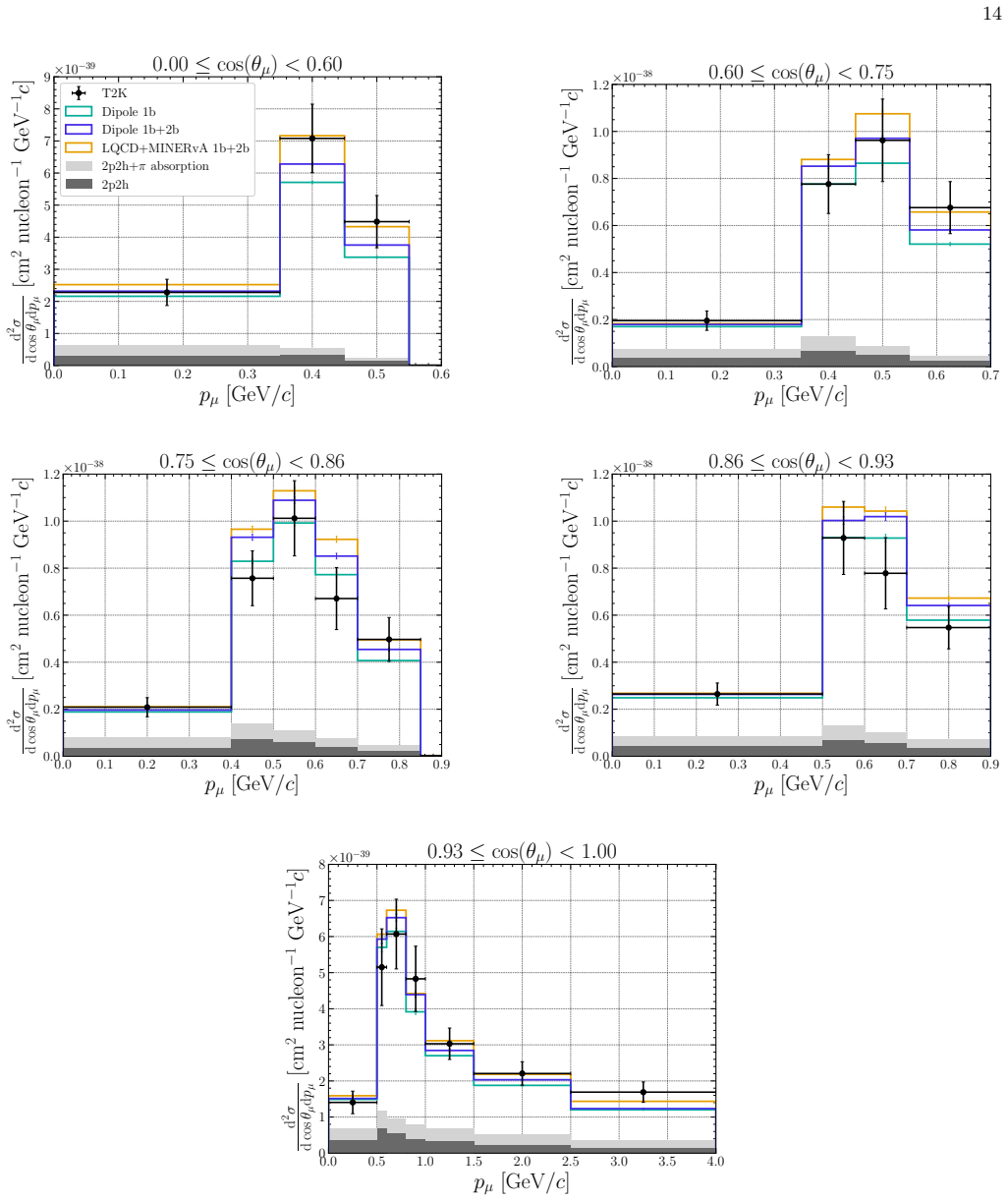
Incorporating two-body meson-exchange currents leads to a sizeable increase of the total cross section, arising from an enhancement of the transverse response, which is the dominant component in charged-current neutrino scattering. Recent fits of the axial form factor predict larger values than the standard dipole form, yielding a systematic enhancement of the cross section. The LQCD plus MINERvA parametrization tends to overestimate the data, while the MINERvA-only fit provides a more moderate increase. Overall, no single configuration consistently provides the best agreement with the different datasets from T2K and MINERvA.
What carries the argument
The unfactorized relativistic spectral function combined with the relativistic distorted-wave impulse approximation and energy-dependent potential, extended by two-body meson-exchange currents contributing to one-particle-one-hole final states, together with multiple tested axial form factor parametrizations.
If this is right
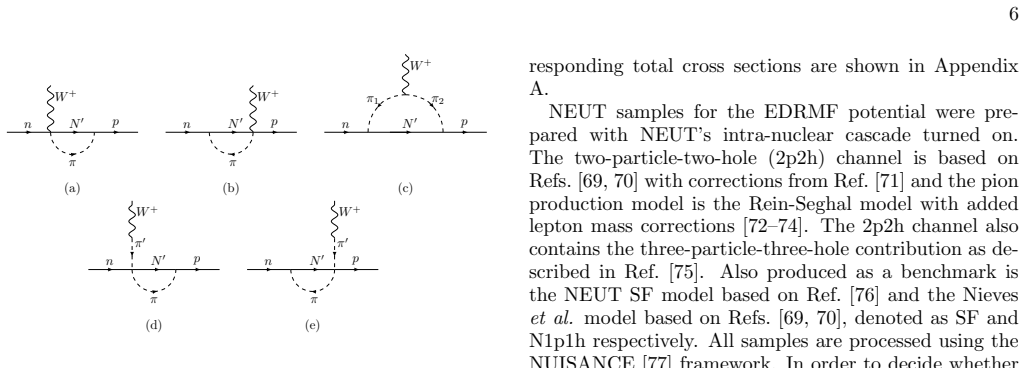
- Two-body meson-exchange currents cause a sizeable increase in the total cross section by enhancing the transverse response that dominates charged-current neutrino scattering.
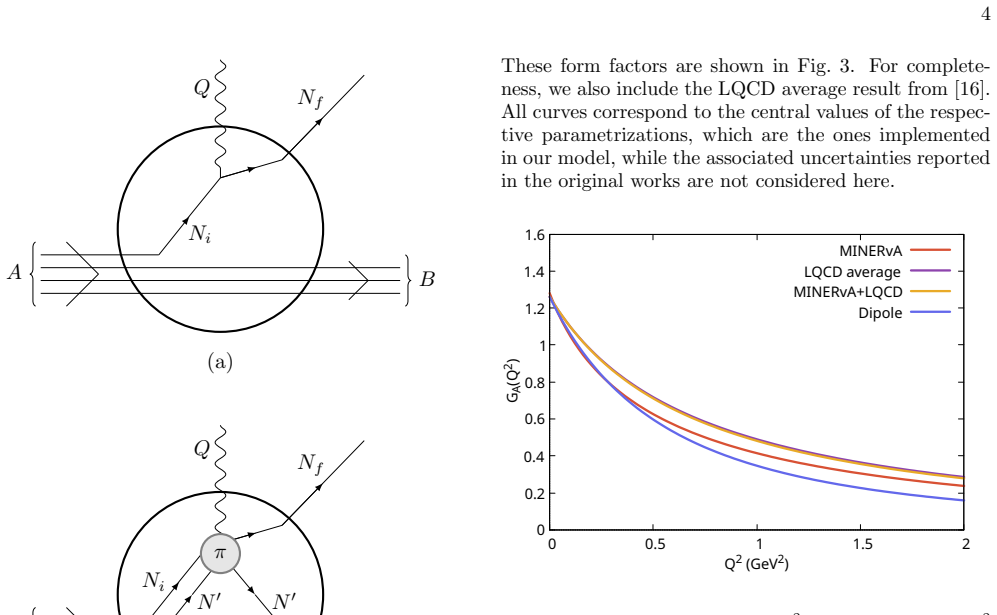
- Axial form factor parametrizations from recent LQCD and MINERvA fits produce larger cross sections than the standard dipole form.
- The LQCD plus MINERvA fit tends to overestimate data while the MINERvA-only fit gives a more moderate increase.
- No single combination of currents and form factor choice matches all T2K and MINERvA CC0π datasets equally well.
Where Pith is reading between the lines
- Accurate inclusion of multi-nucleon currents may be required to reduce nuclear modeling uncertainties that currently limit precision in neutrino oscillation analyses.
- Further tests on different nuclear targets or at higher energies could help separate the effects of two-body currents from changes in the axial form factor.
- The NEUT implementation allows these updates to be propagated directly into oscillation fits, potentially shifting best-fit values if the enhanced rates alter event selection.
Load-bearing premise
The unfactorized relativistic spectral function together with the energy-dependent relativistic potential in the distorted-wave impulse approximation correctly captures the nuclear response for quasielastic scattering, and two-body meson-exchange currents can be added to one-particle-one-hole final states without double-counting or missing higher-order nuclear effects.
What would settle it
A high-precision separation of longitudinal and transverse response functions in charged-current quasielastic neutrino scattering on carbon at kinematics where two-body current contributions are expected to be largest would show whether the predicted transverse enhancement and resulting cross-section increase match the measured values.
Figures




read the original abstract
We present a charged-current quasielastic neutrino-nucleus scattering model based on an unfactorized representation of the spectral function, employing relativistic momentum distributions for bound nucleons and the relativistic distorted-wave impulse approximation with an energy-dependent relativistic potential to describe the scattered nucleon. The model incorporates two-body meson-exchange currents contributing to one-particle-one-hole final states and tests several axial form factor parametrizations, including recent LQCD and MINERvA fits. It is implemented in the NEUT event generator and benchmarked against T2K and MINERvA ${\nu}_{\mu}$-$^{12}$C CC0${\pi}$ measurements. We find that two-body meson-exchange currents lead to a sizeable increase of the total cross section, arising from an enhancement of the transverse response, which is the dominant component in charged-current neutrino scattering. On the other hand, recent fits of the axial form factor predict larger values than the standard dipole form, yielding a systematic enhancement of the cross section. The LQCD+MINERvA parametrization tends to overestimate the data, while the MINERvA-only fit provides a more moderate increase. Overall, no single configuration consistently provides the best agreement with the different datasets.
Editorial analysis
A structured set of objections, weighed in public.
Referee Report
Summary. The manuscript presents a charged-current quasielastic neutrino-nucleus scattering model implemented in the NEUT event generator. It employs an unfactorized relativistic spectral function with relativistic momentum distributions for bound nucleons and the relativistic distorted-wave impulse approximation (RDWIA) using an energy-dependent relativistic potential for the outgoing nucleon. Two-body meson-exchange currents (MEC) are added to one-particle-one-hole final states, and several axial form factor parametrizations (including recent LQCD and MINERvA fits) are tested. The model is benchmarked against T2K and MINERvA νμ-12C CC0π data, with the main findings that MEC produce a sizeable cross-section increase via enhancement of the transverse response and that newer axial form factors yield systematic enhancements, though no single model configuration consistently best matches all datasets.
Significance. If the nuclear modeling assumptions hold, the work is significant for neutrino oscillation experiments because it quantifies the impact of two-body currents and updated axial form factors within a widely used event generator, providing concrete guidance on cross-section uncertainties. The implementation in NEUT and direct data comparisons are strengths that enable immediate application in analyses. However, the headline claims rest on the unverified separation of MEC from the spectral function plus RDWIA framework.
major comments (2)
- [Model description (prior to results)] The model description states that two-body MEC are incorporated into 1p1h final states on top of the unfactorized relativistic spectral function and energy-dependent RDWIA, but provides no explicit demonstration or cross-check (e.g., against electron-scattering data or sum-rule constraints) that this addition avoids double-counting or omission of higher-order 2p2h/FSI contributions. This assumption is load-bearing for the reported sizeable MEC-driven increase in the total cross section.
- [Results and data comparison] The abstract and results claim that the LQCD+MINERvA axial form factor parametrization overestimates data while the MINERvA-only fit gives a moderate increase, yet no quantitative metrics such as χ² per degree of freedom, detailed error propagation, or kinematic cuts are referenced to support the statement that 'no single configuration consistently provides the best agreement.'
minor comments (2)
- [Model description] Notation for the relativistic potential and spectral function could be clarified with explicit definitions or references to prior works on the unfactorized approach to aid reproducibility.
- [Figures] Figure captions should specify the neutrino energy range and exact data selection criteria used for the T2K and MINERvA comparisons.
Simulated Author's Rebuttal
We are grateful to the referee for their thorough review and constructive comments on our manuscript. We address each major comment below and indicate the revisions made to the manuscript.
read point-by-point responses
-
Referee: The model description states that two-body MEC are incorporated into 1p1h final states on top of the unfactorized relativistic spectral function and energy-dependent RDWIA, but provides no explicit demonstration or cross-check (e.g., against electron-scattering data or sum-rule constraints) that this addition avoids double-counting or omission of higher-order 2p2h/FSI contributions. This assumption is load-bearing for the reported sizeable MEC-driven increase in the total cross section.
Authors: We agree that the model description would benefit from additional clarification on the assumptions underlying the MEC addition. Our implementation treats the two-body currents as contributions specifically to 1p1h final states within the unfactorized relativistic spectral function and RDWIA framework, following the standard separation used in similar hybrid models in the literature. To address this, we have revised the model description section to expand on the implementation details, include references to prior validations against electron-scattering data and sum-rule constraints in related approaches, and explicitly state the assumptions regarding avoidance of double-counting with higher-order terms. A dedicated new cross-check calculation is beyond the scope of the present work but is now noted as a direction for future study. revision: partial
-
Referee: The abstract and results claim that the LQCD+MINERvA axial form factor parametrization overestimates data while the MINERvA-only fit gives a moderate increase, yet no quantitative metrics such as χ² per degree of freedom, detailed error propagation, or kinematic cuts are referenced to support the statement that 'no single configuration consistently provides the best agreement.'
Authors: We thank the referee for this suggestion to strengthen the data comparison section. The original claims were based on direct visual comparison of the calculated cross sections to the T2K and MINERvA data points. We have now added quantitative support by including a table of χ² per degree of freedom for each model configuration (with and without MEC, and for each axial form factor parametrization) against both datasets. The table specifies the kinematic cuts corresponding to the CC0π selections and incorporates the published experimental uncertainties (statistical and systematic) in the error propagation. These metrics confirm that the LQCD+MINERvA fit overestimates the data in multiple bins while the MINERvA-only fit yields a moderate enhancement, with no configuration providing the best agreement across all datasets. revision: yes
Circularity Check
No significant circularity detected in derivation chain
full rationale
The paper constructs a CCQE neutrino-nucleus model from an unfactorized relativistic spectral function plus RDWIA with energy-dependent potential, adds MEC contributions to 1p1h states, and evaluates several independently determined axial form-factor parametrizations (LQCD+MINERvA and MINERvA-only fits). These ingredients are implemented in NEUT and compared to separate T2K and MINERvA CC0π datasets. No equation or section reduces a reported prediction to a fitted parameter or self-citation by construction; the axial-form-factor inputs are external, the nuclear-response framework is presented as an assumption subject to external falsification, and the cross-section shifts are computed outputs rather than tautological restatements of the inputs. The derivation chain therefore remains self-contained against external benchmarks.
Axiom & Free-Parameter Ledger
axioms (2)
- domain assumption The impulse approximation holds for quasielastic neutrino-nucleus scattering.
- domain assumption Two-body meson-exchange currents contribute to one-particle-one-hole final states.
Reference graph
Works this paper leans on
-
[1]
Abeet al.(The T2K Collaboration), Constraint on the matter-antimatter symmetry-violating phase in neutrino oscillations, Nature580, 339 (2020)
K. Abeet al.(The T2K Collaboration), Constraint on the matter-antimatter symmetry-violating phase in neutrino oscillations, Nature580, 339 (2020)
2020
-
[2]
M. A. Aceroet al.(NOvA Collaboration), First measure- ment of neutrino oscillation parameters using neutrinos and antineutrinos by nova, Phys. Rev. Lett.123, 151803 (2019)
2019
-
[3]
P. Abratenkoet al.(MicroBooNE Collaboration), First measurement of differential charged current quasielasti- clikeν µ-argon scattering cross sections with the micro- boone detector, Phys. Rev. Lett.125, 201803 (2020)
2020
-
[4]
Caiet al.(The MINERνA Collaboration), Nucleon binding energy and transverse momentum imbalance in neutrino-nucleus reactions, Phys
T. Caiet al.(The MINERνA Collaboration), Nucleon binding energy and transverse momentum imbalance in neutrino-nucleus reactions, Phys. Rev. D101, 092001 (2020)
2020
-
[5]
Abeet al., Physics potential of a long-baseline neu- trino oscillation experiment using a j-parc neutrino beam and hyper-kamiokande, PTEP2015, 053C02 (2015)
K. Abeet al., Physics potential of a long-baseline neu- trino oscillation experiment using a j-parc neutrino beam and hyper-kamiokande, PTEP2015, 053C02 (2015)
2015
- [6]
-
[7]
K. Abeet al.(T2K Collaboration), First t2k measure- ment of transverse kinematic imbalance in the muon- neutrino charged-current single-π + production channel containing at least one proton, Phys. Rev. D103, 112009 (2021)
2021
-
[8]
Khachatryanet al.(CLAS, e4v), Electron-beam en- ergy reconstruction for neutrino oscillation measure- ments, Nature599, 565 (2021)
M. Khachatryanet al.(CLAS, e4v), Electron-beam en- ergy reconstruction for neutrino oscillation measure- ments, Nature599, 565 (2021)
2021
-
[9]
Abratenkoet al.(The MicroBooNE Collaboration), First double-differential measurement of kinematic im- balance in neutrino interactions with the microboone de- tector, Phys
P. Abratenkoet al.(The MicroBooNE Collaboration), First double-differential measurement of kinematic im- balance in neutrino interactions with the microboone de- tector, Phys. Rev. Lett.131, 101802 (2023)
2023
-
[10]
J. Kleykampet al.(MINERvA Collaboration), Simulta- neous measurement ofν µ quasielasticlike cross sections on ch, c, h 2O, fe, and pb as a function of muon kinemat- ics at minerva, Phys. Rev. Lett.130, 161801 (2023)
2023
-
[11]
Alvarez-Rusoet al., Nustec white paper: Status and challenges of neutrino–nucleus scattering, Progress in Particle and Nuclear Physics100, 1 (2018)
L. Alvarez-Rusoet al., Nustec white paper: Status and challenges of neutrino–nucleus scattering, Progress in Particle and Nuclear Physics100, 1 (2018)
2018
-
[12]
Franco-Munoz, J
T. Franco-Munoz, J. Garc´ ıa-Marcos, R. Gonz´ alez- Jim´ enez, and J. M. Ud´ ıas, Relativistic two-body currents for one-nucleon knockout in electron-nucleus scattering, Phys. Rev. C108, 064608 (2023)
2023
-
[13]
T. Franco-Munoz, R. Gonz´ alez-Jim´ enez, and J. M. Ud´ ıas, Effects of two-body currents in the one-particle one-hole electromagnetic responses within a relativistic model, J. Phys. G52, 025103 (2025), arXiv:2203.09996 [nucl-th]. 11
-
[14]
Bernard, L
V. Bernard, L. Elouadrhiri, and U. Meissner, Axial struc- ture of the nucleon, Journal of Physics G: Nuclear and Particle Physics28, R1 (2001)
2001
- [15]
- [16]
-
[17]
Caiet al.(MINERvA), Measurement of the axial vec- tor form factor from antineutrino–proton scattering, Na- ture614, 48 (2023)
T. Caiet al.(MINERvA), Measurement of the axial vec- tor form factor from antineutrino–proton scattering, Na- ture614, 48 (2023)
2023
- [18]
-
[19]
J. McKean, R. Gonz´ alez-Jim´ enez, M. Kabirnezhad, J. M. Ud´ ıas, and Y. Uchida, Implementation of a rel- ativistic distorted wave impulse approximation model into the neut event generator, Physical Review D112, 10.1103/f7x5-snmz (2025)
-
[20]
J. M. Ud´ ıas, P. Sarriguren, E. Moya de Guerra, E. Gar- rido, and J. A. Caballero, Spectroscopic factors in 40Ca and 208Pb from (e,e’p): Fully relativistic analysis, Phys. Rev. C48, 2731 (1993)
1993
-
[21]
Giusti, A
C. Giusti, A. Meucci, F. D. Pacati, G. Co’, and V. De Donno, Quasifree (e, e ′ p) reactions on nuclei with neutron excess, Phys. Rev. C84, 024615 (2011)
2011
-
[22]
M. C. Atkinson, H. P. Blok, L. Lapik´ as, R. J. Char- ity, and W. H. Dickhoff, Validity of the distorted-wave impulse-approximation description of 40Ca(e, e ′ p)39K data using only ingredients from a nonlocal dispersive optical model, Phys. Rev. C98, 044627 (2018)
2018
-
[23]
K. S. Egiyanet al.(CLAS Collaboration), Measurement of two- and three-nucleon short-range correlation proba- bilities in nuclei, Phys. Rev. Lett.96, 082501 (2006)
2006
-
[24]
Dueret al.(The CLAS Collaboration), Probing high- momentum protons and neutrons in neutron-rich nuclei, Nature560, 617 (2018)
M. Dueret al.(The CLAS Collaboration), Probing high- momentum protons and neutrons in neutron-rich nuclei, Nature560, 617 (2018)
2018
-
[25]
Benhar, A
O. Benhar, A. Fabrocini, S. Fantoni, and I. Sick, Spectral function of finite nuclei and scattering of GeV electrons, Nuclear Physics A579, 493 (1994)
1994
-
[26]
A. M. Ankowski, O. Benhar, and M. Sakuda, Determina- tion of the proton spectral function of C12 from (e,e’p) data, Phys. Rev. C110, 054612 (2024)
2024
-
[27]
Benhar, N
O. Benhar, N. Farina, H. Nakamura, M. Sakuda, and R. Seki, Electron- and neutrino-nucleus scattering in the impulse approximation regime, Phys. Rev. D72, 053005 (2005)
2005
-
[28]
Gonz´ alez-Jim´ enez, M
R. Gonz´ alez-Jim´ enez, M. B. Barbaro, J. A. Ca- ballero, T. W. Donnelly, N. Jachowicz, G. D. Megias, K. Niewczas, A. Nikolakopoulos, J. W. Van Orden, and J. M. Ud´ ıas, Neutrino energy reconstruction from semi- inclusive samples, Phys. Rev. C105, 025502 (2022)
2022
-
[29]
J. M. Franco-Patino, R. Gonz´ alez-Jim´ enez, S. Dolan, M. B. Barbaro, J. A. Caballero, G. D. Megias, and J. M. Udias, Final state interactions in semi-inclusive neutrino-nucleus scattering: Applications to the t2k and MINERνA experiments, Phys. Rev. D106, 113005 (2022)
2022
-
[30]
Sharma, M
M. Sharma, M. Nagarajan, and P. Ring, Rho meson cou- pling in the relativistic mean field theory and description of exotic nuclei, Physics Letters B312, 377 (1993)
1993
-
[31]
Gonz´ alez-Jim´ enez, A
R. Gonz´ alez-Jim´ enez, A. Nikolakopoulos, N. Jachowicz, and J. M. Ud´ ıas, Nuclear effects in electron-nucleus and neutrino-nucleus scattering within a relativistic quantum mechanical framework, Phys. Rev. C100, 045501 (2019)
2019
-
[32]
Nikolakopoulos, N
A. Nikolakopoulos, N. Jachowicz, N. Van Dessel, K. Niewczas, R. Gonz´ alez-Jim´ enez, J. M. Ud´ ıas, and V. Pandey, Electron versus muon neutrino induced cross sections in charged current quasielastic processes, Phys. Rev. Lett.123, 052501 (2019)
2019
-
[33]
Gonz´ alez-Jim´ enez, M
R. Gonz´ alez-Jim´ enez, M. B. Barbaro, J. A. Ca- ballero, T. W. Donnelly, N. Jachowicz, G. D. Megias, K. Niewczas, A. Nikolakopoulos, and J. M. Ud´ ıas, Con- straints in modeling the quasielastic response in inclu- sive lepton-nucleus scattering, Phys. Rev. C101, 015503 (2020)
2020
-
[34]
J. M. Ud´ ıas, P. Sarriguren, E. Moya de Guerra, E. Gar- rido, and J. A. Caballero, Relativistic versus nonrelativis- tic optical potentials in a(e,e’p)b reactions, Phys. Rev. C 51, 3246 (1995)
1995
-
[35]
M. C. Mart´ ınez, P. Lava, N. Jachowicz, J. Ryckebusch, K. Vantournhout, and J. M. Ud´ ıas, Relativistic models for quasielastic neutrino scattering, Phys. Rev. C73, 024607 (2006)
2006
-
[36]
N. J. Bakeret al., Quasielastic neutrino scattering: A measurement of the weak nucleon axial-vector form fac- tor, Phys. Rev. D23, 2499 (1981)
1981
-
[37]
K. L. Milleret al., Study of the reactionν µd→µ −pps, Phys. Rev. D26, 537 (1982)
1982
-
[38]
Kitagakiet al., High-energy quasielasticν µn→µ −p scattering in deuterium, Phys
T. Kitagakiet al., High-energy quasielasticν µn→µ −p scattering in deuterium, Phys. Rev. D28, 436 (1983)
1983
-
[39]
L. A. Ahrenset al., Measurement of neutrino-proton and antineutrino-proton elastic scattering, Phys. Rev. D35, 785 (1987)
1987
-
[40]
G. S. Bali, L. Barca, S. Collins, M. Gruber, M. L¨ offler, A. Sch¨ afer, W. S¨ oldner, P. Wein, S. Weish¨ aupl, and T. Wurm (RQCD), Nucleon axial structure from lattice QCD, JHEP05, 126
-
[41]
Y.-C. Jang, R. Gupta, B. Yoon, and T. Bhattacharya, Axial vector form factors from lattice qcd that satisfy the pcac relation, Phys. Rev. Lett.124, 072002 (2020)
2020
-
[42]
S. Park, R. Gupta, B. Yoon, S. Mondal, T. Bhattacharya, Y.-C. Jang, B. Jo´ o, and F. Winter (Nucleon Matrix Ele- ments (NME) Collaboration), Precision nucleon charges and form factors using (2 + 1)-flavor lattice qcd, Phys. Rev. D105, 054505 (2022)
2022
-
[43]
A. S. Meyer, A. Walker-Loud, and C. Wilkinson, Status of Lattice QCD Determination of Nucleon Form Factors and their Relevance for the Few-GeV Neutrino Program, Ann. Rev. Nucl. Part. Sci.72, 205 (2022)
2022
-
[44]
Scherer and M
S. Scherer and M. R. Schindler, Quantum chromodynam- ics and chiral symmetry, inA Primer for Chiral Pertur- bation Theory(Springer Berlin Heidelberg, Berlin, Hei- delberg, 2012) pp. 1–48
2012
-
[45]
J. E. Amaro, V. L. Martinez-Consentino, E. Ruiz Ar- riola, and I. Ruiz Simo, Global superscaling analysis of quasielastic electron scattering with relativistic effective mass, Phys. Rev. C98, 024627 (2018)
2018
-
[46]
V. L. Martinez-Consentino, I. Ruiz Simo, and J. E. Amaro, Meson-exchange currents and superscaling anal- ysis with relativistic effective mass of quasielastic electron scattering from 12C, Phys. Rev. C104, 025501 (2021)
2021
-
[47]
M. V. Ivanov and A. N. Antonov, Superscaling analysis of inclusive electron and (anti)neutrino scattering within the coherent density fluctuation model, Phys. Rev. C 12 109, 064621 (2024)
2024
-
[48]
Franco-Munoz, Towards a more realistic description of nuclear effects in lepton-nucleus scattering (2025), PhD thesis, Universidad Complutense de Madrid
T. Franco-Munoz, Towards a more realistic description of nuclear effects in lepton-nucleus scattering (2025), PhD thesis, Universidad Complutense de Madrid
2025
-
[49]
K. M. Watson, The effect of final state interactions on reaction cross sections, Phys. Rev.88, 1163 (1952)
1952
-
[50]
Alvarez-Ruso, E
L. Alvarez-Ruso, E. Hern´ andez, J. Nieves, and M. J. V. Vacas, Watson’s theorem and then∆(1232) axial transi- tion, Phys. Rev. D93, 014016 (2016)
2016
-
[51]
M. Hooft, A. Nikolakopoulos, J. Garc´ ıa-Marcos, Y. De Backer, T. Franco-Munoz, K. Niewczas, R. Gonz´ alez-Jim´ enez, and N. Jachowicz, Optimizing the description of the Delta region in the Ghent Hybrid model for single-pion production, (2026), arXiv:2603.29486 [nucl-th]
-
[52]
M. J. Dekker, P. J. Brussaard, and J. A. Tjon, Rela- tivistic meson exchange and isobar currents in electron scattering: Noninteracting fermi gas analysis, Phys. Rev. C49, 2650 (1994)
1994
-
[53]
Van der Sluys, J
V. Van der Sluys, J. Ryckebusch, and M. Waroquier, Two-body currents in inclusive electron scattering, Phys. Rev. C51, 2664 (1995)
1995
-
[54]
Niewczas, Multinucleon knock-out in neutrino-nucleus scattering (2023), PhD thesis, University of Wroclaw, Ghent University
K. Niewczas, Multinucleon knock-out in neutrino-nucleus scattering (2023), PhD thesis, University of Wroclaw, Ghent University
2023
-
[55]
Carlson, J
J. Carlson, J. Jourdan, R. Schiavilla, and I. Sick, Longi- tudinal and transverse quasielastic response functions of light nuclei, Phys. Rev. C65, 024002 (2002)
2002
-
[56]
Lovato, S
A. Lovato, S. Gandolfi, J. Carlson, S. C. Pieper, and R. Schiavilla, Electromagnetic and neutral-weak response functions of 4He and 12C, Phys. Rev. C91, 062501 (2015)
2015
-
[57]
Lovato, S
A. Lovato, S. Gandolfi, J. Carlson, S. C. Pieper, and R. Schiavilla, Electromagnetic response of 12C: A first- principles calculation, Phys. Rev. Lett.117, 082501 (2016)
2016
-
[58]
Lovato, J
A. Lovato, J. Carlson, S. Gandolfi, N. Rocco, and R. Schi- avilla, Ab initio study of (ν ℓ, ℓ−) and ( νℓ, ℓ+) inclusive scattering in 12C: Confronting the miniboone and t2k ccqe data, Phys. Rev. X10, 031068 (2020)
2020
-
[59]
Andreoli, J
L. Andreoli, J. Carlson, A. Lovato, S. Pastore, N. Rocco, and R. B. Wiringa, Electron scattering ona= 3 nuclei from quantum monte carlo based approaches, Phys. Rev. C105, 014002 (2022)
2022
-
[60]
Andreoli, G
L. Andreoli, G. B. King, S. Pastore, M. Piarulli, J. Carl- son, S. Gandolfi, and R. B. Wiringa, Quantum monte carlo calculations of electron scattering from 12C in the short-time approximation, Phys. Rev. C110, 064004 (2024)
2024
-
[61]
Lovato, N
A. Lovato, N. Rocco, and N. Steinberg, One- and two- body current contributions to lepton-nucleus scattering, Phys. Rev. C112, 045501 (2025)
2025
-
[62]
Pastore, S
S. Pastore, S. C. Pieper, R. Schiavilla, and R. B. Wiringa, Quantum monte carlo calculations of electromagnetic moments and transitions ina≤9 nuclei with meson- exchange currents derived from chiral effective field the- ory, Phys. Rev. C87, 035503 (2013)
2013
-
[63]
Carlson and R
J. Carlson and R. Schiavilla, Inclusive electron scattering and pion degrees of freedom in light nuclei, Phys. Rev. C 49, R2880 (1994)
1994
-
[64]
Fabrocini, Inclusive transverse response of nuclear matter, Phys
A. Fabrocini, Inclusive transverse response of nuclear matter, Phys. Rev. C55, 338 (1997)
1997
-
[65]
Amaro, M
J. Amaro, M. Barbaro, J. Caballero, T. Donnelly, and A. Molinari, Gauge and lorentz invariant one-pion ex- change currents in electron scattering from a relativistic fermi gas, Physics Reports368, 317 (2002)
2002
-
[66]
J. E. Amaro, M. B. Barbaro, J. A. Caballero, and F. Kazemi Tabatabaei, Semirelativistic meson-exchange currents in (e, e ′ ) and (e, e ′ p) reactions, Phys. Rev. C68, 014604 (2003)
2003
-
[67]
P. R. Casale, J. E. Amaro, V. Belocchi, M. B. Barbaro, A. De Pace, and M. Martini, Interference between meson exchange and one-body currents in quasielastic electron scattering, Phys. Rev. C112, 024603 (2025)
2025
-
[68]
Hayato and L
Y. Hayato and L. Pickering, The NEUT neutrino inter- action simulation program library, Eur. Phys. J. ST230, 4469 (2021)
2021
-
[69]
Nieves, I
J. Nieves, I. R. Simo, and M. J. V. Vacas, Inclusive charged-current neutrino-nucleus reactions, Phys. Rev. C83, 045501 (2011)
2011
-
[70]
Nieves, I
J. Nieves, I. Ruiz Simo, and M. Vicente Vacas, Phys. Lett. B707, 72 (2012)
2012
-
[71]
B. Bourguille, J. Nieves, and F. S´ anchez, Inclusive and exclusive neutrino-nucleus cross sections and the recon- struction of the interaction kinematics, Journal of High Energy Physics2021, 10.1007/jhep04(2021)004 (2021)
-
[72]
Rein and L
D. Rein and L. M. Sehgal, Neutrino Excitation of Baryon Resonances and Single Pion Production, Annals Phys. 133, 79 (1981)
1981
-
[73]
Berger and L
C. Berger and L. M. Sehgal, Lepton mass effects in single pion production by neutrinos, Phys. Rev. D76, 113004 (2007)
2007
-
[74]
K. M. Graczyk and J. T. Sobczyk, Lepton mass effects in weak charged current single pion production, Phys. Rev. D77, 053003 (2008)
2008
-
[75]
Prasad, J
H. Prasad, J. T. Sobczyk, A. M. Ankowski, J. L. Bonilla, R. D. Banerjee, K. M. Graczyk, and B. E. Kowal, New multinucleon knockout model in the nuwro monte carlo generator, Phys. Rev. D111, 036032 (2025)
2025
-
[76]
Benhar, D
O. Benhar, D. Day, and I. Sick, Inclusive quasielastic electron-nucleus scattering, Rev. Mod. Phys.80, 189 (2008)
2008
-
[77]
P. Stowellet al., NUISANCE: a neutrino cross-section generator tuning and comparison framework, JINST12 (01), P01016, arXiv:1612.07393 [hep-ex]
-
[78]
Abeet al.(T2K Collaboration), Simultaneous mea- surement of the muon neutrino charged-current cross sec- tion on oxygen and carbon without pions in the final state at t2k, Phys
K. Abeet al.(T2K Collaboration), Simultaneous mea- surement of the muon neutrino charged-current cross sec- tion on oxygen and carbon without pions in the final state at t2k, Phys. Rev. D101, 112004 (2020)
2020
-
[79]
K. Abeet al.(T2K Collaboration), Measurement of double-differential muon neutrino charged-current inter- actions on c8h8 without pions in the final state using the t2k off-axis beam, Phys. Rev. D93, 112012 (2016)
2016
-
[80]
J. E. Amaro, M. B. Barbaro, J. A. Caballero, T. W. Donnelly, A. Molinari, and I. Sick, Using electron scat- tering superscaling to predict charge-changing neutrino cross sections in nuclei, Phys. Rev. C71, 015501 (2005)
2005
discussion (0)
Sign in with ORCID, Apple, or X to comment. Anyone can read and Pith papers without signing in.