Recognition: unknown
Learning the Helmholtz equation operator with DeepONet for non-parametric 2D geometries
Pith reviewed 2026-05-09 18:58 UTC · model grok-4.3
The pith
DeepONet learns the operator mapping arbitrary scatterer geometries to 2D Helmholtz scattered fields
A machine-rendered reading of the paper's core claim, the machinery that carries it, and where it could break.
Core claim
A physics-informed DeepONet learns the operator that links the geometry of an arbitrary scatterer, encoded via signed distance function, to the scattered field solution of the Helmholtz equation in 2D, generalizing to new geometries provided the training distribution is adequate and avoiding the need to remesh for each instance.
What carries the argument
DeepONet with branch network input as signed distance function values at domain points encoding the scatterer boundary, and trunk network input as local coordinates, to learn the geometry-to-field operator.
If this is right
- If the training space covers the target evaluation space, the model generalizes to unseen geometries.
- The network weights implicitly embed the local physics and their interaction with the domain geometry.
- The approach provides a computationally lighter surrogate model compared to traditional FEM methods.
- It avoids the need to remesh the domain for each new geometry.
- The model can be refined for new regions of interest without full retraining.
Where Pith is reading between the lines
- Similar signed distance encoding might enable operator learning for time-dependent or nonlinear wave equations.
- Optimized scatterer designs could be found more rapidly by querying the learned operator repeatedly.
- This surrogate could support real-time simulations in applications like acoustic design or radar cross-section prediction.
Load-bearing premise
The signed distance function evaluated at several points in the domain is enough to encode arbitrary boundary geometries so the branch network can learn the full operator mapping.
What would settle it
A direct numerical comparison between the DeepONet prediction and a high-resolution FEM solution for an unseen scatterer with a highly irregular or non-convex boundary, checking if errors exceed acceptable tolerances across the domain.
Figures




read the original abstract
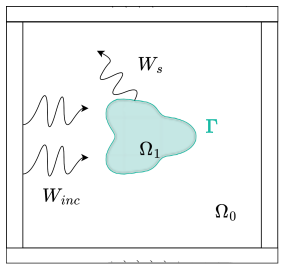
This paper deals with solving the 2D Helmholtz equation on non-parametric domains, leveraging a physics-informed neural operator network based on the DeepONet framework. We consider a 2D square domain with an inclusion of arbitrary boundary geometry at its center. This inclusion acts as a scatterer for an incoming harmonic wave. The aim is to learn the operator linking the geometry of the scatterer to the resulting scattered field. A signed distance function to the boundary of the inner inclusion, evaluated at several points in the domain, is used to encode its geometry. It serves as input for the branch part of the DeepONet architecture, while local information is used as input for the trunk part. This approach enables the encoding of arbitrary geometries, whether they are parameterized or not. The evaluation of the model on unseen geometries is compared with its finite element method (FEM) equivalent to test its generalization capabilities. The trained network weights implicitly embed the local physics and their interaction with the domain geometry. If the training space sufficiently covers the target evaluation space, the model can generalize accordingly. Furthermore, it can be refined to extend to another region of interest without retraining from scratch. This framework also avoids the need to remesh the domain for each geometry. The proposed approach delivers a computationally lighter surrogate model than FEM alternatives and avoids relying on FEM-generated training data.
Editorial analysis
A structured set of objections, weighed in public.
Referee Report
Summary. The paper proposes a DeepONet-based physics-informed neural operator to learn the mapping from arbitrary non-parametric 2D scatterer geometries (encoded via signed distance function values sampled at multiple points) to the scattered field solution of the Helmholtz equation in a fixed square domain. The branch network takes the SDF input while the trunk uses local coordinates; training uses a physics-informed loss, with claims of generalization to unseen geometries validated against FEM, computational efficiency, no remeshing requirement, and implicit embedding of physics in the weights.
Significance. If the quantitative results and generalization claims hold, this would provide a useful surrogate modeling framework for wave scattering on variable non-parametric domains, extending neural operators beyond parametric geometries and reducing the need for repeated FEM meshing. It correctly leverages DeepONet for operator learning and physics-informed training, which are established strengths in the field.
major comments (2)
- [Abstract] Abstract: the central claim of generalization to unseen arbitrary geometries is presented without any quantitative error metrics, training hyperparameters, or implementation details for the physics-informed loss (PDE residual plus boundary conditions at the SDF zero level set), making it impossible to assess whether the operator is learned accurately or merely approximates the training distribution.
- [Abstract and method description] Geometry encoding (as described in the abstract and method): the branch network receives only the signed distance function evaluated at a fixed finite set of points. For the physics-informed loss to enforce correct geometry-dependent scattering conditions on non-smooth or high-curvature inclusions, this fixed sampling must resolve all boundary features that affect the wave field; the manuscript provides no analysis or ablation showing that the chosen sampling density suffices, which is load-bearing for the non-parametric geometry claim.
minor comments (2)
- [Abstract] Abstract: the number and distribution of points used to evaluate the signed distance function are not specified, which affects both reproducibility and the ability to judge whether boundary details are captured.
- [Abstract] Abstract: the statement that the model 'can be refined to extend to another region of interest without retraining from scratch' is asserted but not supported by any description of the refinement procedure or supporting experiments.
Simulated Author's Rebuttal
We thank the referee for the constructive feedback on our manuscript. We address each major comment point by point below and indicate the revisions planned for the next version.
read point-by-point responses
-
Referee: [Abstract] Abstract: the central claim of generalization to unseen arbitrary geometries is presented without any quantitative error metrics, training hyperparameters, or implementation details for the physics-informed loss (PDE residual plus boundary conditions at the SDF zero level set), making it impossible to assess whether the operator is learned accurately or merely approximates the training distribution.
Authors: We agree that the abstract would benefit from quantitative support. The main text (Section 4) and appendix already report relative L2 error metrics versus FEM on unseen geometries, along with training hyperparameters and the explicit form of the physics-informed loss (Helmholtz PDE residual plus boundary conditions at the SDF zero level set). We will revise the abstract to include key quantitative results and a brief description of the loss components so that the generalization claim can be assessed directly from the abstract. revision: yes
-
Referee: [Abstract and method description] Geometry encoding (as described in the abstract and method): the branch network receives only the signed distance function evaluated at a fixed finite set of points. For the physics-informed loss to enforce correct geometry-dependent scattering conditions on non-smooth or high-curvature inclusions, this fixed sampling must resolve all boundary features that affect the wave field; the manuscript provides no analysis or ablation showing that the chosen sampling density suffices, which is load-bearing for the non-parametric geometry claim.
Authors: We acknowledge that the current manuscript does not contain an ablation or sensitivity analysis on the SDF sampling density. The fixed-point sampling is indeed central to the non-parametric claim. In the revision we will add a dedicated analysis (including an ablation on sampling density for representative high-curvature and non-smooth inclusions) to demonstrate that the chosen density suffices to resolve the boundary features relevant to the wave field at the frequencies considered. revision: yes
Circularity Check
No circularity; standard physics-informed DeepONet operator learning
full rationale
The paper encodes non-parametric geometries via fixed-point samples of the signed distance function fed to the DeepONet branch network, uses coordinate inputs for the trunk, and trains with a physics-informed loss that enforces the Helmholtz PDE residual plus implicit boundary conditions at the SDF zero level set. Generalization is assessed by direct numerical comparison against independent FEM solutions on held-out geometries. No derivation step reduces by construction to its own inputs, no fitted parameter is relabeled as a prediction, and no load-bearing claim rests on self-citation chains or imported uniqueness theorems. The approach is self-contained against external FEM benchmarks.
Axiom & Free-Parameter Ledger
free parameters (2)
- DeepONet branch and trunk network hyperparameters
- Training data distribution over geometries
axioms (2)
- standard math The 2D Helmholtz equation with appropriate boundary conditions admits unique solutions for the scattered field.
- domain assumption Signed distance function evaluated at discrete points provides a complete encoding of arbitrary boundary geometry.
Reference graph
Works this paper leans on
-
[1]
Fine-Tuning Physics-Informed Neural Networks for Cavity Flows Using Coordinate Transformation , author =. Computers & Fluids , volume =. doi:10.1016/j.compfluid.2025.106957 , urldate =
-
[2]
IMA Journal of Applied Mathematics , volume =
Can Physics-Informed Neural Networks Beat the Finite Element Method? , author =. IMA Journal of Applied Mathematics , volume =. doi:10.1093/imamat/hxae011 , urldate =
-
[3]
Journal of Computational Physics , author =
Physics-informed neural networks:. Journal of Computational Physics , author =. 2019 , keywords =
2019
-
[4]
2021 , keywords =
Nature Machine Intelligence , author =. 2021 , keywords =
2021
-
[5]
Journal of machine learning research , volume=
Automatic differentiation in machine learning: a survey , author=. Journal of machine learning research , volume=
-
[6]
SIAM Review , volume =
Lu, Lu and Meng, Xuhui and Mao, Zhiping and Karniadakis, George Em , title =. SIAM Review , volume =
-
[7]
, TITLE =
Hecht, F. , TITLE =. J. Numer. Math. , FJOURNAL =. 2012 , NUMBER =
2012
-
[8]
Geuzaine, Christophe and Remacle, Jean-Fran. Gmsh:. International Journal for Numerical Methods in Engineering , volume =. doi:10.1002/nme.2579 , urldate =
-
[9]
Computers & Geosciences , author =. 2026 , keywords =. doi:10.1016/j.cageo.2025.106098 , abstract =
-
[10]
and Pickrell, Greg and Semperlotti, Fabio , month = jun, year =
Nair, Siddharth and Walsh, Timothy F. and Pickrell, Greg and Semperlotti, Fabio , month = jun, year =. Physics and geometry informed neural operator network with application to acoustic scattering , url =. doi:10.48550/arXiv.2406.03407 , abstract =
-
[11]
Engineering with Computers , author =
Multiple scattering simulation via physics-informed neural networks , volume =. Engineering with Computers , author =. 2025 , note =. doi:10.1007/s00366-024-02038-3 , abstract =
-
[12]
Lee, Youngkyu and Florencio, Francesc Levrero and Pathak, Jay and Karniadakis, George Em , month = dec, year =. Hybrid. doi:10.48550/arXiv.2512.14596 , abstract =
-
[13]
Peyvan, Ahmad and Kumar, Varun and Karniadakis, George Em , month = may, year =. Fusion-. doi:10.48550/arXiv.2501.01934 , abstract =
-
[14]
Computer Methods in Applied Mechanics and Engineering , author =
Geom-. Computer Methods in Applied Mechanics and Engineering , author =. 2024 , keywords =. doi:10.1016/j.cma.2024.117130 , abstract =
-
[15]
Fang, Zhiwei and Wang, Sifan and Perdikaris, Paris , month = aug, year =. Learning. doi:10.48550/arXiv.2308.12939 , abstract =
-
[16]
Park, Jangseop and Kang, Namwoo , month = apr, year =. Point-. doi:10.2139/ssrn.5206877 , abstract =
-
[17]
Proceedings of the IEEE conference on computer vision and pattern recognition , pages=
Pointnet: Deep learning on point sets for 3d classification and segmentation , author=. Proceedings of the IEEE conference on computer vision and pattern recognition , pages=
discussion (0)
Sign in with ORCID, Apple, or X to comment. Anyone can read and Pith papers without signing in.