Recognition: unknown
Topological protection of local quantum Fisher information
Pith reviewed 2026-05-09 19:27 UTC · model grok-4.3
The pith
A Majorana zero mode in the Kitaev chain holds boundary quantum Fisher information at a nonzero value for times exponential in system size.
A machine-rendered reading of the paper's core claim, the machinery that carries it, and where it could break.
Core claim
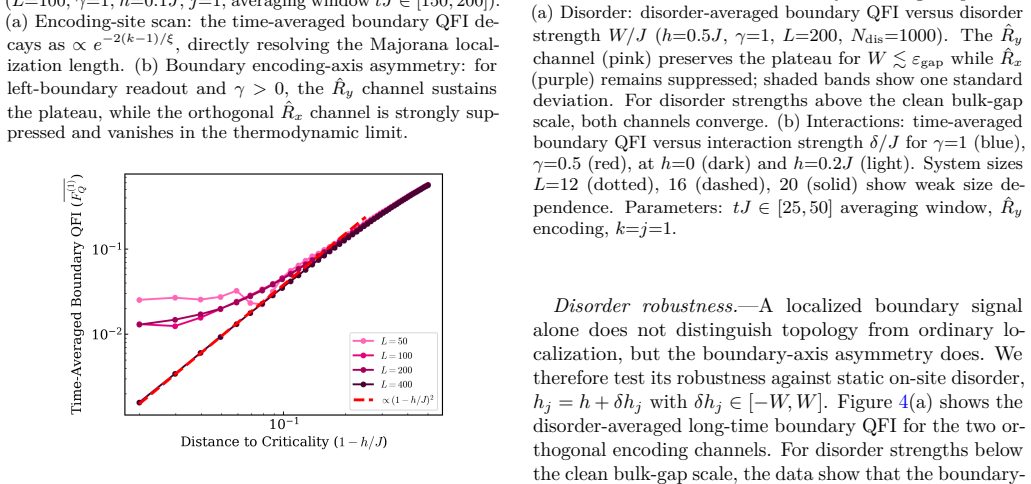
The paper establishes that in the open Kitaev chain in the topological phase, the Majorana zero mode fixes the boundary quantum Fisher information at a nonzero plateau that persists for times exponentially long in system size. Exact expressions for the local QFI follow from the spatial separation of the two Majorana quadratures to opposite chain ends, which produces a boundary encoding-axis asymmetry absent in generic localized subgap states. Numerical checks confirm that the plateau remains visible under moderate quenched disorder and under parity-preserving interactions in finite-size real-time simulations.
What carries the argument
The spatial separation of the two Majorana quadratures to opposite ends of the chain, which generates a boundary-specific encoding-axis asymmetry that shields the local quantum Fisher information from delocalization.
If this is right
- Local metrological sensitivity at the chain end remains usable over long evolution times without requiring global control or error correction.
- The encoding-axis asymmetry distinguishes topological boundary memory from ordinary localized subgap signals that lack such protection.
- The plateau survives moderate on-site disorder and parity-preserving interactions, allowing the protocol to function in imperfect realizations.
- Only product-state preparation, Hamiltonian evolution, and single-site readout are needed, so the scheme is experimentally straightforward.
Where Pith is reading between the lines
- The same separation mechanism could appear in other one-dimensional topological superconductors, suggesting a general route to protect local metrological resources.
- Experimental tests in superconducting qubit arrays or nanowire devices could directly measure the exponential lifetime scaling with length.
- The approach may connect to topological quantum computation by showing how protected edge modes can also stabilize sensing tasks.
- Extensions to weakly open systems could reveal whether dissipation strengthens or weakens the topological plateau.
Load-bearing premise
The system must stay in the topological phase with well-separated Majorana zero modes at the two boundaries while the dynamics preserve parity symmetry.
What would settle it
A numerical simulation of the clean open Kitaev chain in which the boundary quantum Fisher information decays to zero on a time scale that grows only polynomially rather than exponentially with system size would falsify the claimed protection.
Figures


read the original abstract
In many-body quantum systems, unitary dynamics generically delocalize locally encoded information, causing single-site metrological sensitivity to vanish. We analytically demonstrate that a topological phase can prevent this dispersal. In the open Kitaev chain, a Majorana zero mode fixes the boundary quantum Fisher information (QFI) at a nonzero plateau that persists for times exponentially long in system size. We derive exact analytical expressions for the local QFI and identify the mechanism as the spatial separation of the two Majorana quadratures to opposite ends of the chain. This separation produces a boundary encoding-axis asymmetry that distinguishes topological boundary memory from a generic localized subgap signal. We show numerically that the asymmetry is robust to moderate quenched on-site disorder, while the boundary plateau remains visible under parity-preserving interactions in finite-size real-time simulations. The protocol requires only product-state initialization, Hamiltonian evolution, and single-site readout.
Editorial analysis
A structured set of objections, weighed in public.
Referee Report
Summary. The manuscript claims that topological protection in the open Kitaev chain prevents delocalization of locally encoded information under unitary dynamics. Specifically, a Majorana zero mode fixes the boundary quantum Fisher information at a nonzero plateau persisting for times exponentially long in system size. Exact analytical expressions for the local QFI are derived, with the mechanism identified as spatial separation of the two Majorana quadratures producing a boundary encoding-axis asymmetry. Numerical checks demonstrate robustness to moderate quenched on-site disorder and visibility of the plateau under parity-preserving interactions in finite-size simulations. The protocol uses only product-state initialization, Hamiltonian evolution, and single-site readout.
Significance. If the central result holds, the work identifies a concrete topological mechanism for preserving local metrological sensitivity in many-body systems, with the exact solvability of the free-fermion Kitaev model and the explicit distinction from generic localized subgap states via encoding-axis asymmetry constituting clear strengths. The reported numerical robustness to moderate disorder and parity-preserving interactions further supports applicability beyond the ideal case.
minor comments (3)
- The abstract states that exact analytical expressions are derived for the local QFI; the main text should include a dedicated subsection or appendix that explicitly displays these expressions (including any intermediate steps involving the Majorana operators) so that the plateau value and its time independence can be verified directly.
- The numerical section on finite-size real-time simulations with interactions should report the precise system sizes, interaction strengths, and time scales simulated, together with a quantitative statement of how the observed plateau duration scales with system size to support the claimed exponential protection.
- Figure captions and the text discussing the encoding-axis asymmetry should include an explicit comparison (e.g., a side-by-side plot or table) between the topological case and a non-topological localized subgap state to make the distinguishing feature visually and quantitatively clear.
Simulated Author's Rebuttal
We thank the referee for the positive summary of our manuscript and for recommending minor revision. The referee's description accurately captures the central claims, including the role of Majorana zero modes in fixing the boundary QFI at a nonzero plateau for exponentially long times, the exact analytical expressions, the encoding-axis asymmetry mechanism, and the numerical checks for disorder and interactions. We are encouraged by the assessment that the work identifies a concrete topological mechanism with clear strengths in exact solvability and distinction from generic localized states.
Circularity Check
No significant circularity; derivation is self-contained analytical treatment of standard model
full rationale
The paper's central result is an exact analytical derivation for the open Kitaev chain (free-fermion solvable) showing that Majorana zero-mode separation fixes boundary QFI at a nonzero plateau for exponentially long times. This follows directly from the model's standard Hamiltonian and parity symmetries without fitted parameters, self-citations as load-bearing premises, or renaming of known results. Numerical checks for disorder and interactions are presented as robustness tests, not as the source of the main claim. No step reduces by construction to its own inputs or to a self-citation chain; the encoding-axis asymmetry is derived from the spatial separation of quadratures, which is an independent property of the topological phase.
Axiom & Free-Parameter Ledger
axioms (2)
- domain assumption The open Kitaev chain in the topological phase hosts isolated Majorana zero modes localized at the boundaries.
- domain assumption Unitary dynamics in generic many-body quantum systems cause local information to delocalize.
Reference graph
Works this paper leans on
-
[1]
These expressions make the boundary-axis asymmetry explicit
For the real- coupling chain andγ >0, the two orthogonal local en- coding channels are W (y) =U+V, W (x) =U−V.(16) Their zero-mode contributions are W (y/x) j,k (t) ⏐⏐ 0 = 2ϕL/R(k) [ ϕL/R(j)α−iϕR/L(j)β ] ,(17) where α= cos(ε0t) and β= sin(ε0t). These expressions make the boundary-axis asymmetry explicit. At the left boundary, the ˆRy channel couples to th...
2025
-
[2]
S. L. Braunstein and C. M. Caves, Phys. Rev. Lett.72, 3439 (1994)
1994
-
[3]
M. G. A. Paris, Int. J. Quantum Inf.7, 125 (2009)
2009
-
[4]
Pezzè, A
L. Pezzè, A. Smerzi, M. K. Oberthaler, R. Schmied, and P. Treutlein, Rev. Mod. Phys.90, 035005 (2018)
2018
-
[5]
Tóth and I
G. Tóth and I. Apellaniz, J. Phys. A: Math. Theor.47, 424006 (2014)
2014
-
[6]
Zanardi, M
P. Zanardi, M. G. A. Paris, and L. Campos Venuti, Phys. Rev. A78, 042105 (2008)
2008
-
[7]
Hauke, M
P. Hauke, M. Heyl, L. Tagliacozzo, and P. Zoller, Nat. Phys.12, 778 (2016)
2016
-
[8]
Pezzè, M
L. Pezzè, M. Gabbrielli, L. Lepori, and A. Smerzi, Phys. Rev. Lett.119, 250401 (2017)
2017
-
[9]
Swingle, Nat
B. Swingle, Nat. Phys.14, 988 (2018)
2018
-
[10]
Hayden and J
P. Hayden and J. Preskill, J. High Energy Phys.2007 (09), 120
2007
-
[11]
M. Płodzień, Lecture notes on information scram- bling, quantum chaos, and Haar-random states (2025), arXiv:2511.14397 [quant-ph]
-
[12]
Calabrese and J
P. Calabrese and J. Cardy, J. Stat. Mech.2005, P04010 (2005)
2005
-
[13]
Jafari and A
R. Jafari and A. Akbari, Phys. Rev. A101, 062105 (2020)
2020
-
[14]
A. Y. Kitaev, Phys.-Usp.44, 131 (2001), [Usp. Fiz. Nauk 171, 131 (2001)]
2001
-
[15]
Nayak, S
C. Nayak, S. H. Simon, A. Stern, M. Freedman, and S. Das Sarma, Rev. Mod. Phys.80, 1083 (2008)
2008
-
[16]
Alicea, Rep
J. Alicea, Rep. Prog. Phys.75, 076501 (2012)
2012
-
[17]
Mourik, K
V. Mourik, K. Zuo, S. M. Frolov, S. R. Plissard, E. P. A. M. Bakkers, and L. P. Kouwenhoven, Science336, 1003 (2012)
2012
-
[18]
M. Z. Hasan and C. L. Kane, Rev. Mod. Phys.82, 3045 (2010)
2010
-
[19]
E. Lieb, T. Schultz, and D. Mattis, Ann. Phys. (N.Y.)16, 407 (1961)
1961
-
[20]
S. Ryu, A. P. Schnyder, A. Furusaki, and A. W. W. Ludwig, New J. Phys.12, 065010 (2010)
2010
-
[21]
C.-K. Chiu, J. C. Y. Teo, A. P. Schnyder, and S. Ryu, Rev. Mod. Phys.88, 035005 (2016)
2016
-
[22]
See supplemental material
-
[23]
Bernien, S
H. Bernien, S. Schwartz, A. Keesling, H. Levine, A. Om- ran, H. Pichler, S. Choi, A. S. Zibrov, M. Endres, M. Greiner, V. Vuletić, and M. D. Lukin, Nature551, 579 (2017)
2017
-
[24]
Roushan, C
P. Roushan, C. Neill, A. Megrant, Y. Chen, R. Bab- bush, R. Barends, B. Campbell, Z. Chen, B. Chiaro, A. Dunsworth, A. Fowler, E. Jeffrey, J. Kelly, E. Lucero, J. Mutus, P. J. J. O’Malley, C. Quintana, D. Sank, A. Vainsencher, J. Wenner, T. White, E. Kapit, H. Neven, and J. Martinis, Nat. Phys.13, 146 (2017)
2017
-
[25]
Gärttner, J
M. Gärttner, J. G. Bohnet, A. Safavi-Naini, M. L. Wall, J. J. Bollinger, and A. M. Rey, Nat. Phys.13, 781 (2017)
2017
-
[26]
Fidkowski and A
L. Fidkowski and A. Kitaev, Phys. Rev. B83, 075103 (2011)
2011
-
[27]
B. Zeng, X. Chen, D.-L. Zhou, and X.-G. Wen,Quantum Information Meets Quantum Matter: From Quantum En- tanglement to Topological Phases of Many-Body Systems, Quantum Science and Technology (Springer, 2019). 6 Supplemental Material: Topological protection of local quantum Fisher information Jordan–Wigner mapping and BdG framework The spin-1 2 anisotropic X...
2019
-
[28]
This sign convention merely reflects/rotates the Bloch vector and leaves the QFI invariant. 8 The reduced single-site state isˆϱj = 1 2(1+m·ˆσ)with Bloch components mx =⟨ˆXj⟩, my =⟨ˆYj⟩, mz =⟨ˆZj⟩.(S21) Transverse Bloch vector and combined propagator The key identity is mx +imy = 2⟨ˆcj(t)⟩.(S22) Using Eq. (S18), ⟨ˆcj(t)⟩=−sinθ 2 ( ⟨0|ˆcj(t)|k⟩+⟨k|ˆcj(t)|0...
-
[29]
Away from the boundary, the fermionic single-site algebra maps to string-dressed spin operators because of the Jordan–Wigner tail
=−ˆσy 1,1−2ˆn 1 =−ˆσz 1.(S63) Thus the boundary QFI is obtained from ordinary single-spin Pauli measurements. Away from the boundary, the fermionic single-site algebra maps to string-dressed spin operators because of the Jordan–Wigner tail. This is why the experimentally local protocol considered in the Letter focuses on boundary readout. The encoding ste...
discussion (0)
Sign in with ORCID, Apple, or X to comment. Anyone can read and Pith papers without signing in.