Recognition: unknown
The minimal example of quantum network Bell nonlocality
Pith reviewed 2026-05-09 19:06 UTC · model grok-4.3
The pith
Quantum nonlocality is possible in the triangle network with no inputs and binary outcomes.
A machine-rendered reading of the paper's core claim, the machinery that carries it, and where it could break.
Core claim
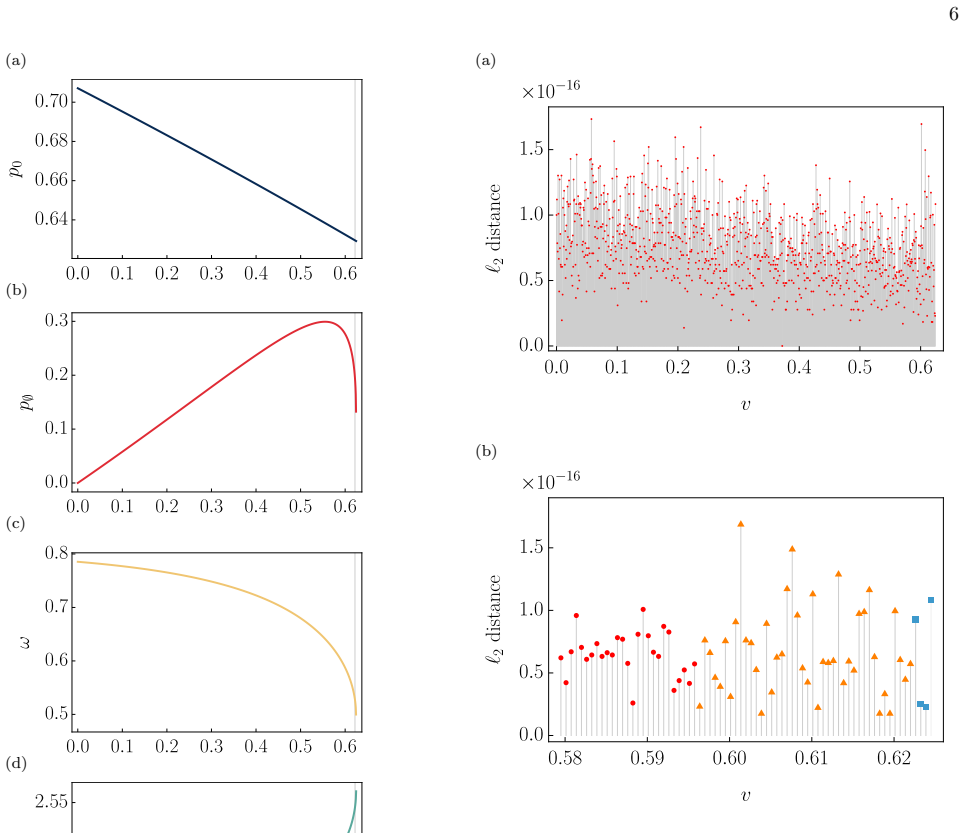
Quantum nonlocality is possible in the triangle network where the parties have no input choices and produce only binary-valued outcomes. We start by identifying a family of target distributions and proving their nonlocality. Next, we construct an explicit quantum model that reproduces the target distributions to machine precision using an efficient method for parameterizing quantum distributions in networks inspired by higher-order quantum operations. This constitutes the smallest scenario possible that supports quantum nonlocality in networks.
What carries the argument
An explicit quantum model for distributions in the triangle network, constructed via a parameterization inspired by higher-order quantum operations that matches target nonlocal distributions to machine precision.
Load-bearing premise
The parameterized quantum model corresponds to a valid physical realization with independent sources and local measurements.
What would settle it
Showing that no valid quantum states and measurements in the triangle network can reproduce the target distributions or that the model violates source independence.
Figures



read the original abstract
In recent years, the study of Bell nonlocality has been generalized to quantum networks, where multiple independent sources distribute physical systems to distant parties who perform local measurements. In this context, a central open question is to identify the minimal network configuration in which quantum resources produce Bell nonlocal correlations. Here we address this question and show that quantum nonlocality is possible in the triangle network where the parties have no input choices and produce only binary-valued outcomes. To do so, we start by identifying a family of target distributions and proving their nonlocality. Next, we construct an explicit quantum model that reproduces the target distributions to machine precision. For this, we develop an efficient method for parameterizing quantum distributions in networks, inspired by the formalism of higher-order quantum operations. When considering the number of observed variables and their cardinality, this constitutes the smallest scenario possible that supports quantum nonlocality in networks. Moreover, by analyzing the explicit quantum model, we obtain new insights into how nonlocal distributions can be generated in quantum networks.
Editorial analysis
A structured set of objections, weighed in public.
Referee Report
Summary. The paper claims to identify the minimal scenario for quantum network Bell nonlocality: the triangle network with no inputs and binary outcomes. It selects a family of target distributions, proves they lie outside the local set, and constructs an explicit quantum model via a parameterization inspired by higher-order quantum operations that reproduces the targets to machine precision. Analysis of this model is said to yield insights into nonlocal correlation generation in networks.
Significance. If the quantum model is a valid realization with independent sources, the result would establish the smallest known scenario (by number of observed variables and outcome cardinality) exhibiting quantum nonlocality in networks, which is a significant advance. The parameterization technique could be reusable for other network scenarios, and the explicit model provides concrete insights beyond abstract existence proofs.
major comments (2)
- [Quantum model construction] In the construction of the explicit quantum model (the section following the nonlocality proof), the higher-order parameterization is optimized to match the target distributions numerically to machine precision. However, the manuscript does not provide an explicit mapping from the optimized parameters back to concrete three independent bipartite source states and the local measurements each party performs on its two incoming systems. Without this mapping and a verification that the resulting objects satisfy the network constraints (independent sources, no communication between parties), it is not guaranteed that the numerical match corresponds to a physically valid quantum network realization rather than an effective model that encodes disallowed correlations.
- [Nonlocality proof] The nonlocality proof for the target distributions is load-bearing for the central claim. The manuscript should specify the exact method (e.g., the linear program or inequality used) and confirm that it correctly incorporates the triangle network structure with three independent sources; any relaxation or approximation in the proof would undermine the separation from the local set.
minor comments (2)
- [Abstract] The abstract states that the model matches 'to machine precision' but does not report the numerical tolerance, the optimization algorithm, or the number of parameters optimized; adding these details would improve reproducibility.
- [Notation and definitions] Notation for the observed distributions and the network elements (sources, parties) should be introduced once and used consistently; minor inconsistencies in variable names appear in the early sections.
Simulated Author's Rebuttal
We thank the referee for their careful reading of the manuscript and for the constructive comments, which help clarify the presentation of our results. We address each major comment below and will revise the manuscript accordingly to strengthen the exposition and explicitness of the constructions.
read point-by-point responses
-
Referee: [Quantum model construction] In the construction of the explicit quantum model (the section following the nonlocality proof), the higher-order parameterization is optimized to match the target distributions numerically to machine precision. However, the manuscript does not provide an explicit mapping from the optimized parameters back to concrete three independent bipartite source states and the local measurements each party performs on its two incoming systems. Without this mapping and a verification that the resulting objects satisfy the network constraints (independent sources, no communication between parties), it is not guaranteed that the numerical match corresponds to a physically valid quantum network realization rather than an effective model that encodes disallowed correlations.
Authors: We appreciate the referee highlighting this important point regarding the explicitness of our quantum model. The parameterization we employ is specifically designed within the framework of higher-order quantum operations to ensure that it corresponds to a valid quantum network with three independent sources and local measurements. Each optimized parameter set directly defines the source states and the measurement operators in a way that respects the network topology and independence constraints. Nevertheless, to address the concern and make the construction fully transparent, we will include in the revised manuscript the explicit extraction of the three bipartite source states and the local measurements from the optimized parameters, along with a direct verification that they satisfy the required conditions (no communication between parties and independent sources). This will confirm that the numerical reproduction corresponds to a physically valid realization. revision: yes
-
Referee: [Nonlocality proof] The nonlocality proof for the target distributions is load-bearing for the central claim. The manuscript should specify the exact method (e.g., the linear program or inequality used) and confirm that it correctly incorporates the triangle network structure with three independent sources; any relaxation or approximation in the proof would undermine the separation from the local set.
Authors: We agree that providing the precise details of the nonlocality proof is essential for the rigor of our central claim. The proof proceeds by formulating and solving a linear program that determines whether the target distribution lies outside the set of local correlations in the triangle network. The LP is constructed using the standard convex characterization of network-local distributions, with variables representing the joint distributions from each independent source and constraints enforcing the independence of the three sources as well as the locality of the measurements. We will add a dedicated subsection or appendix in the revised version that explicitly states the LP formulation, including all variables, objective function, and constraints, and confirm that it fully incorporates the triangle structure without any relaxations or approximations. The separation from the local set is established exactly (up to numerical precision of the solver). revision: yes
Circularity Check
No circularity: nonlocality proved independently before numerical quantum model construction
full rationale
The paper identifies a family of target distributions, proves they lie outside the local set for the triangle network, and separately constructs a quantum realization via a new parameterization method that matches the targets to machine precision. Neither step reduces to the other by definition or construction; the nonlocality proof does not rely on the quantum parameters, and the parameterization is presented as an existence witness rather than a fitted prediction or self-referential ansatz. No self-citation is load-bearing for the central claim, and the derivation remains self-contained against the stated network constraints.
Axiom & Free-Parameter Ledger
axioms (1)
- domain assumption The triangle network with independent sources and no inputs admits a quantum description via higher-order operations that can be parameterized efficiently.
Reference graph
Works this paper leans on
-
[1]
J. S. Bell, On the Einstein Podolsky Rosen paradox, Physics Physique Fizika1, 195 (1964)
1964
-
[2]
N. Brunner, D. Cavalcanti, S. Pironio, V. Scarani, and S. Wehner, Bell nonlocality, Rev. Mod. Phys.86, 419 (2014), arXiv:1303.2849
work page Pith review arXiv 2014
- [3]
-
[4]
Quantum and relativistic protocols for secure multi-party computation , Year =
R. Colbeck,Quantum and relativistic protocols for se- cure multi-Party computation, Ph.D. thesis, University of Cambridge (2006), arXiv:0911.3814
-
[5]
S. Pironio, A. Ac´ ın, S. Massar, A. Boyer de la Giro- day, D. N. Matsukevich, P. Maunz, S. Olmschenk, D. Hayes, L. Luo, T. A. Manning,et al., Random num- bers certified by Bell’s theorem, Nature464, 1021 (2010), arXiv:0911.3427
-
[6]
C. Branciard, N. Gisin, and S. Pironio, Character- izing the nonlocal correlations created via entangle- ment swapping, Phys. Rev. Lett.104, 170401 (2010), arXiv:0911.1314
-
[7]
C. Branciard, D. Rosset, N. Gisin, and S. Pironio, Bilocal versus nonbilocal correlations in entanglement- swapping experiments, Phys. Rev. A85, 032119 (2012), arXiv:1112.4502
-
[8]
Fritz, Beyond Bell’s theorem: correlation scenarios, New J
T. Fritz, Beyond Bell’s theorem: correlation scenarios, New J. Phys.14, 103001 (2012), arXiv:1206.5115
- [9]
- [10]
-
[11]
A. Tavakoli, A. Pozas-Kerstjens, M.-X. Luo, and M.-O. Renou, Bell nonlocality in networks, Rep. Prog. Phys. 85, 056001 (2022), arXiv:2104.10700
-
[12]
P. Sekatski, S. Boreiri, and N. Brunner, Partial self- testing and randomness certification in the trian- gle network, Phys. Rev. Lett.131, 100201 (2023), arXiv:2209.09921
-
[13]
M. Ciudad Ala˜ n´ on, D. Centeno, A. Watford, and E. Wolfe, Certifying randomness or its lack thereof for general network scenarios (2025), arXiv:2510.20993
- [14]
- [15]
- [16]
-
[17]
N. Gisin, The Elegant Joint Quantum Measurement and some conjectures aboutN-locality in the triangle and other configurations (2017), arXiv:1708.05556
-
[18]
M. Weilenmann and R. Colbeck, Non-Shannon inequali- ties in the entropy vector approach to causal structures, Quantum2, 57 (2018), arXiv:1605.02078
-
[19]
S. Boreiri, A. Girardin, B. Ulu, P. Lipka-Bartosik, N. Brunner, and P. Sekatski, Towards a minimal exam- ple of quantum nonlocality without inputs, Phys. Rev. A 107, 062413 (2023), arXiv:2207.08532
-
[20]
N. Gisin, J.-D. Bancal, Y. Cai, P. Remy, A. Tavakoli, E. Z. Cruzeiro, S. Popescu, and N. Brunner, Con- straints on nonlocality in networks from no-signaling and independence, Nat. Commun.11, 2378 (2020), arXiv:1906.06495
-
[21]
J.-D. Bancal and N. Gisin, Nonlocal boxes for networks, Phys. Rev. A104, 052212 (2021), arXiv:2102.03597
-
[22]
A. Pozas-Kerstjens, A. Girardin, T. Kriv´ achy, A. Tavakoli, and N. Gisin, Post-quantum nonlocal- ity in the minimal triangle scenario, New J. Phys.25, 113037 (2023), arXiv:2305.03745
- [23]
-
[24]
G. Chiribella, G. M. D’Ariano, and P. Perinotti, Quan- tum circuit architecture, Phys. Rev. Lett.101, 060401 (2008), arXiv:0712.1325
-
[25]
G. Chiribella, G. M. D’Ariano, and P. Perinotti, Trans- forming quantum operations: Quantum supermaps, EPL 83, 30004 (2008), arXiv:0804.0180
-
[26]
G. Chiribella, G. M. D’Ariano, and P. Perinotti, Theo- 8 retical framework for quantum networks, Phys. Rev. A 80, 022339 (2009), arXiv:0904.4483
-
[27]
Higher-order quantum operations,
P. Taranto, S. Milz, M. Murao, M. T. Quintino, and K. Modi, Higher-order quantum operations (2025), arXiv:2503.09693
- [28]
- [29]
-
[30]
A. Restivo, N. Brunner, and D. Rosset, Possibilistic ap- proach to network nonlocality (2022), arXiv:2208.13526
- [31]
-
[32]
M. Navascu´ es and E. Wolfe, The inflation technique com- pletely solves the causal compatibility problem, J. Causal Inference8, 70 (2020), arXiv:1707.06476
-
[33]
V. Gitton and R. Renner, The Elegant Joint Mea- surement is non-classical in the triangle network (2025),https://vgitton.github.io/fast-inflation/, arXiv:2510.15143
-
[34]
J. M. da Silva, A. Pozas-Kerstjens, and F. Parisio, Lo- cal models and Bell inequalities for the minimal tri- angle network, Phys. Rev. A112, L030403 (2025), arXiv:2503.16654
work page internal anchor Pith review Pith/arXiv arXiv 2025
-
[35]
M. Ziman, Process positive-operator-valued measure: A mathematical framework for the description of pro- cess tomography experiments, Phys. Rev. A77, 062112 (2008), arXiv:0802.3862
-
[36]
G. Chiribella, G. M. D’Ariano, and P. Perinotti, Memory effects in quantum channel discrimination, Phys. Rev. Lett.101, 180501 (2008), arXiv:0803.3237
-
[37]
Bavarescoet al., In preparation (2026)
J. Bavarescoet al., In preparation (2026)
2026
-
[38]
A. Tavakoli, A. Pozas-Kerstjens, P. Brown, and M. Ara´ ujo, Semidefinite programming relaxations for quantum correlations, Rev. Mod. Phys.96, 045006 (2024), arXiv:2307.02551
- [39]
-
[40]
Y.-C. Liang and A. C. Doherty, Bounds on quantum cor- relations in Bell-inequality experiments, Phys. Rev. A75, 042103 (2007), arXiv:quant-ph/0608128
-
[41]
The minimal example of quantum net- work Bell nonlocality
E. Don and A. Pozas-Kerstjens, Computational ap- pendix of “The minimal example of quantum net- work Bell nonlocality” (2026),https://www.github. com/Shamaii/minimal-network-nonlocality
2026
- [42]
-
[43]
T. Van Himbeeck, J. Bohr Brask, S. Pironio, R. Ra- manathan, A. B. Sainz, and E. Wolfe, Quantum vio- lations in the instrumental scenario and their relations to the Bell scenario, Quantum3, 10.22331/q-2019-09-16- 186 (2019), arXiv:1804.04119
- [44]
-
[45]
M. Ciudad-Ala˜ n´ on, E.-C. Boghiu, P. Abiuso, and E. Wolfe, Escaping the shadow of Bell’s theorem in net- work nonlocality (2024), arXiv:2406.15587
-
[46]
A. Pozas-Kerstjens, N. Gisin, and A. Tavakoli, Full net- work nonlocality, Phys. Rev. Lett.128, 010403 (2022), arXiv:2105.09325
-
[47]
I. ˇSupi´ c, J.-D. Bancal, Y. Cai, and N. Brunner, Genuine network quantum nonlocality and self-testing, Phys. Rev. A105, 022206 (2022), arXiv:2105.12341
-
[48]
A. Pozas-Kerstjens, N. Gisin, and M.-O. Renou, Proofs of network quantum nonlocality in continuous families of distributions, Phys. Rev. Lett.130, 090201 (2023), arXiv:2203.16543
-
[49]
Pozas-Kerstjens,Quantum information outside quan- tum information, Ph.D
A. Pozas-Kerstjens,Quantum information outside quan- tum information, Ph.D. thesis, Universitat Polit` ecnica de Catalunya (2019)
2019
-
[50]
M. Pl´ avala, L. T. Ligthart, and D. Gross, The polariza- tion hierarchy for polynomial optimization over convex bodies, with applications to nonnegative matrix rank, Linear Algebra Appl.723, 15 (2025), arXiv:2406.09506
discussion (0)
Sign in with ORCID, Apple, or X to comment. Anyone can read and Pith papers without signing in.