Recognition: unknown
CP violation in neutral kaon mixing in D⁰rightarrow K_SK_S
Pith reviewed 2026-05-09 18:29 UTC · model grok-4.3
The pith
Neutral kaon mixing contributes to CP violation in D^0 to K_S K_S only through second-order weak interactions at the 10^{-6} level.
A machine-rendered reading of the paper's core claim, the machinery that carries it, and where it could break.
Core claim
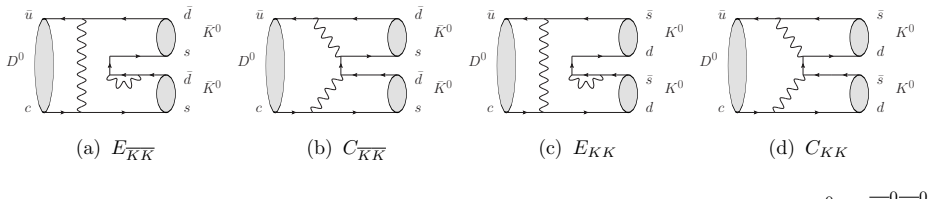
The contribution from neutral kaon mixing to CP violation in D^0 → K_S K_S arises only in connection with second-order weak interactions in D decays and is estimated to be at the 10^{-6} level, negligible compared to current experimental sensitivity and to the expected contribution from CP violation in the charm sector.
What carries the argument
The linkage of neutral kaon mixing effects exclusively to second-order weak interactions in D decays, which enforces the suppression.
Load-bearing premise
Neutral kaon mixing effects on the CP asymmetry appear only when second-order weak interactions are present in the D decay.
What would settle it
An experimental measurement of a_CP(D^0 → K_S K_S) significantly exceeding 10^{-6} that cannot be accounted for by charm-sector CP violation.
Figures
read the original abstract
We study CP violation induced by neutral kaon mixing in $a_{CP}(D^0 \rightarrow K_S K_S)$. We show that the contribution from neutral kaon mixing arises only in connection with second-order weak interactions in $D$ decays. We estimate this effect to be at the $10^{-6}$ level, and thus negligible compared to current experimental sensitivity and to the expected contribution from CP violation in the charm sector.
Editorial analysis
A structured set of objections, weighed in public.
Referee Report
Summary. The manuscript studies CP violation induced by neutral kaon mixing in the CP asymmetry a_CP for the decay D^0 → K_S K_S. It demonstrates that this contribution can only arise in association with second-order weak interactions in the D decay and estimates the magnitude of the effect to be at the 10^{-6} level. Consequently, the authors conclude that it is negligible compared to current experimental sensitivity and to the anticipated CP violation from the charm sector.
Significance. Assuming the result is correct, this paper offers an important clarification for experimental studies of CP violation in charm decays. It shows that the neutral kaon mixing effect is suppressed by the second-order nature of the process, leading to a small contribution consistent with the weak interaction hierarchy (G_F^2 |ε| scaling). This helps ensure that observed asymmetries can be attributed to charm CP violation or beyond-Standard-Model effects without contamination from kaon mixing. The derivation is direct and does not rely on additional free parameters.
minor comments (2)
- The estimate of 10^{-6} would be strengthened by providing the explicit combination of amplitudes and the numerical value of the kaon CP violation parameter |ε| used in the calculation.
- Consider expanding the abstract slightly to include the key argument about second-order weak interactions for better context.
Simulated Author's Rebuttal
We thank the referee for the positive assessment of our manuscript and for the recommendation of minor revision. The referee's summary accurately captures our central result: that the contribution to a_CP(D^0 → K_S K_S) from neutral kaon mixing is suppressed by the requirement of second-order weak interactions in the D decay and is therefore O(10^{-6}). We agree that this clarification is useful for experimental analyses of charm CP violation.
Circularity Check
No significant circularity identified
full rationale
The paper's central result follows from the structure of the effective weak Hamiltonian in the Standard Model, where neutral-kaon mixing (a ΔS=2 process) can only enter the D^0 → K_S K_S amplitude via two ΔS=1 vertices plus the mixing insertion, producing an O(G_F^2 |ε|) suppression relative to the leading amplitude. This yields the 10^{-6} estimate directly from known weak-interaction hierarchies and CKM factors without any fitted parameter defined in terms of the target observable, without renaming an empirical pattern, and without load-bearing self-citation. The derivation is therefore self-contained and does not reduce to its inputs by construction.
Axiom & Free-Parameter Ledger
axioms (1)
- standard math Standard Model weak interactions govern D decays and kaon mixing
Reference graph
Works this paper leans on
-
[1]
It is a singly Cabibbo-suppressed (SCS) process
-
[2]
It involves the spectator quark
-
[3]
The CP asymmetry, aCP (D0 →K SKS)≡ Γ(D0 →K SKS)−Γ( D 0 →K SKS) Γ(D0 →K SKS) + Γ(D 0 →K SKS) ,(2) is particularly interesting
The CKM-leading amplitude vanishes in the U-spin limit [2]. The CP asymmetry, aCP (D0 →K SKS)≡ Γ(D0 →K SKS)−Γ( D 0 →K SKS) Γ(D0 →K SKS) + Γ(D 0 →K SKS) ,(2) is particularly interesting. The third suppression factor mentioned above, namely the U-spin argument, implies that the CP asymmetry is enhanced by a factor of the order of the inverse of the dimensio...
-
[4]
(20, 21)
and Eqs. (20, 21). The asymmetrya K,D CP does not depend on the parameterϵ, as it should. The reason is that it does not depend on CP violation in the neutral kaon system. It depends solely on the kaon-mixing interference between the final statesK 0K 0 and K 0 K 0 in the final stateK SKS. B. CP asymmetry in neutral kaon oscillations,a K,ϵ CP We now consid...
-
[5]
Navaset al.(Particle Data Group), Phys
S. Navaset al.(Particle Data Group), Phys. Rev. D110, 030001 (2024, and 2025 update)
2024
-
[6]
M. J. Savage, Phys. Lett. B257, 414 (1991)
1991
- [7]
-
[8]
U. Nierste and S. Schacht, Phys. Rev. D92, 054036 (2015), arXiv:1508.00074 [hep-ph]
-
[9]
G. Bonviciniet al.(CLEO), Phys. Rev. D63, 071101 (2001), arXiv:hep-ex/0012054
-
[10]
N. Dashet al., Phys. Rev. Lett.119, 171801 (2017), arXiv:1705.05966 [hep-ex]
-
[11]
Adachiet al.(Belle, Belle-II), Phys
I. Adachiet al.(Belle, Belle-II), Phys. Rev. D111, 012015 (2025), arXiv:2411.00306 [hep-ex]
-
[12]
Adachiet al.(Belle, Belle-II), Phys
I. Adachiet al.(Belle, Belle-II), Phys. Rev. D112, 012017 (2025), arXiv:2504.15881 [hep-ex]
-
[13]
Aaijet al.(LHCb), JHEP10, 055 (2015), arXiv:1508.06087 [hep-ex]
R. Aaijet al.(LHCb), JHEP10, 055 (2015), arXiv:1508.06087 [hep-ex]
-
[14]
Aaijet al.(LHCb), JHEP11, 048 (2018), arXiv:1806.01642 [hep-ex]
R. Aaijet al.(LHCb), JHEP11, 048 (2018), arXiv:1806.01642 [hep-ex]
-
[15]
R. Aaijet al.(LHCb), Phys. Rev. D104, L031102 (2021), arXiv:2105.01565 [hep-ex]
-
[16]
Aaijet al.(LHCb), JHEP02, 253 (2026), arXiv:2510.14732 [hep-ex]
R. Aaijet al.(LHCb), JHEP02, 253 (2026), arXiv:2510.14732 [hep-ex]
-
[17]
A. Hayrapetyanet al.(CMS), Eur. Phys. J. C84, 1264 (2024), arXiv:2405.11606 [hep-ex]
-
[18]
G. Tuci on behalf of the LHCb Collaboration, LHC Seminar, CERN, 22 July 2025, https://indico.cern.ch/event/1569705/
-
[19]
W. Altmannshoferet al.(Belle-II), PTEP2019, 123C01 (2019), [Erratum: PTEP 2020, 029201 (2020)], arXiv:1808.10567 [hep-ex]. [16]Physics case for an LHCb Upgrade II, Tech. Rep. (CERN, Geneva, 2018) arXiv:1808.08865
- [20]
-
[21]
Z.-Z. Xing, Phys. Lett. B353, 313 (1995), [Erratum: Phys.Lett.B 363, 266 (1995)], arXiv:hep- ph/9505272
- [22]
-
[23]
Y. Grossman and Y. Nir, JHEP04, 002 (2012), arXiv:1110.3790 [hep-ph]
-
[24]
Y. Grossman, P. Leo, A. Martini, G. Papiri, and A. Rostomyan, (2025), arXiv:2509.07071 [hep-ph]
-
[25]
Aokiet al.(Flavour Lattice Averaging Group (FLAG)), FLAG review 2024, Phys
Y. Aokiet al.(Flavour Lattice Averaging Group (FLAG)), Phys. Rev. D113, 014508 (2026), arXiv:2411.04268 [hep-lat]
-
[26]
B- andD-meson leptonic decay con- stants from four-flavor lattice QCD,
A. Bazavovet al., Phys. Rev. D98, 074512 (2018), arXiv:1712.09262 [hep-lat]
- [27]
-
[28]
N. Carrascoet al., Phys. Rev. D91, 054507 (2015), arXiv:1411.7908 [hep-lat]
-
[29]
F K /Fπ from M¨ obius Domain-Wall fermions solved on gradient-flowed HISQ ensembles,
N. Milleret al., Phys. Rev. D102, 034507 (2020), arXiv:2005.04795 [hep-lat]
-
[30]
Ratio of kaon and pion leptonic decay constants with Nf=2+1+1 Wilson-clover twisted-mass fermions,
C. Alexandrouet al.(Extended Twisted Mass), Phys. Rev. D104, 074520 (2021), arXiv:2104.06747 [hep-lat]
-
[31]
D. Binosi and L. Theußl, Comput. Phys. Commun.161, 76 (2004), arXiv:hep-ph/0309015
- [32]
- [33]
-
[34]
T. B. Day, Phys. Rev.121, 1204 (1961)
1961
-
[35]
H. J. Lipkin, Phys. Rev.176, 1715 (1968)
1968
-
[36]
Einstein, B
A. Einstein, B. Podolsky, and N. Rosen, Phys. Rev.47, 777 (1935)
1935
-
[37]
Babusciet al.(KLOE-2), JHEP04, 059 (2022), [Erratum: JHEP 04, 169 (2022)], arXiv:2111.04328 [hep-ex]
D. Babusciet al.(KLOE-2), JHEP04, 059 (2022), [Erratum: JHEP 04, 169 (2022)], arXiv:2111.04328 [hep-ex]
-
[38]
Buchanan, R
C. Buchanan, R. Cousins, C. Dib, R. D. Peccei, and J. Quackenbush, Phys. Rev. D45, 4088 (1992)
1992
-
[39]
G. C. Branco, L. Lavoura, and J. P. Silva,CP Violation, Vol. 103 (1999)
1999
-
[40]
J. Bernabeu, A. Di Domenico, and P. Villanueva-Perez, Nucl. Phys. B868, 102 (2013), arXiv:1208.0773 [hep-ph]
-
[41]
J. Bernabeu, A. Di Domenico, and P. Villanueva-Perez, JHEP10, 139 (2015), arXiv:1509.02000 [hep-ph]
-
[42]
F. Ambrosinoet al.(KLOE), Phys. Lett. B642, 315 (2006), arXiv:hep-ex/0607027. 14
discussion (0)
Sign in with ORCID, Apple, or X to comment. Anyone can read and Pith papers without signing in.