Recognition: unknown
Modelling Intermediate-Current Transitions in Asymmetric-Valence Binary Electrolytes
Pith reviewed 2026-05-09 18:08 UTC · model grok-4.3
The pith
Asymmetric ion valences produce a smooth transition in steady-state electrolyte behavior at an intermediate current where the Debye layer disappears.
A machine-rendered reading of the paper's core claim, the machinery that carries it, and where it could break.
Core claim
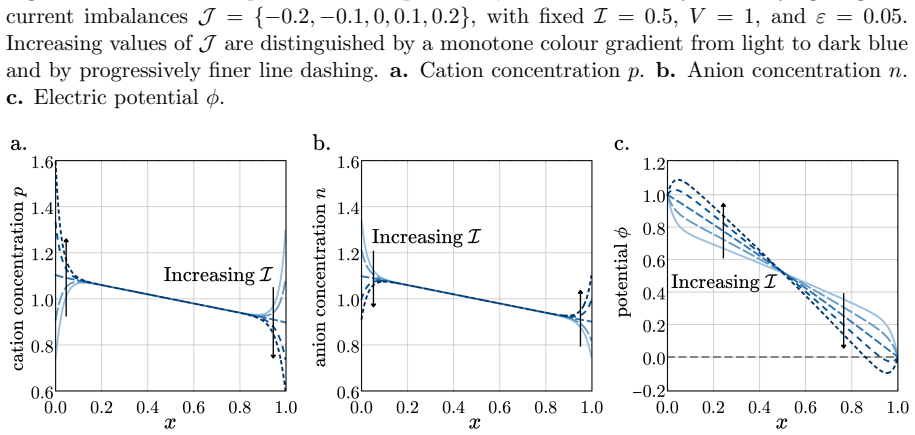
In the steady one-dimensional Poisson-Nernst-Planck description of an asymmetric-valence binary electrolyte subject to constant imposed ionic fluxes, the steady states pass smoothly from a near-equilibrium regime to a strongly non-equilibrium regime. The regimes are separated by a valence-dependent transition current at which the classical Debye-scale boundary layer vanishes. Asymptotic analysis recovers the classical Gouy-Chapman and limiting-current solutions in the appropriate limits and supplies the correct matching expressions in between, together with implicit solutions for arbitrary valences and explicit composite solutions for the 2z:z, z:2z and z:z cases that permit construction of
What carries the argument
The valence-dependent intermediate current at which the Debye-scale boundary layer thickness reaches zero, used to construct asymptotic composite solutions that bridge the Gouy-Chapman and limiting-current regimes.
If this is right
- The phase diagram allows prediction of qualitative steady-state behaviour solely from the ion valences and the imposed fluxes.
- Explicit analytic expressions for 2z:z, z:2z and z:z electrolytes give potential and concentration profiles without requiring numerical solution.
- General asymmetric electrolytes admit implicit analytic solutions that can be evaluated for any valence pair.
- Classical low-current and high-current limits are recovered exactly, confirming consistency with prior equilibrium and limiting-current theories.
Where Pith is reading between the lines
- Real devices with convection or side reactions would experience a shifted transition current, which could be measured to test the model.
- The collapsed diagram suggests that choosing specific valence ratios could tune the current range over which equilibrium-like behaviour persists.
- Extending the analysis to two dimensions might reveal how the transition point varies along an electrode surface.
Load-bearing premise
The analysis assumes a strictly steady, one-dimensional geometry with constant imposed ionic fluxes and no convection or side reactions.
What would settle it
Measurement of the ion concentration or electric potential profile across the cell for a 2:1 valence electrolyte at the theoretically predicted transition current, checking whether the boundary layer has indeed vanished while the bulk solution remains non-uniform.
Figures




read the original abstract
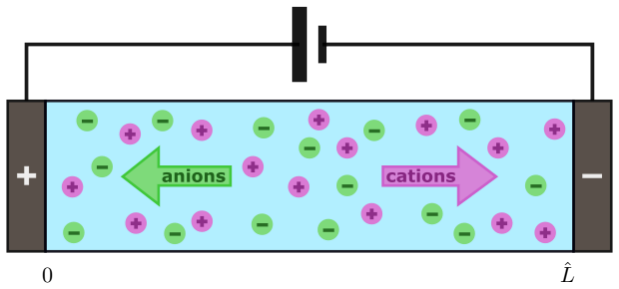
Asymmetric valences in a binary electrolyte can significantly affect the performance of systems such as reverse electrodialysis cells, batteries, and supercapacitors. To generate a theoretical understanding of this effect, we consider a steady one-dimensional Poisson-Nernst-Planck model of an electrolytic cell with imposed constant ionic fluxes, focusing on varying ion valences in a general asymmetric binary electrolyte. Numerical simulations reveal a smooth transition between the qualitatively distinct near-equilibrium and strongly non-equilibrium steady-state regimes. These regimes are distinguished by a valence-dependent transition point at an intermediate current where the classical Debye-scale boundary layer vanishes. We characterise this transition using asymptotic analysis, recovering the Gouy-Chapman and limiting-current results in the appropriate limits, and determining the correct transition results when neither is appropriate. We provide implicit solutions for the potential and ion concentrations of general asymmetric binary electrolytes and, notably, we provide explicit analytic expressions for the asymptotic composite solutions for 2z:z, z:2z, and z:z electrolytes. We show how the results can be presented in a collapsed phase diagram that can be used to predict qualitative intermediate-current steady-state behaviour in terms of ion valences and fluxes.
Editorial analysis
A structured set of objections, weighed in public.
Referee Report
Summary. The manuscript develops a one-dimensional steady-state Poisson-Nernst-Planck model for binary electrolytes with asymmetric ion valences under constant imposed fluxes. Through numerical simulations, it identifies a smooth transition between near-equilibrium and strongly non-equilibrium regimes at an intermediate current that depends on the ion valences and is marked by the vanishing of the classical Debye-scale boundary layer. Asymptotic analysis is used to characterize this transition, recovering the Gouy-Chapman equilibrium and limiting-current regimes in the appropriate limits, and providing implicit general solutions along with explicit composite asymptotic expressions for the cases of 2z:z, z:2z, and z:z electrolytes. The results are consolidated into a collapsed phase diagram for predicting steady-state behavior.
Significance. If validated, the work provides a valuable parameter-free framework for understanding and predicting intermediate-current phenomena in asymmetric electrolytes, with direct relevance to technologies like batteries, supercapacitors, and reverse electrodialysis. The strengths include the consistency between numerical and asymptotic approaches, the explicit analytic forms for common valence combinations, and the absence of ad-hoc parameters, which could facilitate both theoretical extensions and practical applications.
major comments (2)
- §3 (Numerical Results): The identification of the valence-dependent transition current relies on observing the disappearance of the Debye-scale boundary layer in simulations, but the manuscript lacks a quantitative error analysis or convergence study to precisely determine this point and confirm the smoothness of the transition for general valence ratios.
- §4 (Asymptotic Analysis): The composite solutions for specific valence cases are presented as explicit expressions, but the derivation of the matching conditions at the intermediate-current transition point is not detailed sufficiently to allow independent verification of how the near-equilibrium and non-equilibrium asymptotics are combined.
minor comments (3)
- Abstract: The abstract could specify the range of current densities or dimensionless fluxes considered in the study to better contextualize the intermediate regime.
- Figure 5 (Phase Diagram): The collapsed phase diagram is useful, but the axes and curves for different valence pairs should be more distinctly labeled to improve readability.
- §2 (Model): The boundary conditions for the imposed fluxes are clearly stated, but a brief reminder of the non-dimensionalization scheme would aid readers in interpreting the results.
Simulated Author's Rebuttal
Thank you for the opportunity to respond to the referee's report. We appreciate the referee's positive evaluation of our work on modelling intermediate-current transitions in asymmetric-valence binary electrolytes. Below, we provide point-by-point responses to the major comments and indicate the revisions we will make to the manuscript.
read point-by-point responses
-
Referee: §3 (Numerical Results): The identification of the valence-dependent transition current relies on observing the disappearance of the Debye-scale boundary layer in simulations, but the manuscript lacks a quantitative error analysis or convergence study to precisely determine this point and confirm the smoothness of the transition for general valence ratios.
Authors: We agree that a quantitative error analysis and convergence study would strengthen the numerical identification of the transition. In the revised manuscript, we have added a grid-convergence study in §3, including error estimates on the boundary-layer thickness as a function of current and valence ratio. This confirms the smoothness of the transition and supplies quantitative bounds on the valence-dependent transition currents. revision: yes
-
Referee: §4 (Asymptotic Analysis): The composite solutions for specific valence cases are presented as explicit expressions, but the derivation of the matching conditions at the intermediate-current transition point is not detailed sufficiently to allow independent verification of how the near-equilibrium and non-equilibrium asymptotics are combined.
Authors: We thank the referee for this observation. We have expanded §4 to provide a step-by-step derivation of the matching conditions at the transition current. The revised text now explicitly details how the near-equilibrium and non-equilibrium asymptotics are combined, including the explicit calculation of the matching constants for the 2z:z, z:2z, and z:z cases. revision: yes
Circularity Check
No significant circularity; derivation self-contained in PNP model
full rationale
The paper derives its transition point, composite solutions, and phase diagram directly from the steady 1D Poisson-Nernst-Planck equations with constant-flux boundary conditions. Numerical results and asymptotic matching (Gouy-Chapman and limiting-current limits) are obtained without fitted parameters, self-referential definitions, or load-bearing self-citations. Implicit general solutions and explicit expressions for 2z:z, z:2z, z:z cases follow from the governing equations and boundary conditions by standard asymptotic methods. No step reduces to its own input by construction, and the central claim remains independent of prior author work.
Axiom & Free-Parameter Ledger
axioms (2)
- domain assumption The system is steady-state and strictly one-dimensional.
- domain assumption Ionic fluxes are constant and externally imposed.
Reference graph
Works this paper leans on
-
[1]
Barcilon, V. and Chen, D. P. and Eisenberg, R. S. and Jerome, J. W. , year =. Qualitative. SIAM J. Appl. Math. , volume =. doi:10.1137/S0036139995312149 , urldate =
-
[2]
and Faulkner, Larry R
Bard, Allen J. and Faulkner, Larry R. and White, Henry S. , date =. Electrochemical Methods: Fundamentals and Applications , shorttitle =
-
[3]
Chu, Kevin T. and Bazant, Martin Z. , year =. Electrochemical. SIAM J. Appl. Math. , volume =. doi:10.1137/040609926 , urldate =
-
[4]
Bazant, Martin Z. and Chu, Kevin T. and Bayly, B. J. , date =. Current-. doi:10.1137/040609938 , url =
-
[5]
Jarvey, Nathan and Henrique, Filipe and Gupta, Ankur , date =. Ion. doi:10.1149/1945-7111/ac908e , url =
-
[6]
doi:10.1080/14786440408634187 , url =
Chapman, David Leonard , date =. doi:10.1080/14786440408634187 , url =
-
[7]
Kontturi, Kyosti and Murtom\". Ionic
-
[8]
Sur la constitution de la charge électrique à la surface d'un électrolyte , volume =. J. Phys. (Paris) , author =. 1910 , pages =. doi:10.1051/jphystap:019100090045700 , number =
-
[9]
Diffuse-charge dynamics in electrochemical systems , volume =. Phys. Rev. E , author =. 2004 , pages =. doi:10.1103/PhysRevE.70.021506 , language =
-
[10]
Exact solution of the unidimensional. Biophys. J. , author =. 1976 , pages =. doi:10.1016/S0006-3495(76)85761-X , abstract =
-
[11]
, year =
Newman, John and Balsara, Nitash P. , year =. Electrochemical
-
[12]
Physicochemical
Levich, Veniamin , year =. Physicochemical
-
[13]
Physicochemical
Probstein, Ronald , month = jul, year =. Physicochemical
-
[14]
Singular perturbation solutions of steady-state. Phys. Rev. E , author =. 2014 , keywords =. doi:10.1103/PhysRevE.89.022722 , number =
-
[15]
doi:10.1016/j.electacta.2009.03.073 , url =
Imposed currents in galvanic cells , author =. doi:10.1016/j.electacta.2009.03.073 , url =
-
[16]
Mémoires de l'Académie Royale des Sciences de l'Institut de France , volume =
Poisson, Siméon-Denis , title =. Mémoires de l'Académie Royale des Sciences de l'Institut de France , volume =. 1823 , publisher =
-
[17]
Planck, Max , date =. Ueber Die. doi:10.1002/andp.18902750202 , url =
-
[18]
Nernst, Walther , date =. Die Elektromotorische. doi:10.1515/zpch-1889-0112 , url =
-
[19]
Hu, Jingwei and Huang, Xiaodong , date =. A fully discrete positivity-preserving and energy-dissipative finite difference scheme for Poisson--Nernst--. doi:10.1007/s00211-020-01109-z , url =
-
[20]
A conservative finite difference scheme for
Flavell, Allen and Machen, Michael and Eisenberg, Bob and Kabre, Julienne and Liu, Chun and Li, Xiaofan , date =. A conservative finite difference scheme for. doi:10.1007/s10825-013-0506-3 , url =
-
[21]
MacGillivray, A. D. , date =. Nernst--. doi:10.1063/1.1669549 , url =
-
[22]
Membrane Potential and
Ohshima, Hiroyuki and Kondo, Tamotsu , date =. Membrane Potential and
-
[23]
Bicknell, G. V. and Coster, H. G. L. and George, E. P. , date =. Exact
-
[24]
Rubinstein, I. and Zaltzman, B. , date =. Electro-. doi:10.1142/S0218202501000866 , url =
-
[25]
doi:10.1103/PhysRevE.62.2238 , url =
Electro-Osmotically Induced Convection at a Permselective Membrane , author =. doi:10.1103/PhysRevE.62.2238 , url =
-
[26]
NIST Digital Library of Mathematical Functions
-
[27]
Perturbation Methods , author =
-
[28]
Design of monovalent ion selective membranes for reducing the impacts of multivalent ions in reverse electrodialysis , author =. Membranes , volume =. doi:10.3390/membranes10010007 , urldate =
-
[29]
and Malik, Rahul and Liu, Miao and Gallagher, Kevin G
Canepa, Pieremanuele and Sai Gautam, Gopalakrishnan and Hannah, Daniel C. and Malik, Rahul and Liu, Miao and Gallagher, Kevin G. and Persson, Kristin A. and Ceder, Gerbrand , year = 2017, month = mar, journal =. Odyssey of. doi:10.1021/acs.chemrev.6b00614 , urldate =
-
[30]
A brief review on multivalent intercalation batteries with aqueous electrolytes. , author =. Nanomaterials , volume =. doi:10.3390/nano6030041 , urldate =
-
[31]
Influence of multivalent ions on power production from mixing salt and fresh water with a reverse electrodialysis system , author =. J. Membr. Sci. , volume =. doi:10.1016/j.memsci.2008.12.042 , urldate =
-
[32]
Review of recent advances in multivalent ion batteries for next generation energy storage , author =. Electrochem , volume =. doi:10.3390/electrochem6040044 , urldate =
-
[33]
Mitigating the influence of multivalent ions on power density performance in a single-membrane capacitive reverse electrodialysis cell , author =. Sci. Rep. , volume =. doi:10.1038/s41598-024-67690-7 , urldate =
-
[34]
Analysis of diffuse-layer effects on time-dependent interfacial kinetics , author =. J. Electroanal. Chem. , volume =. doi:10.1016/S0022-0728(00)00470-8 , urldate =
-
[35]
Gupta, Ankur and Stone, Howard A. , date =. Electrical double layers: effects of asymmetry in electrolyte valence on steric effects, dielectric decrement, and ion–ion correlations , shorttitle =. doi:10.1021/acs.langmuir.8b02064 , url =
-
[36]
Xing, Xiangjun , date =. Poisson-. doi:10.1103/PhysRevE.83.041410 , url =
-
[37]
An exact solution of the nonlinear
Zhang, Wenyao and Wang, Qiuwang and Zeng, Min and Zhao, Cunlu , date =. An exact solution of the nonlinear. doi:10.1007/s00396-018-4394-8 , url =
-
[38]
doi:10.1007/s10665-006-9114-6 , url =
Time-dependent modelling and asymptotic analysis of electrochemical cells , author =. doi:10.1007/s10665-006-9114-6 , url =
-
[39]
and Tournier, E
Davenport, James Harold and Siret, Y. and Tournier, E. and Davenport, A. , address =. Computer algebra : systems and algorithms for algebraic computation , year =
-
[40]
1971 , publisher =
Handbook of Elliptic Integrals for Engineers and Scientists , author =. 1971 , publisher =
1971
-
[41]
2026 , location =
Mathematica , version =. 2026 , location =
2026
-
[42]
Python Language Reference, version 3.13.9 , year =
-
[43]
and Millman, K
Harris, Charles R. and Millman, K. Jarrod and van der Walt, St. Array programming with NumPy , journal =. 2020 , doi =
2020
-
[44]
and Haberland, Matt and others , title =
Virtanen, Pauli and Gommers, Ralf and Oliphant, Travis E. and Haberland, Matt and others , title =. Nat. Methods , volume =. 2020 , doi =
2020
-
[45]
Keller, Christine and Landstorfer, Manuel and Fuhrmann, Jürgen and Wagner, Barbara , date =. A. doi:10.3390/e27090981 , url =
-
[46]
Zheng, Qiong and Chen, Duan and Wei, Guo-Wei , date =. Second-order. doi:10.1016/j.jcp.2011.03.020 , url =
-
[47]
Singer, A. and Gillespie, D. and Norbury, J. and Eisenberg, R. S. , date =. Singular perturbation analysis of the steady-state. doi:10.1017/S0956792508007596 , url =
-
[48]
doi:10.1039/D2CP00348A , url =
Assessing the impact of valence asymmetry in ionic solutions and its consequences on the performance of supercapacitors , author =. doi:10.1039/D2CP00348A , url =
-
[49]
and Orszag, Steven A
Bender, Carl M. and Orszag, Steven A. , date =. Advanced Mathematical Methods for Scientists and Engineers. 1:
-
[50]
Introduction to Electrochemistry , author =
-
[51]
Kovalenko, Anna and Chubyr, Natalia and Uzdenova, Aminat and Urtenov, Makhamet , date =. Theoretical. doi:10.3390/membranes12111047 , url =
-
[52]
doi:10.1007/s43939-023-00065-3 , url =
A review on electrolytes for supercapacitor device , author =. doi:10.1007/s43939-023-00065-3 , url =
-
[53]
doi:10.1103/PhysRevFluids.4.043702 , url =
Diffusiophoretic and diffusioosmotic velocities for mixtures of valence-asymmetric electrolytes , author =. doi:10.1103/PhysRevFluids.4.043702 , url =
-
[54]
Messias, Andresa and C. Da Silva, Débora A. and Fileti, Eudes E. , date =. Salt-in-water and water-in-salt electrolytes: the effects of the asymmetry in cation and anion valence on their properties , shorttitle =. doi:10.1039/D1CP04259A , url =
-
[55]
doi:10.1016/j.electacta.2022.141220 , url =
Impact of asymmetries in valences and diffusivities on the transport of a binary electrolyte in a charged cylindrical pore , author =. doi:10.1016/j.electacta.2022.141220 , url =
-
[56]
doi:10.1016/j.jelechem.2022.116222 , url =
The electrochemical impedance spectrum of asymmetric electrolytes across low to moderate frequencies , author =. doi:10.1016/j.jelechem.2022.116222 , url =
-
[57]
Diffuse-charge effects on the transient response of electrochemical cells , author =. Phys. Rev. E , volume =. 2010 , month =. doi:10.1103/PhysRevE.81.021503 , url =
-
[58]
doi:doi:10.1515/zpch-1904-4704 , url =
Theorie der reaktionsgeschwindigkeit in heterogenen systemen , author =. doi:doi:10.1515/zpch-1904-4704 , url =
-
[59]
Integral equation method for the
Chao, Zhen and Geng, Weihua and Krasny, Robert , date =. Integral equation method for the. doi:10.1007/s10825-023-02092-y , url =
-
[60]
doi:10.1016/j.electacta.2009.10.078 , url =
Diffuse Layer Effects on the Current in Galvanic Cells Containing Supporting Electrolyte , author =. doi:10.1016/j.electacta.2009.10.078 , url =
-
[61]
doi:10.5281/zenodo.19695204 , url =
Georgina Ryan , title =. doi:10.5281/zenodo.19695204 , url =
-
[62]
Integration in Finite Terms: Fundamental Sources , editor =
Khovanskii, Askold , title =. Integration in Finite Terms: Fundamental Sources , editor =
discussion (0)
Sign in with ORCID, Apple, or X to comment. Anyone can read and Pith papers without signing in.