Recognition: unknown
Leveraging unstructured grids for direct numerical simulations of wall turbulence
Pith reviewed 2026-05-09 18:09 UTC · model grok-4.3
The pith
The η-grid sets wall-normal and spanwise spacings to twice the local Kolmogorov scale above a thin inner layer, reproducing standard DNS accuracy with far fewer points at high Reynolds numbers.
A machine-rendered reading of the paper's core claim, the machinery that carries it, and where it could break.
Core claim
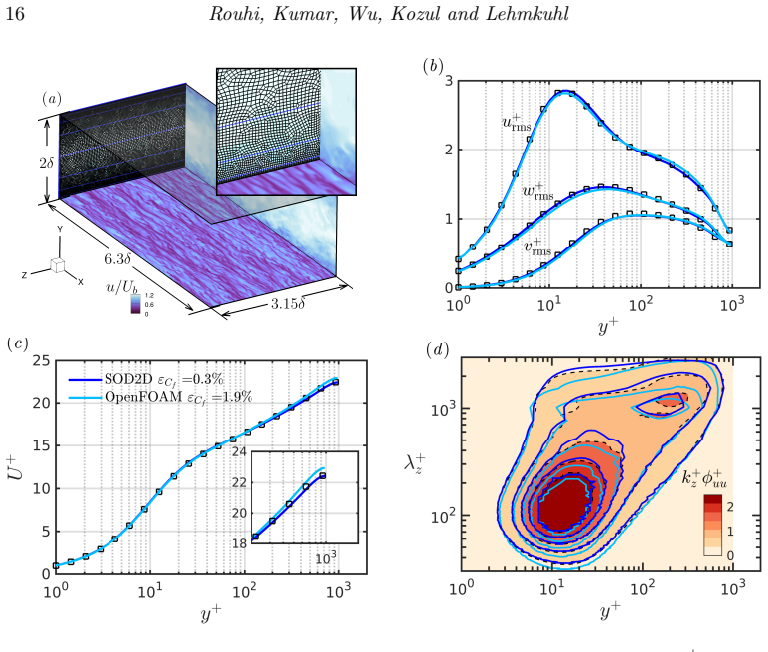
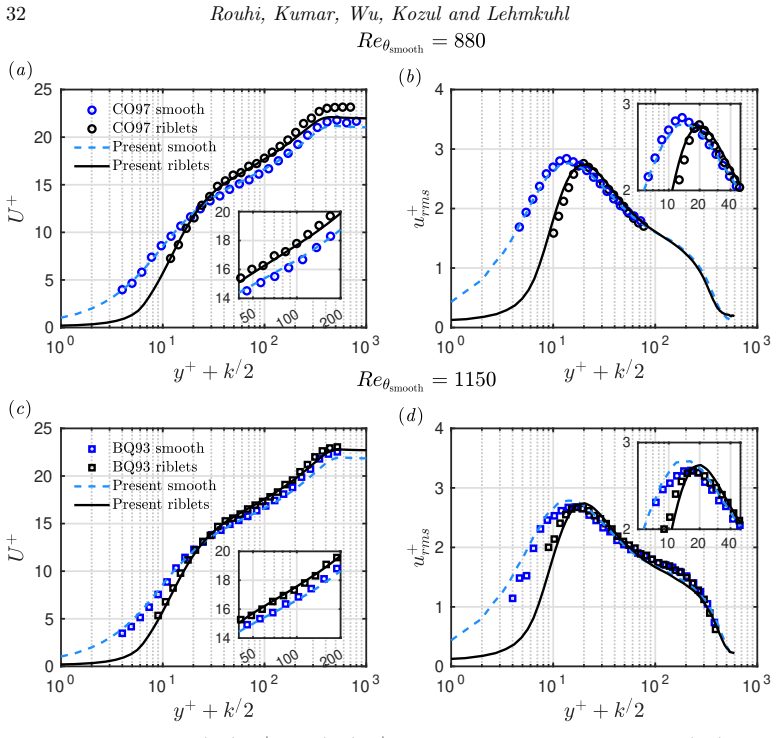
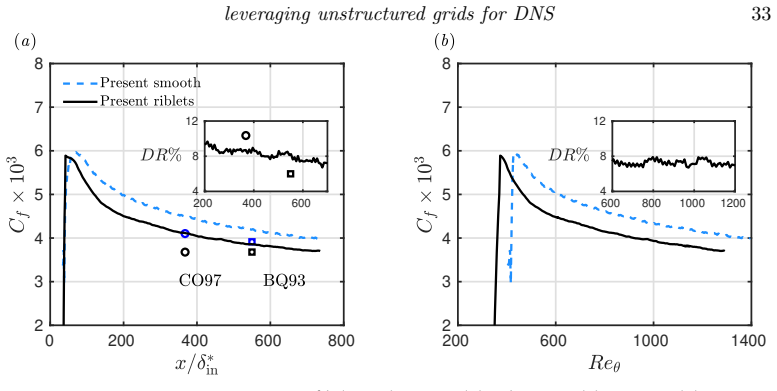
We formulate an unstructured grid-generation framework for direct numerical simulations of wall turbulence, termed η-grid, based on setting the wall-normal and spanwise grid sizes proportional to the local Kolmogorov scale η. The framework consists of an inner layer of thickness ~50 viscous units with conventional grid sizes, and above it Δy+ ~ Δz+ ~ 2η+. Tested with finite-volume and spectral-element codes on turbulent channel flow and boundary layers over smooth walls and various riblet geometries up to δ+0 = 1000, the η-grid yields less than 1% difference from Cartesian grids in skin-friction coefficient, mean velocity, turbulent stresses, and their spectrograms. Grid-point count with the
What carries the argument
The η-grid, an unstructured grid with wall-normal and spanwise spacings proportional to the local Kolmogorov scale η above a fixed inner viscous layer of ~50 units.
If this is right
- At δ+0 = 6000 the η-grid requires only about 10 percent as many points as a conventional tanh-stretched grid over smooth walls.
- Savings are larger over riblets, dropping to roughly 3 percent of the standard grid size for typical drag-reducing triangular geometries.
- Point count scales as δ+0 to the power 2.5 over smooth walls and 2.0 over riblets, versus 3.0 for Cartesian grids.
- The accuracy holds for both finite-volume and spectral-element discretizations and for both channel and boundary-layer configurations.
Where Pith is reading between the lines
- If the scaling continues to hold, the method could open DNS to Reynolds numbers typical of aircraft or wind turbines without requiring orders-of-magnitude more resources.
- The same local-scale adaptation might be applied to other spatially inhomogeneous turbulent flows where the smallest eddy size varies strongly in space.
- Riblet studies at realistic Reynolds numbers become more practical, allowing direct assessment of drag-reduction mechanisms under flight or marine conditions.
Load-bearing premise
That grid spacings of about twice the local Kolmogorov scale above the inner layer capture all dynamically important scales without introducing numerical dissipation or aliasing errors at Reynolds numbers well beyond the tested range.
What would settle it
A direct comparison at δ+0 = 5000 between an η-grid simulation and a reference high-resolution Cartesian grid that shows skin-friction coefficient or turbulence spectra differing by more than 1 percent would falsify the accuracy claim.
Figures








read the original abstract
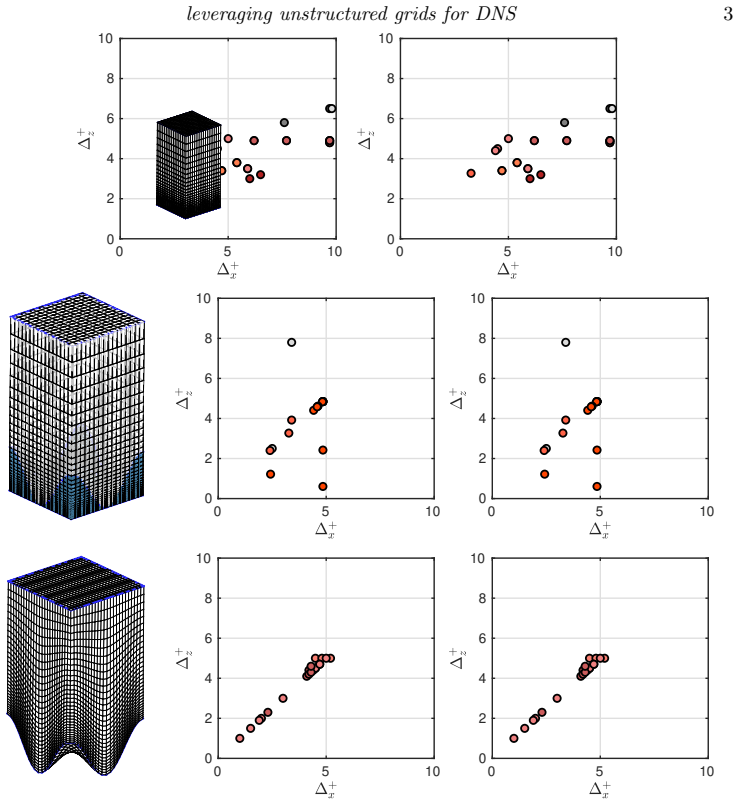
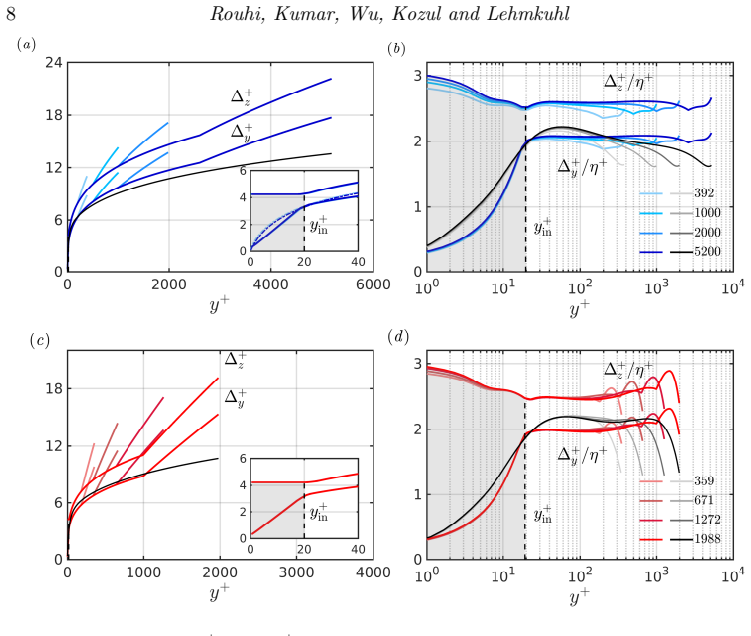
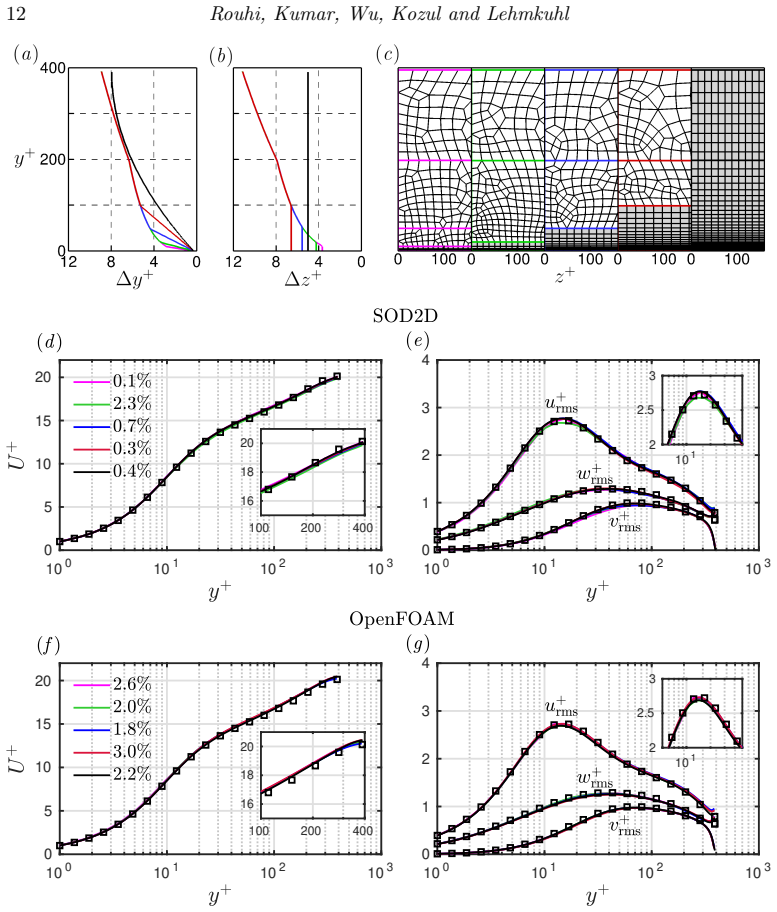
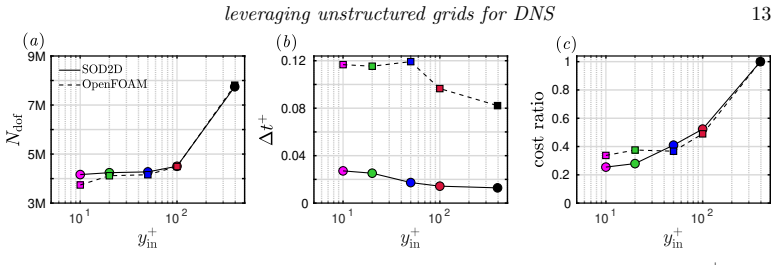
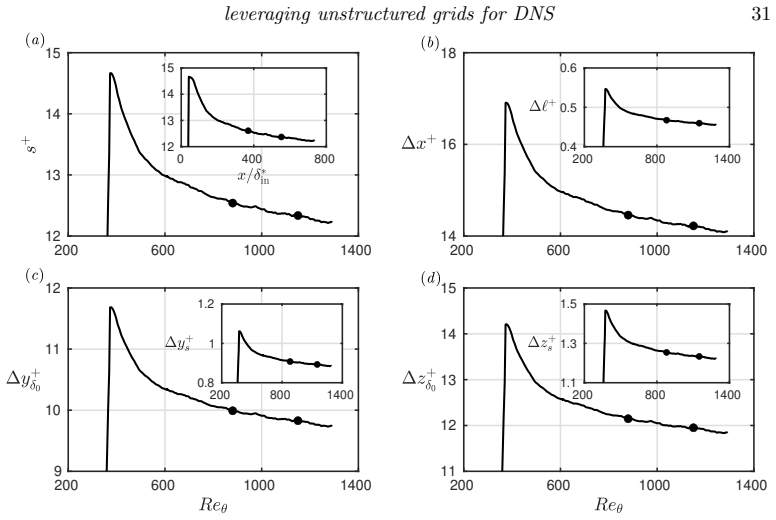
We formulate an unstructured grid-generation framework for direct numerical simulations (DNSs) of wall turbulence, termed {\eta}-grid, based on setting the wall-normal (y) and spanwise (z) grid sizes proportional to the local Kolmogorov scale {\eta}. The framework consists of an inner layer, with a thickness ~50 viscous units, with viscous-scaled grid sizes similar to a conventional DNS grid; 0.3 < {\Delta}y+ < 4, {\Delta}z+ ~ 5 over a smooth wall, and l+/30 < {\Delta}y+, {\Delta}z+ < 4 over a non-smooth surface, where l+ is the smallest surface wavelength. Above the inner layer, {\Delta}y+~ {\Delta}z+ ~ 2{\eta}+. We test {\eta}-grid with a finite volume method (FVM) code, as well as a spectral element method (SEM) code, and conduct a campaign of DNSs of turbulent channel flow and turbulent boundary layer over smooth wall and various riblet geometries (as streamwise-aligned microgrooves), up to friction Reynolds number {\delta}+0= 1000. We assess the accuracy of the {\eta}-grid against the conventional Cartesian grids, as well as the reference DNS and experimental data. We obtain less than 1% difference between the {\eta}-grid and the Cartesian grids, in terms of skin-friction coefficient, mean velocity, turbulent stresses, and their spectrograms. Up to {\delta}+0 ~ 104, the number of grid points with the {\eta} -grid (N{\eta}) scales proportional to {\delta}+02.5 over smooth wall, and proportional to {\delta}+02.0 over riblets, whereas the number of grid points with a Cartesian grid and hyperbolic tangent y-gird (NTanh) scales proportional to {\delta}+03.0. This leads to an enormous grid saving with the {\eta}-grid; by {\delta}+0 = 6000, N{\eta} / NTanh ~ 0.1 over smooth wall, and N{\eta} / NTanh ~ 0.03 over typical drag-reducing triangular riblets with tip angle 60o, and viscous-scaled spacing 15.
Editorial analysis
A structured set of objections, weighed in public.
Referee Report
Summary. The manuscript proposes an η-grid framework for unstructured DNS of wall-bounded turbulence. The grid is refined near the wall with conventional viscous scaling in an inner layer of thickness approximately 50 viscous units, and set to Δy+ ≈ Δz+ ≈ 2η+ in the outer layer, where η is the local Kolmogorov scale. DNSs using both finite-volume and spectral-element methods are performed for channel flow and boundary layers over smooth walls and riblet surfaces up to Re_τ = 1000. The authors report agreement within 1% with reference Cartesian-grid DNS and experiments for skin friction, mean profiles, Reynolds stresses, and spectra. They further claim that the η-grid yields grid-point counts scaling as Re_τ^{2.5} (smooth) or Re_τ^{2.0} (riblets), projecting order-of-magnitude savings at Re_τ = 6000.
Significance. If the accuracy claims hold, the η-grid approach could enable DNS at Reynolds numbers an order of magnitude higher than currently routine with Cartesian grids, which would be a significant advance for the study of wall turbulence at realistic Re. The dual-code validation with FVM and SEM, together with the application to both smooth walls and riblet geometries, adds robustness. The explicit scaling relations for Nη provide a concrete, falsifiable prediction for computational cost that can be tested in future work.
major comments (3)
- [Abstract] Abstract: The claim of less than 1% difference between the η-grid and Cartesian grids for skin-friction coefficient, mean velocity, turbulent stresses, and spectrograms is stated without error bars, without a reported grid-convergence study, and without any description of how the local Kolmogorov scale η is computed inside the code. These omissions are load-bearing for the central accuracy claim at the tested Re_τ=1000.
- [Abstract] Abstract: The projected grid savings at δ+0=6000 (Nη/NTanh ~0.1 for smooth walls and ~0.03 for riblets) rest on the scaling Nη ∝ δ+0^{2.5} (smooth) or ∝ δ+0^{2.0} (riblets) together with the assumption that the outer-layer criterion Δy+~Δz+~2η+ remains adequate without introducing numerical dissipation or aliasing at Reynolds numbers well beyond the validated range of 1000. No additional analysis or simulations are supplied to support this extrapolation, which is central to the headline result.
- [Abstract] Abstract: The inner-layer thickness is fixed at ~50 viscous units with specific resolution bounds (0.3 < Δy+ < 4, Δz+ ~5 for smooth walls; l+/30 < Δy+, Δz+ <4 for riblets). No sensitivity tests to this thickness or to the precise 2η+ multiplier are reported, leaving the robustness of the hybrid inner/outer construction unquantified.
minor comments (2)
- [Abstract] Abstract: The notation 'δ+0 ~ 104' is unclear and should be written explicitly (e.g., δ+0 ≈ 10^4). Similarly, '60o' should be rendered as 60° and 'viscous-scaled spacing 15' should specify the quantity (e.g., s+ = 15).
- The manuscript would benefit from a dedicated subsection or appendix detailing the implementation of the local η computation and the unstructured grid-generation algorithm, including any free parameters and their default values.
Simulated Author's Rebuttal
We thank the referee for the positive assessment of the work and the constructive comments on the abstract. We address each major comment below, clarifying details from the manuscript and indicating revisions where they strengthen the presentation without altering the core claims.
read point-by-point responses
-
Referee: [Abstract] Abstract: The claim of less than 1% difference between the η-grid and Cartesian grids for skin-friction coefficient, mean velocity, turbulent stresses, and spectrograms is stated without error bars, without a reported grid-convergence study, and without any description of how the local Kolmogorov scale η is computed inside the code. These omissions are load-bearing for the central accuracy claim at the tested Re_τ=1000.
Authors: The manuscript body details the computation of the local Kolmogorov scale as η = (ν³/ε)^{1/4}, with ε obtained directly from the resolved velocity gradients in both the FVM and SEM solvers (Section 3.2). Grid-convergence comparisons against reference Cartesian DNS and experiments are reported in Sections 4 and 5 for all quantities at Re_τ = 1000, confirming differences below 1%. We will revise the abstract to reference these validation studies and note the maximum observed deviation, while retaining the concise summary format. revision: partial
-
Referee: [Abstract] Abstract: The projected grid savings at δ+0=6000 (Nη/NTanh ~0.1 for smooth walls and ~0.03 for riblets) rest on the scaling Nη ∝ δ+0^{2.5} (smooth) or ∝ δ+0^{2.0} (riblets) together with the assumption that the outer-layer criterion Δy+~Δz+~2η+ remains adequate without introducing numerical dissipation or aliasing at Reynolds numbers well beyond the validated range of 1000. No additional analysis or simulations are supplied to support this extrapolation, which is central to the headline result.
Authors: The reported scalings follow directly from integrating the local spacing rule Δy, Δz ~ 2η over the outer layer, using the established outer-layer behavior of η. The multiplier 2 is conservative relative to resolutions used in existing DNS at Re_τ ≤ 1000. We will add a dedicated paragraph in the discussion section explaining why the criterion remains adequate at higher Re (increasing scale separation reduces the relative impact of any residual numerical dissipation), while acknowledging that direct verification at Re_τ = 6000 lies beyond present resources. revision: partial
-
Referee: [Abstract] Abstract: The inner-layer thickness is fixed at ~50 viscous units with specific resolution bounds (0.3 < Δy+ < 4, Δz+ ~5 for smooth walls; l+/30 < Δy+, Δz+ <4 for riblets). No sensitivity tests to this thickness or to the precise 2η+ multiplier are reported, leaving the robustness of the hybrid inner/outer construction unquantified.
Authors: The inner-layer thickness of ~50 viscous units is chosen to encompass the near-wall region of rapid η variation and viscous dominance, with the stated resolution bounds matching or exceeding conventional DNS practice. Although dedicated sensitivity sweeps on thickness or the exact 2η+ factor were not performed, the framework yields consistent <1% agreement across two numerical methods and multiple geometries. We will expand the methods section with a short justification of these parameter choices, citing supporting DNS literature, to better address robustness. revision: yes
Circularity Check
No significant circularity detected
full rationale
The paper explicitly defines the η-grid construction rule (inner layer of fixed ~50 viscous units with conventional spacing, then Δy+ ≈ Δz+ ≈ 2η+), performs direct DNS validation against independent Cartesian grids and reference data to obtain the <1% agreement in Cf, mean profiles, stresses and spectrograms up to δ+0=1000, and separately tallies grid-point counts Nη from the same rule applied across the tested Reynolds-number range to observe the Nη ∝ δ+0^2.5 scaling. The extrapolated savings ratio at δ+0=6000 is obtained by applying the observed power-law exponents (2.5 versus the known 3.0 for tanh grids) to the physical scaling of η; neither the accuracy metrics nor the cost ratio reduce by construction to a fit of the same quantities, a self-citation, or a redefinition of inputs. The derivation chain therefore remains self-contained against external benchmarks.
Axiom & Free-Parameter Ledger
free parameters (3)
- inner-layer thickness
- outer-layer multiplier
- viscous-unit bounds
axioms (2)
- domain assumption Kolmogorov scale η is a sufficient local length scale for grid sizing outside the inner layer
- domain assumption Standard DNS assumptions remain valid when grid spacing is allowed to vary with local η
Reference graph
Works this paper leans on
-
[1]
Annual review of fluid mechanics 12 (1), 103--138
Adamson Jr, TC & Messiter, AF 1980 Analysis of two-dimensional interactions between shock waves and boundary layers . Annual review of fluid mechanics 12 (1), 103--138
1980
-
[2]
Journal of Fluid Mechanics 916 , A29
Alc \'a ntara- \'A vila, Francisco , Hoyas, Sergio & P \'e rez-Quiles, Mar \' a Jezabel 2021 Direct numerical simulation of thermal channel flow for . Journal of Fluid Mechanics 916 , A29
2021
-
[3]
Journal of Fluid Mechanics 906 , A8
Anderson, William & Salesky, Scott T 2021 Uniform momentum zone scaling arguments from direct numerical simulation of inertia-dominated channel turbulence . Journal of Fluid Mechanics 906 , A8
2021
-
[4]
Experiments in Fluids 57 (5), 90
Baars, Woutijn J , Squire, DT , Talluru, KM , Abbassi, MR , Hutchins, Nicholas & Marusic, Ivan 2016 Wall-drag measurements of smooth-and rough-wall turbulent boundary layers using a floating element . Experiments in Fluids 57 (5), 90
2016
-
[5]
International journal of heat and fluid flow 14 (3), 223--230
Baron, Arturo & Quadrio, Maurizio 1993 Some preliminary results on the influence of riblets on the structure of a turbulent boundary layer . International journal of heat and fluid flow 14 (3), 223--230
1993
-
[6]
Journal of fluid mechanics 206 , 105--129
Bechert, DW & Bartenwerfer, M 1989 The viscous flow on surfaces with longitudinal ribs . Journal of fluid mechanics 206 , 105--129
1989
-
[7]
Annual Review of Fluid Mechanics 10 (1), 47--64
Berman, Neil S 1978 Drag reduction by polymers . Annual Review of Fluid Mechanics 10 (1), 47--64
1978
-
[8]
Journal of Fluid Mechanics 742 , 171--191
Bernardini, Matteo , Pirozzoli, Sergio & Orlandi, Paolo 2014 Velocity statistics in turbulent channel flow up to . Journal of Fluid Mechanics 742 , 171--191
2014
-
[9]
Annual review of fluid mechanics 50 , 535--561
Bose, Sanjeeb T & Park, George Ilhwan 2018 Wall-modeled large-eddy simulation for complex turbulent flows . Annual review of fluid mechanics 50 , 535--561
2018
-
[10]
Annual Review of Fluid Mechanics 21 , 1--20
Bushnell, Dennis M & McGinley, Catherine B 1989 Turbulence control in wall flows . Annual Review of Fluid Mechanics 21 , 1--20
1989
-
[11]
Journal of Fluid Mechanics 712 , 169--202
Busse, Angela & Sandham, Neil D 2012 Parametric forcing approach to rough-wall turbulent channel flow . Journal of Fluid Mechanics 712 , 169--202
2012
-
[12]
Camobreco, Christopher J , Endrikat, Sebastian , Garc \' a-Mayoral, Ricardo , Luhar, Mitul & Chung, Daniel 2025 Why do only some riblets promote spanwise rollers? Journal of Fluid Mechanics 1022 , A35
2025
-
[13]
Computer physics communications 192 , 205--219
Cantwell, Chris D , Moxey, David , Comerford, Andrew , Bolis, Alessandro , Rocco, Gabriele , Mengaldo, Gianmarco , De Grazia, Daniele , Yakovlev, Sergey , Lombard, J-E , Ekelschot, Dirk & others 2015 Nektar++: An open-source spectral/hp element framework . Computer physics communications 192 , 205--219
2015
-
[14]
Journal of Computational Physics: X 17 , 100128
Ceci, Alessandro & Pirozzoli, Sergio 2023 Natural grid stretching for dns of compressible wall-bounded flows . Journal of Computational Physics: X 17 , 100128
2023
-
[15]
Journal of Fluid Mechanics 854 , 5--33
Chan, L , MacDonald, M , Chung, D , Hutchins, N & Ooi, A 2018 Secondary motion in turbulent pipe flow with three-dimensional roughness . Journal of Fluid Mechanics 854 , 5--33
2018
-
[16]
Physics of fluids 24 (1)
Choi, Haecheon & Moin, Parviz 2012 Grid-point requirements for large eddy simulation: Chapman’s estimates revisited . Physics of fluids 24 (1)
2012
-
[17]
Experimental Thermal and Fluid Science 15 (2), 109--124
Choi, K-S & Orchard, DM 1997 Turbulence management using riblets for heat and momentum transfer . Experimental Thermal and Fluid Science 15 (2), 109--124
1997
-
[18]
Journal of computational physics 2 (1), 12--26
Chorin, Alexandre Joel 1967 A numerical method for solving incompressible viscous flow problems . Journal of computational physics 2 (1), 12--26
1967
-
[19]
Annual Review of Fluid Mechanics 53 (1), 439--471
Chung, Daniel , Hutchins, Nicholas , Schultz, Michael P & Flack, Karen A 2021 Predicting the drag of rough surfaces . Annual Review of Fluid Mechanics 53 (1), 439--471
2021
-
[20]
Journal of Fluid Mechanics 742 , R3
Chung, D , Monty, JP & Ooi, A 2014 An idealised assessment of townsend’s outer-layer similarity hypothesis for wall turbulence . Journal of Fluid Mechanics 742 , R3
2014
-
[21]
Annual Review of Fluid Mechanics 46 (1), 469--492
Clemens, Noel T & Narayanaswamy, Venkateswaran 2014 Low-frequency unsteadiness of shock wave/turbulent boundary layer interactions . Annual Review of Fluid Mechanics 46 (1), 469--492
2014
-
[22]
Journal of Fluid Mechanics 974 , A10
Cogo, Michele , Ba \`u , Umberto , Chinappi, Mauro , Bernardini, Matteo & Picano, Francesco 2023 Assessment of heat transfer and mach number effects on high-speed turbulent boundary layers . Journal of Fluid Mechanics 974 , A10
2023
-
[23]
Journal of Fluid Mechanics 945 , A30
Cogo, Michele , Salvadore, Francesco , Picano, Francesco & Bernardini, Matteo 2022 Direct numerical simulation of supersonic and hypersonic turbulent boundary layers at moderate-high reynolds numbers and isothermal wall condition . Journal of Fluid Mechanics 945 , A30
2022
-
[24]
Experiments in fluids 46 (3), 499--515
De Jong, J , Cao, L , Woodward, SH , Salazar, JPLC , Collins, LR & Meng, H 2009 Dissipation rate estimation from piv in zero-mean isotropic turbulence . Experiments in fluids 46 (3), 499--515
2009
-
[25]
Annual review of fluid mechanics 15 , 77--96
De Vries, Otto 1983 On the theory of the horizontal-axis wind turbine . Annual review of fluid mechanics 15 , 77--96
1983
-
[26]
Journal of Fluid Mechanics 913 , A37
Endrikat, S , Modesti, D , Garc \' a-Mayoral, R , Hutchins, N & Chung, D 2021 Influence of riblet shapes on the occurrence of kelvin--helmholtz rollers . Journal of Fluid Mechanics 913 , A37
2021
-
[27]
Journal of Fluid Mechanics 952 , A27
Endrikat, Sebastian , Newton, Ryan , Modesti, Davide , Garc \' a-Mayoral, RICARDO , Hutchins, Nick & Chung, Daniel 2022 Reorganisation of turbulence by large and spanwise-varying riblets . Journal of Fluid Mechanics 952 , A27
2022
-
[28]
Fischer, Paul F , Lottes, James W & Kerkemeier, Stefan G 2008 Nek5000 web page https://nek5000.mcs.anl.gov/
2008
-
[29]
Annual Review of Fluid Mechanics 56 (1), 69--90
Fukagata, Koji , Iwamoto, Kaoru & Hasegawa, Yosuke 2024 Turbulent drag reduction by streamwise traveling waves of wall-normal forcing . Annual Review of Fluid Mechanics 56 (1), 69--90
2024
-
[30]
Journal of Fluid Mechanics 678 , 317--347
Garcia-Mayoral, Ricardo & Jim \'e nez, Javier 2011 Hydrodynamic stability and breakdown of the viscous regime over riblets . Journal of Fluid Mechanics 678 , 317--347
2011
-
[31]
Physics of Fluids 24 (10)
Garc \' a-Mayoral, Ricardo & Jim \'e nez, Javier 2012 Scaling of turbulent structures in riblet channels up to 550 . Physics of Fluids 24 (10)
2012
-
[32]
Computer Physics Communications 297 , 109067
Gasparino, Lucas , Spiga, Filippo & Lehmkuhl, Oriol 2024 Sod2d: A gpu-enabled spectral finite elements method for compressible scale-resolving simulations . Computer Physics Communications 297 , 109067
2024
-
[33]
International journal for numerical methods in engineering 79 (11), 1309--1331
Geuzaine, Christophe & Remacle, Jean-Fran c ois 2009 Gmsh: A 3-d finite element mesh generator with built-in pre-and post-processing facilities . International journal for numerical methods in engineering 79 (11), 1309--1331
2009
-
[34]
Journal of Fluid Mechanics 302 , 333--376
Goldstein, D , Handler, R & Sirovich, L 1995 Direct numerical simulation of turbulent flow over a modeled riblet covered surface . Journal of Fluid Mechanics 302 , 333--376
1995
-
[35]
Annual Research Briefs 2004 (3-14), 118
Ham, Frank & Iaccarino, Gianluca 2004 Energy conservation in collocated discretization schemes on unstructured meshes . Annual Research Briefs 2004 (3-14), 118
2004
-
[36]
Annual Research Briefs 243
Ham, Frank , Mattsson, Ken & Iaccarino, Gianluca 2006 Accurate and stable finite volume operators for unstructured flow solvers . Annual Research Briefs 243
2006
-
[37]
Physics of fluids 18 (1)
Hoyas, Sergio & Jim \'e nez, Javier 2006 Scaling of the velocity fluctuations in turbulent channels up to re = 2003 . Physics of fluids 18 (1)
2006
-
[38]
Annual Review of Fluid Mechanics 25 (1), 485--537
Hucho, W & Sovran, G 1993 Aerodynamics of road vehicles . Annual Review of Fluid Mechanics 25 (1), 485--537
1993
-
[39]
Progress in Aerospace Sciences 38 (4-5), 421--446
Hutchins, Nick & Choi, Kwing-So 2002 Accurate measurements of local skin friction coefficient using hot-wire anemometry . Progress in Aerospace Sciences 38 (4-5), 421--446
2002
-
[40]
Journal of computational physics 62 (1), 40--65
Issa, Raad I 1986 Solution of the implicitly discretised fluid flow equations by operator-splitting . Journal of computational physics 62 (1), 40--65
1986
-
[41]
Computer methods in applied mechanics and engineering 174 (3-4), 299--317
Jansen, Kenneth E 1999 A stabilized finite element method for computing turbulence . Computer methods in applied mechanics and engineering 174 (3-4), 299--317
1999
-
[42]
Physics of Fluids 26 (9)
Jelly, TO , Jung, SY & Zaki, TA 2014 Turbulence and skin friction modification in channel flow with streamwise-aligned superhydrophobic surface texture . Physics of Fluids 26 (9)
2014
-
[43]
Journal of Fluid Mechanics 852 , 710--724
Jelly, Thomas O & Busse, Angela 2018 Reynolds and dispersive shear stress contributions above highly skewed roughness . Journal of Fluid Mechanics 852 , 710--724
2018
-
[44]
Jim \'e nez, Javier 2004 Turbulent flows over rough walls . Annu. Rev. Fluid Mech. 36 (1), 173--196
2004
-
[45]
Journal of Fluid Mechanics 842 , P1
Jim \'e nez, Javier 2018 Coherent structures in wall-bounded turbulence . Journal of Fluid Mechanics 842 , P1
2018
-
[46]
Journal of Fluid Mechanics 657 , 335--360
Jim \'e nez, Javier , Hoyas, Sergio , Simens, Mark P & Mizuno, Yoshinori 2010 Turbulent boundary layers and channels at moderate reynolds numbers . Journal of Fluid Mechanics 657 , 335--360
2010
-
[47]
Annual review of fluid mechanics 35 (1), 45--62
Karniadakis, GE & Choi, Kwing-So 2003 Mechanisms on transverse motions in turbulent wall flows . Annual review of fluid mechanics 35 (1), 45--62
2003
-
[48]
Journal of Computational Physics 227 (3), 1676--1700
Kennedy, Christopher A & Gruber, Andrea 2008 Reduced aliasing formulations of the convective terms within the navier--stokes equations for a compressible fluid . Journal of Computational Physics 227 (3), 1676--1700
2008
-
[49]
Journal of fluid mechanics 177 , 133--166
Kim, John , Moin, Parviz & Moser, Robert 1987 Turbulence statistics in fully developed channel flow at low reynolds number . Journal of fluid mechanics 177 , 133--166
1987
-
[50]
Annual Review of Fluid Mechanics 2 (1), 95--112
Kovasznay, Leslie SG 1970 The turbulent boundary layer . Annual Review of Fluid Mechanics 2 (1), 95--112
1970
-
[51]
Journal of Fluid Mechanics 796 , 437--472
Kozul, Melissa , Chung, Daniel & Monty, JP 2016 Direct numerical simulation of the incompressible temporally developing turbulent boundary layer . Journal of Fluid Mechanics 796 , 437--472
2016
-
[52]
In Turbo Expo: Power for Land, Sea, and Air\/ , , vol
Kozul, Melissa , Nardini, Massimiliano , Przytarski, Pawel J , Solomon, William , Shabbir, Aamir & Sandberg, Richard D 2023 Direct numerical simulation of riblets applied to gas turbine compressor blades at on-and off-design incidences. In Turbo Expo: Power for Land, Sea, and Air\/ , , vol. 87080 , p. V13AT29A006 . American Society of Mechanical Engineers
2023
-
[53]
Flow, turbulence and combustion 101 (2), 521--551
Krank, Benjamin , Kronbichler, Martin & Wall, Wolfgang A 2018 Direct numerical simulation of flow over periodic hills up to re h= 10, 595 . Flow, turbulence and combustion 101 (2), 521--551
2018
-
[54]
Journal of Fluid Mechanics 952 , A21
Kuwata, Yusuke 2022 Dissimilar turbulent heat transfer enhancement by kelvin--helmholtz rollers over high-aspect-ratio longitudinal ribs . Journal of Fluid Mechanics 952 , A21
2022
-
[55]
Annual Review of Fluid Mechanics 11 (1), 173--205
Landweber, L & Patel, VC 1979 Ship boundary layers . Annual Review of Fluid Mechanics 11 (1), 173--205
1979
-
[56]
Journal of fluid mechanics 774 , 395--415
Lee, Myoungkyu & Moser, Robert D 2015 Direct numerical simulation of turbulent channel flow up to . Journal of fluid mechanics 774 , 395--415
2015
-
[57]
Journal of Fluid Mechanics 860 , 886--938
Lee, Myoungkyu & Moser, Robert D 2019 Spectral analysis of the budget equation in turbulent channel flows at high reynolds number . Journal of Fluid Mechanics 860 , 886--938
2019
-
[58]
In Computational methods in applied sciences' 96 (Paris, 9-13 September 1996)\/ , pp
Luchini, P 1996 Reducing the turbulent skin friction. In Computational methods in applied sciences' 96 (Paris, 9-13 September 1996)\/ , pp. 465--470
1996
-
[59]
Annual review of fluid mechanics 1
Lumley, John L 1969 Drag reduction by additives . Annual review of fluid mechanics 1
1969
-
[60]
Journal of Computational Physics 197 (1), 215--240
Mahesh, Krishnan , Constantinescu, George & Moin, Parviz 2004 A numerical method for large-eddy simulation in complex geometries . Journal of Computational Physics 197 (1), 215--240
2004
-
[61]
AIAA Journal 61 (5), 1986--2001
Malathi Ananth, Sivaramakrishnan , Nardini, Massimiliano , Vaid, Aditya , Kozul, Melissa , Rao Vadlamani, Nagabhushana & Sandberg, Richard D 2023 Riblet performance beneath transitional and turbulent boundary layers at low reynolds numbers . AIAA Journal 61 (5), 1986--2001
2023
-
[62]
Annual Review of Fluid Mechanics 51 (1), 49--74
Marusic, Ivan & Monty, Jason P 2019 Attached eddy model of wall turbulence . Annual Review of Fluid Mechanics 51 (1), 49--74
2019
-
[63]
Meyers, Johan & Sagaut, Pierre 2007 Is plane-channel flow a friendly case for the testing of large-eddy simulation subgrid-scale models? Physics of Fluids 19 (4)
2007
-
[64]
Physics of Fluids 16 (7), L55--L58
Min, Taegee & Kim, John 2004 Effects of hydrophobic surface on skin-friction drag . Physics of Fluids 16 (7), L55--L58
2004
-
[65]
Journal of Fluid Mechanics 917 , A55
Modesti, Davide , Endrikat, Sebastian , Hutchins, Nicholas & Chung, Daniel 2021 Dispersive stresses in turbulent flow over riblets . Journal of Fluid Mechanics 917 , A55
2021
-
[66]
Annual review of fluid mechanics 30 (1), 539--578
Moin, Parviz & Mahesh, Krishnan 1998 Direct numerical simulation: a tool in turbulence research . Annual review of fluid mechanics 30 (1), 539--578
1998
-
[67]
Annual Review of Fluid Mechanics 2 (1), 225--250
Monin, AS 1970 The atmospheric boundary layer . Annual Review of Fluid Mechanics 2 (1), 225--250
1970
-
[68]
Moser, RD & Moin, P 1984 Direct numerical simulation of curved turbulent channel flow . Tech. Rep.\/
1984
-
[69]
Moser, Robert D , Kim, John , Mansour, Nagi N & others 1999 Direct numerical simulation of turbulent channel flow up to re= 590 . Phys. fluids 11 (4), 943--945
1999
-
[70]
Computer Physics Communications 249 , 107110
Moxey, David , Cantwell, Chris D , Bao, Yan , Cassinelli, Andrea , Castiglioni, Giacomo , Chun, Sehun , Juda, Emilia , Kazemi, Ehsan , Lackhove, Kilian , Marcon, Julian & others 2020 Nektar++: Enhancing the capability and application of high-fidelity spectral/hp element methods . Computer Physics Communications 249 , 107110
2020
-
[71]
International Journal of Heat and Fluid Flow 115 , 109848
Neuhauser, Jonathan , Schmidt, Carola , Gatti, Davide & Frohnapfel, Bettina 2025 Predicting the global drag of turbulent channel flow over roughness strips . International Journal of Heat and Fluid Flow 115 , 109848
2025
-
[72]
theoretical development
Ochoa-Tapia, J Alberto & Whitaker, Stephen 1995 Momentum transfer at the boundary between a porous medium and a homogeneous fluid—i. theoretical development . International Journal of Heat and Mass Transfer 38 (14), 2635--2646
1995
-
[73]
Journal of Fluid Mechanics 1010 , A69
Okochi, Yusuke , Nabae, Yusuke & Fukagata, Koji 2025 Direct numerical simulations of a bump-installed turbulent channel flow for drag reduction by blowing and suction . Journal of Fluid Mechanics 1010 , A69
2025
-
[74]
Computers & Fluids 268 , 106108
O’Connor, Joseph , Laizet, Sylvain , Wynn, Andrew , Edeling, Wouter & Coveney, Peter V 2024 Quantifying uncertainties in direct numerical simulations of a turbulent channel flow . Computers & Fluids 268 , 106108
2024
-
[75]
Annual Review of Fluid Mechanics 6 (1), 147--177
Panofsky, Hans A 1974 The atmospheric boundary layer below 150 meters . Annual Review of Fluid Mechanics 6 (1), 147--177
1974
-
[76]
Physics of Fluids 11 (10), 3095--3105
Park, Jeongyoung & Choi, Haecheon 1999 Effects of uniform blowing or suction from a spanwise slot on a turbulent boundary layer flow . Physics of Fluids 11 (10), 3095--3105
1999
-
[77]
Journal of Computational Physics 108 (1), 51--58
Perot, J Blair 1993 An analysis of the fractional step method . Journal of Computational Physics 108 (1), 51--58
1993
-
[78]
Annual review of fluid mechanics 34 (1), 349--374
Piomelli, Ugo & Balaras, Elias 2002 Wall-layer models for large-eddy simulations . Annual review of fluid mechanics 34 (1), 349--374
2002
-
[79]
Journal of Fluid Mechanics 965 , A7
Pirozzoli, Sergio 2023 a\/ Prandtl number effects on passive scalars in turbulent pipe flow . Journal of Fluid Mechanics 965 , A7
2023
-
[80]
Journal of Fluid Mechanics 971 , A15
Pirozzoli, Sergio 2023 b\/ Searching for the log law in open channel flow . Journal of Fluid Mechanics 971 , A15
2023
discussion (0)
Sign in with ORCID, Apple, or X to comment. Anyone can read and Pith papers without signing in.