Recognition: unknown
Grain boundary segregation of light elements and their effects on cohesion in ferritic steels
Pith reviewed 2026-05-09 15:10 UTC · model grok-4.3
The pith
Calculations show boron and carbon strengthen grain boundaries in iron while helium, oxygen and sulfur weaken them.
A machine-rendered reading of the paper's core claim, the machinery that carries it, and where it could break.
Core claim
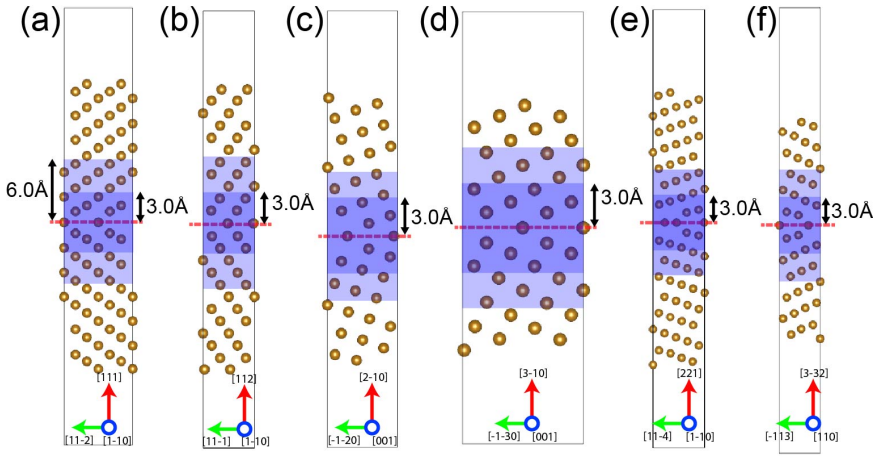
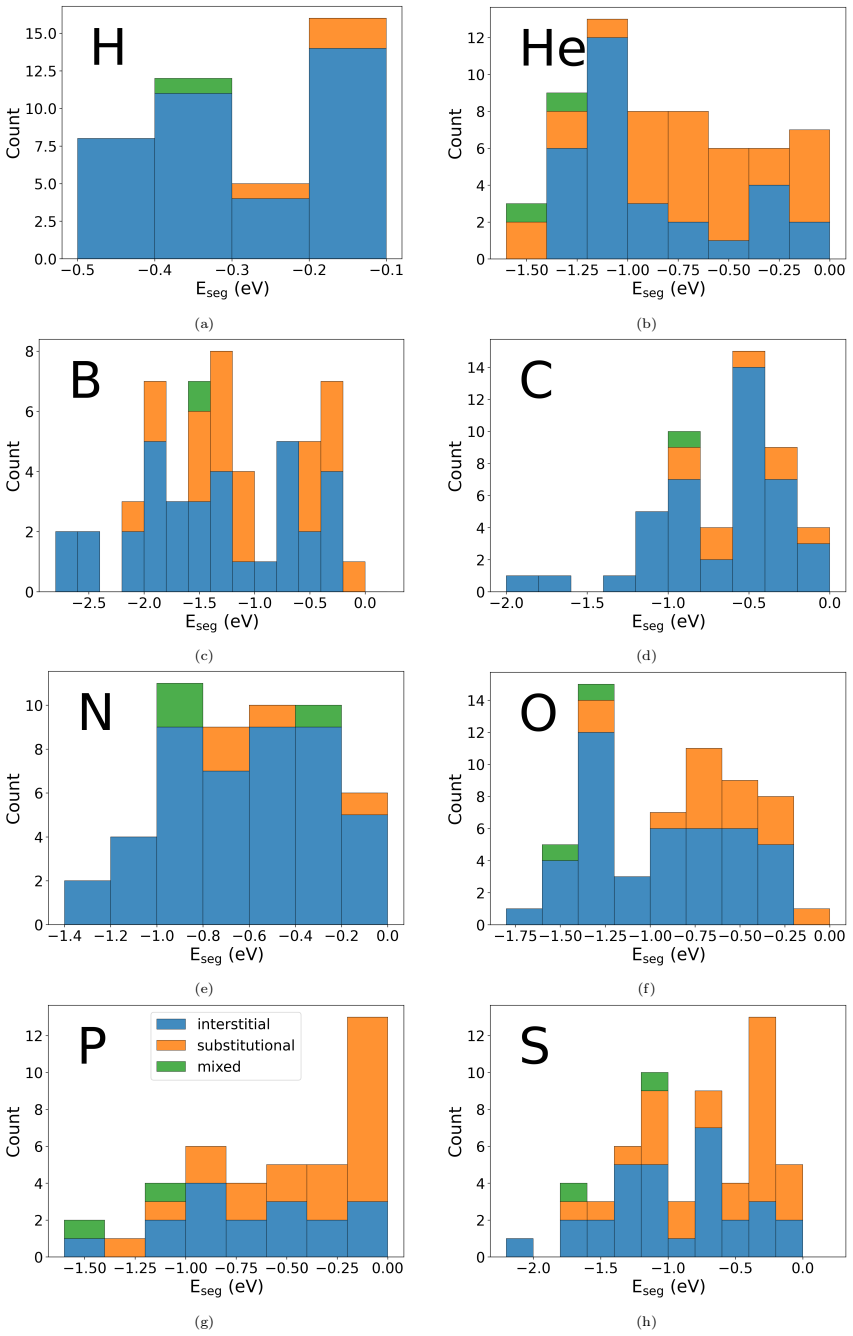
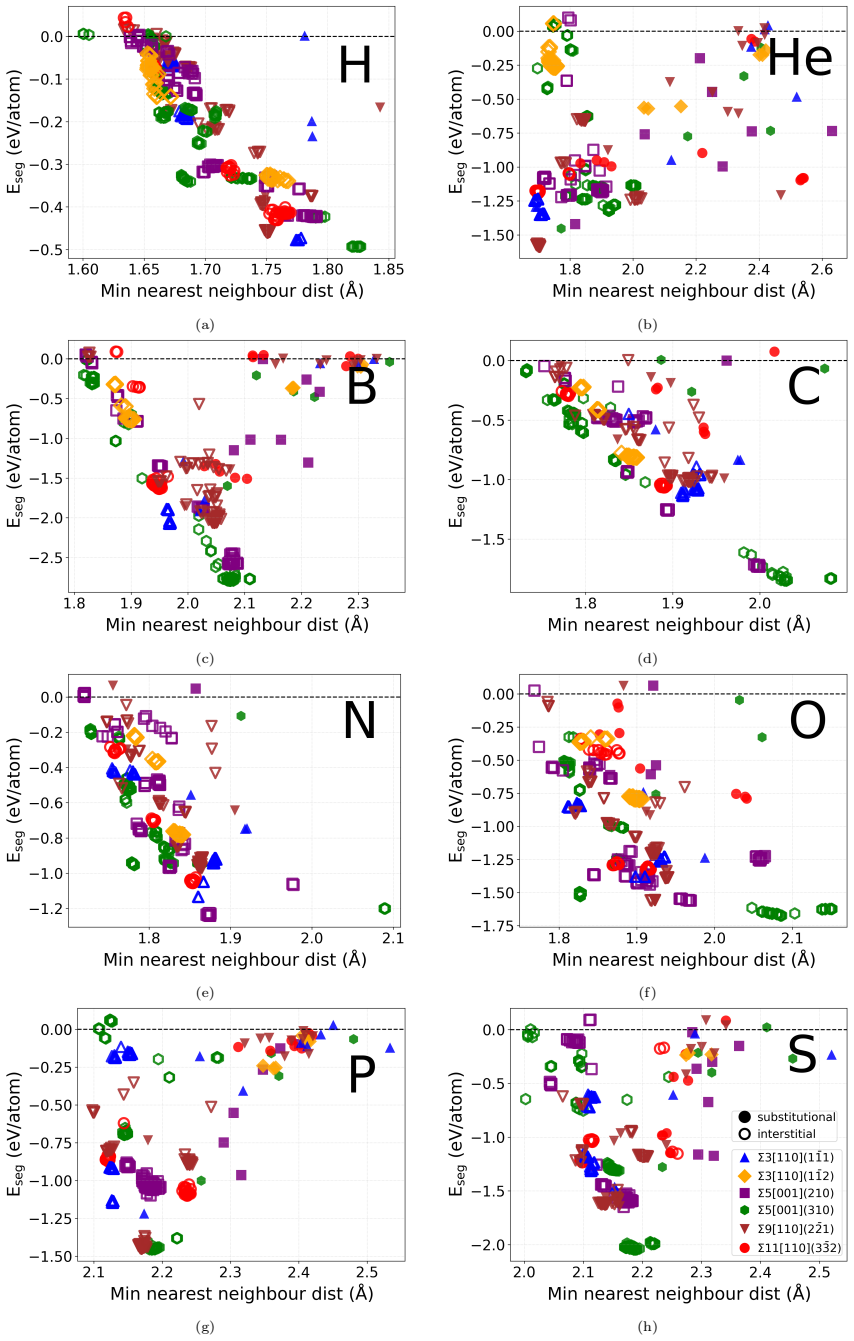
Density functional theory calculations on six coincident site lattice grain boundaries in body-centered cubic iron show that, when compared at the same concentration, boron and carbon increase grain boundary cohesion, nitrogen phosphorus and hydrogen mildly decrease it, and helium oxygen and sulfur are strong decohesive agents. Accurate segregation spectra require sampling both interstitial and substitutional starting positions because volume-based criteria miss the deepest sites and atomic relaxations can erase site-type distinctions. Nearest-neighbor distances after relaxation control the lower threshold of segregation energies.
What carries the argument
Density functional theory sampling of substitutional and interstitial sites in six CSL grain boundary models, evaluated with bond-order analysis and the rigid Rice-Wang cohesive strength framework.
If this is right
- Boron and carbon additions can be used to enhance grain boundary cohesion in ferritic steels.
- Helium, oxygen, and sulfur concentrations should be minimized to avoid severe grain boundary embrittlement.
- Both substitutional and interstitial sites must be considered when predicting light-element segregation spectra.
- The released DFT dataset enables training of machine learning interatomic potentials for larger-scale steel simulations.
Where Pith is reading between the lines
- The nearest-neighbor distance correlation after relaxation could serve as a low-cost screen for other solutes in similar metals.
- Trends identified here may extend to other body-centered cubic metals where electronic interactions with iron dominate.
- Multi-element co-segregation at the same boundary could shift the single-element rankings and deserves separate study.
- Results suggest that grain boundary engineering strategies in steels for nuclear or hydrogen-service environments should prioritize these light-element effects.
Load-bearing premise
The six chosen CSL grain boundary models and the DFT settings are representative of real polycrystalline ferritic steels and capture the lowest-energy segregation states.
What would settle it
Direct experimental measurement of grain boundary fracture strength or segregation site occupancies in controlled-concentration ferritic iron samples containing boron versus sulfur or helium.
Figures





read the original abstract
Light elements play an important role in influencing the macroscale properties of engineering alloys through grain boundary (GB) segregation phenomena. However, the scarcity and scattered nature of ab initio datasets for light elements in steels makes reproduction and extraction of general trends from the literature difficult. Here, we present a comprehensive ab initio evaluation of the segregation energies and cohesive effects for H, He, B, C, N, O, P, S, extensively sampling both substitutional and interstitial sites in six model coincident site lattice (CSL) ferritic iron GBs using density functional theory (DFT). Cohesive effects are evaluated in both a quantum-chemistry bond-order and rigid Rice-Wang interfacial cohesive strength framework. Our calculations indicate that, compared at the same concentration, B and C enhance GB cohesion, N, P, H are mildly detrimental, and He, O, S as powerful decohesive agents/embrittlers. Sampling both interstitial and substitutional starting positions is necessary to accurately capture segregation spectra. Commonly utilised sampling criteria such as site volumes prove insufficient for identifying deepest GB binding sites. Solutes placed in either kind of site can induce large relaxations to the same final configuration, resulting in site classification ambiguity. The nearest neighbour distance of a solute to its neighbours after relaxation is shown to be a controlling factor for the lower threshold of segregation energies at sites. The freely available DFT dataset and analysis repositories are expected to advance understanding of GB segregation behaviours of light elements in steels and serve as a resource for developing machine learning interatomic potentials.
Editorial analysis
A structured set of objections, weighed in public.
Referee Report
Summary. The manuscript reports DFT calculations of segregation energies for light elements H, He, B, C, N, O, P, and S at both substitutional and interstitial sites across six CSL grain boundaries in bcc Fe. Cohesive effects are quantified via quantum-chemistry bond-order analysis and the rigid Rice-Wang interfacial strength model. The central result is a ranking at fixed concentration: B and C enhance GB cohesion, N/P/H are mildly detrimental, and He/O/S act as strong decohesives/embrittlers. The work also demonstrates that volume-based site selection is inadequate, that relaxations can blur interstitial/substitutional classification, and that nearest-neighbor distance after relaxation correlates with the lower bound of segregation energies. An open DFT dataset and analysis code are provided.
Significance. If the reported trends and dataset prove robust, the paper supplies a much-needed systematic ab initio resource for light-element GB segregation in ferritic steels, where existing literature is scattered and incomplete. The emphasis on sampling ambiguities and the release of raw data directly support development of machine-learned interatomic potentials and mechanistic understanding of embrittlement, which are high-value contributions in the field.
major comments (3)
- [Methods] Methods section (and associated supplementary tables): the manuscript does not report the specific exchange-correlation functional, plane-wave cutoff, k-point sampling, supercell dimensions, or convergence criteria used for the segregation-energy calculations. Without these, the numerical reliability of the small energy differences that underpin the “mildly detrimental” classification for N, P, and H cannot be assessed.
- [GB models and site sampling] Results on GB models and site sampling (abstract and § on CSL boundaries): the ranking of cohesive effects is derived exclusively from six specific CSL boundaries with a finite set of sampled sites. No exhaustive enumeration, comparison against experimental segregation isotherms, or tests on additional (non-CSL) boundaries are presented, yet the abstract presents the ordering as generally indicative for ferritic steels. If lower-energy sites or other boundary types reverse the sign for any element, the reported classification would not generalize.
- [Results tables] Table of segregation energies and cohesion changes: no error bars or estimates of numerical uncertainty are attached to the reported values. Given that several elements are classified as “mildly” vs. “strongly” detrimental on the basis of differences of only a few tens of meV, the absence of uncertainty quantification weakens the quantitative ordering.
minor comments (2)
- [Figures and text] Figure captions and text occasionally use “site volume” without defining the precise geometric criterion employed; a short explicit definition would aid reproducibility.
- [Cohesion metrics] The bond-order and Rice-Wang metrics are introduced without a brief reminder of their exact definitions or the reference states used; adding one sentence would improve accessibility.
Simulated Author's Rebuttal
We thank the referee for their careful reading and constructive comments, which have identified areas where the manuscript can be strengthened. We address each major comment below and indicate the revisions we will make.
read point-by-point responses
-
Referee: [Methods] Methods section (and associated supplementary tables): the manuscript does not report the specific exchange-correlation functional, plane-wave cutoff, k-point sampling, supercell dimensions, or convergence criteria used for the segregation-energy calculations. Without these, the numerical reliability of the small energy differences that underpin the “mildly detrimental” classification for N, P, and H cannot be assessed.
Authors: We agree that these computational parameters are essential for evaluating the reliability of the reported energy differences. We will revise the Methods section to explicitly state the exchange-correlation functional, plane-wave cutoff, k-point sampling scheme and density, supercell dimensions for each CSL grain boundary model, and the convergence criteria for energy and atomic forces. The supplementary tables will be updated with the same information. This addition will directly address the concern regarding the numerical precision of the small energy values used in the element classifications. revision: yes
-
Referee: [GB models and site sampling] Results on GB models and site sampling (abstract and § on CSL boundaries): the ranking of cohesive effects is derived exclusively from six specific CSL boundaries with a finite set of sampled sites. No exhaustive enumeration, comparison against experimental segregation isotherms, or tests on additional (non-CSL) boundaries are presented, yet the abstract presents the ordering as generally indicative for ferritic steels. If lower-energy sites or other boundary types reverse the sign for any element, the reported classification would not generalize.
Authors: We accept that the abstract should be qualified to avoid implying broader generality than the calculations support. We will revise the abstract to state that the reported ranking of cohesive effects applies to the six CSL grain boundaries studied. We will add a dedicated paragraph in the Discussion section that explicitly notes the limitations of the chosen CSL models and finite site sampling, references the computational impracticality of exhaustive enumeration, and discusses how other boundary types might alter trends. We will also incorporate qualitative comparisons to available experimental segregation data from the literature for the elements considered. These changes will clarify the scope without requiring new calculations. revision: partial
-
Referee: [Results tables] Table of segregation energies and cohesion changes: no error bars or estimates of numerical uncertainty are attached to the reported values. Given that several elements are classified as “mildly” vs. “strongly” detrimental on the basis of differences of only a few tens of meV, the absence of uncertainty quantification weakens the quantitative ordering.
Authors: We agree that uncertainty estimates are needed to support the distinctions drawn between mildly and strongly detrimental elements. We will perform additional convergence tests and include numerical uncertainty estimates (derived from variations with respect to cutoff and k-point density) in the revised tables and text. Error bars or ranges will be added to the segregation energy and cohesion change values, and the discussion of element classifications will be updated to reflect these uncertainties. This will strengthen the quantitative aspects of the results. revision: yes
Circularity Check
No circularity: direct DFT outputs with independent computational chain
full rationale
The paper's central results—segregation energies, site preferences, and cohesion changes for H/He/B/C/N/O/P/S—are obtained as direct numerical outputs from DFT structural relaxations performed on six fixed CSL GB supercells. No equations or procedures fit a parameter to a subset of the computed data and then rename that parameter as a 'prediction' of a related quantity within the same dataset. No self-citation supplies a uniqueness theorem, ansatz, or load-bearing premise that the present calculations rely upon; the Rice-Wang and bond-order metrics are standard external frameworks applied to the relaxed structures. The observation that nearest-neighbor distance correlates with the lower bound of segregation energies is an empirical post-processing finding, not a definitional reduction. The representativeness of the six CSL models for polycrystalline steels is an external-validity assumption, not a circularity internal to the derivation. The reported element ranking therefore follows from independent first-principles computations rather than from any self-referential construction.
Axiom & Free-Parameter Ledger
axioms (1)
- domain assumption Density functional theory with typical exchange-correlation functionals yields reliable relative segregation energies and cohesive strength trends for light elements in iron.
Reference graph
Works this paper leans on
-
[1]
W. H. Johnson, II. On some remarkable changes produced in iron and steel by the action of hydrogen and acids, Proceedings of the Royal Society of London 23 (156-163) (1875) 168–179
-
[2]
W. H. Johnson, On some remarkable changes produced in iron and steel by the action of hydrogen and acids, Nature 11 (281) (1875) 393
-
[3]
D. Kalderon, Steam Turbine Failure at Hinkley Point ‘A’, Proceedings of the Institution of Mechanical Engineers 186 (1) (1972) 341–377.doi:10.1243/PIME_PROC_1972_186_037_02
-
[4]
M. Yamaguchi, Y. Nishiyama, H. Kaburaki, Decohesion of iron grain boundaries by sulfur or phosphorous segregation: First-principles calculations, Physical Review B 76 (3) (2007) 035418.doi:10.1103/PhysRevB.76.035418
-
[5]
Yamaguchi, K.-I
M. Yamaguchi, K.-I. Ebihara, M. Itakura, T. Kadoyoshi, T. Suzudo, H. Kaburaki, First- principles study on the grain boundary embrittlement of metals by solute segregation: Part II. Metal (Fe, Al, Cu)-hydrogen (H) systems, Metallurgical and Materials Transactions A 42 (2) (2011) 330–339
2011
-
[6]
Yamaguchi, First-principles study on the grain boundary embrittlement of metals by solute segregation: Part I
M. Yamaguchi, First-principles study on the grain boundary embrittlement of metals by solute segregation: Part I. iron (Fe)-solute (B, C, P, and S) systems, Metallurgical and Materials Transactions A 42 (2) (2011) 319–329
2011
-
[7]
M. Yamaguchi, J. Kameda, K.-I. Ebihara, M. Itakura, H. Kaburaki, Mobile effect of hydro- gen on intergranular decohesion of iron: First-principles calculations, Philosophical Magazine 92 (11) (2012) 1349–1368.doi:10.1080/14786435.2011.645077
-
[8]
Yamaguchi, J
M. Yamaguchi, J. Kameda, Intergranular Decohesion Induced by Mobile Hydrogen in Iron with and without Segregated Carbon: First-Principles Calculations (Jan. 2014).doi:10. 1115/1.860298_ch80. 28
2014
-
[9]
A. M. Tahir, R. Janisch, A. Hartmaier, Hydrogen embrittlement of a carbon segregated $\Sigma$5(310)[001] symmetrical tilt grain boundary in $\alpha$-Fe, Materials Science and Engineering: A 612 (2014) 462–467.doi:10.1016/j.msea.2014.06.071
-
[10]
A. Azócar Guzmán, R. Janisch, Effects of mechanical stress, chemical potential, and cov- erage on hydrogen solubility during hydrogen-enhanced decohesion of ferritic steel grain boundaries: A first-principles study, Physical Review Materials 8 (7) (2024) 073601.doi: 10.1103/PhysRevMaterials.8.073601
-
[11]
P. Lejček, M. Šob, V. Paidar, Interfacial segregation and grain boundary embrittlement: An overview and critical assessment of experimental data and calculated results, Progress in Materials Science 87 (2017) 83–139.doi:10.1016/j.pmatsci.2016.11.001
-
[12]
A. Sakic, R. Schnitzer, D. Holec, Interplay between alloying and tramp element effects on temper embrittlement in bcc iron: DFT and thermodynamic insights, Acta Materialia 275 (2024) 120044.doi:10.1016/j.actamat.2024.120044
-
[13]
Z. Xu, L. Cheng, K. Xia, C. Hu, K. Wu, Effect of alloying solutes on hydrogen segregation at pure ironΣ3(111) grain boundary: First-principles calculation, International Journal of Hydrogen Energy 84 (2024) 321–333.doi:10.1016/j.ijhydene.2024.08.232
-
[14]
Y. A. Du, L. Ismer, J. Rogal, T. Hickel, J. Neugebauer, R. Drautz, First-principles study on the interaction of H interstitials with grain boundaries in $\ensuremath{\alpha}$- and $\ensuremath{\gamma}$-Fe, Physical Review B 84 (14) (2011) 144121.doi:10.1103/ PhysRevB.84.144121
2011
-
[15]
Y. Zhang, W.-Q. Feng, Y.-L. Liu, G.-H. Lu, T. Wang, First-principles study of helium effect in a ferromagnetic iron grain boundary: Energetics, site preference and segregation, Nuclear Instruments and Methods in Physics Research Section B: Beam Interactions with Materials and Atoms 267 (18) (2009) 3200–3203.doi:10.1016/j.nimb.2009.06.064
-
[16]
L. Zhang, X. Shu, S. Jin, Y. Zhang, G.-H. Lu, First-principles study of He effects in a bcc Fe grain boundary: Site preference, segregation and theoretical tensile strength, Journal of Physics: Condensed Matter 22 (37) (2010) 375401.doi:10.1088/0953-8984/22/37/375401
-
[17]
T. Suzudo, M. Yamaguchi, T. Tsuru, Atomistic modeling of He embrittlement at grain bound- aries ofα-Fe: A common feature over different grain boundaries, Modelling and Simulation in Materials Science and Engineering 21 (8) (2013) 085013.doi:10.1088/0965-0393/21/8/ 085013. 29
-
[18]
E. Wachowicz, A. Kiejna, Effect of impurities on structural, cohesive and magnetic properties of grain boundaries in $\upalpha$-Fe 19 (2) (2011) 025001.doi:10.1088/0965-0393/19/2/ 025001
-
[19]
J. Wang, R. Janisch, G. K. H. Madsen, R. Drautz, First-principles study of carbon segregation in bcc iron symmetrical tilt grain boundaries, Acta Materialia 115 (2016) 259–268.doi: 10.1016/j.actamat.2016.04.058
-
[20]
N. Hatcher, G. K. H. Madsen, R. Drautz, Parameterized electronic description of carbon cohesion in iron grain boundaries, Journal of Physics: Condensed Matter 26 (14) (2014) 145502.doi:10.1088/0953-8984/26/14/145502
-
[21]
K. Ito, H. Sawada, S. Tanaka, S. Ogata, M. Kohyama, Electronic origin of grain boundary segregationofAl, Si, P,andSinbcc-Fe: Combinedanalysisofabinitiolocalenergyandcrystal orbital Hamilton population, Modelling and Simulation in Materials Science and Engineering 29 (1) (2020) 015001.doi:10.1088/1361-651X/abc04c
-
[22]
A. S. Kholtobina, W. Ecker, R. Pippan, V. I. Razumovskiy, Effect of alloying elements on hy- drogen enhanced decohesion in bcc iron, Computational Materials Science 188 (2021) 110215. doi:10.1016/j.commatsci.2020.110215
-
[23]
H. L. Mai, X.-Y. Cui, D. Scheiber, L. Romaner, S. P. Ringer, The segregation of transition metals to iron grain boundaries and their effects on cohesion, Acta Materialia 231 (2022) 117902.doi:10.1016/j.actamat.2022.117902
-
[24]
H. L. Mai, X.-Y. Cui, D. Scheiber, L. Romaner, S. P. Ringer, Phosphorus and transition metal co-segregation in ferritic iron grain boundaries and its effects on cohesion, Acta Materialia 250 (2023) 118850.doi:10.1016/j.actamat.2023.118850
-
[25]
M. Wagih, C. A. Schuh, Viewpoint: Can symmetric tilt grain boundaries represent polycrys- tals?, Scripta Materialia 237 (2023) 115716.doi:10.1016/j.scriptamat.2023.115716
-
[26]
A. Tehranchi, W. A. Curtin, Atomistic study of hydrogen embrittlement of grain boundaries in nickel: I. Fracture, Journal of the Mechanics and Physics of Solids 101 (2017) 150–165. doi:10.1016/j.jmps.2017.01.020
-
[27]
A. Reiners-Sakic, A. Reichmann, C. Dösinger, L. Romaner, D. Holec, Interstitials as a key ingredient for P segregation to grain boundaries in polycrystallineα-Fe, Scripta Materialia 268 (2025) 116864.doi:10.1016/j.scriptamat.2025.116864. 30
-
[28]
M. Wagih, Y. Naunheim, T. Lei, C. Schuh, Grain Boundary Segregation Predicted by Quantum-Accurate Segregation Spectra but not by Classical Models, Acta Materialia (2024) 119674doi:10.1016/j.actamat.2024.119674
-
[29]
N. Tuchinda, G. B. Olson, C. A. Schuh, A grain boundary embrittlement genome for substitu- tional cubic alloys, Applied Physics Letters 126 (17) (Apr. 2025).doi:10.1063/5.0264543
-
[30]
F. Shuang, Z. Wei, K. Liu, W. Gao, P. Dey, Universal machine learning interatomic potentials poised to supplant DFT in modeling general defects in metals and random alloys, Machine Learning: Science and Technology 6 (3) (2025) 030501.doi:10.1088/2632-2153/adea2d
-
[31]
K. Ito, T. Yokoi, K. Hyodo, H. Mori, Machine learning interatomic potential with DFT accuracy for general grain boundaries inα-Fe, npj Computational Materials 10 (1) (2024) 255.doi:10.1038/s41524-024-01451-y
-
[32]
B. Deng, Y. Choi, P. Zhong, J. Riebesell, S. Anand, Z. Li, K. Jun, K. A. Persson, G. Ceder, Systematic softening in universal machine learning interatomic potentials, npj Computational Materials 11 (1) (2025) 9.doi:10.1038/s41524-024-01500-6
-
[33]
K. Li, A. N. Rubungo, X. Lei, D. Persaud, K. Choudhary, B. DeCost, A. B. Dieng, J. Hattrick- Simpers, Probing out-of-distribution generalization in machine learning for materials, Com- munications Materials 6 (1) (2025) 9.doi:10.1038/s43246-024-00731-w
-
[34]
S. Echeverri Restrepo, N. K. Mohandas, M. H. F. Sluiter, A. T. Paxton, Applicability of uni- versal machine learning interatomic potentials to the simulation of steels, Modelling and Sim- ulation in Materials Science and Engineering 33 (3) (2025) 035003.doi:10.1088/1361-651X/ adb483
-
[35]
M. Černý, P. Šesták, Segregation of Phosphorus and Silicon at the Grain Boundary in Bcc Iron via Machine-Learned Force Fields, Crystals 14 (1) (2024) 74.doi:10.3390/cryst14010074
-
[36]
Wagih, C
M. Wagih, C. A. Schuh, The spectrum of interstitial solute energies in polycrystals, Scripta Materialia 235 (2023) 115631
2023
-
[37]
F.-S. Meng, S. Shinzato, S. Zhang, K. Matsubara, J.-P. Du, P. Yu, W.-T. Geng, S. Ogata, A highly transferable and efficient machine learning interatomic potentials study ofα <math><mi is=“true”> α </mi></math>-Fe–C binary system, Acta Materialia 281 (2024) 120408.doi:10.1016/j.actamat.2024.120408
-
[38]
F.-S. Meng, S. Shinzato, K. Matsubara, J.-P. Du, P. Yu, S. Ogata, A Neural Network Interatomic Potential for the Ternaryα-Fe-C-H System: Toward Million-Atom Simula- 31 tions of Hydrogen Embrittlement in Steel, JOM 77 (11) (2025) 8101–8117.doi:10.1007/ s11837-025-07721-4
2025
-
[39]
P. Lejček, S. Hofmann, Interstitial and substitutional solute segregation at individual grain boundaries ofα-iron: Data revisited, Journal of Physics: Condensed Matter 28 (6) (2016) 064001.doi:10.1088/0953-8984/28/6/064001
-
[40]
H. L. Mai, X.-Y. Cui, T. Hickel, J. Neugebauer, S. P. Ringer, A high-throughput ab initio study of elemental segregation and cohesion at ferritic-iron grain boundaries, Acta Materialia 297 (2025) 121288.doi:10.1016/j.actamat.2025.121288
-
[41]
P. E. Blöchl, Projector augmented-wave method, Physical Review B 50 (24) (1994) 17953– 17979.doi:10.1103/PhysRevB.50.17953
-
[42]
G. Kresse, J. Furthmüller, Efficiency of ab-initio total energy calculations for metals and semiconductors using a plane-wave basis set, Computational Materials Science 6 (1) (1996) 15–50.doi:10.1016/0927-0256(96)00008-0
-
[43]
Kresse, J
G. Kresse, J. Furthmüller, Efficient iterative schemes for ab initio total-energy calculations using a plane-wave basis set, Physical Review B 54 (16) (1996) 11169–11186.doi:10.1103/ PhysRevB.54.11169
1996
-
[44]
J. P. Perdew, K. Burke, M. Ernzerhof, Generalized Gradient Approximation Made Simple, Physical Review Letters 77 (18) (1996) 3865–3868.doi:10.1103/PhysRevLett.77.3865
-
[45]
S. P. Ong, W. D. Richards, A. Jain, G. Hautier, M. Kocher, S. Cholia, D. Gunter, V. L. Chevrier, K. A. Persson, G. Ceder, Python Materials Genomics (pymatgen): A robust, open- source python library for materials analysis, Computational Materials Science 68 (2013) 314– 319.doi:10.1016/j.commatsci.2012.10.028
-
[46]
J. Janssen, S. Surendralal, Y. Lysogorskiy, M. Todorova, T. Hickel, R. Drautz, J. Neugebauer, Pyiron: An integrated development environment for computational materials science, Com- putational Materials Science 163 (2019) 24–36.doi:10.1016/j.commatsci.2018.07.043
-
[47]
M. D. Wilkinson, M. Dumontier, I. J. Aalbersberg, G. Appleton, M. Axton, A. Baak, N. Blomberg, J.-W. Boiten, L. B. da Silva Santos, P. E. Bourne, J. Bouwman, A. J. Brookes, T. Clark, M. Crosas, I. Dillo, O. Dumon, S. Edmunds, C. T. Evelo, R. Finkers, A. Gonzalez- Beltran, A. J. G. Gray, P. Groth, C. Goble, J. S. Grethe, J. Heringa, P. A. C. ’t Hoen, R. Ho...
-
[48]
Momma, F
K. Momma, F. Izumi, VESTA: A three-dimensional visualization system for electronic and structural analysis, Journal of Applied Crystallography 41 (3) (2008) 653–658.doi:10.1107/ S0021889808012016
2008
-
[49]
S. Menon, G. Leines, J. Rogal, Pyscal: A python module for structural analysis of atomic environments, Journal of Open Source Software 4 (43) (2019) 1824.doi:10.21105/joss. 01824
-
[50]
Rycroft, Voro++: A three-dimensional Voronoi cell library in C++ (Feb
C. Rycroft, Voro++: A three-dimensional Voronoi cell library in C++ (Feb. 2009)
2009
-
[51]
Thermal-FIST: A package for heavy-ion collisions and hadronic equation of state
L. Himanen, M. O. Jäger, E. V. Morooka, F. Federici Canova, Y. S. Ranawat, D. Z. Gao, P. Rinke, A. S. Foster, DScribe: Library of descriptors for machine learning in materials science, Computer Physics Communications 247 (2020) 106949.doi:10.1016/j.cpc.2019. 106949
-
[52]
Wagih, P
M. Wagih, P. M. Larsen, C. A. Schuh, Learning grain boundary segregation energy spectra in polycrystals, Nature Communications 11 (1) (2020) 6376.doi:10.1038/ s41467-020-20083-6
2020
-
[53]
D. McLean, A. Maradudin, Grain Boundaries in Metals, Physics Today 11 (1958) 35.doi: 10.1063/1.3062658
-
[54]
T. A. Manz, Introducing DDEC6 atomic population analysis: Part 3. Comprehensive method to compute bond orders, RSC advances 7 (72) (2017) 45552–45581
2017
-
[55]
S. Bechtle, M. Kumar, B. P. Somerday, M. E. Launey, R. O. Ritchie, Grain-boundary engi- neering markedly reduces susceptibility to intergranular hydrogen embrittlement in metallic materials, Acta Materialia 57 (14) (2009) 4148–4157.doi:10.1016/j.actamat.2009.05.012
-
[56]
D. Mirzaev, A. Mirzoev, K.Yu. Okishev, A. Verkhovykh, Ab initio modelling of the interaction of H interstitials with grain boundaries in bcc Fe, Molecular Physics 114 (9) (2016) 1502–1512. doi:10.1080/00268976.2015.1136439
-
[57]
B. He, W. Xiao, W. Hao, Z. Tian, First-principles investigation into the effect of Cr on the segregation of multi-H at the FeΣ3 (111) grain boundary, Journal of Nuclear Materials 441 (1) (2013) 301–305.doi:10.1016/j.jnucmat.2013.06.015. 33
-
[58]
D. Scheiber, L. Romaner, Impact of the segregation energy spectrum on the enthalpy and entropy of segregation, Acta Materialia 221 (2021) 117393.doi:10.1016/j.actamat.2021. 117393
-
[59]
C. J. McMahon, V. Vitek, G. R. Belton, On the theory of embrittlement of steels by segre- gated impurities, Scripta Metallurgica 12 (9) (1978) 785–789.doi:10.1016/0036-9748(78) 90036-4
-
[60]
C. L. Briant, On the chemistry of grain boundary segregation and grain boundary fracture, Metallurgical Transactions A 21 (9) (1990) 2339–2354.doi:10.1007/BF02646981. 34
discussion (0)
Sign in with ORCID, Apple, or X to comment. Anyone can read and Pith papers without signing in.