Recognition: unknown
Effects of surface viscosities on the motion of a droplet enclosing a translating particle
Pith reviewed 2026-05-09 18:42 UTC · model grok-4.3
The pith
Surface shear viscosity leaves the velocity of a concentric droplet enclosing a particle unchanged, while dilatational viscosity and eccentricity both alter the motion.
A machine-rendered reading of the paper's core claim, the machinery that carries it, and where it could break.
Core claim
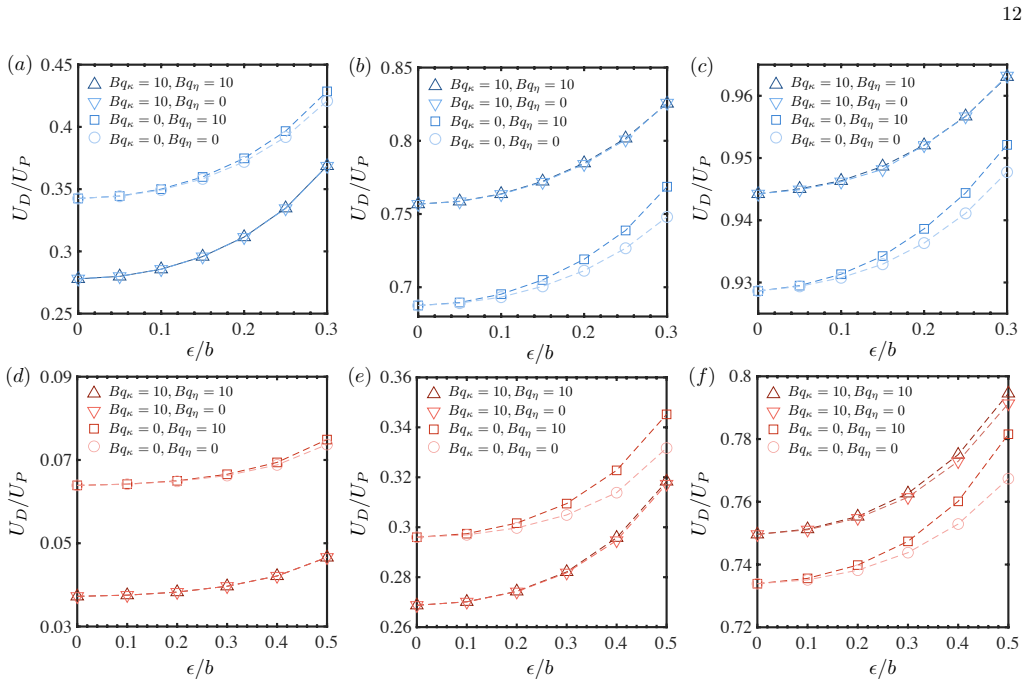
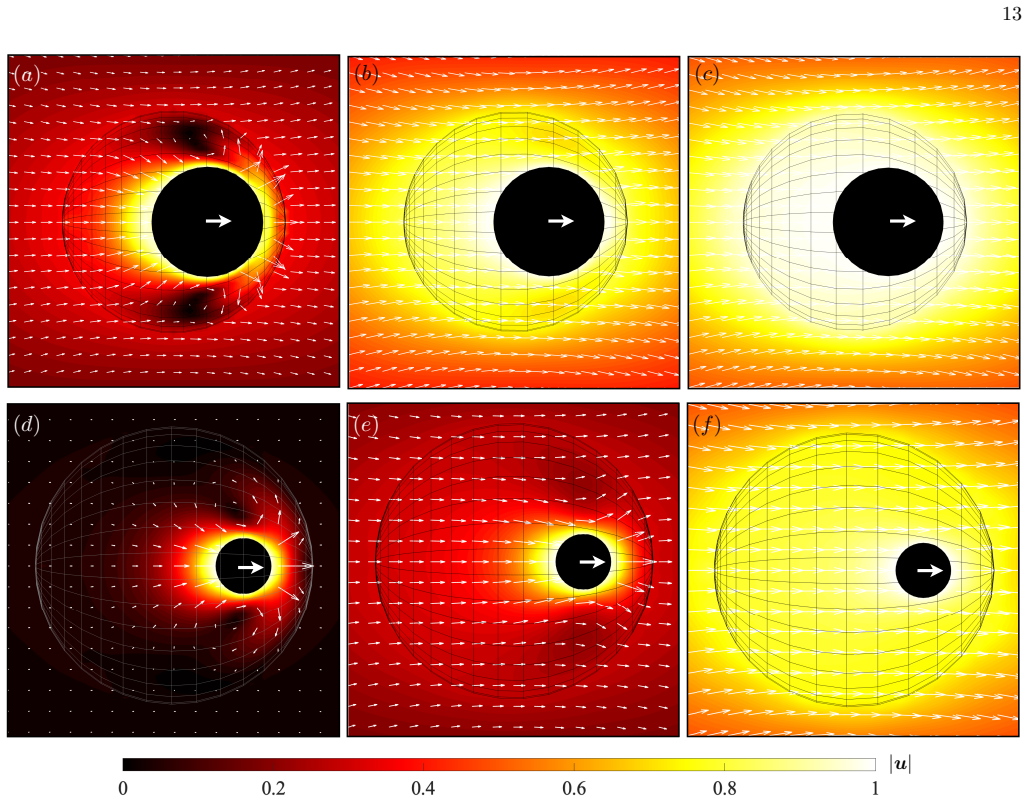
For concentric configurations, the induced droplet velocity is independent of surface shear viscosity, while surface dilatational viscosity can either enhance or suppress the droplet motion depending on the interplay between confinement and viscosity ratio. In contrast, when the particle is eccentrically positioned within the droplet, a dependence on surface shear viscosity emerges, leading to a consistent enhancement of droplet motion that becomes more pronounced with increasing eccentricity. The analytical and numerical results agree closely and reveal how interfacial rheology, confinement, and symmetry breaking jointly govern the dynamics.
What carries the argument
The Boussinesq-Scriven constitutive law applied to the droplet interface, which incorporates both surface shear and dilatational viscosities; solved exactly for concentric geometries and via spectral boundary integral method for eccentric cases.
Load-bearing premise
The droplet interface obeys the Boussinesq-Scriven constitutive law exactly, with no additional interfacial effects such as Marangoni stresses, bending rigidity, or non-Newtonian surface behavior.
What would settle it
Direct experimental measurement of droplet velocity for a centered particle at fixed particle speed but varying surface shear viscosity, which should show no change if the claim holds, or a measurable velocity shift if the independence assumption fails.
Figures



read the original abstract
We investigate the influence of interfacial rheology on the motion of a compound particle consisting of a viscous droplet enclosing a translating rigid particle in the Stokes flow regime. The droplet interface is modeled using the Boussinesq-Scriven constitutive law, incorporating both surface shear and dilatational viscosities. An exact analytical solution is derived for the concentric configuration, and the analysis is extended to eccentric geometries using a spectral boundary integral method, enabling a systematic examination of confinement, viscosity contrast, and interfacial properties. For concentric configurations, we show that the induced droplet velocity is independent of surface shear viscosity, while surface dilatational viscosity can either enhance or suppress the droplet motion depending on the interplay between confinement and viscosity ratio. This behavior is rationalized in terms of competing effects between reduced interfacial mobility and increased driving force required to maintain the prescribed particle speed. In contrast, when the particle is eccentrically positioned within the droplet, a dependence on surface shear viscosity emerges, leading to a consistent enhancement of droplet motion that becomes more pronounced with increasing eccentricity. The analytical and numerical results are in excellent agreement and reveal how interfacial rheology, confinement, and symmetry breaking jointly govern the dynamics of compound particle systems. These findings provide mechanistic insight and establish a quantitative benchmark for future studies of active compound particles with complex interfaces.
Editorial analysis
A structured set of objections, weighed in public.
Referee Report
Summary. The paper investigates the effects of surface shear and dilatational viscosities on the motion of a viscous droplet enclosing a translating rigid particle under Stokes flow, modeling the interface with the Boussinesq-Scriven law. It derives an exact analytical solution for concentric configurations showing droplet velocity independence from surface shear viscosity but dependence on dilatational viscosity (modulated by confinement and viscosity ratio, via competing mobility and driving-force effects), and employs a spectral boundary integral method for eccentric cases revealing shear-viscosity-induced enhancement that increases with eccentricity. Analytical and numerical results agree closely, highlighting the roles of interfacial rheology, confinement, and symmetry breaking.
Significance. If the results hold, the work delivers mechanistic insight into compound-particle dynamics with complex interfaces and establishes quantitative benchmarks via the exact concentric solution and validated spectral method. The symmetry-based separation of shear (null effect concentrically, enhancement eccentrically) and dilatational effects is a clear strength, with direct applicability to microfluidics and active soft-matter systems.
minor comments (4)
- Abstract and §4 (numerical results): the claim of 'excellent agreement' between analytical and numerical solutions should be supported by a quantitative metric (e.g., relative error or L2 norm) rather than qualitative description alone.
- §2 (model formulation): define the surface shear and dilatational viscosity coefficients (and their nondimensional groups) at first use and maintain consistent notation throughout the velocity expressions.
- §3 (concentric analytical solution): a brief schematic or additional sentence clarifying the physical competition between reduced mobility and increased driving force would aid reader intuition without altering the derivation.
- Figure captions (throughout): expand to list the specific parameter values (viscosity contrast, confinement ratio, eccentricity) used in each panel for reproducibility.
Simulated Author's Rebuttal
We thank the referee for their positive and accurate summary of our manuscript, as well as for recognizing its significance and recommending minor revision. The referee's description correctly captures the key results on the independence from surface shear viscosity in concentric cases, the role of dilatational viscosity, and the enhancement due to eccentricity. Since the report lists no specific major comments, we have no individual points requiring rebuttal or clarification at this time. We will incorporate minor revisions to improve presentation, clarity, or any other aspects as appropriate.
Circularity Check
No significant circularity; derivation follows from governing equations
full rationale
The paper presents an exact analytical solution for the concentric configuration derived directly from the Stokes equations with the Boussinesq-Scriven constitutive law at the interface, demonstrating independence from surface shear viscosity and a dependence on dilatational viscosity via competing mobility and driving-force effects. The eccentric case is handled via a spectral boundary integral method. These steps are self-contained mathematical derivations from the stated model assumptions with no reduction to fitted parameters, self-referential definitions, or load-bearing self-citations. No enumerated circularity pattern is present; the central claims are independent of the inputs by construction.
Axiom & Free-Parameter Ledger
free parameters (3)
- viscosity contrast
- confinement ratio
- surface shear and dilatational viscosity coefficients
axioms (2)
- domain assumption Stokes flow (negligible inertia, Re = 0)
- domain assumption Boussinesq-Scriven constitutive law for the interface
Reference graph
Works this paper leans on
-
[1]
xkVllwGD9iMTtKCz5I7A2z7IOXQ=
CONCLUSION In this work, we have examined the hydrodynamics of a compound particle system with interfacial rheology, focusing on how surface viscosities influence the droplet motion induced by a translating particle enclosed within the droplet. An analytical solution was derived for the concentric configuration, and the analysis was extended to eccentric ...
-
[2]
K. M. Wisdom, J. A. Watson, X. Qu, F. Liu, G. S. Watson, and C.-H. Chen. Self-cleaning of superhydrophobic surfaces by self-propelled jumping condensate.Proc. Natl. Acad. Sci. U.S.A., 110(20):7992–7997, 2013
2013
-
[3]
Boˇ ziˇ c and M
A. Boˇ ziˇ c and M. Kanduˇ c. Relative humidity in droplet and airborne transmission of disease.J. Biol. Phys., 47:1, 2021
2021
-
[4]
M. L. P¨ ohlker, C. P¨ ohlker, O. O. Kr¨ uger, J.-D. F¨ orster, T. Berkemeier, W. Elbert, J. Fr¨ ohlich-Nowoisky, U. P¨ oschl, G. Bagheri, E. Bodenschatz, J. A. Huffman, S. Scheithauer, and E. Mikhailov. Respiratory aerosols and droplets in the transmission of infectious diseases.Rev. Mod. Phys., 95:045001, 2023
2023
-
[5]
A. R. Abate, C.-H. Chen, J. J. Agresti, and D. A. Weitz. Beating poisson encapsulation statistics using close-packed ordering.Lab Chip, 9:2628–2631, 2009
2009
-
[6]
E. W. M. Kemna, R. M. Schoeman, F. Wolbers, I. Vermes, D. A. Weitz, and A. van den Berg. High-yield cell ordering and deterministic cell-in-droplet encapsulation using dean flow in a curved microchannel.Lab Chip, 12:2881–2887, 2012
2012
-
[7]
Brouzes, T
E. Brouzes, T. Kruse, R. Kimmerling, and H. H. Strey. Rapid and continuous magnetic separation in droplet microfluidic devices.Lab Chip, 15:908–919, 2015
2015
-
[8]
Y. Ding, F. Qiu, X. Casadevall i Solvas, F. W. Y. Chiu, B. J. Nelson, and A. DeMello. Microfluidic-based droplet and cell manipulations using artificial bacterial flagella.Micromachines, 7(2), 2016
2016
-
[9]
Ramos, M
G. Ramos, M. L. Cordero, and R. Soto. Bacteria driving droplets.Soft Matter, 16:1359–1365, 2020
2020
-
[10]
Rajabi, H
M. Rajabi, H. Baza, T. Turiv, and O. D. Lavrentovich. Directional self-locomotion of active droplets enabled by nematic environment.Nat. Phys., 17:260, 2021
2021
-
[11]
Kokot, H
G. Kokot, H. A. Faizi, G. E. Pradillo, A. Snezhko, and P. M. Vlahovska. Spontaneous self-propulsion and nonequilibrium shape fluctuations of a droplet enclosing active particles.Commun. Phys., 5:91, 2022
2022
-
[12]
M. He, J. S. Edgar, G. D. M. Jeffries, R. M. Lorenz, J. P. Shelby, and D. T. Chiu. Selective encapsulation of single cells and subcellular organelles into picoliter- and femtoliter-volume droplets.Anal. Chem., 77:1539, 2005
2005
-
[13]
A. D. Griffiths and D. S. Tawfik. Miniaturising the laboratory in emulsion droplets.Trends Biotechnol., 24:395, 2006
2006
-
[14]
B. T. Kelly, J.-C. Baret, V. Taly, and A. D. Griffiths. Miniaturizing chemistry and biology in microdroplets.Chem. Commun., pages 1773–1788, 2007
2007
-
[15]
Chabert and J.-L
M. Chabert and J.-L. Viovy. Microfluidic high-throughput encapsulation and hydrodynamic self-sorting of single cells. Proc. Natl. Acad. Sci. U.S.A., 105(9):3191–3196, 2008
2008
-
[16]
Clausell-Tormos, D
J. Clausell-Tormos, D. Lieber, J.-C. Baret, A. El-Harrak, O. J. Miller, L. Frenz, J. Blouwolff, K. J. Humphry, S. K¨ oster, H. Duan, C. Holtze, D. A. Weitz, A. D. Griffiths, and C. A. Merten. Droplet-based microfluidic platforms for the encapsulation and screening of mammalian cells and multicellular organisms.Chem. Biol., 15(5):427–437, 2008. 16
2008
-
[17]
Thiele and S
J. Thiele and S. Seiffert. Double emulsions with controlled morphology by microgel scaffolding.Lab Chip, 11:3188–3192, 2011
2011
-
[18]
H. Wen, Y. Yu, G. Zhu, L. Jiang, and J. Qin. A droplet microchip with substance exchange capability for the developmental study of c. elegans.Lab Chip, 15:1905–1911, 2015
1905
-
[19]
R. E. Johnson and S. S. Sadhal. Fluid mechanics of compound multiphase drops and bubbles.Annu. Rev. Fluid Mech., 17:289–320, 1985. doi:10.1146/annurev.fl.17.010185.001445
-
[20]
S. S. Sadhal and H. N. Oguz. Stokes flow past compound multiphase drops: the case of completely engulfed drops/bubbles. J. Fluid Mech., 160:511–529, 1985. doi:10.1017/S0022112085003585
-
[21]
A. Daddi-Moussa-Ider, H. L¨ owen, and S. Gekle. Creeping motion of a solid particle inside a spherical elastic cavity.Eur. Phys. J. E, 41:104, 2018. doi:10.1140/epje/i2018-11715-7
-
[22]
S. Y. Reigh, L. Zhu, F. Gallaire, and E. Lauga. Swimming with a cage: low-reynolds-number locomotion inside a droplet. Soft Matter, 13:3161–3173, 2017
2017
-
[23]
V. A. Shaik, V. Vasani, and A. M. Ardekani. Locomotion inside a surfactant-laden drop at low surface P´ eclet numbers.J. Fluid Mech., 851:187–230, 2018. doi:10.1017/jfm.2018.491
-
[24]
Kree and A
R. Kree and A. Zippelius. Controlled locomotion of a droplet propelled by an encapsulated squirmer.Eur. Phys. J. E, 44: 6, 2021
2021
-
[25]
Kree and A
R. Kree and A. Zippelius. Mobilities of a drop and an encapsulated squirmer.Eur. Phys. J. E, 45:15, 2022
2022
-
[26]
R. Kree, L. R¨ uckert, and A. Zippelius. Influence of heterogeneity or shape on the locomotion of a caged squirmer.J. Fluid Mech., 967:A7, 2023. doi:10.1017/jfm.2023.450
-
[27]
H. Nganguia, A. Adegbuyi, M. Uffenheimer, and O. S. Pak. Squirming inside a liquid droplet with surface viscosities. Phys. Rev. Fluids, 10:033104, Mar 2025. doi:10.1103/PhysRevFluids.10.033104
-
[28]
A. R. Sprenger, V. A. Shaik, A. M. Ardekani, M. Lisicki, A. J. T. M. Mathijssen, F. Guzm´ an-Lastra, H. L¨ owen, A. M. Menzel, and A. Daddi-Moussa-Ider. Towards an analytical description of active microswimmers in clean and in surfactant- covered drops.Eur. Phys. J. E, 43:58, 2020
2020
-
[29]
R. Kree, L. R¨ uckert, and A. Zippelius. Dynamics of a droplet driven by an internal active device.Phys. Rev. Fluids, 6: 034201, Mar 2021. doi:10.1103/PhysRevFluids.6.034201
-
[30]
Kawakami and P
S. Kawakami and P. M. Vlahovska. Microswimmer dynamics in a hele-shaw droplet.Phil. Trans. R. Soc. A, 383(2304): 20240254, 2025
2025
-
[31]
S. Kawakami and P. M. Vlahovska. Migration and deformation of a droplet enclosing an active particle.J. Fluid Mech., 1007:A41, 2025. doi:10.1017/jfm.2025.75
-
[32]
C. K. V. S. and S. P. Thampi. Dynamics and stability of a concentric compound particle – a theoretical study.Soft Matter, 15:7605, 2019
2019
-
[33]
P. K. Singeetham, K. V. S. Chaithanya, and S. P. Thampi. Dilute dispersion of compound particles: deformation dynamics and rheology.J. Fluid Mech., 917:A2, 2021. doi:10.1017/jfm.2021.233
-
[34]
G. G. Fuller and J. Vermant. Complex fluid-fluid interfaces: Rheology and structure.Annu. Rev. Chem. Biomol. Eng., 3 (1):519–543, 2012
2012
-
[35]
J. R. Samaniuk and J. Vermant. Micro and macrorheology at fluid–fluid interfaces.Soft Matter, 10:7023–7033, 2014
2014
-
[36]
Manikantan and T
H. Manikantan and T. M. Squires. Surfactant dynamics: hidden variables controlling fluid flows.J. Fluid Mech., 892:P1,
-
[37]
doi:10.1017/jfm.2020.170
-
[38]
N. O. Jaensson, P. D. Anderson, and J. Vermant. Computational interfacial rheology.J. Non-Newton. Fluid Mech., 290: 104507, 2021
2021
-
[39]
H. A. Stone and L. G. Leal. The effects of surfactants on drop deformation and breakup.J. Fluid Mech., 220:161–186,
-
[40]
doi:10.1017/S0022112090003226
-
[41]
P. M. Vlahovska, J. Blawzdziewicz, and M. Loewenberg. Small-deformation theory for a surfactant-covered drop in linear flows.J. Fluid Mech., 624:293–337, 2009. doi:10.1017/S0022112008005417
-
[42]
S. Mandal, U. Ghosh, and S. Chakraborty. Effect of surfactant on motion and deformation of compound droplets in arbitrary unbounded Stokes flows.J. Fluid Mech., 803:200–249, 2016. doi:10.1017/jfm.2016.497
-
[43]
S. Chembai Ganesh, J. Koplik, J. F. Morris, and C. Maldarelli. Dynamics of a surface tension driven colloidal motor based on an active janus particle encapsulated in a liquid drop.J. Fluid Mech., 958:A12, 2023. doi:10.1017/jfm.2023.5
-
[44]
J. G. Oldroyd. The effect of interfacial stabilizing films on the elastic and viscous properties of emulsions.Proc. R. Soc. Lond. A, 232:567–577, 1955. doi:10.1098/rspa.1955.0240
-
[45]
D. Langevin. Rheology of adsorbed surfactant monolayers at fluid surfaces.Annu. Rev. Fluid Mech., 46:47–65, 2014. doi:10.1146/annurev-fluid-010313-141403
-
[46]
H. Manikantan and T. M. Squires. Surface viscosity and Marangoni stresses at surfactant laden interfaces.J. Fluid Mech., 792:712–739, 2016. doi:10.1017/jfm.2016.96
-
[47]
R. W. Flumerfelt. Effects of dynamic interfacial properties on drop deformation and orientation in shear and extensional flow fields.J. Colloid Interface Sci., 76:330–349, 1980. doi:10.1016/0021-9797(80)90377-X
-
[48]
M. D. Levan. Motion of a droplet with a newtonian interface.J. Colloid Interface Sci., 83(1):11–17, 1981
1981
-
[49]
Narsimhan
V. Narsimhan. Letter: The effect of surface viscosity on the translational speed of droplets.Phys. Fluids, 30(8):081703, 2018
2018
-
[50]
J. M. Rallison. The deformation of small viscous drops and bubbles in shear flows.Annu. Rev. Fluid Mech., 16:45–66,
-
[51]
doi:10.1146/annurev.fl.16.010184.000401
-
[52]
C. Pozrikidis. Effects of surface viscosity on the finite deformation of a liquid drop and the rheology of dilute emulsions in simple shearing flow.J. Non-Newton. Fluid Mech., 51:161–178, 1994. doi:10.1016/0377-0257(94)85010-0. 17
-
[53]
J. Gounley, G. Boedec, M. Jaeger, and M. Leonetti. Influence of surface viscosity on droplets in shear flow.J. Fluid Mech., 791:464–494, 2016. doi:10.1017/jfm.2016.39
-
[54]
A. Ponce-Torres, J. M. Montanero, M. A. Herrada, E. J. Vega, and J. M. Vega. Influence of the surface viscosity on the breakup of a surfactant-laden drop.Phys. Rev. Lett., 118:024501, 2017. doi:10.1103/PhysRevLett.118.024501
-
[55]
V. Narsimhan. Shape and rheology of droplets with viscous surface moduli.J. Fluid Mech., 862:385–420, 2019. doi: 10.1017/jfm.2018.960
-
[56]
R. Dandekar and A. M. Ardekani. Effect of interfacial viscosities on droplet migration at low surfactant concentrations. J. Fluid Mech., 902:A2, 2020. doi:10.1017/jfm.2020.551
-
[57]
N. Singh and V. Narsimhan. Deformation and burst of a liquid droplet with viscous surface moduli in a linear flow field. Phys. Rev. Fluids, 5:063601, Jun 2020. doi:10.1103/PhysRevFluids.5.063601
-
[58]
D. P. Panigrahi, S. Santra, T. N. Banuprasad, S. Das, and S. Chakraborty. Interfacial viscosity-induced suppression of lateral migration of a surfactant laden droplet in a nonisothermal poiseuille flow.Phys. Rev. Fluids, 6:053603, May 2021
2021
-
[59]
M. A. Herrada, A. Ponce-Torres, M. Rubio, J. Eggers, and J. M. Montanero. Stability and tip streaming of a surfactant- loaded drop in an extensional flow. Influence of surface viscosity.J. Fluid Mech., 934:A26, 2022. doi:10.1017/jfm.2021.1118
-
[60]
N. Singh and V. Narsimhan. Numerical investigation of the effect of surface viscosity on droplet breakup and relaxation under axisymmetric extensional flow.J. Fluid Mech., 946:A24, 2022. doi:10.1017/jfm.2022.601
-
[61]
L. E. Scriven. Dynamics of a fluid interface: Equation of motion for Newtonian surface fluids.Chem. Eng. Sci., 12:98–108,
-
[62]
doi:10.1016/0009-2509(60)87003-0
-
[63]
D. A. Edwards, H. Brenner, and D. T. Wasan.Interfacial Transport Processes and Rheology. Butterworth-Heinemann, 1991
1991
-
[64]
Happel and H
J. Happel and H. Brenner.Low Reynolds Number Hydrodynamics: with Special Applications to Particulate Media. Noord- hoff International Publishing, 1973
1973
-
[65]
Masoud and H
H. Masoud and H. A. Stone. The reciprocal theorem in fluid dynamics and transport phenomena.J. Fluid Mech., 879:P1,
-
[66]
doi:10.1017/jfm.2019.553
-
[67]
H. Zhao, A. H. G. Isfahani, L. N. Olson, and J. B. Freund. A spectral boundary integral method for flowing blood cells. J. Comput. Phys., 229(10):3726–3744, 2010. ISSN 0021-9991. doi:10.1016/j.jcp.2010.01.024
-
[68]
I. G. Graham and I. H. Sloan. Fully discrete spectral boundary integral methods for Helmholtz problems on smooth closed surfaces inR 3.Numer. Math., 92(2):289–323, 2002. ISSN 0945-3245. doi:10.1007/s002110100343
-
[69]
P.-C. Chao, A. G¨ urb¨ uz, F. Sachs, and M. V. Sivaselvan. Fully implicit spectral boundary integral computation of red blood cell flow.Phys. Fluids, 33(7):071909, 2021. doi:10.1063/5.0055036
-
[70]
G¨ urb¨ uz.Simulations of Red Blood Cell Flow by Boundary Integral Methods
A. G¨ urb¨ uz.Simulations of Red Blood Cell Flow by Boundary Integral Methods. PhD thesis, State University of New York at Buffalo, 2021
2021
-
[71]
A. Rahimian, S. K. Veerapaneni, D. Zorin, and G. Biros. Boundary integral method for the flow of vesicles with viscosity contrast in three dimensions.J. Comput. Phys., 298:766–786, 2015. ISSN 0021-9991. doi:10.1016/j.jcp.2015.06.017
-
[72]
G. K. Youngren and A. Acrivos. Stokes flow past a particle of arbitrary shape: a numerical method of solution.J. Fluid Mech., 69:377–403, 1975. doi:10.1017/S0022112075001486
-
[73]
Pozrikidis.Boundary integral and singularity methods for linearized viscous flow, volume 8
C. Pozrikidis.Boundary integral and singularity methods for linearized viscous flow, volume 8. Cambridge University Press, New York, 1992. ISBN 0521406935
1992
-
[74]
C. Pozrikidis. Interfacial dynamics for Stokes flow.J. Comput. Phys., 169:250–301, 2001. doi:10.1006/jcph.2000.6582
-
[75]
Barthes-Biesel
D. Barthes-Biesel. Motion and deformation of elastic capsules and vesicles in flow.Annu. Rev. Fluid Mech., 48:25–52,
-
[76]
doi:10.1146/annurev-fluid-122414-034345
-
[77]
K. E. Atkinson.The Numerical Solution of Integral Equations of the Second Kind. Cambridge University Press, 1997. ISBN 9780521583916
1997
-
[78]
O. A. Ladyzhenskaya.The Mathematical Theory of Viscous Incompressible Flow. Gordon and Breach, New York, 2nd edition, 1969
1969
-
[79]
Kim and S
S. Kim and S. J. Karrila.Microhydrodynamics: Principles and Selected Applications. Dover, 1991
1991
-
[80]
J. C. Adams and P. N. Swarztrauber. SPHEREPACK 3.0: A model development facility.Mon. Weather Rev., 127(8): 1872–1878, 1999. ISSN 1520-0493
1999
discussion (0)
Sign in with ORCID, Apple, or X to comment. Anyone can read and Pith papers without signing in.