Recognition: unknown
Multireference Covariant Density Functional Theory with Stochastic Basis
Pith reviewed 2026-05-10 14:44 UTC · model grok-4.3
The pith
Stochastic external fields in multireference covariant density functional theory generate better nuclear ground states than empirical coordinate choices.
A machine-rendered reading of the paper's core claim, the machinery that carries it, and where it could break.
Core claim
The central discovery is that augmenting conventional MR-DFT with a stochastic external field to generate diverse mean-field reference states, followed by Projection-Selection to form a compact subspace, produces lower ground-state energies, smaller point-proton rms radii and softer ground-state bands in 20Ne, 24Mg and 28Si when using covariant density functional theory.
What carries the argument
The stochastic external field that creates an ensemble of mean-field configurations, together with the Projection-Selection method that selects a compact subspace for linear superposition within the multireference framework.
Load-bearing premise
The stochastic external field combined with Projection-Selection will generate and retain the relevant collective degrees of freedom that empirical generator coordinates miss.
What would settle it
An explicit computation for 20Ne showing that the MR-SCDFT ground-state energy is not lower than that from standard MR-CDFT, or that the band is not softer.
Figures


read the original abstract
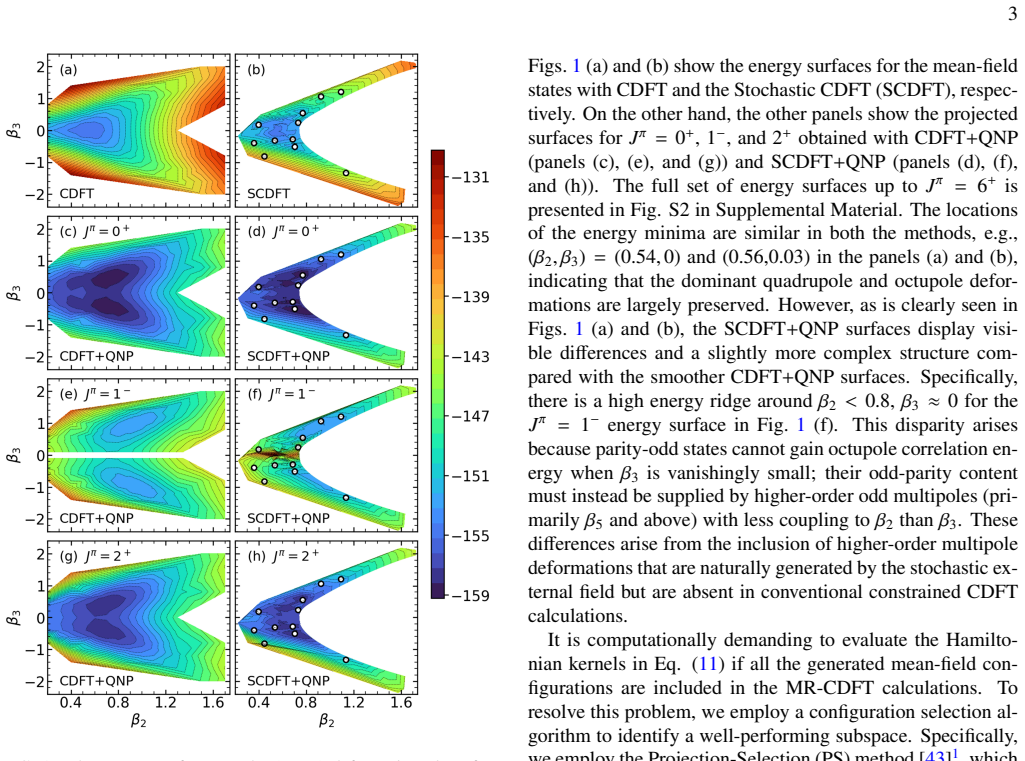
Multireference density functional theory (MR-DFT) provides a pivotal microscopic framework for the description of the ground state properties, low-lying nuclear spectra and transition properties of atomic nuclei. Conventionally, practical implementations of MR-DFT rely on empirically chosen generator coordinates, which may omit relevant collective degrees of freedom and thus fail to capture sufficient collective correlations. Here we introduce the stochastic-basis multireference density functional theory (MR-SDFT). This is an extended scheme that augments the MR-DFT toolkit by (i) generating a diverse ensemble of mean-field reference configurations via a stochastic external field and (ii) selecting a compact subspace with Projection-Selection method. The chosen reference configurations are then linearly superposed within the MR-DFT framework to yield spectroscopic observables. Applying this framework to \nuclide[20]{Ne}, \nuclide[24]{Mg} and \nuclide[28]{Si} with the covariant density functional theory (CDFT), it is demonstrated that the MR-SCDFT leads to lower ground-state energies, smaller point-proton rms radius, and a softer ground-state band compared to the conventional MR-CDFT.
Editorial analysis
A structured set of objections, weighed in public.
Referee Report
Summary. The manuscript proposes the multireference stochastic covariant density functional theory (MR-SCDFT) as an extension of conventional MR-CDFT. It generates an ensemble of mean-field reference configurations via a stochastic external field, applies a Projection-Selection procedure to obtain a compact subspace, and performs a linear superposition within the MR-DFT framework to compute ground-state energies, radii, and spectroscopic observables. For the nuclei 20Ne, 24Mg, and 28Si the authors report that MR-SCDFT produces lower ground-state energies, smaller point-proton rms radii, and a softer ground-state band than standard MR-CDFT with empirically chosen generator coordinates.
Significance. If the stochastic augmentation can be shown to systematically incorporate additional collective correlations without introducing uncontrolled parameter dependence, the approach would address a recognized limitation of generator-coordinate MR-DFT and could improve the microscopic description of nuclear deformation and spectra. The explicit demonstration on three light nuclei provides a concrete test case, but the significance hinges on establishing that the reported improvements are robust rather than an artifact of the particular stochastic implementation.
major comments (3)
- [Abstract and numerical results] The abstract and results section report only qualitative improvements (lower energies, smaller radii, softer bands) without supplying numerical values, error estimates, or the explicit functional form and amplitude of the stochastic external field. This omission prevents assessment of the magnitude of the effect and whether the claimed superiority is statistically significant.
- [Method description and results for 20Ne, 24Mg, 28Si] No convergence tests with respect to the stochastic-field strength, the number of generated configurations, or the Projection-Selection threshold are presented. Without such tests it remains unclear whether the variational lowering arises from genuinely capturing omitted collective modes or simply from the inclusion of additional (possibly redundant) configurations.
- [Discussion of results] The manuscript does not compare the stochastic basis against a deliberately enlarged, manually chosen generator-coordinate set of comparable size. Such a control calculation is necessary to distinguish the claimed systematic improvement from the generic effect of expanding the basis.
minor comments (2)
- [Throughout] The LaTeX notation for nuclides (e.g., nuclide[20]{Ne}) should be rendered consistently in the published version; a few instances appear unformatted in the text.
- [Method section] The manuscript would benefit from an explicit statement of the computational cost scaling of the stochastic generation step relative to conventional MR-CDFT.
Simulated Author's Rebuttal
We thank the referee for the careful reading and constructive comments on our manuscript. We address each major comment below and indicate the changes we will implement in the revised version.
read point-by-point responses
-
Referee: [Abstract and numerical results] The abstract and results section report only qualitative improvements (lower energies, smaller radii, softer bands) without supplying numerical values, error estimates, or the explicit functional form and amplitude of the stochastic external field. This omission prevents assessment of the magnitude of the effect and whether the claimed superiority is statistically significant.
Authors: We agree that quantitative details are necessary for a proper assessment. In the revised manuscript we will augment the abstract and the results section with explicit numerical values for the ground-state energy lowering, changes in point-proton rms radii, and shifts in the ground-state band energies for 20Ne, 24Mg, and 28Si. We will also state the functional form and amplitude of the stochastic external field and include any available statistical uncertainties arising from the stochastic sampling. revision: yes
-
Referee: [Method description and results for 20Ne, 24Mg, 28Si] No convergence tests with respect to the stochastic-field strength, the number of generated configurations, or the Projection-Selection threshold are presented. Without such tests it remains unclear whether the variational lowering arises from genuinely capturing omitted collective modes or simply from the inclusion of additional (possibly redundant) configurations.
Authors: We acknowledge that convergence tests are essential to establish robustness. We will add a dedicated subsection (or appendix) presenting results obtained with varying stochastic-field strengths, different numbers of generated configurations, and different Projection-Selection thresholds. These tests will demonstrate the stability of the reported improvements and help confirm that the energy lowering originates from additional collective correlations rather than redundant configurations. revision: yes
-
Referee: [Discussion of results] The manuscript does not compare the stochastic basis against a deliberately enlarged, manually chosen generator-coordinate set of comparable size. Such a control calculation is necessary to distinguish the claimed systematic improvement from the generic effect of expanding the basis.
Authors: The referee correctly identifies a useful control. A systematic comparison with a manually enlarged generator-coordinate set of comparable dimension is computationally demanding and not trivial to construct without introducing its own bias. In the revised manuscript we will expand the discussion to articulate why the stochastic sampling provides a more unbiased exploration of the collective space than empirical generator-coordinate choices. We will also report a limited comparison, where feasible, between the stochastic basis and a modestly enlarged manual set to illustrate the difference in sampling efficiency. revision: partial
Circularity Check
No circularity: derivation augments existing MR-CDFT independently
full rationale
The paper introduces MR-SCDFT via stochastic external field generation plus Projection-Selection, then applies the resulting configurations inside the standard MR-CDFT superposition to compute observables for 20Ne, 24Mg and 28Si. No equation or procedure defines the reported lower energies, smaller radii or softer bands as a direct algebraic or statistical consequence of quantities fitted from the same data; the stochastic field and selection criterion are presented as external augmentations whose effect is tested variationally. No self-citation chain, uniqueness theorem, or ansatz is invoked to force the outcome, and the central comparison to conventional MR-CDFT remains falsifiable by enlarging the manual generator-coordinate set. The derivation chain is therefore self-contained against external benchmarks.
Axiom & Free-Parameter Ledger
axioms (1)
- domain assumption Covariant density functional theory provides a valid effective description of nuclear ground states and low-lying excitations
Reference graph
Works this paper leans on
-
[1]
K Goeke and P.-G Reinhard , abstract =. The generator-coordinate-method with conjugate parameters and the unification of microscopic theories for large amplitude collective motion , journal =. 1980 , issn =. doi:https://doi.org/10.1016/0003-4916(80)90210-9 , url =
-
[2]
Journal of Physics G: Nuclear Physics , abstract =
P -G Reinhard and K Goeke , title =. Journal of Physics G: Nuclear Physics , abstract =. 1978 , month =. doi:10.1088/0305-4616/4/9/006 , url =
-
[3]
Myo, Takayuki and Lyu, Mengjiao and Zhao, Qing and Isaka, Masahiro and Wan, Niu and Takemoto, Hiroki and Horiuchi, Hisashi , journal =. Variation of multi-Slater determinants in antisymmetrized molecular dynamics and its application to ^. 2023 , month =. doi:10.1103/PhysRevC.108.064314 , url =
-
[4]
Progress of Theoretical and Experimental Physics , volume =
Myo, Takayuki and Lyu, Mengjiao and Zhao, Qing and Isaka, Masahiro and Wan, Niu and Takemoto, Hiroki and Horiuchi, Hisashi and Doté, Akinobu , title =. Progress of Theoretical and Experimental Physics , volume =. 2025 , month =. doi:10.1093/ptep/ptae187 , url =
-
[5]
Progress of Theoretical Physics , volume =
Saito, Sakae , title =. Progress of Theoretical Physics , volume =. 1969 , month =. doi:10.1143/PTP.41.705 , url =
-
[6]
S.J. Krieger and P. Bonche and H. Flocard and P. Quentin and M.S. Weiss , abstract =. An improved pairing interaction for mean field calculations using skyrme potentials* , journal =. 1990 , issn =. doi:https://doi.org/10.1016/0375-9474(90)90035-K , url =
-
[7]
Time-dependent density-functional description of nuclear dynamics , author =. Rev. Mod. Phys. , volume =. 2016 , month =. doi:10.1103/RevModPhys.88.045004 , url =
-
[8]
Balian, R. and Brezin, E. , title = ". Nuovo Cimento B Serie , year = 1969, month = nov, volume =. doi:10.1007/BF02710281 , adsurl =
-
[9]
Fukuoka, Y. and Shinohara, S. and Funaki, Y. and Nakatsukasa, T. and Yabana, K. , journal =. Deformation and cluster structures in. 2013 , month =. doi:10.1103/PhysRevC.88.014321 , url =
-
[10]
Configuration mixing calculation for complete low-lying spectra with a mean-field Hamiltonian , author =. Phys. Rev. C , volume =. 2006 , month =. doi:10.1103/PhysRevC.74.054315 , url =
-
[11]
Applications of the dynamical generator coordinate method to quadrupole excitations , author =. Phys. Rev. C , volume =. 2022 , month =. doi:10.1103/PhysRevC.105.064302 , url =
-
[12]
Generator coordinate method with a conjugate momentum: Application to particle number projection , author =. Phys. Rev. C , volume =. 2021 , month =. doi:10.1103/PhysRevC.103.034313 , url =
-
[13]
Shape and multiple shape coexistence of nuclei within covariant density functional theory , author =. Phys. Rev. C , volume =. 2023 , month =. doi:10.1103/PhysRevC.107.024308 , url =
-
[14]
Beyond relativistic mean-field studies of low-lying states in neutron-deficient krypton isotopes , author =. Phys. Rev. C , volume =. 2013 , month =. doi:10.1103/PhysRevC.87.054305 , url =
-
[15]
Progress of Theoretical and Experimental Physics , volume =
Kanada-En'yo, Yoshiko and Kimura, Masaaki and Ono, Akira , title =. Progress of Theoretical and Experimental Physics , volume =. 2012 , month =. doi:10.1093/ptep/pts001 , url =
-
[16]
Mode Coupling and the Pygmy Dipole Resonance in a Relativistic Two-Phonon Model , author =. Phys. Rev. Lett. , volume =. 2010 , month =. doi:10.1103/PhysRevLett.105.022502 , url =
-
[17]
Frycz, Dorian and Men\'endez, Javier and Rios, Arnau and Bally, Benjamin and Rodr\'. Shell-model study of ^. Phys. Rev. C , volume =. 2024 , month =. doi:10.1103/PhysRevC.110.054326 , url =
-
[18]
Chiba, Y. and Kimura, M. , journal =. Cluster states and isoscalar monopole transitions of ^. 2015 , month =. doi:10.1103/PhysRevC.91.061302 , url =
-
[19]
Nauruzbayev, D. K. and Goldberg, V. Z. and Nurmukhanbetova, A. K. and Golovkov, M. S. and Volya, A. and Rogachev, G. V. and Tribble, R. E. , journal =. Structure of ^. 2017 , month =. doi:10.1103/PhysRevC.96.014322 , url =
-
[20]
Probing negative-parity states of ^
Kanada-En'yo, Yoshiko and Ogata, Kazuyuki , journal =. Probing negative-parity states of ^. 2021 , month =. doi:10.1103/PhysRevC.103.024603 , url =
-
[21]
I. Angeli and K.P. Marinova , keywords =. Table of experimental nuclear ground state charge radii: An update , journal =. 2013 , issn =. doi:https://doi.org/10.1016/j.adt.2011.12.006 , url =
-
[22]
Extension of the generator coordinate method with basis optimization , author =. Phys. Rev. C , volume =. 2023 , month =. doi:10.1103/PhysRevC.108.L051302 , url =
-
[23]
Zhang, X. and Lin, W. and Yao, J. M. and Jiao, C. F. and Romero, A. M. and Rodr\'. Optimization of the generator coordinate method with machine-learning techniques for nuclear spectra and neutrinoless double-. Phys. Rev. C , volume =. 2023 , month =. doi:10.1103/PhysRevC.107.024304 , url =
-
[24]
Analysis of a Skyrme energy density functional with deep learning , author =. Phys. Rev. C , volume =. 2023 , month =. doi:10.1103/PhysRevC.108.034311 , url =
-
[25]
Neutrinoless Double-Beta Decay: A Roadmap for Matching Theory to Experiment
Cirigliano, Vincenzo and others. Neutrinoless Double-Beta Decay: A Roadmap for Matching Theory to Experiment. 2022. arXiv:2203.12169
-
[26]
Emulating the generator coordinate method with extended eigenvector continuation for the Lipkin-Meshkov-Glick model , author =. Phys. Rev. C , volume =. 2024 , month =. doi:10.1103/PhysRevC.110.014309 , url =
-
[27]
Bayesian refinement of covariant energy density functionals
Salinas, Marc and Piekarewicz, J. Bayesian refinement of covariant energy density functionals. Phys. Rev. C. 2023. doi:10.1103/PhysRevC.107.045802. arXiv:2301.09692
-
[28]
McDonnell, J. D. and Schunck, N. and Higdon, D. and Sarich, J. and Wild, S. M. and Nazarewicz, W. Uncertainty Quantification for Nuclear Density Functional Theory and Information Content of New Measurements. Phys. Rev. Lett. 2015. doi:10.1103/PhysRevLett.114.122501. arXiv:1501.03572
-
[29]
Electric dipole moments and the search for new physics,
Alarcon, Ricardo and others. Electric dipole moments and the search for new physics. 2022. arXiv:2203.08103
-
[30]
Beaujeault-Taudiere, Yann and Lacroix, Denis. Solving the Lipkin model using quantum computers with two qubits only with a hybrid quantum-classical technique based on the generator coordinate method. Phys. Rev. C. 2024. doi:10.1103/PhysRevC.109.024327. arXiv:2312.04703
-
[31]
Editorial: Uncertainty Estimates , author =. Phys. Rev. A , volume =. 2011 , month =. doi:10.1103/PhysRevA.83.040001 , url =
-
[32]
Dobaczewski, J. and Nazarewicz, W. and Reinhard, P. -G. Error Estimates of Theoretical Models: a Guide. J. Phys. G. 2014. doi:10.1088/0954-3899/41/7/074001. arXiv:1402.4657
-
[33]
Shalev-Shwartz, Shai and Ben-David, Shai , biburl =
-
[34]
Geron, Aurelien , biburl =
-
[35]
Barlow, R. J. , title = "
-
[36]
Projection and ground state correlations made simple , author =. Phys. Rev. C , volume =. 2002 , month =. doi:10.1103/PhysRevC.65.064320 , url =
-
[37]
Yao, J. M. and Ginnett, I. and Belley, A. and Miyagi, T. and Wirth, R. and Bogner, S. and Engel, J. and Hergert, H. and Holt, J. D. and Stroberg, S. R. Ab initio studies of double Gamow-Teller transition and its correlation with neutrinoless double beta decay. Phys. Rev. C. 2022. doi:10.1103/PhysRevC.106.014315. arXiv:2204.12971
-
[38]
om, Andreas and Hagen, Gaute , title =
Ekstr\"om, Andreas and Hagen, Gaute , title = ". Phys. Rev. Lett. 2019. doi:10.1103/PhysRevLett.123.252501. arXiv:1910.02922
-
[39]
Bayesian approach to model-based extrapolation of nuclear observables
Neufcourt, L\'eo and Cao, Yuchen and Nazarewicz, Witold and Viens, Frederi. Bayesian approach to model-based extrapolation of nuclear observables. Phys. Rev. C. 2018. doi:10.1103/PhysRevC.98.034318. arXiv:1806.00552
-
[40]
Costiris, N. J. and Mavrommatis, E. and Gernoth, K. A. and Clark, J. W. , journal =. Decoding. 2009 , month =. doi:10.1103/PhysRevC.80.044332 , url =
-
[41]
Bally, B. and Avez, B. and Bender, M. and Heenen, P. -H. Beyond Mean-Field Calculations for Odd-Mass Nuclei. Phys. Rev. Lett. 2014. doi:10.1103/PhysRevLett.113.162501. arXiv:1406.5984
-
[42]
Novel Bayesian neural network based approach for nuclear charge radii
Dong, Xiao-Xu and An, Rong and Lu, Jun-Xu and Geng, Li-Sheng. Novel Bayesian neural network based approach for nuclear charge radii. Phys. Rev. C. 2022. doi:10.1103/PhysRevC.105.014308. arXiv:2109.09626
-
[43]
Nuclear charge radii: Density functional theory meets Bayesian neural networks
Utama, Raditya and Chen, Wei-Chia and Piekarewicz, Jorge. Nuclear charge radii: Density functional theory meets Bayesian neural networks. J. Phys. G. 2016. doi:10.1088/0954-3899/43/11/114002. arXiv:1608.03020
-
[44]
Wu, Di and Bai, C. L. and Sagawa, H. and Zhang, H. Q. Calculation of nuclear charge radii with a trained feed-forward neural network. Phys. Rev. C. 2020. doi:10.1103/PhysRevC.102.054323. arXiv:2006.09677
-
[45]
A mathematical foundation for discretisation techniques in the generator coordinate method , author =. Z. Phys. A , volume =. 1979 , doi =
1979
-
[46]
Quadrupole correlation energy by the generator coordinate method , author =. Phys. Rev. C , volume =. 2003 , month =. doi:10.1103/PhysRevC.68.024306 , url =
-
[48]
Nuclear structure within a discrete nonorthogonal shell model approach: New frontiers , author =. Phys. Rev. C , volume =. 2022 , month =. doi:10.1103/PhysRevC.105.054314 , url =
-
[49]
Wu, X. H. and Ren, Z. X. and Zhao, P. W. Nuclear energy density functionals from machine learning. Phys. Rev. C. 2022. doi:10.1103/PhysRevC.105.L031303. arXiv:2105.07696
-
[50]
Wu, X. H. and Lu, Y. Y. and Zhao, P. W. Multi-task learning on nuclear masses and separation energies with the kernel ridge regression. Phys. Lett. B. 2022. doi:10.1016/j.physletb.2022.137394. arXiv:2208.13966
-
[51]
Calibration of nuclear charge density distribution by back-propagation neural networks
Yang, Zu-Xing and Fan, Xiao-Hua and Naito, Tomoya and Niu, Zhong-Ming and Li, Zhi-Pan and Liang, Haozhao. Calibration of nuclear charge density distribution by back-propagation neural networks. 2022. arXiv:2205.15649
-
[52]
Trimmed Sampling Algorithm for the Noisy Generalized Eigenvalue Problem
Hicks, Caleb and Lee, Dean. Trimmed Sampling Algorithm for the Noisy Generalized Eigenvalue Problem. 2022. arXiv:2209.02083
-
[53]
Borrajo, Marta and Egido, J. Luis. Ground-state properties of even and odd Magnesium isotopes in a symmetry-conserving approach. Phys. Lett. B. 2017. doi:10.1016/j.physletb.2016.11.037. arXiv:1611.06982
-
[54]
Duguet, T. and Ebran, J. -P. and Frosini, M. and Hergert, H. and Som\`a, V. Rooting the EDF method into the ab initio framework. PGCM-PT formalism based on MR-IMSRG pre-processed Hamiltonians. 2022. arXiv:2209.03424
-
[56]
Bernard, R\'emi N. and Robledo, Luis M. and Rodr\' guez, Tom\'as R. Octupole correlations in the ^ 144 Ba nucleus described with symmetry-conserving configuration-mixing calculations. Phys. Rev. C. 2016. doi:10.1103/PhysRevC.93.061302. arXiv:1604.06706
-
[57]
Zhou, E. F. and Yao, J. M. and Li, Z. P. and Meng, J. and Ring, P. Anatomy of molecular structures in ^ 20 Ne. Phys. Lett. B. 2016. doi:10.1016/j.physletb.2015.12.028. arXiv:1510.05232
-
[58]
Role of triaxiality in (76)Ge and (76)Se nuclei studied with Gogny energy density functionals
Rodr\' guez, Tom. Role of triaxiality in (76)Ge and (76)Se nuclei studied with Gogny energy density functionals. J. Phys. G. 2017. doi:10.1088/1361-6471/aa57d3
-
[59]
Yao, J. M. and Hagino, K. and Li, Z. P. and Meng, J. and Ring, P. Microscopic benchmark study of triaxiality in low-lying states of 76Kr. Phys. Rev. C. 2014. doi:10.1103/PhysRevC.89.054306. arXiv:1403.4812
-
[60]
Bender, M. and Bertsch, G. F. and Heenen, P. -H. Systematics of quadrupolar correlation energies. Phys. Rev. Lett. 2005. doi:10.1103/PhysRevLett.94.102503. arXiv:nucl-th/0410023
-
[61]
and Arzhanov, Alexander and Mart\' nez-Pinedo, Gabriel
Rodr\' guez, Tom\'as R. and Arzhanov, Alexander and Mart\' nez-Pinedo, Gabriel. Toward global beyond-mean-field calculations of nuclear masses and low-energy spectra. Phys. Rev. C. 2015. doi:10.1103/PhysRevC.91.044315. arXiv:1407.7699
-
[62]
Structure of Krypton isotopes calculated with symmetry conserving configuration mixing methods
Rodr\' guez, Tom\'as R. Structure of Krypton isotopes calculated with symmetry conserving configuration mixing methods. Phys. Rev. C. 2014. doi:10.1103/PhysRevC.90.034306. arXiv:1408.5170
-
[63]
Interacting fermions and bosons with definite total momentum , author =. Phys. Rev. B , volume =. 2005 , month =. doi:10.1103/PhysRevB.71.125113 , url =
-
[64]
and Capelle, K
Orestes, E. and Capelle, K. and da Silva, A. B. F. and Ullrich, C. A. , title =. The Journal of Chemical Physics , volume =. 2007 , doi =
2007
-
[65]
, title =
Capelle,K. , title =. The Journal of Chemical Physics , volume =. 2003 , doi =
2003
-
[66]
Day and Clint Richardson and Charles K
Pankaj Mehta and Marin Bukov and Ching-Hao Wang and Alexandre G.R. Day and Clint Richardson and Charles K. Fisher and David J. Schwab , abstract =. A high-bias, low-variance introduction to Machine Learning for physicists , journal =. 2019 , issn =. doi:https://doi.org/10.1016/j.physrep.2019.03.001 , url =
-
[67]
Gogami, T. and others. Accurate hypernuclear spectroscopy with electromagnetic probe at Jefferson Lab. AIP Conf. Proc. 2021. doi:10.1063/5.0037353
-
[68]
Convergence of Eigenvector Continuation , author =. Phys. Rev. Lett. , volume =. 2021 , month =. doi:10.1103/PhysRevLett.126.032501 , url =
-
[69]
Niu, Z. M. and Liang, H. Z. and Sun, B. H. and Long, W. H. and Niu, Y. F. Predictions of nuclear -decay half-lives with machine learning and their impact on r -process nucleosynthesis. Phys. Rev. C. 2019. doi:10.1103/PhysRevC.99.064307. arXiv:1810.03156
-
[70]
el-David and Regnier, David and Ebran, Jean-Paul and Penon, Antonin , title =
Lasseri, Rapha\"el-David and Regnier, David and Ebran, Jean-Paul and Penon, Antonin , title = ". Phys. Rev. Lett. 2020. doi:10.1103/PhysRevLett.124.162502. arXiv:1910.04132
-
[71]
Bayesian Evaluation of Incomplete Fission Yields
wang, Zi-Ao and Pei, Junchen and Liu, Yue and Qiang, Yu. Bayesian Evaluation of Incomplete Fission Yields. Phys. Rev. Lett. 2019. doi:10.1103/PhysRevLett.123.122501. arXiv:1906.04485
-
[72]
Niu, Z. M. and Liang, H. Z. Nuclear mass predictions based on Bayesian neural network approach with pairing and shell effects. Phys. Lett. B. 2018. doi:10.1016/j.physletb.2018.01.002. arXiv:1801.04411
-
[73]
Utama, R. and Piekarewicz, J. and Prosper, H. B. Nuclear Mass Predictions for the Crustal Composition of Neutron Stars: A Bayesian Neural Network Approach. Phys. Rev. C. 2016. doi:10.1103/PhysRevC.93.014311. arXiv:1508.06263
-
[74]
Niu, Z. M. and Liang, H. Z. Nuclear mass predictions with machine learning reaching the accuracy required by r -process studies. Phys. Rev. C. 2022. doi:10.1103/PhysRevC.106.L021303. arXiv:2208.04783
-
[75]
How Well Do We Know the Neutron-Matter Equation of State at the Densities Inside Neutron Stars? A Bayesian Approach with Correlated Uncertainties , author =. Phys. Rev. Lett. , volume =. 2020 , month =. doi:10.1103/PhysRevLett.125.202702 , url =
-
[76]
Mathematics , year=
Sensitivity Estimates for Nonlinear Mathematical Models , author=. Mathematics , year=
-
[77]
Global sensitivity indices for nonlinear mathematical models and their Monte Carlo estimates,
I.M Sobol′ , keywords =. Global sensitivity indices for nonlinear mathematical models and their Monte Carlo estimates , journal =. 2001 , note =. doi:https://doi.org/10.1016/S0378-4754(00)00270-6 , url =
-
[78]
Relativistic configuration-interaction density functional theory: Nonaxial effects on nuclear decay
Wang, Yakun and Zhao, Pengwei and Meng, Jie. Relativistic configuration-interaction density functional theory: Nonaxial effects on nuclear decay. Sci. Bull. 2024. doi:10.1016/j.scib.2024.04.071. arXiv:2304.12009
-
[79]
Wang, Y. K. and Zhao, P. W. and Meng, J. Correlation between neutrinoless double- decay and double Gamow-Teller transitions. Phys. Lett. B. 2024. doi:10.1016/j.physletb.2024.138796. arXiv:2403.06455
-
[80]
Drischler, C. and Quinonez, M. and Giuliani, P. G. and Lovell, A. E. and Nunes, F. M. Toward emulating nuclear reactions using eigenvector continuation. Phys. Lett. B. 2021. doi:10.1016/j.physletb.2021.136777. arXiv:2108.08269
-
[81]
Bai, Dong and Ren, Zhongzhou. Phys. Rev. C. 2021. doi:10.1103/PhysRevC.103.014612. arXiv:2101.06336
-
[82]
Furnstahl, R. J. and Garcia, A. J. and Millican, P. J. and Zhang, Xilin. Efficient emulators for scattering using eigenvector continuation. Phys. Lett. B. 2020. doi:10.1016/j.physletb.2020.135719. arXiv:2007.03635
discussion (0)
Sign in with ORCID, Apple, or X to comment. Anyone can read and Pith papers without signing in.