Recognition: unknown
Impurity-Scattering Assisted Umklapp Scattering as the Origin of Low-Temperature Resistivity in the Normal-State of Cuprate Superconductors
Pith reviewed 2026-05-10 14:44 UTC · model grok-4.3
The pith
Impurity-scattering assisted umklapp scattering from spin excitations produces the doping-dependent low-temperature resistivity crossover in cuprate superconductors.
A machine-rendered reading of the paper's core claim, the machinery that carries it, and where it could break.
Core claim
Starting from the microscopic electronic structure of cuprate superconductors, the low-temperature resistivity in the normal state requires both impurity scattering, which restricts the modification of the distribution function to around the antinodal region, and the impurity-scattering assisted umklapp scattering from a spin excitation. This mechanism carries a doping-dependent temperature scale that follows the antinodal spin pseudogap crossover temperature. Above the scale in the overdoped strange-metal phase the resistivity is T-linear; below the scale in the underdoped pseudogap phase the opening of the spin pseudogap lowers the spin excitation density of states at the antinode, reduces
What carries the argument
impurity-scattering assisted umklapp scattering from a spin excitation, which sets the doping-dependent temperature scale and changes the scattering strength when the antinodal spin pseudogap suppresses the relevant density of states
If this is right
- The resistivity is T-linear above the temperature scale in the overdoped strange-metal phase.
- The resistivity becomes T-quadratic below the temperature scale in the underdoped pseudogap phase because the pseudogap reduces antinodal spin excitation density of states and thereby weakens the assisted umklapp scattering.
- The temperature scale follows the doping dependence of the antinodal spin pseudogap crossover temperature.
- The same scattering channel accounts for both the linear and quadratic regimes without requiring separate mechanisms.
Where Pith is reading between the lines
- Controlled addition of impurities should shift the crossover temperature in a predictable way if the restriction of the distribution function is essential.
- Applying a magnetic field that closes the pseudogap should restore T-linear resistivity at temperatures below the zero-field crossover scale.
- The mechanism suggests analogous resistivity crossovers could appear in other doped Mott insulators that host both pseudogaps and strong spin fluctuations.
Load-bearing premise
Impurity scattering is strong enough to restrict distribution-function changes to the antinodal region and the spin pseudogap lowers the spin excitation density of states at the antinode enough to weaken umklapp scattering and produce quadratic resistivity.
What would settle it
Observation that the resistivity remains linear in temperature below the antinodal spin pseudogap crossover temperature across a range of underdoped dopings, or that the resistivity crossover temperature does not track the pseudogap temperature when impurity concentration is varied.
Figures



read the original abstract
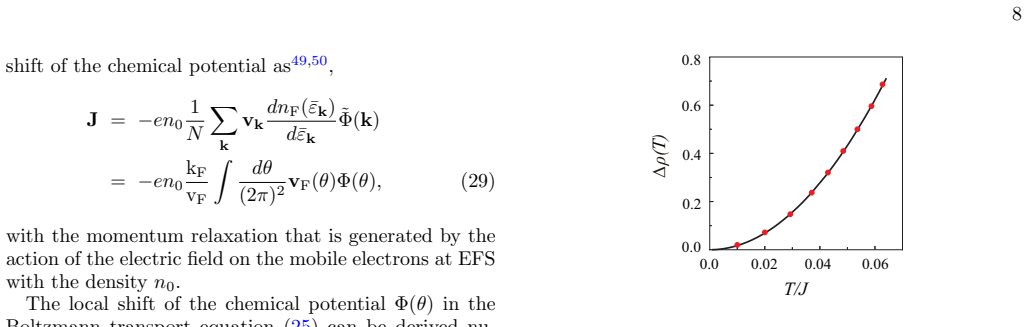
The transport experiments reveal that the low-temperature resistivity in the normal-state of cuprate superconductors is quadratic in temperature (T-quadratic) in the underdoped pseudogap phase, while it is linear in temperature (T-linear) in the overdoped strange-metal phase, however, the full understanding of these different behaviours is still a challenging issue. Here starting from the microscopic electronic structure of cuprate superconductors, the low-temperature resistivity in the normal-state is investigated from the underdoped pseudogap phase to the overdoped strange-metal phase. It is shown that the mechanism requires both the impurity scattering and the umklapp scattering: the impurity scattering is needed to restrict the modification of the distribution function to at around the antinodal region,while the impurity-scattering assisted umklapp scattering from a spin excitation is at the heart of the behaviour in the low-temperature resistivity, where the doping dependence of the temperature scale exists, and presents a similar behavior of the antinodal spin pseudogap crossover temperature. In the low-temperature region above the temperature scale in the overdoped strange-metal phase, the resistivity is T-linear, however, in the low-temperature region below the temperature scale in the underdoped pseudogap phase, the opening of the spin pseudogap lowers the spin excitation density of states at around the antinodal region, which reduces the strength of the electron umklapp scattering from a spin excitation associated with the antinode, and thus leads to a T-quadratic behaviour of the resistivity.
Editorial analysis
A structured set of objections, weighed in public.
Referee Report
Summary. The manuscript proposes that the low-temperature normal-state resistivity in cuprate superconductors arises from impurity-scattering assisted umklapp scattering off spin excitations. In the overdoped strange-metal phase, this yields T-linear resistivity above a doping-dependent temperature scale. In the underdoped pseudogap phase, below this scale, the spin pseudogap reduces the antinodal spin-excitation density of states, weakening the umklapp channel and producing T-quadratic resistivity. The temperature scale is stated to track the antinodal spin pseudogap crossover temperature, with impurity scattering invoked to localize the nonequilibrium distribution deviation to the antinodal region.
Significance. If the central mechanism can be derived rigorously from the Boltzmann equation, the result would be significant: it supplies a microscopic link between the doping evolution of resistivity exponents and the pseudogap, potentially unifying transport and spectroscopic data in the cuprates. The proposal addresses a long-standing puzzle in the field by tying the T-linear to T^2 crossover directly to spin-excitation physics.
major comments (3)
- [Abstract] Abstract: The assertion that impurity scattering restricts the modification of the distribution function to the antinodal region is stated without derivation. No explicit form of the impurity collision integral or solution of the Boltzmann transport equation is given to show how momentum-dependent relaxation rates localize the deviation to antinodes, which is load-bearing for the claim that only antinodal umklapp processes control the resistivity.
- [Abstract] Abstract: The doping-dependent temperature scale is described as exhibiting similar behavior to the antinodal spin pseudogap crossover temperature, yet the manuscript provides no derivation showing that this scale emerges from the scattering model. This leaves open the possibility that the scale is introduced by hand, undermining the claim that the pseudogap opening naturally converts T-linear to T^2 resistivity.
- [Abstract] Abstract: No explicit expressions for the resistivity (e.g., integrals involving the spin-excitation DOS, umklapp matrix elements, or temperature-dependent scattering rates) are supplied to demonstrate how the reduction in antinodal spin DOS produces the observed change from linear to quadratic temperature dependence.
minor comments (2)
- [Abstract] Abstract: Typographical error: missing space after comma in 'region,while'.
- The manuscript would benefit from adding a brief comparison of the predicted doping dependence of the temperature scale to existing experimental compilations of the pseudogap crossover temperature.
Simulated Author's Rebuttal
We thank the referee for the detailed and constructive report. The comments correctly identify areas where the manuscript would benefit from greater rigor and explicit derivations. We will revise the manuscript accordingly to address each point.
read point-by-point responses
-
Referee: [Abstract] Abstract: The assertion that impurity scattering restricts the modification of the distribution function to the antinodal region is stated without derivation. No explicit form of the impurity collision integral or solution of the Boltzmann transport equation is given to show how momentum-dependent relaxation rates localize the deviation to antinodes, which is load-bearing for the claim that only antinodal umklapp processes control the resistivity.
Authors: We agree that the current presentation is conceptual and lacks an explicit derivation. In the revised manuscript we will add a dedicated section deriving the impurity collision integral within the Boltzmann transport equation. This will show how the momentum-dependent relaxation rates, arising from the anisotropic Fermi surface and impurity scattering, localize the nonequilibrium deviation to the antinodal region, thereby justifying that only antinodal umklapp processes control the resistivity. revision: yes
-
Referee: [Abstract] Abstract: The doping-dependent temperature scale is described as exhibiting similar behavior to the antinodal spin pseudogap crossover temperature, yet the manuscript provides no derivation showing that this scale emerges from the scattering model. This leaves open the possibility that the scale is introduced by hand, undermining the claim that the pseudogap opening naturally converts T-linear to T^2 resistivity.
Authors: The scale is not introduced by hand; it is the temperature at which the antinodal spin pseudogap begins to suppress the spin-excitation density of states and thereby weakens the umklapp channel. In the revision we will derive this scale explicitly from the temperature- and doping-dependent scattering rate, demonstrating that it tracks the antinodal spin pseudogap crossover and naturally produces the T-linear to T^2 crossover. revision: yes
-
Referee: [Abstract] Abstract: No explicit expressions for the resistivity (e.g., integrals involving the spin-excitation DOS, umklapp matrix elements, or temperature-dependent scattering rates) are supplied to demonstrate how the reduction in antinodal spin DOS produces the observed change from linear to quadratic temperature dependence.
Authors: We will include the explicit integral expressions for the resistivity in the revised manuscript. These expressions will be written in terms of the spin-excitation density of states, the umklapp matrix elements, and the temperature-dependent scattering rates, thereby showing directly how the reduction in antinodal spin DOS converts the resistivity from T-linear to T-quadratic. revision: yes
Circularity Check
No significant circularity in derivation chain
full rationale
The paper starts from the microscopic electronic structure of cuprates and invokes both impurity scattering (to localize distribution-function deviations near antinodes) and impurity-assisted umklapp scattering off spin excitations to explain the T-linear to T-quadratic crossover. The doping-dependent temperature scale is described as exhibiting behavior similar to the antinodal spin pseudogap crossover, but the provided text contains no equations, fitted parameters, or self-citations that reduce this scale or the resistivity behaviors to the inputs by construction. No load-bearing step equates a claimed prediction to a prior fit or self-referential definition; the central mechanism remains independent of the patterns that would trigger circularity flags.
Axiom & Free-Parameter Ledger
free parameters (1)
- doping-dependent temperature scale
axioms (2)
- domain assumption Impurity scattering restricts the modification of the distribution function to the antinodal region
- ad hoc to paper Umklapp scattering from spin excitations dominates the low-temperature resistivity
Reference graph
Works this paper leans on
-
[1]
See, e.g., the review, M. A. Kastner, R. J. Birgeneau, G. Shirane, and Y. Endoh, Magnetic, transport, and optical properties of monolayer copper oxides, Rev. Mod. Phys. 70 , 897 (1998)
1998
-
[2]
Fujita, H
See, e.g., the review, M. Fujita, H. Hiraka, M. Matsuda, M. Matsuura, J. M. Tranquada, S. Wakimoto, G. Xu, and K. Yamada, Progress in neutron scattering studies of spin excitations in high-T _c cuprates, J. Phys. Soc. Jpan. 81 , 011007 (2012)
2012
-
[3]
J. G. Bednorz and K. A. M\"uller, Possible high T _c superconductivity in the Ba-La-Cu-O system, Z. Phys. B 64 , 189 (1986)
1986
-
[4]
Damascelli, Z
See, e.g., the review, A. Damascelli, Z. Hussain, and Z.-X. Shen, Angle-resolved photoemission studies of the cuprate superconductors, Rev. Mod. Phys. 75 , 473 (2003)
2003
-
[5]
See, e.g., the review, J. C. Campuzano, M. R. Norman, M. Randeira, Photoemission in the high-T _c superconductors, in Physics of Superconductors , vol. II, edited by K. H. Bennemann and J. B. Ketterson (Springer, Berlin Heidelberg New York, 2004), p. 167
2004
-
[6]
uechner, and H. Berger, Dressing of the charge carriers in high-T _c superconductors, in Lecture Notes in Physics , vol. 715, edited by S. H\
See, e.g., the review, J. Fink, S. Borisenko, A. Kordyuk, A. Koitzsch, J. Geck, V. Zabalotnyy, M. Knupfer, B. B\"uechner, and H. Berger, Dressing of the charge carriers in high-T _c superconductors, in Lecture Notes in Physics , vol. 715, edited by S. H\"ufner (Springer-Verlag Berlin Heidelberg, 2007), p. 295
2007
-
[7]
I. K. Drozdov, I. Pletikosi\'c, C. -K. Kim, K. Fujita, G. D. Gu, J. C. S. Davis, P. D. Johnson, I. Bo\ zovi\'c, and T. Valla, Phase diagram of Bi _2 Sr _2 CaCu _2 O _ 8+ revisited, Nat. Commun. 9 , 5210 (2018)
2018
-
[8]
Timusk and B
See, e.g., the review, T. Timusk and B. Statt, The pseudogap in high-temperature superconductors: an experimental survey, Rep. Prog. Phys. 62 , 61 (1999)
1999
-
[9]
H\"ufner, M
See, e.g., the review, S. H\"ufner, M. A. Hossain, A. Damascelli, and G. A. Sawatzky, Two gaps make a high-temperature superconductor? Rep. Prog. Phys. 71 , 062501 (2008)
2008
-
[10]
N. E. Hussey, What drives pseudogap physics in high-T _c cuprates? A view from the (resistance) bridge, J. Phys. Chem. Solids 72 , 529 (2011)
2011
-
[11]
See, e.g., the review, I. M. Vishik, Photoemission perspective on pseudogap, superconducting fluctuations, and charge order in cuprates: a review of recent progress, Rep. Prog. Phys. 81 , 062501 (2018)
2018
-
[12]
A. G. Loeser, Z.-X. Shen, D. S. Dessau, D. S. Marshall, C. H. Park, P. Fournier, A. Kapitulnik, Excitation gap in the normal state of underdoped Bi _2 Sr _2 CaCu _2 O _ 8+ , Science 273 , 325 (1996)
1996
-
[13]
M. R. Norman, H. Ding, M. Randeria, J. C. Campuzano, T. Yokoya, T. Takeuchi, T. Takahashi, T. Mochiku, K. Kadowaki, P. Guptasarma, and D. G. Hinks, Destruction of the Fermi surface in underdoped high-T _c superconductors, Nature 392 , 157 (1998)
1998
-
[14]
Renner, B
Ch. Renner, B. Revaz, J.-Y. Genoud, K. Kadowaki, and . Fischer, Pseudogap precursor of the superconducting gap in under- and overdoped Bi _2 Sr _2 CaCu _2 O _ 8+ , Phys. Rev. Lett. 80 , 149 (1998)
1998
-
[15]
W. W. Warren, Jr., R. E. Walstedt, G. F. Brennert, R. J. Cava, R. Tycko, R. F. Bell, and G. Dabbagh, Cu spin dynamics and superconducting precursor effects in planes above T _c in YBa _2 Cu _3 O _ 6.7 , Phys. Rev. Lett. 62 , 1193 (1989)
1989
-
[16]
Alloul, T
H. Alloul, T. Ohno, and P. Mendels, ^ 89 Y NMR evidence for a Fermi-liquid behavior in YBa _2 Cu _3 O _ 6+x , Phys. Rev. Lett. 63 , 1700 (1989)
1989
-
[17]
R. E. Walstedt, W. W. Warren, Jr., R. F. Bell, R. J. Cava, G. P. Espinosa, L. F. Schneemeyer, and J. V. Waszczak, ^ 63 Cu NMR shift and linewidth anomalies in the T _c =60 K phase of Y-Ba-Cu-O, Phys. Rev. B 41 , 9574(R) (1990)
1990
-
[18]
Keimer, S
See, e.g., the review, B. Keimer, S. A. Kivelson, M. R. Norman, S. Uchida, and J. Zaanen, From quantum matter to high-temperature superconductivity in copper oxides, Nature 518 , 179 (2015)
2015
-
[19]
See, e.g., the review, C. M. Varma, Colloquium: Linear in temperature resistivity and associated mysteries including high temperature superconductivity, Rev. Mod. Phys. 92 , 031001 (2020)
2020
-
[20]
See, e.g., the review, N. E. Hussey, High-temperature superconductivity and strange metallicity: Simple observations with (possibly) profound implications, Physica C 614 , 1354362 (2023)
2023
-
[21]
See, e.g., J. R. Schrieffer, Theory of Superconductivity , Benjamin, New York, 1964
1964
-
[22]
See, e.g., A. A. Abrikosov, Fundamentals of the Theory of Metals , Elsevier Science Publishers B. V., 1988
1988
-
[23]
See, e.g., G. D. Mahan, Many-Particle Physics , (Plenum Press, New York, 1981)
1981
-
[24]
Bucher, P
B. Bucher, P. Steiner, J. Karpinski, E. Kaldis, and P. Wachter, Influence of the spin gap on the normal state transport in YBa _2 Cu _4 O _8 , Phys. Rev. Lett. 70 , 2012 (1993)
2012
-
[25]
T. Ito, K. Takenaka, and S. Uchida, Systematic deviation from T-linear behavior in the in-plane resistivity of YBa _ 2 Cu _ 3 O _ 7-y : Evidence for dominant spin scattering, Phys. Rev. Lett. 70 , 3995 (1993)
1993
-
[26]
Nakano, M
T. Nakano, M. Oda, C. Manabe, N. Momono, Y. Miura, and M. Ido, Magnetic properties and electronic conduction of superconducting La _ 2-x Sr _x CuO _4 , Phys. Rev. B 49 , 16000 (1994)
1994
-
[27]
Y. Ando, A. N. Lavrov, S. Komiya, K. Segawa, and X. F. Sun, Mobility of the doped holes and the antiferromagnetic correlations in underdoped high-T _c cuprates, Phys.Rev. Lett. 87 , 017001 (2001)
2001
-
[28]
R. A. Cooper, Y. Wang, B. Vignolle, O. J. Lipscombe, S. M. Hayden, Y. Tanabe, T. Adachi, Y. Koike, M. Nohara, H. Takagi, C. Proust, N. E. Hussey, Anomalous criticality in the electrical resistivity of La _ 2-x Sr _x CuO _4 , Science 323 , 603 (2009)
2009
-
[29]
S. I. Mirzaei, D. Stricker, J. N. Hancock, C. Berthod, A. Georges, E. Heumen, M. K. Chan, X. Zhao, Y. Li, M. Greven, N. Bari s i\'c, and D. Marel, Spectroscopic evidence for Fermi liquid-like energy and temperature dependence of the relaxation rate in the pseudogap phase of the cuprates, Proc. Natl. Acad. Sci. USA 110 , 5774 (2013)
2013
-
[30]
Bari s i\'c, M
N. Bari s i\'c, M. K. Chan, Y. Li, G. Yu, X. Zhao, M. Dressel, A. Smontara, and M. Greven, Universal sheet resistance and revised phase diagram of the cuprate high-temperature superconductors, Proc. Natl. Acad. Sci. USA 110 , 12235 (2013)
2013
-
[31]
D. Pelc, M. J. Veit, C. J. Dorow, Y. Ge, N. Bari s i\'c, and M. Greven, Resistivity phase diagram of cuprates revisited, Phys. Rev. B 102 , 075114 (2020)
2020
-
[32]
Legros, S
A. Legros, S. Benhabib, W. Tabis, F. Lalibert\'e, M. Dion, M. Lizaire, B. Vignolle, D. Vignolles, H. Raffy, Z. Z. Li, P. Auban-Senzier, N. Doiron-Leyraud, P. Fournier, D. Colson, L. Taillefer, and C. Proust, Universal T-linear resistivity and Planckian dissipation in overdoped cuprates, Nat. Phys. 15 , 142 (2019)
2019
-
[33]
Ayres, M
J. Ayres, M. Berben, M. C ulo, Y.-T. Hsu, E. van Heumen, Y. Huang, J. Zaanen, T. Kondo, T. Takeuchi, J. R. Cooper, C. Putzke, S. Friedemann, A. Carrington, and N. E. Hussey, Incoherent transport across the strange-metal regime of overdoped cuprates, Nature 595 , 661 (2021)
2021
-
[34]
Grissonnanche, Y
G. Grissonnanche, Y. Fang, A. Legros, S. Verret, F. Lalibert\'e, C. Collignon, J. Zhou, D. Graf, P. A. Goddard, L. Taillefer, and B. J. Ramshaw, Linear-in temperature resistivity from an isotropic Planckian scattering rate, Nature 595 , 667 (2021)
2021
-
[35]
Gurvitch and A
M. Gurvitch and A. T. Fiory, Resistivity of La _ 1.825 Sr _ 0.175 CuO _4 and YBa _2 Cu _3 O _7 to 1100 K: Absence of saturation and its implications, Phys. Rev. Lett. 59 , 1337 (1987)
1987
-
[36]
Campi, G
G. Campi, G. Logvenov, S. Caprara, A. Valletta, and A. Bianconi, Kondo Versus Fano in Superconducting Artificial High-Tc Heterostructures, Condens. Matter 9 , 43 (2024)
2024
-
[37]
Campi, A
G. Campi, A. Alimenti, G. Logvenov, G. A. Smith, F. Balakirev, S.-E. Lee, L. Balicas, E. Silva, G. A. Ummarino, G. Midei, A. Perali, A. Valletta, and A. Bianconi, Upper critical magnetic field and multiband superconductivity in artificial high- T_ c superlattices of nano quantum wells, Phys. Rev. Materials 9 , 074204 (2025)
2025
-
[38]
Damle and S
K. Damle and S. Sachdev, Nonzero-temperature transport near quantum critical points, Phys. Rev. B 56 , 8714 (1997)
1997
-
[39]
Sachdev, Quantum Phase Transitions , (Cambridge University Press, 1999)
S. Sachdev, Quantum Phase Transitions , (Cambridge University Press, 1999)
1999
-
[40]
Zaanen, Why the temperature is high, Nature 430 , 512 (2004)
J. Zaanen, Why the temperature is high, Nature 430 , 512 (2004)
2004
-
[41]
Dell'Anna and W
L. Dell'Anna and W. Metzner, Electrical resistivity near Pomeranchuk instability in two dimensions, Phys. Rev. Lett. 98 , 136402 (2007)
2007
-
[42]
Zaanen, Planckian dissipation, minimal viscosity and the transport in cuprate strange metals, SciPost Phys
See, e.g., the review, J. Zaanen, Planckian dissipation, minimal viscosity and the transport in cuprate strange metals, SciPost Phys. 6 , 061 (2019)
2019
-
[43]
See, e.g., the review, S. A. Hartnoll and A. P. Mackenzie, Colloquium: Planckian dissipation in metals, Rev. Mod. Phys. 94 , 041002 (2022)
2022
-
[44]
T. M. Rice, N. J. Robinson, and A. M. Tsvelik, Umklapp scattering as the origin of T-linear resistivity in the normal state of high-T _c cuprate superconductors, Phys. Rev. B 96 , 220502(R) (2017)
2017
-
[45]
See, e.g., the review, N. E. Hussey, Low-energy quasiparticles in high- T_c cuprates, Adv. Phys. 51 , 1685 (2002)
2002
-
[46]
See, e.g., the review, A. V. Balatsky, I. Vekhter, and J.-X. Zhu, Impurity-induced states in conventional and unconventional superconductors, Rev. Mod. Phys. 78 , 373 (2006)
2006
-
[47]
Alloul, J
See, e.g., the review, H. Alloul, J. Bobroff, M. Gabay, and P. J. Hirschfeld, Defects in correlated metals and superconductors, Rev. Mod. Phys. 81 , 45 (2009)
2009
-
[48]
P. A. Lee, Low-temperature T-linear resistivity due to umklapp scattering from a critical mode, Phys. Rev. B 104 , 035140 (2021)
2021
-
[49]
X. Ma, M. Zeng, Z. Cao, and S. Feng, Low-temperature T-linear resistivity in the strange metal phase of overdoped cuprate superconductors due to umklapp scattering from a spin excitation, Phys. Rev. B 108 , 134502 (2023)
2023
-
[50]
X. Ma, M. Zeng, H. Guo, and S. Feng, Low-temperature T^ 2 resistivity in the underdoped pseudogap phase versus T-linear resistivity in the overdoped strange-metal phase of cuprate superconductors, Phys. Rev. B 110 , 094520 (2024)
2024
-
[51]
P. W. Anderson, The resonating valence bond state in La _2 CuO _4 and superconductivity, Science 235 , 1196 (1987)
1987
-
[52]
C. Kim, P. J. White, Z.-X. Shen, T. Tohyama, Y. Shibata, S. Maekawa, B. O. Wells, Y. J. Kim, R. J. Birgeneau, and M. A. Kastner, Systematics of the Photoemission Spectral Function of Cuprates: Insulators and Hole- and Electron-Doped Superconductors, Phys. Rev. Lett. 80 , 4245 (1998)
1998
-
[53]
M. S. Hybertsen, E. B. Stechel, M. Schluter, and D. R. Jennison, Renormalization from density-functional theory to strong-coupling models for electronic states in Cu-O materials, Phys. Rev. B 41 , 11068 (1990)
1990
-
[54]
R. J. Gooding, K. J. E. Vos, and P. W. Leung, Theory of electron-hole asymmetry in doped CuO _ 2 planes, Phys. Rev. B 50 , 12866 (1994)
1994
-
[55]
Tanaka, T
K. Tanaka, T. Yoshida, A. Fujimori, D. H. Lu, Z.-X. Shen, X.-J. Zhou, H. Eisaki, Z. Hussain, S. Uchida, Y. Aiura, K. Ono, T. Sugaya, T. Mizuno, and I. Terasaki, Effects of next-nearest-neighbor hopping t' on the electronic structure of cuprate superconductors, Phys. Rev. B 70 , 092503 (2004)
2004
-
[56]
C. T. Shih, T. K. Lee, R. Eder, C.-Y. Mou, and Y. C. Chen, Enhancement of Pairing Correlation by t' in the Two-Dimensional Extended t - J Model, Phys. Rev. Lett. 92 , 227002 (2004)
2004
-
[57]
Pavarini, I
E. Pavarini, I. Dasgupta, T. Saha-Dasgupta, O. Jepsen, and O. K. Andersen, Band-Structure Trend in Hole-Doped Cuprates and Correlation with T_ c max , Phys. Rev. Lett. 87 , 047003 (2001)
2001
-
[58]
Y. Liu, Y. Lan, and S. Feng, Peak-structure in the self-energy of cuprate superconductors, Phys. Rev. B 103 , 024525 (2021)
2021
-
[59]
S. Tan, Y. Liu, Y. Mou, and S. Feng, Anisotropic dressing of electrons in electron-doped cuprate superconductors, Phys. Rev. B 103 , 014503 (2021)
2021
-
[60]
D. Gao, Y. Mou, and S. Feng, Anomalous electron spectrum and its relation to peak structure of electron scattering rate in cuprate superconductors, J. Low Temp. Phys. 192 , 19 (2018)
2018
-
[61]
Feng and T
S. Feng and T. Ma, Enhancement of superconducting transition temperature by the additional second neighbor hopping t' in the t - J model, Phys. Lett. A 350 , 138 (2006)
2006
-
[62]
Yu, Many-body problems in high temperature superconductivity, in Recent Progress in Many-Body Theories , edited by T
See, e.g., the review, L. Yu, Many-body problems in high temperature superconductivity, in Recent Progress in Many-Body Theories , edited by T. L. Ainsworth, C. E. Campbell, B. E. Clements, and E. Krotscheck (Plenum, New York, 1992), Vol. 3 , p. 157
1992
-
[63]
S. Feng, J. B. Wu, Z. B. Su, and L. Yu, Slave-particle studies of the electron-momentum distribution in the low-dimensional t - J model, Phys. Rev. B 47 , 15192 (1993)
1993
-
[64]
Zhang, J
L. Zhang, J. K. Jain, and V. J. Emery, Importance of the local constraint in slave-boson theories, Phys. Rev. B 47 , 3368 (1993)
1993
-
[65]
See, e.g., the review, P. A. Lee, N. Nagaosa, and X.-G. Wen, Doping a Mott insulator: Physics of high-temperature superconductivity, Rev. Mod. Phys. 78 , 17 (2006)
2006
-
[66]
S. Feng, J. Qin, and T. Ma, A gauge invariant dressed holon and spinon description of the normal state of underdoped cuprates, J. Phys.: Condens. Matter 16 , 343 (2004); S. Feng, Z. B. Su, and L. Yu, Fermion-spin transformation to implement the charge-spin separation, Phys. Rev. B 49 , 2368 (1994)
2004
-
[67]
See, e.g., the review, S. Feng, Y. Lan, H. Zhao, L. Kuang, L. Qin, and X. Ma, Kinetic-energy-driven superconductivity in cuprate superconductors, Int. J. Mod. Phys. B 29 , 1530009 (2015)
2015
-
[68]
S. Feng, H. Zhao, and Z. Huang, Two gaps with one energy scale in cuprate superconductors, Phys. Rev. B. 85 , 054509 (2012); Phys. Rev. B 85 , 099902(E) (2012)
2012
-
[69]
X. Li, M. Zeng, H. Guo, and S. Feng, Unusual electronic structure in underdoped cuprate superconductors, Physica C 636 , 1354767 (2025)
2025
-
[70]
S. Feng, L. Kuang, and H. Zhao, Electronic structure of cuprate superconductors in a full charge-spin recombination scheme, Physica C 517 , 5 (2015)
2015
-
[71]
S. Feng, D. Gao, and H. Zhao, Charge order driven by Fermi-arc instability and its connection with pseudogap in cuprate superconductors, Phil. Mag. 96 , 1245 (2016)
2016
-
[72]
Kuang, Y
L. Kuang, Y. Lan, and S. Feng, Dynamical spin response in cuprate superconductors from low-energy to high-energy, J. Magn. Magn. Mater. 374 ,624 (2015)
2015
-
[73]
Comin and A
See, e.g., the review, R. Comin and A. Damascelli, Resonant x-ray scattering studies of charge order in cuprates, Annu. Rev. Condens. Matter Phys. 7 , 369 (2016)
2016
-
[74]
Comin, A
R. Comin, A. Frano, M. M. Yee, Y. Yoshida, H. Eisaki, E. Schierle, E. Weschke, R. Sutarto, F. He, A. Soumyanarayanan, Yang He, M. L. Tacon, I. S. Elfimov, Jennifer E. Hoffman, G. A. Sawatzky, B. Keimer, and A. Damascelli, Charge order driven by Fermi-arc instability in Bi _ 2 Sr _ 2-x La _ x CuO _ 6+ , Science 343 , 390 (2014)
2014
-
[75]
Ghiringhelli, M
G. Ghiringhelli, M. Le Tacon, M. Minola, S. Blanco-Canosa, C. Mazzoli, N. B. Brookes, G. M. De Luca, A. Frano, D. G. Hawthorn, F. He, T. Loew, M. M. Sala, D. C. Peets, M. Salluzzo, E. Schierle, R. Sutarto, G. A. Sawatzky, E. Weschke, B. Keimer, and L. Braicovich, Long-range incommensurate charge fluctuations in (Y,Nd)Ba _ 2 Cu _ 3 O _ 6+x , Science 337 , ...
2012
-
[76]
E. H. da Silva Neto, P. Aynajian, A. Frano, R. Comin, E. Schierle, E. Weschke, A. Gyenis, J. Wen, J. Schneeloch, Z. Xu, S. Ono, G. Gu, M. Le Tacon, and A. Yazdani, Ubiquitous interplay between charge ordering and high-temperature superconductivity in cuprates, Science 343 , 393 (2014)
2014
-
[77]
Campi, A
G. Campi, A. Bianconi, N. Poccia, G. Bianconi, L. Barba, G. Arrighetti, D. Innocenti, J. Karpinski, N. D. Zhigadlo, S. M. Kazakov, M. Burghammer, M. v. Zimmermann, M. Sprung and A. Ricci, Inhomogeneity of charge-density-wave order and quenched disorder in a high- T_ c superconductor, Nature 525 , 359 (2015)
2015
-
[78]
Hashimoto, E
M. Hashimoto, E. A. Nowadnick, R.-H. He, I. M. Vishik, B. Moritz, Y. He, K. Tanaka, R. G. Moore, D. Lu, Y. Yoshida, M. Ishikado, T. Sasagawa, K. Fujita, S. Ishida, S. Uchida, H. Eisaki, Z. Hussain, T. P. Devereaux, and Z.-X. Shen, Direct spectroscopic evidence for phase competition between the pseudogap and superconductivity in Bi _ 2 Sr _ 2 CaCu _ 2 O _ ...
2015
-
[79]
D. S. Dessau, B. O. Wells, Z.-X. Shen, W. E. Spicer, A. J. Arko, R. S. List, D. B. Mitzi, and A. Kapitulnik, Anomalous spectral weight transfer at the superconducting transition of Bi _ 2 Sr _ 2 CaCu _ 2 O _ 8+ , Phys. Rev. Lett. 66 , 2160 (1991)
1991
-
[80]
J. C. Campuzano, H. Ding, M. R. Norman, H. M. Fretwell, M. Randeria, A. Kaminski, J. Mesot, T. Takeuchi, T. Sato, T. Yokoya, T. Takahashi, T. Mochiku, K. Kadowaki, P. Guptasarma, D. G. Hinks, Z. Konstantinovic, Z. Z. Li, and H. Raffy, Electronic spectra and their relation to the ( , ) collective mode in high- T_c superconductors, Phys. Rev. Lett. 83 , 3709 (1999)
1999
discussion (0)
Sign in with ORCID, Apple, or X to comment. Anyone can read and Pith papers without signing in.