Recognition: unknown
Emergent Kinetic Constraints and Subspace Fragmentation in Rydberg Arrays
Pith reviewed 2026-05-10 15:42 UTC · model grok-4.3
The pith
Variable detuning in Rydberg arrays splits the Hilbert space into fragments of differing sizes that scale variously with atom number, enforcing emergent kinetic constraints on the dynamics.
A machine-rendered reading of the paper's core claim, the machinery that carries it, and where it could break.
Core claim
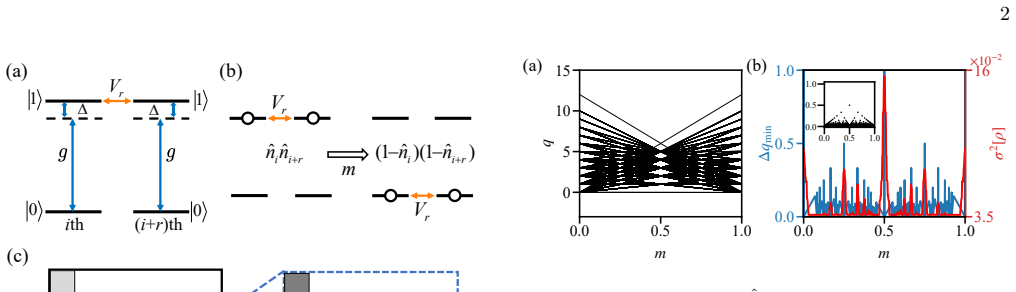
In strongly interacting Rydberg atom arrays, the existence of decoupled Hilbert subspaces depends on the interplay between detuning and interaction strength; these subspaces are strongly fragmented, with fragment dimensions displaying various scaling behaviors with increasing system size. The resulting dynamics are therefore controlled by the dimension and connectivity of the fragments, which an auxiliary fermion description reveals to arise from emergent kinetic constraints.
What carries the argument
Auxiliary fermion description that maps the Rydberg dynamics onto fermions subject to emergent kinetic constraints, thereby accounting for the observed subspace fragmentation.
If this is right
- System evolution remains confined within individual fragments rather than exploring the full Hilbert space.
- Different fragment-size scalings produce distinct long-time dynamical regimes as atom number increases.
- Nonergodic behavior can be realized in Rydberg arrays beyond the PXP model simply by adjusting the global detuning.
- Fragment connectivity sets strict selection rules for allowed transitions between configurations.
Where Pith is reading between the lines
- The same detuning-interaction mechanism could produce analogous fragmentation in other driven lattice models with tunable offsets.
- Preparing initial states within a single predicted fragment and tracking leakage would provide a direct experimental test of the kinetic constraints.
- Boundary conditions in open Rydberg chains may modify the fragment scalings in ways that become measurable for moderate system sizes.
- The fermion mapping hints at connections to kinetically constrained models in classical statistical mechanics.
Load-bearing premise
The auxiliary fermion description fully captures the emergent kinetic constraints and resulting fragmentation without hidden effects that would invalidate the scaling behaviors in finite or realistic Rydberg arrays.
What would settle it
Exact diagonalization or quantum trajectory simulations for Rydberg chains of increasing length that show fragment dimensions failing to match the predicted scaling laws at fixed detuning values would falsify the fragmentation picture.
Figures


read the original abstract
In a strongly interacting Rydberg atom array, the dynamics are often constrained to the decoupled Hilbert subspaces, representing an intriguing paradigm for nonergodicity. By considering a variable detuning of the global Rydberg coupling, we show that, not only is the existence of these Hilbert subspaces dependent on the interplay of detuning and interaction, but they are also strongly fragmented, with the fragment dimensions exhibiting various scaling behaviors with increasing system size. The resulting constrained dynamics of the system are thus governed by the dimension and connectivity of these fragments. We then adopt an auxiliary fermion description to reveal the underlying emergent kinetic constraints for the subspace fragmentation and fragment-confined dynamics. Our results provide a systematic understanding of Hilbert-space fragmentation in Rydberg arrays, and shed light on engineering nonergodic many-body dynamics beyond the PXP model.
Editorial analysis
A structured set of objections, weighed in public.
Referee Report
Summary. The paper studies Hilbert-space fragmentation in Rydberg atom arrays by introducing a variable detuning to the global Rydberg coupling. It claims that the existence and structure of decoupled subspaces depend on the detuning-interaction interplay, resulting in strong fragmentation whose fragment dimensions display multiple scaling behaviors with system size. Constrained dynamics are then governed by fragment dimension and connectivity. An auxiliary fermion description is adopted to expose the emergent kinetic constraints that underlie the fragmentation and fragment-confined evolution, extending the analysis beyond the PXP model.
Significance. If the central claims hold, the work supplies a tunable route to nonergodicity in Rydberg arrays and a concrete mapping that makes the kinetic constraints explicit. The demonstration that fragmentation strength and scaling can be controlled by detuning is potentially useful for designing constrained many-body dynamics. Credit is due for attempting a systematic classification of fragments and for introducing the auxiliary-fermion picture as an explanatory tool.
major comments (2)
- [Auxiliary fermion description] Auxiliary fermion description (the section introducing the mapping): the claim that this description 'reveals the underlying emergent kinetic constraints' without hidden approximations is load-bearing for the scaling and fragmentation results. The manuscript must explicitly state the regime of validity, show whether virtual processes or long-range tails of the original Rydberg Hamiltonian are retained, and provide a direct comparison (analytic or numerical) between the fermion model and the microscopic Hamiltonian for the system sizes used in the scaling plots. Without this, the predicted fragment dimensions and connectivity may not survive in the physical model.
- [Fragment dimensions and scaling] Section on fragment dimensions and scaling: the statement that fragments 'exhibit various scaling behaviors with increasing system size' is central. The manuscript should identify the distinct scaling classes (e.g., exponential, polynomial, or sub-extensive) with explicit formulas or fits, and demonstrate that these scalings are robust under the detuning-interaction tuning rather than being artifacts of the auxiliary mapping or finite-size effects.
minor comments (2)
- [Abstract] The abstract refers to 'various scaling behaviors' without naming them; a brief enumeration would improve clarity for readers.
- [Notation] Notation for detuning and interaction strength should be defined once and used consistently; occasional redefinitions slow reading.
Simulated Author's Rebuttal
We thank the referee for their careful reading of our manuscript and for the constructive comments, which highlight important aspects that will strengthen the presentation of our results on Hilbert-space fragmentation in Rydberg arrays. We address each major comment below and commit to revisions that directly respond to the concerns raised.
read point-by-point responses
-
Referee: Auxiliary fermion description (the section introducing the mapping): the claim that this description 'reveals the underlying emergent kinetic constraints' without hidden approximations is load-bearing for the scaling and fragmentation results. The manuscript must explicitly state the regime of validity, show whether virtual processes or long-range tails of the original Rydberg Hamiltonian are retained, and provide a direct comparison (analytic or numerical) between the fermion model and the microscopic Hamiltonian for the system sizes used in the scaling plots. Without this, the predicted fragment dimensions and connectivity may not survive in the physical model.
Authors: We thank the referee for this important observation. The auxiliary-fermion mapping is derived exactly from the Rydberg Hamiltonian in the limit of strong nearest-neighbor interactions (V ≫ Ω) and for detuning values that energetically forbid double excitations, with no further approximations. Virtual processes are suppressed by the large energy denominators set by V and Δ, while long-range tails of the van der Waals interaction are retained as effective longer-range fermion hoppings. In the revised manuscript we will add an explicit paragraph stating the regime of validity (Δ/J ∈ [0.5, 3] and V/J > 10) and include a new supplementary figure that directly compares fragment dimensions and connectivity obtained from exact diagonalization of the microscopic Rydberg Hamiltonian versus the auxiliary-fermion model for all system sizes appearing in the scaling plots (N ≤ 16). The comparison confirms quantitative agreement within statistical fluctuations, demonstrating that the reported fragmentation properties survive in the physical model. revision: yes
-
Referee: Section on fragment dimensions and scaling: the statement that fragments 'exhibit various scaling behaviors with increasing system size' is central. The manuscript should identify the distinct scaling classes (e.g., exponential, polynomial, or sub-extensive) with explicit formulas or fits, and demonstrate that these scalings are robust under the detuning-interaction tuning rather than being artifacts of the auxiliary mapping or finite-size effects.
Authors: We agree that the scaling classification requires greater explicitness. Our data reveal three robust classes: (i) exponential scaling dim(F) ∼ φ^N (φ = (1 + √5)/2) for fully connected fragments, (ii) polynomial scaling dim(F) ∼ N^α with α ≈ 1.5–2.5 for kinetically constrained fragments, and (iii) sub-extensive (constant or logarithmic) scaling for isolated states. In the revised manuscript we will state these classes with the corresponding analytic expressions, include least-squares fits together with goodness-of-fit metrics on the existing scaling plots, and add a new panel demonstrating that the same three classes and their exponents persist across the full range of detuning-interaction ratios explored (Δ/J from 0.1 to 5). This additional analysis confirms that the scalings are intrinsic to the constrained dynamics and independent of the auxiliary mapping or finite-size artifacts. revision: yes
Circularity Check
No significant circularity; derivation relies on independent mapping and numerical evidence
full rationale
The paper's central claims rest on showing that Hilbert subspaces in the Rydberg Hamiltonian depend on detuning-interaction interplay, exhibit fragmentation with specific dimension scalings, and that dynamics are governed by fragment properties. These are established prior to introducing the auxiliary fermion description, which is presented as a standard mapping applied to the microscopic model to reveal emergent kinetic constraints. No load-bearing step reduces a prediction to a fitted parameter, self-definition, or self-citation chain; the fragmentation scalings and connectivity are not constructed by the mapping but explained by it. The derivation chain remains self-contained against the original Hamiltonian without the result being equivalent to its inputs by construction.
Axiom & Free-Parameter Ledger
axioms (1)
- standard math Standard quantum mechanics and the form of the Rydberg interaction Hamiltonian with global detuning and coupling terms
invented entities (1)
-
auxiliary fermion description
no independent evidence
Reference graph
Works this paper leans on
-
[1]
J. M. Deutsch, Quantum statistical mechanics in a closed system, Phys. Rev. A43, 2046 (1991)
2046
-
[2]
Srednicki, Chaos and quantum thermalization, Phys
M. Srednicki, Chaos and quantum thermalization, Phys. Rev. E50, 888 (1994)
1994
-
[3]
Rigol, V
M. Rigol, V. Dunjko, and M. Olshanii, Thermalization and its mechanism for generic isolated quantum systems, Nature452, 854 (2008)
2008
-
[4]
D’Alessio, Y
L. D’Alessio, Y. Kafri, A. Polkovnikov, and M. Rigol, From Quantum Chaos and Eigenstate Thermalization to Statistical Mechanics and Thermodynamics, Advances in Physics65, 239 (2016)
2016
-
[5]
D. M. Basko, I. L. Aleiner, and B. L. Altshuler, Metal- insulator transition in a weakly interacting many-electron system with localized single-particle states, Ann. Phys. 321, 1126 (2006)
2006
-
[6]
Oganesyan and D
V. Oganesyan and D. A. Huse, Localization of interacting fermions at high temperature, Phys. Rev. B75, 155111 (2007)
2007
-
[7]
Serbyn, Z
M. Serbyn, Z. Papi´ c, and D. A. Abanin, Local conserva- tion laws and the structure of the many-body localized states, Phys. Rev. Lett.111, 127201 (2013)
2013
-
[8]
J. Z. Imbrie, Diagonalization and many-body localization for a disordered quantum spin chain, Phys. Rev. Lett. 117, 027201 (2016)
2016
-
[9]
Pal and D
A. Pal and D. A. Huse, Many-body localization phase transition, Phys. Rev. B82, 174411 (2010)
2010
-
[10]
D. A. Huse, R. Nandkishore, and V. Oganesyan, Phe- nomenology of fully many-body-localized systems, Phys. Rev. B 90, 174202 (2014)
2014
-
[11]
De Roeck and F
W. De Roeck and F. Huveneers, Asymptotic Quantum Many-Body Localization from Thermal Disorder, Com- mun. Math. Phys. 332, 1017 (2014)
2014
-
[12]
Nandkishore and D
R. Nandkishore and D. A. Huse, Many-Body Localization and Thermalization in Quantum Statistical Mechanics, Annu. Rev. Condens. Matter Phys.6, 15 (2015)
2015
-
[13]
D. A. Abanin, E. Altman, I. Bloch, and M. Serbyn, Col- loquium: Many-body localization, thermalization, and entanglement, Rev. Mod. Phys.91, 021001 (2019)
2019
-
[14]
C. J. Turner, A. A. Michailidis, D. A. Abanin, M. Serbyn, and Z. Papi´ c, Weak ergodicity breaking from quantum many-body scars, Nat. Phys.14, 745 (2018)
2018
-
[15]
S. Choi, C. J. Turner, H. Pichler, W. W. Ho, A. A. Michailidis, Z. Papi´ c, M. Serbyn, M. D. Lukin, and D. A. Abanin, Emergent SU(2) dynamics and perfect quantum many-body scars, Phys. Rev. Lett.122, 220603 (2019)
2019
-
[16]
Serbyn, D
M. Serbyn, D. A. Abanin, and Z. Papi´ c, Quantum many- body scars and weak breaking of ergodicity, Nat. Phys. 17, 675 (2021)
2021
-
[17]
Moudgalya, B
S. Moudgalya, B. A. Bernevig, and N. Regnault, Quan- tum many-body scars and Hilbert space fragmentation: A review of exact results, Rep. Prog. Phys.85, 086501 (2022)
2022
-
[18]
Bernien et al., Probing many-body dynamics on a 51- atom quantum simulator, Nature551, 579 (2017)
H. Bernien et al., Probing many-body dynamics on a 51- atom quantum simulator, Nature551, 579 (2017)
2017
-
[19]
W. W. Ho, S. Choi, H. Pichler, and M. D. Lukin, Periodic Orbits, Entanglement, and Quantum Many-Body Scars in Constrained Models: Matrix Product State Approach, Phys. Rev. Lett.122, 040603 (2019)
2019
-
[20]
Magoni, P
M. Magoni, P. P. Mazza, and I. Lesanovsky, Emergent Bloch Oscillations in a Kinetically Constrained Rydberg Spin Lattice, Phys. Rev. Lett.126, 103002 (2021)
2021
-
[21]
C. J. Turner, A. A. Michailidis, D. A. Abanin, M. Serbyn, and Z. Papi´ c Quantum scarred eigenstates in a Rydberg atom chain: Entanglement, breakdown of thermalization, and stability to perturbations, Phys. Rev. B98, 155134 (2018). 6
2018
-
[22]
Lin and O
C.-J. Lin and O. I. Motrunich, Exact Quantum Many- Body Scar States in the Rydberg-Blockaded Atom Chain, Phys. Rev. Lett.122, 173401 (2019)
2019
-
[23]
Z. Yao, L. Pan, S. Liu, and H. Zhai, Quantum many- body scars and quantum criticality, Phys. Rev. B105, 125123 (2022)
2022
-
[25]
H. Li, K. Sun, and W. Yi, Collective quantum stochas- tic resonance in Rydberg atoms, Phys. Rev. Research 6, L042046 (2024)
2024
-
[26]
F. Yang, H. Yarloo, H.-C. Zhang, K. Mølmer and A. E. B. Nielsen, Probing Hilbert space fragmentation with strongly interacting Rydberg atoms, Phys. Rev. B111, 144313 (2025)
2025
-
[27]
C. Ates, T. Pohl, T. Pattard, and J. M. Rost, Antiblock- ade in Rydberg excitation of an ultracold lattice gas, Phys. Rev. Lett.98, 023002 (2007)
2007
-
[28]
Amthor, C
T. Amthor, C. Giese, C. S. Hofmann, and M. Wei- dem¨ uller, Evidence of antiblockade in an ultracold Ry- dberg gas, Phys. Rev. Lett.104, 013001 (2010)
2010
-
[29]
Marcuzzi, J
M. Marcuzzi, J. Min´ aˇ r, D. Barredo, S. de L´ es´ eleuc, H. Labuhn, T. Lahaye, A. Browaeys, E. Levi, and I. Lesanovsky, Facilitation dynamics and localization phe- nomena in Rydberg lattice gases with position disorder, Phys. Rev. Lett.118, 063606 (2017)
2017
-
[30]
Chen, Z.-Y
H.-C. Chen, Z.-Y. Zhang, M. Zhou, X. Liu, L.-H. Zhang, B. Liu, L.-X. Wang, D.-S. Ding, and B.-S. Shi, Frag- mented quantum phases in the antiblockade regime of a Rydberg atom array, Phys. Rev. B113, 014317 (2026)
2026
-
[31]
Z.-C. Yang, F. Liu, A. V. Gorshkov, and T. Iadecola, Hilbert-Space Fragmentation from Strict Confinement, Phys. Rev. Lett. 124, 207602 (2020)
2020
-
[32]
Nicolau, A
E. Nicolau, A. M. Marques, R. G. Dias, and V. Ahufin- ger, Flat band induced local Hilbert space fragmentation, Phys. Rev. B108, 205104 (2023)
2023
-
[33]
Francica and L
G. Francica and L. Dell’Anna, Hilbert space fragmenta- tion in a long-range system, Phys. Rev. B108, 045127 (2023)
2023
-
[34]
Y. Li, P. Sala, and F. Pollmann, Hilbert space fragmen- tation in open quantum systems, Phys. Rev. Research 5, 043239 (2023)
2023
-
[35]
Moudgalya and O
S. Moudgalya and O. I. Motrunich, Hilbert Space Frag- mentation and Commutant Algebras, Phys. Rev. X 12, 011050 (2022)
2022
-
[36]
P. Sala, T. Shi, S. K¨ uhn, M. C. Ba˜ nuls, E. Demler, and J. I. Cirac, Variational study of U(1) and SU(2) lattice gauge theories with Gaussian states in 1 + 1 dimensions, Phys. Rev. D 98, 034505 (2018)
2018
-
[37]
Pan and H
L. Pan and H. Zhai, Composite spin approach to the blockade effect in Rydberg atom arrays, Phys. Rev. Re- search 4, L032037 (2022)
2022
-
[38]
Cheng, S
Y. Cheng, S. Liu, W. Zheng, P. Zhang, and H. Zhai, Tunable Confinement-Deconfinement Transition in an Ultracold-Atom Quantum Simulator, PRX Quantum3, 040317 (2022)
2022
-
[39]
Browaeys and T
A. Browaeys and T. Lahaye, Many-body physics with individually controlled Rydberg atoms, Nat. Phys.16, 132 (2020)
2020
-
[40]
X. Wu, X. Liang, Y. Tian, F. Yang, C. Chen, Y.-C. Liu, M. K. Tey, and L. You, A concise review of Rydberg atom based quantum computation and quantum simulation, Chinese Phys. B30, 020305 (2021)
2021
-
[41]
Bluvstein, A
D. Bluvstein, A. Omran, H. Levine, A. Keesling, G. Se- meghini, S. Ebadi, T. T. Wang, A. A. Michailidis, N. Maskara, W. W. Ho, S. Choi, M. Serbyn, M. Greiner, V. Vuleti´ c, and M. D. Lukin, Controlling quantum many- body dynamics in driven Rydberg atom arrays, Science 371, 1355 (2021)
2021
-
[42]
Deng, X.-Y
F. Deng, X.-Y. Chen, X.-Y. Luo, W. Zhang, S. Yi, and T. Shi, Effective potential and superfluidity of microwave- dressed polar molecules, Phys. Rev. Lett.130, 183001 (2023)
2023
-
[43]
Cheng and H
Y. Cheng and H. Zhai, Emergent U(1) lattice gauge the- ory in Rydberg atom arrays, Nat Rev Phys6, 566 (2024)
2024
-
[44]
See the Supplemental Material for more details
-
[45]
R. G. Bartle and D. R. Sherbert,Introduction to Real Analysis, 4th ed. (John Wiley & Sons, Hoboken, NJ, 2011)
2011
-
[46]
de L´ es´ eleuc, V
S. de L´ es´ eleuc, V. Lienhard, P. Scholl, D. Barredo, S. We- ber, N. Lang, H. P. B¨ uchler, T. Lahaye, and A. Browaeys, Observation of a symmetry-protected topological phase of interacting bosons with Rydberg atoms, Science365, 775 (2019)
2019
-
[47]
F. M. Surace, M. Votto, E. G. Lazo, A. Silva, M. Dal- monte, and G. Giudici, Exact many-body scars and their stability in constrained quantum chains, Phys. Rev. B 103, 104302 (2021)
2021
-
[48]
Desaules, K
J.-Y. Desaules, K. Bull, A. Daniel, and Z. Papi´ c, Hyper- grid subgraphs and the origin of scarred quantum walks in many-body Hilbert space, Phys. Rev. B105, 245137 (2022)
2022
-
[49]
Kerschbaumer, M
A. Kerschbaumer, M. Ljubotina, M. Serbyn, and J.-Y. Desaules, Quantum Many-Body Scars beyond the PXP Model in Rydberg Simulators, Phys. Rev. Lett.134, 160401 (2025)
2025
-
[50]
Zadnik and M
L. Zadnik and M. Fagotti, The Folded Spin-1/2 XXZ Model: I. Diagonalisation, Jamming, and Ground State Properties, SciPost Phys. Core 4, 010 (2021)
2021
-
[51]
Zadnik, K
L. Zadnik, K. Bidzhiev, and M. Fagotti, The folded spin- 1/2 XXZ model: II. Thermodynamics and hydrodynam- ics with a minimal set of charges, SciPost Phys.10, 099 (2021)
2021
-
[52]
Emergent Kinetic Constraints and Subspace Fragmentation in Rydberg Arrays
G. H. Hardy and E. M. Wright,An Introduction to the Theory of Numbers, 6th ed. (Oxford University Press, Oxford, 2008). 7 Supplemental Material for “Emergent Kinetic Constraints and Subspace Fragmentation in Rydberg Arrays” In this Supplemental Material, we provide details on the general connection of minimum spectral gap and Thomae function, the dynamica...
2008
discussion (0)
Sign in with ORCID, Apple, or X to comment. Anyone can read and Pith papers without signing in.