Recognition: unknown
A note on methods for computing the critical curve of Kerr-like black holes
Pith reviewed 2026-05-09 18:23 UTC · model grok-4.3
The pith
Bardeen's definition of the black hole critical curve gives smaller sizes than de Vries's or Grenzebach et al.'s at finite observer distances and in homogeneous plasma.
A machine-rendered reading of the paper's core claim, the machinery that carries it, and where it could break.
Core claim
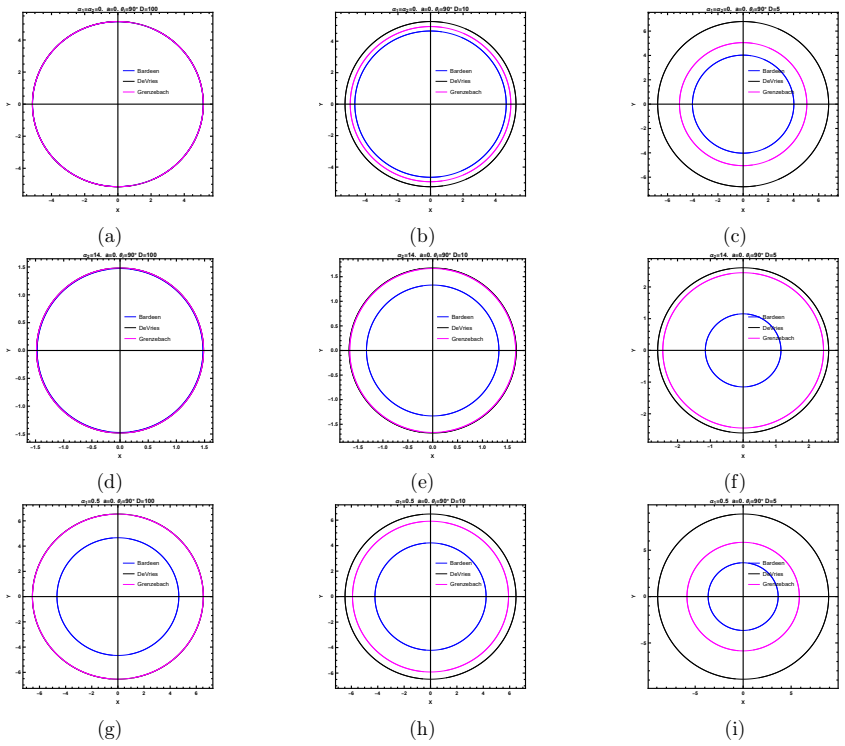
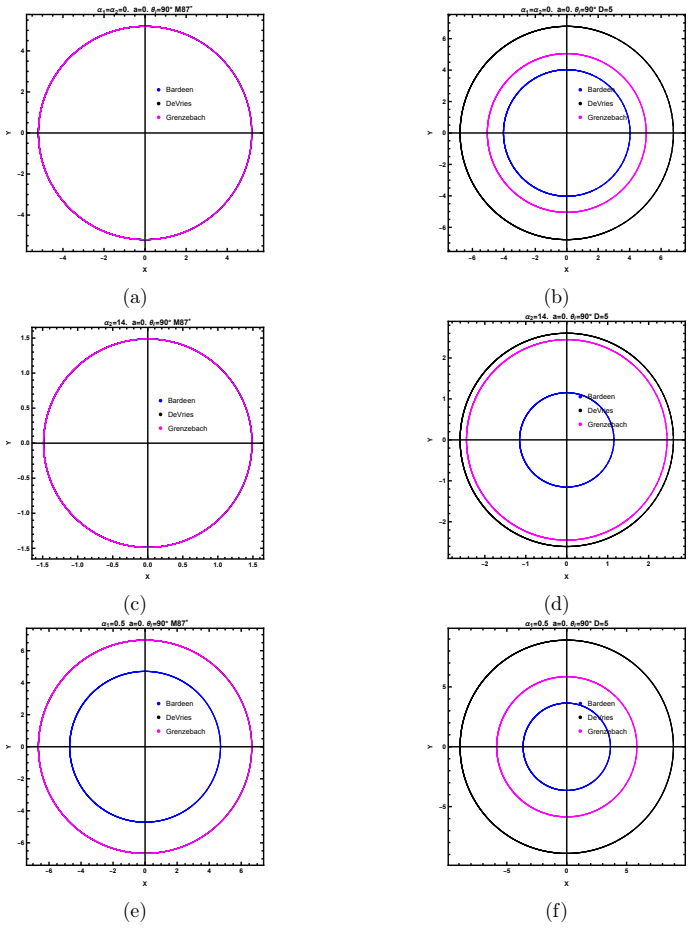
All three celestial coordinate definitions of the critical curve agree for black holes in vacuum or surrounded by inhomogeneous plasma when viewed from large distances. They diverge for observers at finite distance, where Bardeen's definition yields the smallest curve and de Vries's the largest. When homogeneous plasma is present, Bardeen's definition deviates from the other two even at large distances and the curve contracts compared with the vacuum case as plasma density increases, in contradiction with de Vries's and Grenzebach et al.'s definitions and with prior lensing studies. De Vries's definition is derived by assuming the critical curve lies on the observer's sky plane, which also
What carries the argument
Celestial coordinate definitions of the critical curve (Bardeen's, de Vries's, and Grenzebach et al.'s) that map unstable photon orbits onto the observer's sky plane.
If this is right
- Bardeen's critical curve is the smallest of the three for any finite-distance observer.
- In homogeneous plasma Bardeen's curve contracts with rising density even when the observer is far away.
- De Vries's and Grenzebach et al.'s definitions remain consistent with each other and with gravitational lensing results.
- Changing from the Bardeen tetrad to the Carter tetrad shifts the plotted critical curve horizontally but does not alter its size for Schwarzschild or Kerr black holes in plasma.
Where Pith is reading between the lines
- Observers using different definitions will infer different black-hole parameters when fitting shadow data from finite-distance or plasma-filled regions.
- The contradiction with prior lensing studies suggests that one family of definitions may be unsuitable for homogeneous plasma.
- Explicit choice of coordinate definition will be required in future shadow modeling codes to avoid systematic offsets.
Load-bearing premise
The plasma is perfectly homogeneous and the chosen observer distance plus tetrad introduce no additional effects that would make the three definitions agree.
What would settle it
A ray-tracing calculation of photon orbits around a Kerr black hole in uniform-density plasma, performed for a distant observer, that measures whether the critical curve size grows, shrinks, or stays the same relative to the vacuum case.
Figures



read the original abstract
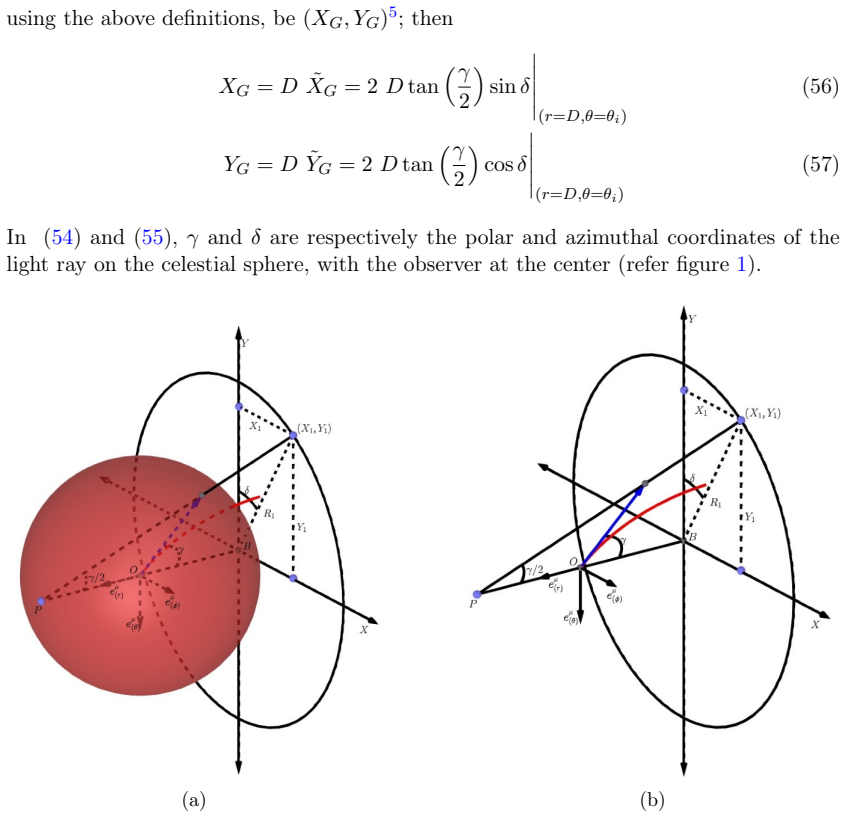
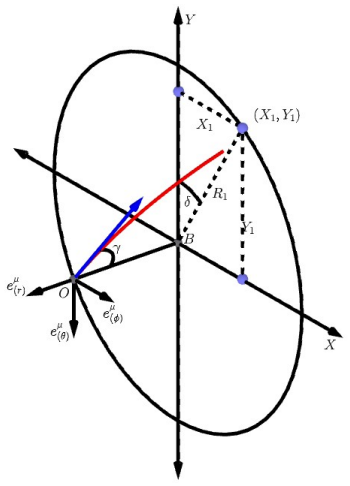
This study systematically compares Bardeen's, de Vries's, and Grenzebach et al.'s celestial coordinate definitions of the critical curve ("shadow") of Kerr-like black holes. We find that all three definitions agree for black holes in vacuum or surrounded by inhomogeneous plasma observed from large distances. However, they diverge for observers located at a finite distance: Bardeen's definition yields the smallest critical curve, while de Vries's yields the largest. When homogeneous plasma is considered, critical curve computed using Bardeen's definition deviates from the other two even at large distances and contracts compared to the vacuum case with increasing plasma density. This is in clear contradiction with the behaviour predicted by de Vries's, Grenzebach et al.'s definitions, and previous gravitational lensing studies. We derive de Vries's definition assuming a critical curve on the observer's sky plane and explain its discrepancy with Grenzebach et al.'s definition. We further explore the effect of the change of tetrad on the critical curve. Using Bardeen and Carter tetrads, we plot the critical curve for Schwarzschild and Kerr black holes in the presence of plasma, highlighting that tetrad changes introduce only a horizontal shift in the critical curve.
Editorial analysis
A structured set of objections, weighed in public.
Referee Report
Summary. The paper systematically compares Bardeen's, de Vries's, and Grenzebach et al.'s celestial coordinate definitions of the critical curve (shadow) for Kerr-like black holes. It reports agreement among the definitions in vacuum and for inhomogeneous plasma when observed from large distances, but discrepancies at finite observer distances (Bardeen smallest, de Vries largest). For homogeneous plasma, Bardeen's definition deviates even at large distances, with the curve contracting as plasma density increases; this contradicts the other two definitions and prior gravitational lensing results. The paper derives de Vries's definition from a sky-plane assumption, explains its difference from Grenzebach et al., and shows that tetrad changes (Bardeen vs. Carter) produce only a horizontal shift in plots for Schwarzschild and Kerr cases with plasma.
Significance. If the reported discrepancies and the homogeneous-plasma contraction hold after addressing the asymptotic limit, the work is significant for clarifying definitional choices in black-hole shadow calculations in plasma, directly relevant to EHT data interpretation. The systematic side-by-side comparison, explicit derivations, and concrete plots for Schwarzschild/Kerr cases constitute a useful methodological contribution that can prevent inconsistent results in future studies.
major comments (1)
- [homogeneous plasma discussion] The central claim that Bardeen's definition deviates from de Vries and Grenzebach even at large distances for homogeneous plasma (and contracts with increasing density) is load-bearing for the paper's main result. However, the computations appear to be performed at finite (though large) r_obs; because homogeneous plasma extends to infinity, an explicit analytic or numerical demonstration of the r_obs → ∞ limit is required to rule out a residual finite-distance effect. Without this, the reported contradiction with prior lensing studies may not be intrinsic to the definitions.
minor comments (3)
- [Abstract] The abstract states that the definitions 'agree for black holes in vacuum or surrounded by inhomogeneous plasma observed from large distances' but does not specify the numerical value or criterion used for 'large distances'; adding this would improve reproducibility.
- [derivation section] The derivation of de Vries's definition (assuming a critical curve on the observer's sky plane) is presented clearly, but a short side-by-side comparison table of the three coordinate expressions would help readers see the exact algebraic origin of the discrepancy with Grenzebach et al.
- [tetrad exploration] The statement that tetrad changes introduce 'only a horizontal shift' is useful; confirming this holds for all plotted cases (including the homogeneous-plasma Kerr example) would strengthen the claim.
Simulated Author's Rebuttal
We thank the referee for their detailed and constructive review. The concern regarding the need for an explicit r_obs → ∞ demonstration in the homogeneous plasma case is well taken, and we address it below while committing to a revision that strengthens this aspect of the manuscript.
read point-by-point responses
-
Referee: The central claim that Bardeen's definition deviates from de Vries and Grenzebach even at large distances for homogeneous plasma (and contracts with increasing density) is load-bearing for the paper's main result. However, the computations appear to be performed at finite (though large) r_obs; because homogeneous plasma extends to infinity, an explicit analytic or numerical demonstration of the r_obs → ∞ limit is required to rule out a residual finite-distance effect. Without this, the reported contradiction with prior lensing studies may not be intrinsic to the definitions.
Authors: We agree that an explicit demonstration of the asymptotic limit is required to confirm the discrepancy is intrinsic to the definitions rather than a finite-distance artifact. In the revised manuscript we will add numerical results computed at substantially larger observer radii (r_obs up to 10^5 M and beyond) to show convergence of the reported trends. We will also include a short analytic argument for the r_obs → ∞ limit, derived from the asymptotic form of the null geodesic equations in uniform plasma, demonstrating that Bardeen's celestial coordinates continue to produce a contracted curve while de Vries and Grenzebach definitions remain consistent with the vacuum case. This addition will directly address the potential inconsistency with prior lensing studies and reinforce the central claim. revision: yes
Circularity Check
No significant circularity; comparisons rest on independent literature definitions and explicit derivations
full rationale
The paper systematically compares three pre-existing celestial coordinate definitions (Bardeen, de Vries, Grenzebach et al.) drawn from the literature, derives de Vries's version from the assumption of a critical curve on the observer sky plane, and numerically explores tetrad dependence via explicit plots for Schwarzschild and Kerr cases in plasma. No equations reduce a claimed result to a fitted parameter or self-referential input by construction; no load-bearing self-citations are invoked to justify uniqueness or ansatzes; all reported discrepancies follow directly from the stated definitions and coordinate choices without circular reduction. The homogeneous-plasma deviation at large but finite distance is a computed outcome, not a definitional tautology.
Axiom & Free-Parameter Ledger
axioms (1)
- domain assumption Standard general relativity framework for null geodesics in Kerr-like spacetimes with refractive plasma
Reference graph
Works this paper leans on
-
[1]
Testing General Relativity with Present and Future Astrophysical Observations
E. Bertiet al., “Testing General Relativity with Present and Future Astrophysical Observations,”Class. Quant. Grav.32(2015) 243001,arXiv:1501.07274 [gr-qc]
work page internal anchor Pith review arXiv 2015
-
[2]
The Confrontation between General Relativity and Experiment
C. M. Will, “The Confrontation between General Relativity and Experiment,” Living Rev. Rel.17(2014) 4,arXiv:1403.7377 [gr-qc]
work page internal anchor Pith review arXiv 2014
-
[3]
Cosmological Tests of Gravity,
P. G. Ferreira, “Cosmological Tests of Gravity,”Ann. Rev. Astron. Astrophys.57 (2019) 335–374,arXiv:1902.10503 [astro-ph.CO]. [21]Event Horizon T elescopeCollaboration, K. Akiyamaet al., “First Sagittarius A* Event Horizon Telescope Results. VI. Testing the Black Hole Metric,” Astrophys. J. Lett.930no. 2, (2022) L17
-
[4]
Relativ.11 [arXiv:0806.1531] URL http://www.livingreviews
D. Psaltis, “Probes and Tests of Strong-Field Gravity with Observations in the Electromagnetic Spectrum,”Living Rev. Rel.11(2008) 9,arXiv:0806.1531 [astro-ph]. [23]Event Horizon T elescopeCollaboration, P. Kocherlakotaet al., “Constraints on black-hole charges with the 2017 EHT observations of M87*,”Phys. Rev. D103 no. 10, (2021) 104047,arXiv:2105.09343 [gr-qc]
-
[5]
Investigating rotating black holes in bumblebee gravity: insights from EHT observations,
S. U. Islam, S. G. Ghosh, and S. D. Maharaj, “Investigating rotating black holes in bumblebee gravity: insights from EHT observations,”JCAP12(2024) 047, arXiv:2410.05395 [gr-qc]. 32
-
[6]
Imprints of Einstein-Maxwell-dilaton-axion gravity in the observed shadows of Sgr A* and M87*,
S. K. Sahoo, N. Yadav, and I. Banerjee, “Imprints of Einstein-Maxwell-dilaton-axion gravity in the observed shadows of Sgr A* and M87*,”Phys. Rev. D109no. 4, (2024) 044008,arXiv:2305.14870 [gr-qc]
-
[7]
S. Kumar Sahoo and I. Banerjee, “Deciphering signatures of Kerr-Sen black holes in presence of plasma from the Event Horizon Telescope data,”JCAP10(2025) 100,arXiv:2504.09443 [gr-qc]
-
[8]
S. Kumar Sahoo and I. Banerjee, “Investigating the interplay of the braneworld gravity and the plasma environment on the black hole shadow,” arXiv:2512.06051 [gr-qc]
work page internal anchor Pith review arXiv
-
[9]
Testing metric-affine gravity using particle dynamics and photon motion,
A. Ditta, X. Tiecheng, S. Mumtaz, F. Atamurotov, G. Mustafa, and A. Abdujabbarov, “Testing metric-affine gravity using particle dynamics and photon motion,”Phys. Dark Univ.41(2023) 101248,arXiv:2303.05438 [gr-qc]
- [10]
-
[11]
Hunting extra dimensions in the shadow of Sgr A*,
I. Banerjee, S. Chakraborty, and S. SenGupta, “Hunting extra dimensions in the shadow of Sgr A*,”Phys. Rev. D106no. 8, (2022) 084051,arXiv:2207.09003 [gr-qc]
-
[12]
S. Vagnozziet al., “Horizon-scale tests of gravity theories and fundamental physics from the Event Horizon Telescope image of Sagittarius A,”Class. Quant. Grav.40 no. 16, (2023) 165007,arXiv:2205.07787 [gr-qc]
-
[13]
S. E. Gralla, D. E. Holz, and R. M. Wald, “Black Hole Shadows, Photon Rings, and Lensing Rings,”Phys. Rev. D100no. 2, (2019) 024018,arXiv:1906.00873 [astro-ph.HE]
- [14]
-
[15]
Black holes: A General introduction,
J.-P. Luminet, “Black holes: A General introduction,”Lect. Notes Phys.514 (1998) 3–34,arXiv:astro-ph/9801252
-
[16]
Universal Interferometric Signatures of a Black Hole’s Photon Ring,
M. D. Johnsonet al., “Universal interferometric signatures of a black hole’s photon ring,”Sci. Adv.6no. 12, (2020) eaaz1310,arXiv:1907.04329 [astro-ph.IM]
-
[17]
V. Perlick, O. Y. Tsupko, and G. S. Bisnovatyi-Kogan, “Influence of a plasma on the shadow of a spherically symmetric black hole,”Phys. Rev. D92no. 10, (2015) 104031,arXiv:1507.04217 [gr-qc]
-
[18]
On the Observable Shape of Black Hole Photon Rings,
S. E. Gralla and A. Lupsasca, “Observable shape of black hole photon rings,”Phys. Rev. D102no. 12, (2020) 124003,arXiv:2007.10336 [gr-qc]. 33
-
[19]
V. Perlick and O. Y. Tsupko, “Calculating black hole shadows: Review of analytical studies,”Phys. Rept.947(2022) 1–39,arXiv:2105.07101 [gr-qc]
-
[20]
Spherical Photon Orbits Around a Kerr Black Hole,
E. Teo, “Spherical Photon Orbits Around a Kerr Black Hole,”Gen. Rel. Grav.35 no. 11, (2003) 1909–1926
2003
-
[21]
Gravitational lensing from a spacetime perspective,
V. Perlick, “Gravitational lensing from a spacetime perspective,”Living Rev. Rel. 7(2004) 9.10.12942/lrr-2004-9
-
[22]
The Escape of Photons from Gravitationally Intense Stars,
J. L. Synge, “The Escape of Photons from Gravitationally Intense Stars,”Mon. Not. Roy. Astron. Soc.131no. 3, (1966) 463–466
1966
-
[23]
Relativistic astrophysics. ii,
Y. B. Zel’dovich and I. D. Novikov, “Relativistic astrophysics. ii,”Phys. Usp.8 no. 4, (1966) 522–577.https://ufn.ru/en/articles/1966/4/c/
1966
-
[24]
Timelike and null geodesics in the Kerr metric.,
J. M. Bardeen, “Timelike and null geodesics in the Kerr metric.,” inBlack Holes (Les Astres Occlus), C. Dewitt and B. S. Dewitt, eds., pp. 215–239. Jan., 1973
1973
-
[25]
2003.The computation factory: de Prony’s project for making tables in the 1790s
S. Chandrasekhar,The Mathematical Theory of Black Holes. Oxford University Press, 09, 1998.https://doi.org/10.1093/oso/9780198503705.001.0001
-
[26]
Black hole shadows of charged spinning black holes,
R. Takahashi, “Black hole shadows of charged spinning black holes,”Publ. Astron. Soc. Jap.57(2005) 273,arXiv:astro-ph/0505316
-
[27]
Photon Rings around Kerr and Kerr-like Black Holes,
T. Johannsen, “Photon Rings around Kerr and Kerr-like Black Holes,”Astrophys. J.777(2013) 170,arXiv:1501.02814 [astro-ph.HE]
-
[28]
The apparent shape of a rotating charged black hole, closed photon orbits and the bifurcation set A4,
A. de Vries, “The apparent shape of a rotating charged black hole, closed photon orbits and the bifurcation set A4,”Classical and Quantum Gravity17no. 1, (Jan.,
-
[29]
Strong field gravitational lensing by a Kerr black hole,
S. E. Vazquez and E. P. Esteban, “Strong field gravitational lensing by a Kerr black hole,”Nuovo Cim. B119(2004) 489–519,arXiv:gr-qc/0308023
-
[30]
A. Grenzebach, V. Perlick, and C. Lämmerzahl, “Photon Regions and Shadows of Kerr-Newman-NUT Black Holes with a Cosmological Constant,”Phys. Rev. D89 no. 12, (2014) 124004,arXiv:1403.5234 [gr-qc]
-
[31]
Grenzebach,The Shadow of Black Holes: An Analytic Description
A. Grenzebach,The Shadow of Black Holes: An Analytic Description. SpringerBriefs in Physics. Springer, Cham, 2016
2016
-
[32]
V. Perlick and O. Y. Tsupko, “Light propagation in a plasma on Kerr spacetime: Separation of the Hamilton-Jacobi equation and calculation of the shadow,”Phys. Rev. D95no. 10, (2017) 104003,arXiv:1702.08768 [gr-qc]
-
[33]
Revisiting a rotating black hole shadow with astrometric observables,
Z. Chang and Q.-H. Zhu, “Revisiting a rotating black hole shadow with astrometric observables,”Phys. Rev. D101no. 8, (2020) 084029,arXiv:2001.05175 [gr-qc]. 34
-
[34]
Does the shape of the shadow of a black hole depend on motional status of an observer?,
Z. Chang and Q.-H. Zhu, “Does the shape of the shadow of a black hole depend on motional status of an observer?,”Phys. Rev. D102no. 4, (2020) 044012, arXiv:2006.00685 [gr-qc]
-
[35]
Global structure of the Kerr family of gravitational fields,
B. Carter, “Global structure of the Kerr family of gravitational fields,”Phys. Rev. 174(1968) 1559–1571
1968
-
[36]
Stationary frames in the Kerr field,
O. Semerák, “Stationary frames in the Kerr field,”General Relativity and Gravitation25no. 10, (Oct., 1993) 1041–1077
1993
-
[37]
B. Bezdekova, V. Perlick, and J. Bicak, “Light propagation in a plasma on an axially symmetric and stationary spacetime: Separability of the Hamilton–Jacobi equation and shadow,”J. Math. Phys.63no. 9, (2022) 092501,arXiv:2204.05593 [gr-qc]
-
[38]
Generating rotating regular black hole solutions without complexification
M. Azreg-Aïnou, “Generating rotating regular black hole solutions without complexification,”Phys. Rev. D90no. 6, (2014) 064041,arXiv:1405.2569 [gr-qc]
work page Pith review arXiv 2014
-
[39]
Maximal analytic extension of the Kerr metric,
R. H. Boyer and R. W. Lindquist, “Maximal analytic extension of the Kerr metric,”J. Math. Phys.8(1967) 265
1967
-
[40]
Propagation of high-frequency electromagnetic waves through a magnetized plasma in curved space-time. i,
R. A. Breuer and J. Ehlers, “Propagation of high-frequency electromagnetic waves through a magnetized plasma in curved space-time. i,”Proceedings of the Royal Society of London. A. Mathematical and Physical Sciences370no. 1742, (1980) 389–406
1980
-
[41]
Propagation of high-frequency electromagnetic waves through a magnetized plasma in curved space-time. ii. application of the asymptotic approximation,
R. A. Breuer and J. Ehlers, “Propagation of high-frequency electromagnetic waves through a magnetized plasma in curved space-time. ii. application of the asymptotic approximation,”Proceedings of the Royal Society of London. A. Mathematical and Physical Sciences374no. 1756, (1981) 65–86
1981
-
[42]
Propagation of High-Frequency Electromagnetic Waves Through a Magnetized Plasma in Curved Space-Time. I,
R. A. Breuer and J. Ehlers, “Propagation of High-Frequency Electromagnetic Waves Through a Magnetized Plasma in Curved Space-Time. I,”Proceedings of the Royal Society of London Series A370no. 1742, (Mar., 1980) 389–406
1980
-
[43]
Rotating black holes: Locally nonrotating frames, energy extraction, and scalar synchrotron radiation,
J. M. Bardeen, W. H. Press, and S. A. Teukolsky, “Rotating black holes: Locally nonrotating frames, energy extraction, and scalar synchrotron radiation,” Astrophys. J.178(1972) 347
1972
-
[44]
Slice-reducible conformal Killing tensors, photon surfaces, and shadows,
K. Kobialko, I. Bogush, and D. Gal’tsov, “Slice-reducible conformal Killing tensors, photon surfaces, and shadows,”Phys. Rev. D106no. 2, (2022) 024006, arXiv:2202.09126 [gr-qc]
-
[45]
Black hole shadows of massive particles and photons in plasma,
K. Kobialko, I. Bogush, and D. Gal’tsov, “Black hole shadows of massive particles and photons in plasma,”Phys. Rev. D109no. 2, (2024) 024060, arXiv:2312.07498 [gr-qc]. 35
-
[46]
Shadow analysis for rotating black holes in the presence of plasma for an expanding universe,
A. Chowdhuri and A. Bhattacharyya, “Shadow analysis for rotating black holes in the presence of plasma for an expanding universe,”Phys. Rev. D104no. 6, (2021) 064039,arXiv:2012.12914 [gr-qc]
-
[47]
Shadows and strong gravitational lensing by Van der Waals black hole in homogeneous plasma,
N. U. Molla and U. Debnath, “Shadows and strong gravitational lensing by Van der Waals black hole in homogeneous plasma,”Annals Phys.453(2023) 169304, arXiv:2212.02104 [gr-qc]
- [48]
-
[49]
Gravitational lensing in plasma: Relativistic images at homogeneous plasma,
O. Y. Tsupko and G. S. Bisnovatyi-Kogan, “Gravitational lensing in plasma: Relativistic images at homogeneous plasma,”Phys. Rev. D87no. 12, (2013) 124009,arXiv:1305.7032 [astro-ph.CO]
-
[50]
Gravitational lensing in a non-uniform plasma,
G. S. Bisnovatyi-Kogan and O. Y. Tsupko, “Gravitational lensing in a non-uniform plasma,”Mon. Not. Roy. Astron. Soc.404(2010) 1790–1800,arXiv:1006.2321 [astro-ph.CO]
-
[51]
Accretion onto black holes: The emergent radiation spectrum. iii. rotating (kerr) black holes,
S. L. Shapiro, “Accretion onto black holes: The emergent radiation spectrum. iii. rotating (kerr) black holes,”Astrophysical Journal, Vol. 189, pp. 343-352 (1974) 189(1974) 343–352
1974
-
[52]
K. Hioki and U. Miyamoto, “Determining parameters of Kerr-Newman black holes by shadow observation from finite distance and spatial infinity,”Classical and Quantum Gravity42no. 12, (June, 2025) 125009,arXiv:2411.08486 [gr-qc]
-
[53]
Black hole electrodynamics and the Carter tetrad.,
R. L. Znajek, “Black hole electrodynamics and the Carter tetrad.,” MNRAS179 (May, 1977) 457–472. 36
1977
discussion (0)
Sign in with ORCID, Apple, or X to comment. Anyone can read and Pith papers without signing in.