Recognition: unknown
Statistical analysis of solar energetic particle rise times using Earth and Mars observations and constraints on particle transport parameters
Pith reviewed 2026-05-10 15:00 UTC · model grok-4.3
The pith
SEP rise times follow a power law with energy that flattens at greater distances from the Sun
A machine-rendered reading of the paper's core claim, the machinery that carries it, and where it could break.
Core claim
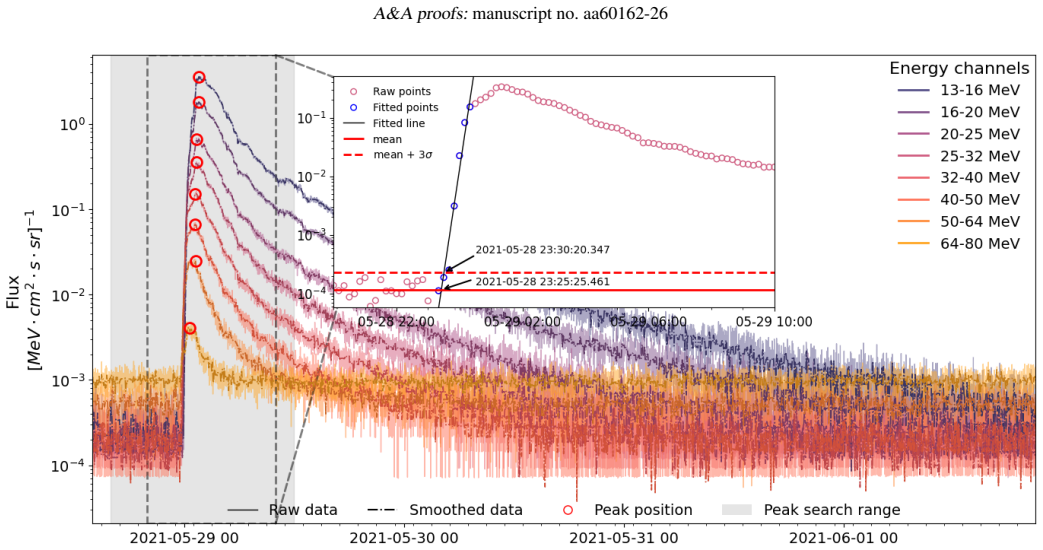
By determining onset times through linear fits and peak times through sliding-median and Savitzky-Golay smoothing across 75 events at 1 AU and 58 events near Mars, the analysis shows that SEP rise time scales with energy as a power law. The exponent of this scaling is smaller at Mars than at Earth. Matching the observed exponents to the analytic solution of the parallel diffusion equation yields a parallel mean free path whose rigidity dependence weakens and approaches independence with increasing distance from the Sun.
What carries the argument
The rigidity dependence of the parallel mean free path in the pure parallel diffusion model, which is constrained by matching the observed energy scaling of rise times to the model's predicted scaling.
If this is right
- The energy dependence of SEP rise times becomes weaker with increasing heliocentric distance.
- Turbulence scattering effects approach a rigidity-independent regime near Mars orbit.
- Statistical rise-time relations provide a route to constrain mean-free-path parameters that does not require absolute flux intensities.
- Transport models must incorporate radial evolution of turbulence properties between Earth and Mars distances.
Where Pith is reading between the lines
- Forecast models for SEP arrival at Mars could adopt simpler, nearly energy-independent scattering parameters for paths longer than 1 AU.
- Repeating the rise-time analysis with data from additional spacecraft at intermediate or larger distances would map the radial change in turbulence dissipation.
- The same statistical method could be tested on other particle populations to check whether rigidity independence emerges in different transport regimes.
Load-bearing premise
The difference between linearly fitted onset times and smoothed peak times isolates the interplanetary transport delay without substantial contamination from variable particle release times at the Sun or from background fluctuations.
What would settle it
New SEP events observed at both Earth and Mars in which the power-law index of rise time versus energy is the same or steeper at Mars than at Earth would falsify the reported flattening and the inference of approaching rigidity independence.
Figures


read the original abstract
The propagation of solar energetic particles (SEPs) in interplanetary space is modulated by solar wind turbulence, which significantly influences particle diffusion and energy evolution through scattering processes. Traditional analyses based on absolute flux measurements face inherent difficulties in disentangling source acceleration from subsequent transport, while temporal features such as onset and peak times are less affected and better suited for studying SEP transport. This study establishes a statistical relationship between the rise time of SEP events at different energies using multi-satellite observations at Earth and Mars. We use data from SOHO/ERNE and Tianwen-1/MEPA between November 2020 and March 2025, selecting 75 SEP events at 1 AU and 58 near Mars. For each energy range, onset times are determined by linear fitting, and peak times are extracted via a sliding median filter combined with Savitzky-Golay smoothing; the difference gives the SEP rise time. Comparing with the pure diffusion equation prediction, we examine the statistical behavior of rise time at Earth and Mars. Despite event selection uncertainties, SEP rise time follows a clear power-law relation with energy. The flatter power-law at Mars indicates weaker energy dependence with increasing solar distance. Using these empirical relations, we constrain the rigidity dependence of the parallel mean free path within the parallel diffusion model. Our results show that turbulence scattering at Mars approaches a rigidity-independent regime, reflecting turbulence evolution toward a dissipation-dominated state from Earth to Mars.
Editorial analysis
A structured set of objections, weighed in public.
Referee Report
Summary. The paper analyzes 75 SEP events at 1 AU (SOHO/ERNE) and 58 near Mars (Tianwen-1/MEPA) from Nov 2020–Mar 2025. Onset times are obtained by linear fitting and peak times by sliding-median plus Savitzky-Golay smoothing; the resulting rise times are shown to follow power-law relations with energy. These empirical indices are inserted into the parallel diffusion model to constrain the rigidity dependence of the parallel mean free path λ_||, with the conclusion that scattering approaches a rigidity-independent regime at Mars.
Significance. If the extracted rise times faithfully isolate transport delays, the multi-point power-law indices supply direct empirical constraints on the energy dependence of interplanetary scattering and on the radial evolution of solar-wind turbulence. Such constraints are useful for SEP propagation models and space-weather applications. The statistical sample size and direct comparison to the diffusion-equation prediction are positive features.
major comments (2)
- [rise-time determination and model comparison (abstract and data-analysis section)] The onset and peak extraction procedure (linear fit for onset, sliding-median/Savitzky-Golay for peak) is used without a quantified sensitivity study to energy-dependent source injection profiles, background fluctuations, or instrument-response differences between SOHO/ERNE and Tianwen-1/MEPA. Because the measured rise times are fed directly into the power-law fit and then into the diffusion-model inversion for the exponent α in λ_|| ∝ R^α, any systematic bias that varies with energy or heliocentric distance will propagate into the reported Earth–Mars difference and the claim of rigidity-independent scattering at Mars.
- [event selection and diffusion-model comparison] The abstract acknowledges 'event selection uncertainties,' yet the manuscript does not demonstrate that the chosen 75/58 events and the pure-diffusion assumption remain robust when plausible finite-duration injection profiles or background contamination are included. This assumption is load-bearing for the final inference that turbulence at Mars 'approaches a rigidity-independent regime.'
minor comments (1)
- [data and instrumentation] Clarify whether the same energy-channel boundaries and instrument geometric factors are used at both locations so that the reported flattening of the power-law index can be unambiguously attributed to radial evolution rather than instrumental effects.
Simulated Author's Rebuttal
We thank the referee for the detailed and constructive report. The two major comments highlight important aspects of methodological robustness that we will address through targeted revisions. Our responses below explain how the existing analysis supports the conclusions while outlining the additions we will make to strengthen the manuscript.
read point-by-point responses
-
Referee: [rise-time determination and model comparison (abstract and data-analysis section)] The onset and peak extraction procedure (linear fit for onset, sliding-median/Savitzky-Golay for peak) is used without a quantified sensitivity study to energy-dependent source injection profiles, background fluctuations, or instrument-response differences between SOHO/ERNE and Tianwen-1/MEPA. Because the measured rise times are fed directly into the power-law fit and then into the diffusion-model inversion for the exponent α in λ_|| ∝ R^α, any systematic bias that varies with energy or heliocentric distance will propagate into the reported Earth–Mars difference and the claim of rigidity-independent scattering at Mars.
Authors: We agree that a formal sensitivity study would provide stronger validation. In the revised manuscript we will add a dedicated subsection (and appendix) that quantifies the effects of (i) varying background fluctuation levels, (ii) changes in Savitzky-Golay window length and polynomial order, and (iii) simulated energy-dependent source injection profiles (both instantaneous and finite-duration). We will re-derive the power-law indices under these perturbations and demonstrate that the Earth–Mars difference in the exponent remains statistically significant. For instrument-response differences we will include a short comparison of the ERNE and MEPA proton channels and note that the selected energy bins overlap sufficiently; any residual calibration offset is energy-independent to first order and therefore does not alter the power-law slope. These tests will be performed on both the real data and on synthetic SEP time series generated from the diffusion equation. revision: yes
-
Referee: [event selection and diffusion-model comparison] The abstract acknowledges 'event selection uncertainties,' yet the manuscript does not demonstrate that the chosen 75/58 events and the pure-diffusion assumption remain robust when plausible finite-duration injection profiles or background contamination are included. This assumption is load-bearing for the final inference that turbulence at Mars 'approaches a rigidity-independent regime.'
Authors: The pure-diffusion model is used as an analytic baseline whose predicted rise-time energy dependence can be directly compared with observations; we do not claim it is the only valid description. To address the referee’s concern we will expand the discussion and add numerical experiments: (1) solutions of the time-dependent diffusion equation with finite-duration solar injections (Gaussian and power-law profiles of 10–60 min duration) to show that the resulting rise-time power-law index changes by less than 0.1 for the observed event durations; (2) a Monte-Carlo resampling of the event list in which background contamination thresholds are varied by ±20 % and events are randomly dropped or added within the stated selection uncertainties. The revised text will report that the flattening of the power-law index between Earth and Mars, and the consequent inference that λ_|| approaches rigidity independence at larger heliocentric distance, remains within the 1-σ uncertainties of these tests. We will also update the abstract to reflect the added robustness checks. revision: yes
Circularity Check
No significant circularity in the derivation chain
full rationale
The paper extracts onset and peak times from multi-spacecraft SEP flux data via linear fitting and Savitzky-Golay smoothing, computes rise times, fits empirical power-law indices to the energy dependence of those rise times, and then matches the observed indices against the analytic scaling predicted by the parallel diffusion equation for different values of the rigidity exponent α in λ_|| ∝ R^α. This is a conventional two-step data-to-model inference procedure. No step defines a quantity in terms of itself, renames a fit as an independent prediction, or reduces the central claim to a self-citation chain or imported ansatz; the diffusion-model comparison rests on stated assumptions that are external to the fitted indices.
Axiom & Free-Parameter Ledger
free parameters (2)
- power-law index of rise time vs energy at Earth
- power-law index of rise time vs energy at Mars
axioms (1)
- domain assumption Rise time is governed by the parallel diffusion equation with scattering mean free path as the dominant transport parameter.
Reference graph
Works this paper leans on
-
[1]
W., Matthaeus, W
Bieber, J. W., Matthaeus, W. H., Smith, C. W., et al. 1994, ApJ, 420, 294
1994
-
[2]
& Eichler, D
Blandford, R. & Eichler, D. 1987, Phys. Rep., 154, 1
1987
-
[3]
& Carbone, V
Bruno, R. & Carbone, V . 2013, Living Rev. Sol. Phys., 10, 2
2013
-
[4]
& Trenchi, L
Bruno, R. & Trenchi, L. 2014, ApJL, 787, L24
2014
-
[5]
2025, A&A, 695, A25
Cao, Y ., Wang, Y ., & Guo, J. 2025, A&A, 695, A25
2025
-
[6]
2014, GeoRL., 41, 8081
Chen, C., Leung, L., Boldyrev, S., Maruca, B., & Bale, S. 2014, GeoRL., 41, 8081
2014
-
[7]
Chen, X., Giacalone, J., Guo, F., & Klein, K. G. 2024, ApJ, 965, 61
2024
-
[8]
2025, ApJ, 994, 242
Chen, X., Zhao, L., Giacalone, J., et al. 2025, ApJ, 994, 242
2025
-
[9]
& Wang, Y
Cheng, L. & Wang, Y . 2022, ApJ, 941, 37
2022
-
[10]
2021, ApJ, 915, 8
Chiappetta, F., Laurenza, M., Lepreti, F., & Consolini, G. 2021, ApJ, 915, 8
2021
-
[11]
Conlon, T. F. 1978, JGR. Space Phys., 83, 541
1978
-
[12]
& Giacalone, J
Desai, M. & Giacalone, J. 2016, Living Rev. Sol. Phys., 13, 3
2016
-
[13]
Domingo, V ., Fleck, B., & Poland, A. I. 1995, SoPh., 162, 1 Dröge, W. 1994, in IAU Colloq. 142: Solar Cosmic Rays, V ol. 142, 567–576 Dröge, W. 2000, ApJ, 537, 1073 Dröge, W., Kartavykh, Y ., Klecker, B., & Kovaltsov, G. 2010, ApJ, 709, 912
1995
-
[14]
Drury, L. O. 1983, Rep. Prog. Phys., 46, 973
1983
-
[15]
A., Chen, C
Duan, D., Bowen, T. A., Chen, C. H., et al. 2020, ApJS, 246, 55
2020
-
[16]
2018, ApJ, 865, 89
Duan, D., He, J., Pei, Z., et al. 2018, ApJ, 865, 89
2018
-
[17]
2025, Adv
Farwa, G., Dresing, N., Vuorinen, L., et al. 2025, Adv. Space Res
2025
-
[18]
& Jokipii, J
Giacalone, J. & Jokipii, J. 1999, ApJ, 520, 204
1999
-
[19]
2024, Adv
Guo, J., Wang, B., Whitman, K., et al. 2024, Adv. Space Res
2024
-
[20]
1992, ApJ, 391, 359
Heras, A., Sanahuja, B., Smith, Z., Detman, T., & Dryer, M. 1992, ApJ, 391, 359
1992
-
[21]
M., Sanahuja, B., Lario, D., et al
Heras, A. M., Sanahuja, B., Lario, D., et al. 1995, ApJ, 445, 497
1995
-
[22]
S., Forman, M., & Oughton, S
Horbury, T. S., Forman, M., & Oughton, S. 2008, Phys. Rev. Lett., 101, 175005
2008
-
[23]
P., & Verkhoglyadova, O
Hu, J., Li, G., Ao, X., Zank, G. P., & Verkhoglyadova, O. 2017, JGR. Space Phys., 122, 10
2017
-
[24]
& Shalchi, A
Hussein, M. & Shalchi, A. 2014, ApJ, 785, 31
2014
-
[25]
2005, A&A, 442, 673
Huttunen-Heikinmaa, K., Valtonen, E., & Laitinen, T. 2005, A&A, 442, 673
2005
-
[26]
1964, Soviet Astronomy, V ol
Iroshnikov, P. 1964, Soviet Astronomy, V ol. 7, p. 566, 7, 566
1964
-
[27]
1971, Rev
Jokipii, J. 1971, Rev. Geophys., 9, 27
1971
-
[28]
Jokipii, J. R. 1966, APJ, 146, 480
1966
-
[29]
Kahler, S. W. & Ling, A. G. 2017, SoPh., 292, 59
2017
-
[30]
Kolmogorov, A. N. 1941, Numbers. In Dokl. Akad. Nauk SSSR, 30, 301
1941
-
[31]
Kolmogorov, A. N. 1991, Proc. R. Soc. Lond. A, 434, 9
1991
-
[32]
Kraichnan, R. H. 1965, Phys. Fluids, 8, 1385
1965
-
[33]
Krimigis, S. M. 1965, JGR., 70, 2943
1965
-
[34]
& Lin, R
Krucker, S. & Lin, R. 2000, ApJ, 542, L61
2000
-
[35]
2013, ApJ, 767, 41
Lario, D., Aran, A., Gómez-Herrero, R., et al. 2013, ApJ, 767, 41
2013
-
[36]
2016, JPhCS, 767, 012015
Laurenza, M., Consolini, G., Storini, M., Pallocchia, G., & Damiani, A. 2016, JPhCS, 767, 012015
2016
-
[37]
1995, SSRv., 71, 207
Lepping, R., Ac˜una, M., Burlaga, L., et al. 1995, SSRv., 71, 207
1995
-
[38]
2021, SSRv., 217, 26
Li, C., Tang, S., Hu, X., et al. 2021, SSRv., 217, 26
2021
-
[39]
2020, ApJL, 900, L16
Li, G., Zhao, L., Wang, L., Liu, W., & Wu, X. 2020, ApJL, 900, L16
2020
-
[40]
2025, Natl
Li, Y ., Guo, J., Pacheco, D., et al. 2025, Natl. Sci. Rev., 12, nwaf348
2025
-
[41]
2023, ApJ, 942, 93
Lotz, S., Nel, A., Wicks, R., et al. 2023, ApJ, 942, 93
2023
-
[42]
& Sorriso-Valvo, L
Marino, R. & Sorriso-Valvo, L. 2023, Phys. Rep., 1006, 1
2023
-
[43]
1956, Phys
Meyer, P., Parker, E., & Simpson, J. 1956, Phys. Rev., 104, 768
1956
-
[44]
2017, ApJ, 837, 158
Pallocchia, G., Laurenza, M., & Consolini, G. 2017, ApJ, 837, 158
2017
-
[45]
1982, Rev
Palmer, I. 1982, Rev. Geophys., 20, 335 Article number, page 9 A&A proofs:manuscript no. aa60162-26
1982
-
[46]
Parker, E. N. 1965, Planet. Space Sci., 13, 9
1965
-
[47]
& Shalchi, A
Qin, G. & Shalchi, A. 2012, Adv. Space Res., 49, 1643
2012
-
[48]
2006, JGR
Qin, G., Zhang, M., & Dwyer, J. 2006, JGR. Space Phys., 111
2006
-
[49]
Reames, D. V . 1999, SSRv., 90, 413
1999
-
[50]
& Golay, M
Savitzky, A. & Golay, M. J. 1964, Anal. Chem., 36, 1627
1964
-
[51]
Schafer, R. W. 2011, IEEE Signal processing magazine, 28, 111
2011
-
[52]
2018, Icarus, 303, 53
Semkova, J., Koleva, R., Benghin, V ., et al. 2018, Icarus, 303, 53
2018
-
[53]
2020, SSRv., 216, 23
Shalchi, A. 2020, SSRv., 216, 23
2020
-
[54]
2020, Earth and Planetary Physics, 4, 355
Tang, S., Wang, Y ., Zhao, H., et al. 2020, Earth and Planetary Physics, 4, 355
2020
-
[55]
1995, SoPh., 162, 505 Van den Berg, J., Engelbrecht, N., Wijsen, N., & Strauss, R
Torsti, J., Valtonen, E., Lumme, M., et al. 1995, SoPh., 162, 505 Van den Berg, J., Engelbrecht, N., Wijsen, N., & Strauss, R. 2021, ApJ, 922, 200
1995
-
[56]
& Guo, J
Wang, Y . & Guo, J. 2024, A&A, 691, A54
2024
-
[57]
2022, ApJ, 940, 67
Wang, Y ., Lyu, D., Wu, X., & Qin, G. 2022, ApJ, 940, 67
2022
-
[58]
& Qin, G
Wang, Y . & Qin, G. 2015, ApJ, 806, 252
2015
-
[59]
2023, Earth and Planetary Physics, 7, 216
Wang, Y ., Zhang, T., Wang, G., et al. 2023, Earth and Planetary Physics, 7, 216
2023
-
[60]
G., et al
Whitman, K., Egeland, R., Richardson, I. G., et al. 2023, Adv. Space Res., 72, 5161
2023
-
[61]
Wilks, D. S. 2011, Statistical methods in the atmospheric sciences, V ol. 100
2011
-
[62]
Xie, H., Mäkelä, P., Gopalswamy, N., & St. Cyr, O. 2016, JGR. Space Phys., 121, 6168
2016
-
[63]
2023, ApJ, 953, 105
Yu, B., Chi, Y ., Owens, M., et al. 2023, ApJ, 953, 105
2023
-
[64]
2009, ApJ, 692, 109
Zhang, M., Qin, G., & Rassoul, H. 2009, ApJ, 692, 109
2009
-
[65]
2025, ApJ, 988, 76
Zou, Z., Wang, Y ., Su, Z., et al. 2025, ApJ, 988, 76
2025
-
[66]
2023, Sci
Zou, Z., Wang, Y ., Zhang, T., et al. 2023, Sci. China Technol. Sci., 66, 2396 Article number, page 10
2023
discussion (0)
Sign in with ORCID, Apple, or X to comment. Anyone can read and Pith papers without signing in.