Recognition: 3 theorem links
· Lean TheoremA position dependent mass Hamiltonian and abstract ladder operators
Pith reviewed 2026-05-08 19:25 UTC · model grok-4.3
The pith
Abstract ladder operators find eigenvalues and eigenvectors for a position-dependent mass Hamiltonian that is factorizable, even if not self-adjoint, via pseudo-bosonic operators and attached bi-coherent states.
A machine-rendered reading of the paper's core claim, the machinery that carries it, and where it could break.
Core claim
We consider the Hamiltonian H of a particle in one dimension with a position dependent mass for which we apply the recent strategy of the so-called abstract ladder operators, in the attempt to find its eigenvalues and eigenvectors. We don't assume that H is self-adjoint, while we focus on the case of a factorizable operator. We show then that pseudo-bosonic operators play a relevant role in this analysis, and we construct bi-coherent states attached to these operators.
What carries the argument
Abstract ladder operators defined on a factorizable position-dependent-mass Hamiltonian, which produce pseudo-bosonic operators and permit construction of bi-coherent states.
If this is right
- The eigenvalues of such Hamiltonians can be found algebraically without solving a differential equation.
- The corresponding eigenvectors are obtained by applying the ladder operators to a reference state.
- Bi-coherent states exist and are explicitly constructible for the pseudo-bosonic operators that arise.
- The procedure remains valid for non-self-adjoint operators that are still factorizable.
Where Pith is reading between the lines
- The same ladder-operator technique may apply to other non-Hermitian Hamiltonians that arise in effective models with variable coefficients.
- Bi-coherent states could be used to study time evolution or resolution of the identity in position-dependent-mass systems.
- The construction suggests a route for defining coherent-state bases in any quantum system whose Hamiltonian is factorizable but not necessarily Hermitian.
Load-bearing premise
The Hamiltonian must admit a factorization that lets abstract ladder operators be defined and applied to extract the spectrum.
What would settle it
A concrete factorizable position-dependent-mass Hamiltonian whose eigenvalues or eigenvectors cannot be recovered by repeated action of the abstract ladder operators.
Figures
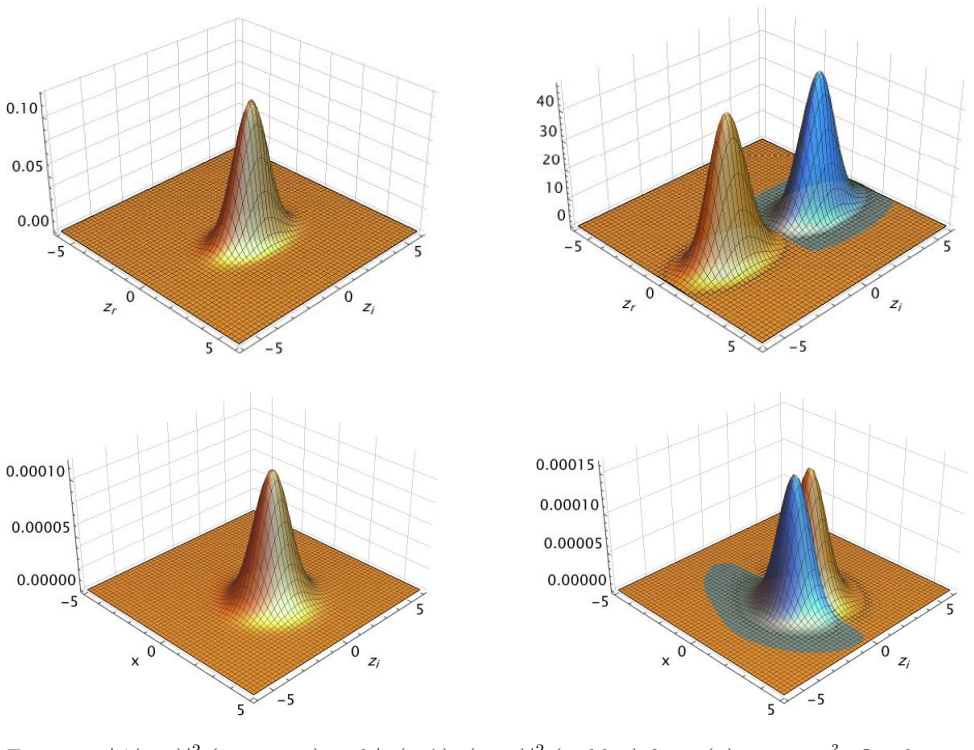


read the original abstract
We consider the Hamiltonian $H$ of a particle in one dimension with a position dependent mass for which we apply the recent strategy of the so-called {\em abstract ladder operators}, in the attempt to find its eigenvalues and eigenvectors. We don't assume that $H$ is self-adjoint, while we focus on the case of a factorizable operator. We show then that pseudo-bosonic operators play a relevant role in this analysis, and we construct bi-coherent states attached to these operators. Explicit examples are discussed.
Editorial analysis
A structured set of objections, weighed in public.
Referee Report
Summary. The manuscript considers a one-dimensional Hamiltonian with position-dependent mass that is factorizable (but not necessarily self-adjoint). It applies the abstract ladder operator technique to determine eigenvalues and eigenvectors, establishes the relevance of pseudo-bosonic operators in this setting, constructs associated bi-coherent states, and illustrates the results with explicit examples.
Significance. If the constructions are correct, the work extends abstract ladder and pseudo-boson methods to a physically relevant class of non-Hermitian position-dependent-mass operators. The explicit examples provide concrete verification and could facilitate applications in variable-mass quantum models. The approach is grounded in the factorizability assumption rather than ad-hoc fitting.
minor comments (3)
- [Abstract] The abstract states that explicit examples are discussed, but the introduction or §2 could briefly name the specific forms of the mass function m(x) and potential used in those examples to orient the reader.
- [§3] Notation for the abstract ladder operators A and A† (and their pseudo-bosonic counterparts) should be introduced with a short comparison table or explicit commutation relations to avoid confusion with standard bosonic operators.
- [§4] In the construction of bi-coherent states, the overlap or resolution-of-identity property is asserted; a one-line reference to the relevant prior result (or a short derivation) would strengthen readability.
Simulated Author's Rebuttal
We thank the referee for the positive summary of our manuscript and for recommending minor revision. The referee's description accurately reflects the scope and contributions of the work on abstract ladder operators for a factorizable position-dependent mass Hamiltonian, including the role of pseudo-bosonic operators and bi-coherent states.
Circularity Check
Minor self-citation of abstract ladder/pseudo-boson framework; central application to factorizable PDM Hamiltonian remains independent
full rationale
The paper applies the abstract ladder operator method to a position-dependent-mass Hamiltonian that is factorizable (but not necessarily self-adjoint), derives the relevance of pseudo-bosonic operators, and constructs attached bi-coherent states, with explicit examples provided. These techniques originate in prior literature that overlaps with the authors, but the load-bearing steps are the explicit factorization assumption on H and the direct construction of eigenvalues, eigenvectors, and states for the new Hamiltonian class. No step reduces by definition to a fitted parameter, self-referential renaming, or unverified self-citation chain; the result is a concrete application rather than a tautology.
Axiom & Free-Parameter Ledger
Lean theorems connected to this paper
-
IndisputableMonolith.Cost.FunctionalEquation (J(x)=½(x+x⁻¹)−1 uniqueness)washburn_uniqueness_aczel unclearH = −ℏ²/(2m(x)) d²/dx² + ℏ²m'(x)/(2m²(x)) d/dx + V(x) … [H,A]=λA … H−E₀1 = BA … [a,b]=1 1 … H = −λN + E₀1 1.
-
IndisputableMonolith.Constants (φ-ladder for ℏ, G)ladder constants c, ℏ, G as φ-powers unclearE_n = E_0 − nλ = −γ²ℏ²/2 − (n+1/2)λ
-
Foundation.RealityFromDistinction (zero-parameter forcing chain)reality_from_one_distinction uncleardifferent λ's correspond to different operators H and A … λ and γ are free complex parameters, m(x) is freely chosen (e.g. m₀e^{-x²}, m₀/(1+x²), m₀eˣ).
Reference graph
Works this paper leans on
-
[1]
C. M. Bender, S. Boettcher,Real Spectra in Non-Hermitian Hamiltonians Having PT- Symmetry, Phys. Rev. Lett.80, 5243-5246, (1998)
1998
-
[2]
Bender, A
C. Bender, A. Fring, U. G¨ uenther, H. Jones Eds,Special issue on quantum physics with non-Hermitian operators, J. Phys. A: Math. and Ther.,45(2012)
2012
-
[4]
C. M. Bender,P TSymmetry In Quantum and Classical Physics, World Scientific Pub- lishing Europe Ltd., London (2019)
2019
-
[5]
Bagarello, J
F. Bagarello, J. P. Gazeau, F. H. Szafraniec e M. Znojil Eds.,Non-selfadjoint operators in quantum physics: Mathematical aspects, John Wiley and Sons (2015)
2015
-
[6]
Bagarello, R
F. Bagarello, R. Passante, C. Trapani,Non-Hermitian Hamiltonians in Quantum Physics; Selected Contributions from the 15th International Conference on Non-Hermitian Hamil- tonians in Quantum Physics, Palermo, Italy, 18-23 May 2015, Springer (2016) 29
2015
-
[7]
Bagarello,Pseudo-Bosons and Their Coherent States, Springer, Mathematical Physics Studies, 2022
F. Bagarello,Pseudo-Bosons and Their Coherent States, Springer, Mathematical Physics Studies, 2022
2022
-
[8]
Mostafazadeh,Pseudo-hermitian quantum mechanics, Int
A. Mostafazadeh,Pseudo-hermitian quantum mechanics, Int. J. Geom. Methods Mod. Phys.,7, 1191-1306 (2010)
2010
-
[9]
von Roos,Position-dependent effective masses in semiconductor theory, Phys
O. von Roos,Position-dependent effective masses in semiconductor theory, Phys. Rev. B, 27, 7547–7552 (1983)
1983
-
[10]
Bagchi, A
B. Bagchi, A. Banerjee, C. Quesne, V. M. Tkachuk,Deformed shape invariance and exactly solvable Hamiltonians with position-dependent effective mass, J. Phys. A: Math. Gen.,38, 2929–2945 (2005)
2005
-
[11]
Cruz y Cruz, O
S. Cruz y Cruz, O. Rosas-Ortiz,Position-dependent mass oscillators and coherent states, J. Phys. A: Math. Theor.,42, 185205 (2009)
2009
-
[12]
M. I. Estrada-Delgado, Z. I. Blanco-Garcia,Oscillator Algebra in Complex Position- Dependent Mass Systems, Symmetry,17, 10, 1690 (2025)
2025
-
[13]
D. S. Takou, A. Y. Mora, I. Nonkan´ e, L. M. Lawson, G. Y. H. Avossevou,Gazeau-Klauder coherent states for a harmonic position-dependent mass, J. Comput. Electron.,24, 191 (2025)
2025
-
[14]
Quesne,Semi-infinite quantum wells in a position-dependent mass background, Quan- tum Stud.: Math
C. Quesne,Semi-infinite quantum wells in a position-dependent mass background, Quan- tum Stud.: Math. Found.10237-244, (2023)
2023
-
[15]
Mustafa, S
O. Mustafa, S. H. Mazharimousavi,Complexified von Roos Hamiltonian’sη-weak-pseudo- Hermiticity, isospectrality and exact solvability, J. Phys. A: Math. Theor.41244020 (2008)
2008
-
[16]
Mustafa, S
O. Mustafa, S. H. Mazharimousavi,First-Order Intertwining Operators with Position De- pendent Mass andη-Weak-Pseudo-Hermiticity Generators, Int J Theor Phys47, 446–454 (2008)
2008
-
[17]
Ballesteros, R
A. Ballesteros, R. Ram´ ırez, M. Reboiro,Non-standard quantum algebras and infinite- dimensional PT-symmetric systemsJ. Phys. A: Math. Theor.58, 455301 (2025)
2025
-
[18]
F. C. E. Lima, L. N. Monteiro, C. A. S. Almeida,Non-Hermitian fermions with effective mass, Physica E: Low-dimensional Systems and Nanostructures,150, 115682 (2023) 30
2023
-
[19]
Jia, A de Souza Dutra,Position-dependent effective mass Dirac equations with PT- symmetric and non-PT-symmetric potentials, J
C.-S. Jia, A de Souza Dutra,Position-dependent effective mass Dirac equations with PT- symmetric and non-PT-symmetric potentials, J. Phys. A: Math. Gen.39, 11877–11887 (2006)
2006
-
[20]
F. M. Fernandez,Algebraic treatment of PT-symmetric coupled oscillators, Int. J. Theor. Phys.543871-3876 (2015)
2015
-
[21]
F. M. Fernandez,Symmetric quadratic Hamiltonians with pseudo-Hermitian matrix repre- sentation, Ann. Phys.369, 168-176 (2016)
2016
-
[22]
F. M. Fernandez,Algebraic treatment of non-Hermitian quadratic Hamiltonians, J. Math. Chem.,58, 2094–2107 (2020)
2094
-
[23]
Bagarello,Abstract ladder operators and their applications, J
F. Bagarello,Abstract ladder operators and their applications, J. Phys. A,54, 445203 (2021)
2021
-
[24]
Bagarello,Abstract ladder operators for non self-adjoint Hamiltonians, with applica- tions, Ann
F. Bagarello,Abstract ladder operators for non self-adjoint Hamiltonians, with applica- tions, Ann. of Phys.,468, 169727 (2024)
2024
-
[25]
S. Reed, B. Simon,Methods of modern mathematical physics, Vol I:Functional analysis, Academic, New York (1975)
1975
-
[26]
Barton,Quantum mechanics of the inverted oscillator potential, Ann
G. Barton,Quantum mechanics of the inverted oscillator potential, Ann. of Phys.,166, 322-363 (1986)
1986
-
[27]
Krason, J
P. Krason, J. Milewski,On eigenproblem for inverted harmonic oscillators, Banach Center Publications,124, 61-73 (2021)
2021
-
[28]
Subramanyan, S
V. Subramanyan, S. S. Hegde, S. Vishveshwara, B. Bradlyn,Physics of the inverted har- monic oscillator: from the lowest Landau level to event horizons, Ann. of Phys.,435, 168470 (2021)
2021
-
[29]
Sriram Sundaram, C. P. Burgess, D. H. J. O’Dell,Duality between the quantum inverted harmonic oscillator and inverse square potentials, New J. Phys.26(2024) 053023
2024
-
[30]
Fujita, Y
T. Fujita, Y. Kaku, A. Matsumura, Y. Michimura,Inverted oscillators for testing gravity- induced quantum entanglement, Class. Quantum Grav.42, 165003 (2025)
2025
-
[31]
Bagarello,A Swanson-like Hamiltonian and the inverted harmonic oscillator, J
F. Bagarello,A Swanson-like Hamiltonian and the inverted harmonic oscillator, J. Phys. A,55. 225204 (2022) 31
2022
-
[32]
Bagarello, E
F. Bagarello, E. Balistreri, S.Ku˙ zel,An unified approach for the (inverted) quantum har- monic oscillator and the Berry-Keating hamiltonian, J. Math. Phys., submitted
-
[33]
Bagarello,Examples of Pseudo-bosons in quantum mechanics, Phys
F. Bagarello,Examples of Pseudo-bosons in quantum mechanics, Phys. Lett. A,374, 3823- 3827 (2010)
2010
-
[34]
Bagarello,Deformed canonical (anti-)commutation relations and non hermitian Hamil- tonians, in Non-selfadjoint operators in quantum physics: Mathematical aspects, F
F. Bagarello,Deformed canonical (anti-)commutation relations and non hermitian Hamil- tonians, in Non-selfadjoint operators in quantum physics: Mathematical aspects, F. Bagarello, J. P. Gazeau, F. H. Szafraniec and M. Znojil Eds., Wiley (2015)
2015
-
[35]
Kolmogorov and S
A. Kolmogorov and S. Fomine,El´ ements de la th´ eorie des fonctions et de l’analyse fonc- tionnelle, Mir (1973) 32
1973
discussion (0)
Sign in with ORCID, Apple, or X to comment. Anyone can read and Pith papers without signing in.