Recognition: unknown
Multimodal Fragmentation of All-Heavy Pentaquarks: Uncertainty-Aware Predictions for Hadron Colliders
Pith reviewed 2026-05-09 14:15 UTC · model grok-4.3
The pith
A multimodal set of fragmentation functions gives uncertainty-aware predictions for all-charm pentaquark production at hadron colliders.
A machine-rendered reading of the paper's core claim, the machinery that carries it, and where it could break.
Core claim
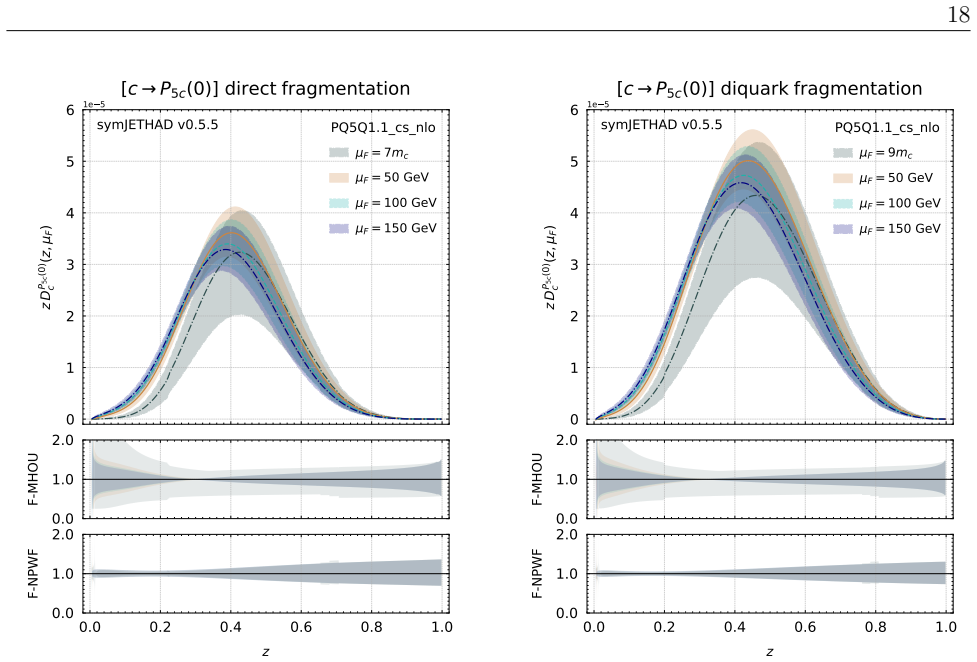
The central claim is that leading-power fragmentation for all-charm pentaquarks can be described by the multimodal collinear fragmentation functions PQ5Q1.1, which incorporate perturbative uncertainties through missing higher-order variations and nonperturbative uncertainties through controlled modifications of the transverse-momentum structure of the wave function, all combined in a replica-like framework with refined initial-scale inputs that accommodate both compact multiquark and diquark-driven charm fragmentation mechanisms.
What carries the argument
The multimodal collinear fragmentation functions PQ5Q1.1, which integrate perturbative and nonperturbative uncertainty estimates to model the fragmentation of all-charm pentaquarks.
If this is right
- NLL/NLO+ predictions for semi-inclusive pentaquark-plus-jet production become available at the HL-LHC and FCC with both perturbative and nonperturbative uncertainties quantified.
- The same framework supplies a flexible tool for uncertainty-controlled studies that link exotic-hadron structure to heavy-flavor fragmentation and high-energy QCD.
- The bottom sector is set aside for later work because it shows greater sensitivity to nonperturbative modeling choices.
- The replica-like combination of uncertainty sources yields a practical way to generate families of fragmentation functions for collider phenomenology.
Where Pith is reading between the lines
- The method could be extended to other multiquark states once analogous fragmentation functions are constructed for them.
- Comparison with early LHC data on pentaquark candidates might help test whether the compact versus diquark mechanisms dominate in real production.
- If the uncertainty bands prove reliable, the approach would support more targeted experimental searches for heavy exotic hadrons at future colliders.
Load-bearing premise
The transverse-momentum structure of the nonperturbative wave function can be modified in a controlled way to describe both compact multiquark and diquark-driven production mechanisms at the same time.
What would settle it
A measurement of the rate for pentaquark-plus-jet production at the HL-LHC that falls well outside the uncertainty bands obtained from the PQ5Q1.1 functions would show that the uncertainty modeling or the initial-scale inputs require revision.
Figures




read the original abstract
We present an uncertainty-aware description of leading-power fragmentation for all-charm pentaquark states ($S$-wave $|cccc\bar{c}\rangle$) at hadron colliders. We construct a multimodal set of collinear fragmentation functions, PQ5Q1.1, incorporating both perturbative and nonperturbative uncertainties. Perturbative effects are estimated via missing higher-order variations (F-MHOUs), while the nonperturbative wave function is modeled through controlled modifications of its transverse-momentum structure (F-NPWF), consistently combined within a replica-like framework. The initial-scale input for constituent charm fragmentation is refined to describe both compact multiquark and diquark-driven production mechanisms. We employ the (sym)JETHAD interface to study NLL/NLO$^+$ semi-inclusive pentaquark-plus-jet production at the HL-LHC and future FCC. The bottom sector is left to future dedicated studies due to its enhanced sensitivity to nonperturbative modeling. Our results provide a flexible framework for uncertainty-controlled predictions, bridging exotic-hadron structure, heavy-flavor fragmentation, and high-energy QCD.
Editorial analysis
A structured set of objections, weighed in public.
Referee Report
Summary. The manuscript constructs a multimodal set of collinear fragmentation functions (PQ5Q1.1) for S-wave all-charm pentaquarks (|cccc c-bar>) at hadron colliders. It incorporates perturbative missing-higher-order uncertainties (F-MHOU) and nonperturbative wave-function uncertainties (F-NPWF) combined in a replica-like framework. The initial-scale input for constituent charm fragmentation is refined to simultaneously describe compact multiquark and diquark-driven mechanisms. Semi-inclusive pentaquark-plus-jet cross sections are computed at NLL/NLO+ accuracy for HL-LHC and FCC using the (sym)JETHAD interface; the bottom sector is deferred.
Significance. If the central modeling choices are placed on firmer ground, the work supplies a practical uncertainty-aware framework for leading-power fragmentation of exotic all-heavy states. The controlled transverse-momentum modifications and replica combination constitute a concrete strength for propagating both perturbative and nonperturbative effects into collider predictions.
major comments (2)
- [Abstract, §2] Abstract and §2 (construction of PQ5Q1.1): the statement that the initial-scale input for constituent charm fragmentation is 'refined to describe both compact multiquark and diquark-driven production mechanisms' is load-bearing for the multimodal claim, yet the manuscript provides no explicit matching to the standard heavy-quark fragmentation function or first-principles wave-function calculation that would justify the refinement as more than a phenomenological adjustment. Without such a derivation or consistency check, the subsequent F-MHOU/F-NPWF envelope cannot be shown to bound the true theoretical uncertainty on the leading-power fragmentation function.
- [§3] §3 (uncertainty combination): the replica-like merging of F-MHOU and F-NPWF variations assumes a specific correlation structure between perturbative and nonperturbative sources that is not derived from the factorization theorem or validated against an external benchmark; this directly affects the width of the uncertainty bands reported for HL-LHC and FCC predictions.
minor comments (2)
- [§2] Notation for the PQ5Q1.1 set and the F-MHOU/F-NPWF labels should be defined at first use with a brief reminder of their relation to standard DGLAP evolution.
- [§4] Figure captions for the pentaquark-plus-jet distributions should explicitly state the kinematic cuts and the value of the factorization scale used in the NLL/NLO+ calculation.
Simulated Author's Rebuttal
We appreciate the referee's thorough review and constructive feedback on our manuscript. Below, we provide point-by-point responses to the major comments, indicating the revisions planned for the next version.
read point-by-point responses
-
Referee: [Abstract, §2] Abstract and §2 (construction of PQ5Q1.1): the statement that the initial-scale input for constituent charm fragmentation is 'refined to describe both compact multiquark and diquark-driven production mechanisms' is load-bearing for the multimodal claim, yet the manuscript provides no explicit matching to the standard heavy-quark fragmentation function or first-principles wave-function calculation that would justify the refinement as more than a phenomenological adjustment. Without such a derivation or consistency check, the subsequent F-MHOU/F-NPWF envelope cannot be shown to bound the true theoretical uncertainty on the leading-power fragmentation function.
Authors: We thank the referee for highlighting this point. The refinement of the initial-scale input is indeed a phenomenological adjustment aimed at accommodating both compact multiquark and diquark-driven mechanisms in the multimodal PQ5Q1.1 set. In the revised manuscript, we will add an explicit matching to the standard heavy-quark fragmentation function in the appropriate limit, as well as a brief discussion of the parameter choices that allow interpolation between the two mechanisms. This will serve as a consistency check and better support the claim that the F-MHOU/F-NPWF envelope provides a reasonable bound on the theoretical uncertainty. A complete first-principles derivation from wave-function calculations lies outside the present scope but will be addressed in follow-up work. revision: partial
-
Referee: [§3] §3 (uncertainty combination): the replica-like merging of F-MHOU and F-NPWF variations assumes a specific correlation structure between perturbative and nonperturbative sources that is not derived from the factorization theorem or validated against an external benchmark; this directly affects the width of the uncertainty bands reported for HL-LHC and FCC predictions.
Authors: The replica-like framework for merging F-MHOU and F-NPWF is a practical method to propagate both types of uncertainties into the predictions, assuming independence between perturbative and nonperturbative variations to obtain a conservative envelope. We acknowledge that this correlation structure is not derived from the factorization theorem. In the updated version, we will clarify this assumption in §3 and discuss its impact on the uncertainty bands for the HL-LHC and FCC cross sections. Validation against external benchmarks is currently limited by the absence of suitable calculations for all-charm pentaquarks, which we will note as a direction for future research. revision: yes
Circularity Check
Refined initial-scale input for charm fragmentation is adjusted to encode both production mechanisms, making subsequent multimodal predictions dependent on that modeling choice by construction
specific steps
-
fitted input called prediction
[Abstract]
"The initial-scale input for constituent charm fragmentation is refined to describe both compact multiquark and diquark-driven production mechanisms. We construct a multimodal set of collinear fragmentation functions, PQ5Q1.1, incorporating both perturbative and nonperturbative uncertainties. Perturbative effects are estimated via missing higher-order variations (F-MHOUs), while the nonperturbative wave function is modeled through controlled modifications of its transverse-momentum structure (F-NPWF), consistently combined within a replica-like framework."
The refinement is performed expressly to encode both production mechanisms inside a single initial-scale input; this input then directly supplies the PQ5Q1.1 set whose F-MHOU/F-NPWF variations generate the uncertainty-aware predictions. The collider observables are therefore not independent results but re-expressions of the same phenomenological adjustment, with no cited matching condition or external calculation that would break the dependence.
full rationale
The paper's central construction begins by refining the initial-scale input for constituent charm fragmentation specifically to describe both compact multiquark and diquark-driven mechanisms, then builds the PQ5Q1.1 multimodal fragmentation functions from this input together with F-MHOU and F-NPWF variations combined in a replica-like framework. These functions are subsequently used to generate predictions for NLL/NLO+ semi-inclusive pentaquark-plus-jet production. Because the refinement is presented as a phenomenological adjustment rather than a derivation from leading-power factorization, heavy-quark fragmentation matching, or an independent wave-function calculation, the uncertainty envelope and collider predictions reduce to variations around the chosen input. This matches the fitted-input-called-prediction pattern: the output is statistically and structurally forced by the modeling decision that was introduced to cover the desired mechanisms. The decision to defer the bottom sector due to nonperturbative sensitivity further underscores that the charm treatment remains under-constrained by external benchmarks.
Axiom & Free-Parameter Ledger
free parameters (2)
- initial-scale input for constituent charm fragmentation
- transverse-momentum structure modifications
axioms (2)
- domain assumption Leading-power collinear factorization holds for pentaquark fragmentation
- standard math NLL/NLO+ accuracy in perturbative QCD calculations
invented entities (1)
-
PQ5Q1.1 multimodal fragmentation functions
no independent evidence
Reference graph
Works this paper leans on
-
[1]
N. Brambilla, S. Eidelman, C. Hanhart, A. Nefediev, C.-P. Shen, C. E. Thomas, A. Vairo, and C.-Z. Yuan, Phys. Rept.873, 1 (2020),1907.07583
-
[2]
Yuan, TheXY Zstates revisited, Int
C.-Z. Yuan, Int. J. Mod. Phys. A33, 1830018 (2018),1808.01570
-
[3]
Albaladejoet al.(JPAC), Novel approaches in hadron spectroscopy, Prog
M. Albaladejo et al. (JPAC), Prog. Part. Nucl. Phys.127, 103981 (2022),2112.13436
-
[4]
Gell-Mann, Phys
M. Gell-Mann, Phys. Lett.8, 214 (1964)
1964
-
[5]
Zweig,An SU(3) model for strong interaction symmetry and its breaking
G. Zweig,An SU(3) model for strong interaction symmetry and its breaking. Version 2 (1964), pp. 22–101
1964
-
[6]
R. L. Jaffe, Phys. Rev. D15, 281 (1977)
1977
-
[7]
R. L. Jaffe, Phys. Rev. Lett.38, 195 (1977), [Erratum: Phys.Rev.Lett. 38, 617 (1977)]
1977
-
[8]
J. L. Rosner, Phys. Rev. D33, 2043 (1986)
2043
- [9]
-
[10]
J. Vijande, A. Valcarce, and J. M. Richard, Phys. Rev. D85, 014019 (2012),1111.5921
-
[11]
A. Esposito, A. Pilloni, and A. D. Polosa, Phys. Rept.668, 1 (2017),1611.07920
- [12]
- [13]
- [14]
-
[15]
A. Ali, L. Maiani, and A. D. Polosa,Multiquark Hadrons(Cambridge University Press, 2019), ISBN 978-1-316-76146-5, 978-1-107-17158-9, 978-1-316-77419-9
2019
-
[16]
G. Apollinari, O. Br¨ uning, T. Nakamoto, and L. Rossi, CERN Yellow Rep. pp. 1–19 (2015),1705.08830
-
[17]
Science Requirements and Detector Concepts for the Electron-Ion Collider: EIC Yellow Report
R. Abdul Khalek et al., Nucl. Phys. A1026, 122447 (2022),2103.05419
work page internal anchor Pith review arXiv 2022
-
[18]
Abdul Khalek et al., in2022 Snowmass Summer Study(2022),2203.13199
R. Abdul Khalek et al., in2022 Snowmass Summer Study(2022),2203.13199
- [19]
-
[20]
Abada et al
A. Abada et al. (FCC), Eur. Phys. J. C79, 474 (2019). 39
2019
-
[21]
Abada et al
A. Abada et al. (FCC), Eur. Phys. J. ST228, 261 (2019)
2019
-
[22]
Abada et al
A. Abada et al. (FCC), Eur. Phys. J. ST228, 755 (2019)
2019
-
[23]
Abada et al
A. Abada et al. (FCC), Eur. Phys. J. ST228, 1109 (2019)
2019
- [24]
-
[25]
Maiani, A
L. Maiani, A. D. Polosa, and V. Riquer, Phys. Lett. B749, 289 (2015)
2015
- [26]
-
[27]
E. Braaten and M. Kusunoki, Phys. Rev. D69, 074005 (2004),hep-ph/0311147
- [28]
- [29]
- [30]
-
[31]
Karliner and J
M. Karliner and J. L. Rosner, Phys. Rev. Lett.115, 122001 (2015)
2015
- [32]
-
[33]
The role of the pion in the lineshape of the X(3872),
A. Esposito, D. Germani, A. Glioti, A. D. Polosa, R. Rattazzi, and M. Tarquini, Phys. Lett. B847, 138285 (2023),2307.11400
-
[34]
B. Grinstein, L. Maiani, and A. D. Polosa, Phys. Rev. D109, 074009 (2024),2401.11623
- [35]
-
[36]
G. ’t Hooft, G. Isidori, L. Maiani, A. D. Polosa, and V. Riquer, Phys. Lett. B662, 424 (2008),0801.2288
- [37]
- [38]
- [39]
- [40]
-
[41]
S. Dubynskiy and M. B. Voloshin, Phys. Lett. B666, 344 (2008),0803.2224. 40
- [42]
- [43]
-
[44]
J. Ferretti and E. Santopinto, Phys. Lett. B789, 550 (2019),1806.02489
- [45]
-
[46]
S. K. Choi et al. (Belle), Phys. Rev. Lett.91, 262001 (2003)
2003
- [47]
-
[48]
A. Hayrapetyan et al. (CMS), Phys. Rev. Lett.132, 111901 (2024),2306.07164
-
[49]
Hayrapetyanet al.(CMS), Nature648, 58 (2025), arXiv:2506.07944 [hep-ex]
A. Hayrapetyan et al. (CMS), Nature648, 58 (2025),2506.07944
-
[50]
T. Nakano et al. (LEPS), Phys. Rev. Lett.91, 012002 (2003),hep-ex/0301020
- [51]
-
[52]
Diakonov, V
D. Diakonov, V. Petrov, and M. V. Polyakov, Z. Phys. A359, 305 (1997),hep-ph/ 9703373
1997
-
[53]
M. Battaglieri et al. (CLAS), Phys. Rev. Lett.96, 042001 (2006),hep-ex/0510061
-
[54]
K. H. Hicks, Prog. Part. Nucl. Phys.55, 647 (2005)
2005
-
[55]
Amsler et al
C. Amsler et al. (Particle Data Group), Phys. Lett. B667, 1 (2008)
2008
- [56]
-
[57]
Aaij et al
R. Aaij et al. (LHCb), Phys. Rev. Lett.115, 072001 (2015)
2015
-
[58]
Aaij et al
R. Aaij et al. (LHCb), Phys. Rev. Lett.122, 222001 (2019)
2019
- [59]
-
[60]
R. Aaij et al. (LHCb), Phys. Rev. Lett.131, 031901 (2023),2210.10346
-
[61]
R. Aaij et al. (LHCb), Phys. Rev. Lett.117, 082003 (2016), [Addendum: Phys.Rev.Lett. 117, 109902 (2016), Addendum: Phys.Rev.Lett. 118, 119901 (2017)],1606.06999
-
[62]
R. Aaij et al. (LHCb), Phys. Rev. Lett.128, 062001 (2022),2108.04720
-
[63]
R. Maciu la, W. Sch¨ afer, and A. Szczurek, Phys. Lett. B812, 136010 (2021),2009.02100
-
[64]
M. Karliner, S. Nussinov, and J. L. Rosner, Phys. Rev. D95, 034011 (2017),1611.00348. 41
- [65]
-
[66]
A. Francis, R. J. Hudspith, R. Lewis, and K. Maltman,Evidence for charm-bottom tetraquarks and the mass dependence of heavy-light tetraquark states from lattice QCD (2019),1810.10550
-
[67]
L. Leskovec, S. Meinel, M. Pflaumer, and M. Wagner, Phys. Rev. D100, 014503 (2019), 1904.04197
- [68]
- [69]
-
[70]
C. Alexandrou, J. Finkenrath, T. Leontiou, S. Meinel, M. Pflaumer, and M. Wagner, Phys. Rev. D110, 054510 (2024),2404.03588
- [71]
- [72]
- [73]
-
[74]
Y. Yamaguchi, A. Giachino, A. Hosaka, E. Santopinto, S. Takeuchi, and M. Takizawa, Phys. Rev. D96, 114031 (2017),1709.00819
- [75]
- [76]
- [77]
- [78]
-
[79]
Suzuki, Phys
M. Suzuki, Phys. Lett. B71, 139 (1977)
1977
- [80]
discussion (0)
Sign in with ORCID, Apple, or X to comment. Anyone can read and Pith papers without signing in.