Recognition: unknown
Structured Parameterization and Non-Stabilizerness in Hypergraph QAOA
Pith reviewed 2026-05-09 13:59 UTC · model grok-4.3
The pith
kA-QAOA matches MA-QAOA approximation ratios on 3-uniform hypergraphs while using significantly fewer function evaluations.
A machine-rendered reading of the paper's core claim, the machinery that carries it, and where it could break.
Core claim
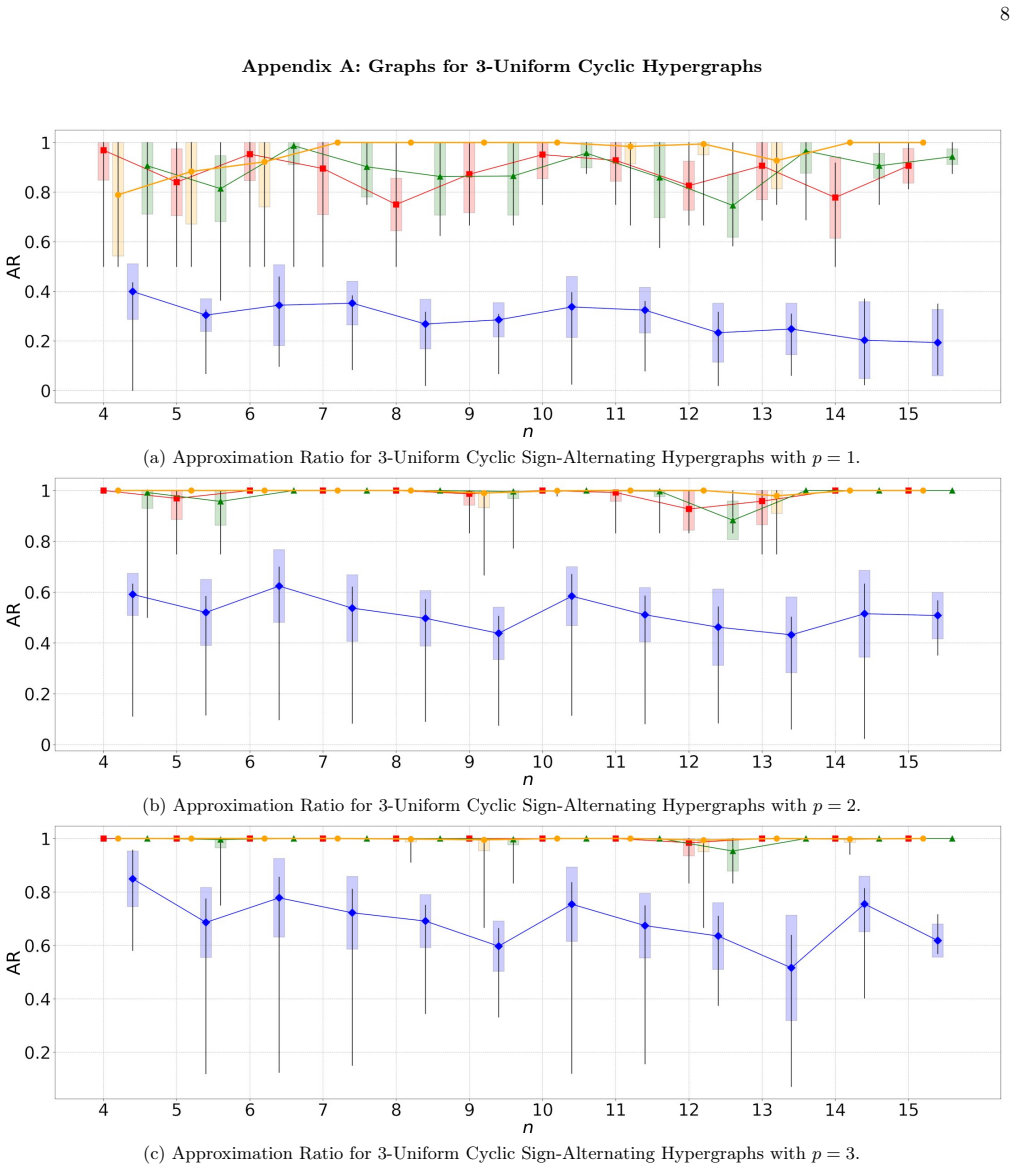
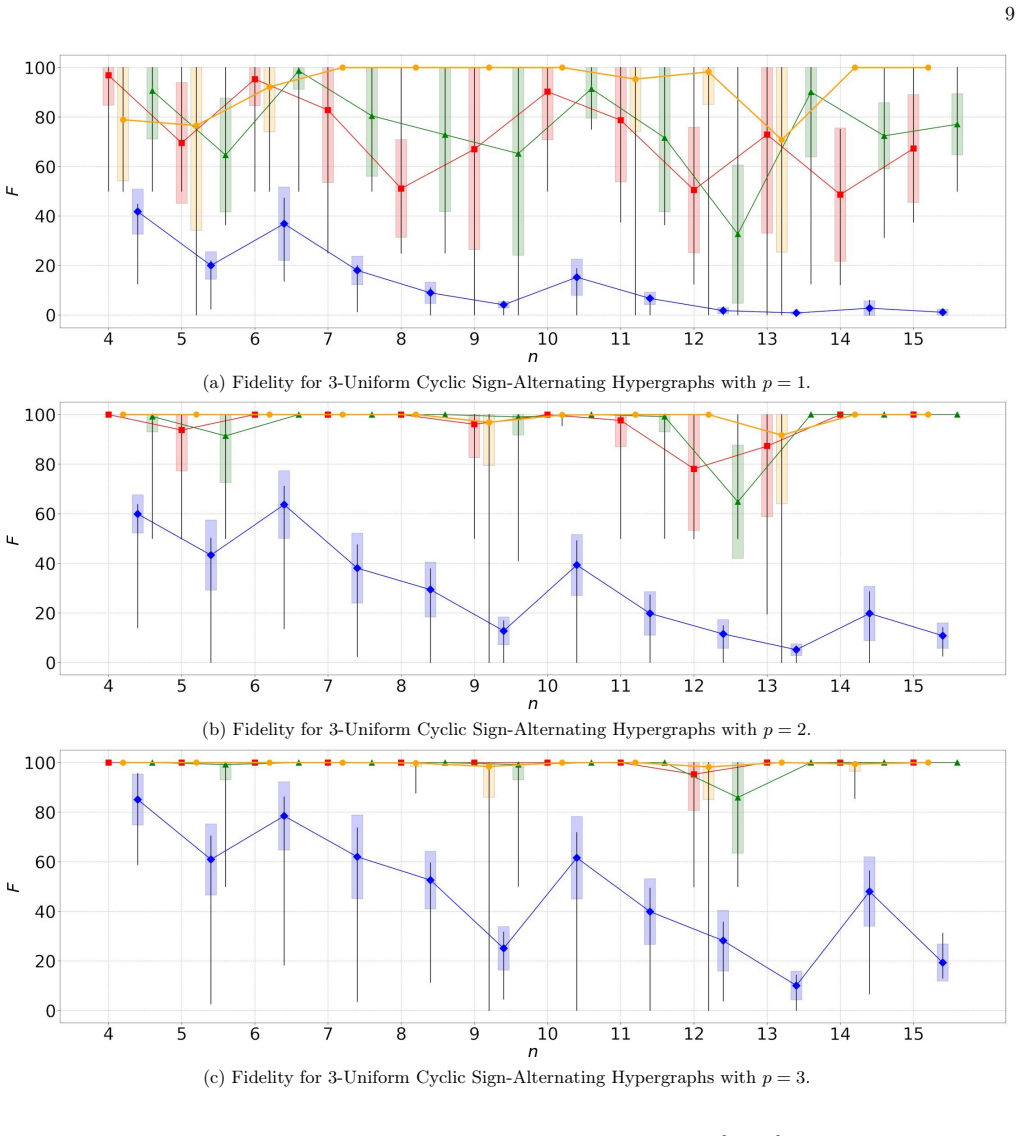
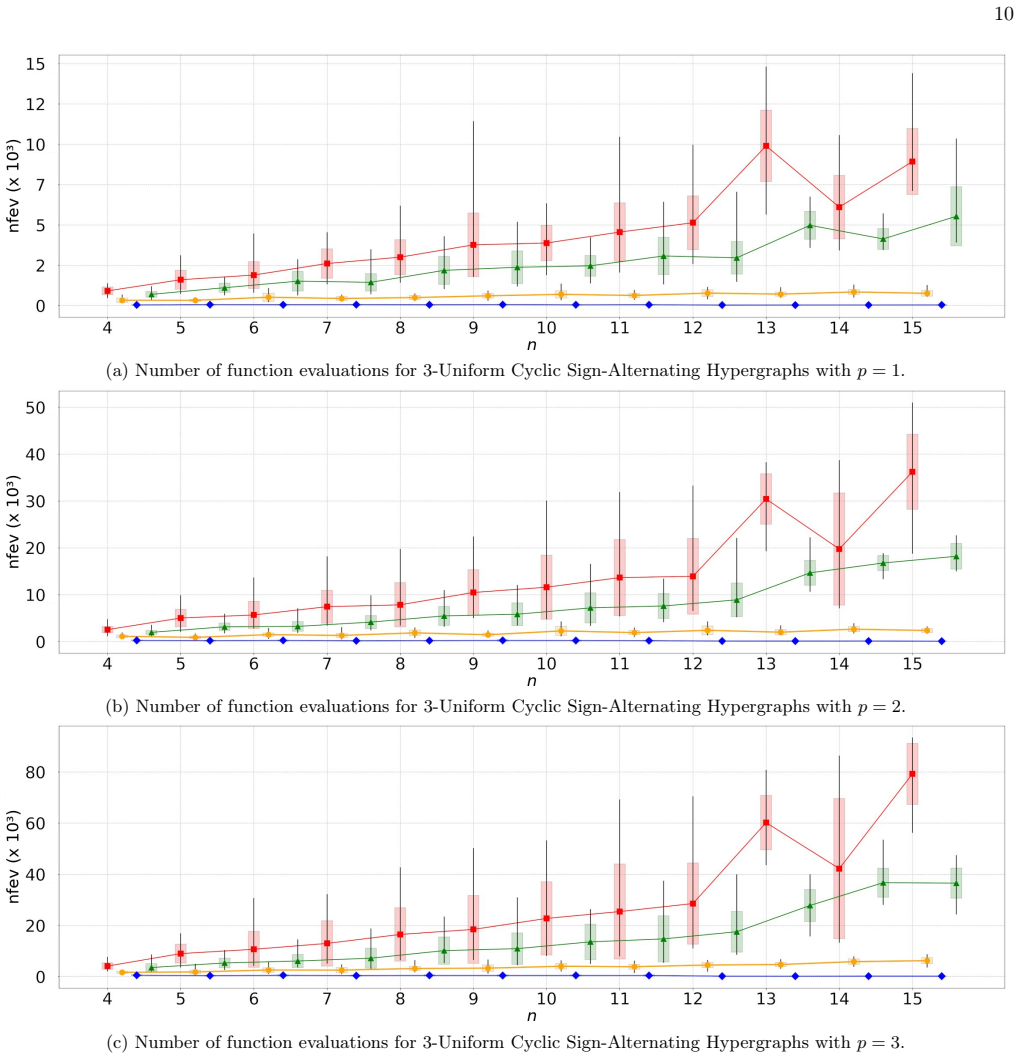
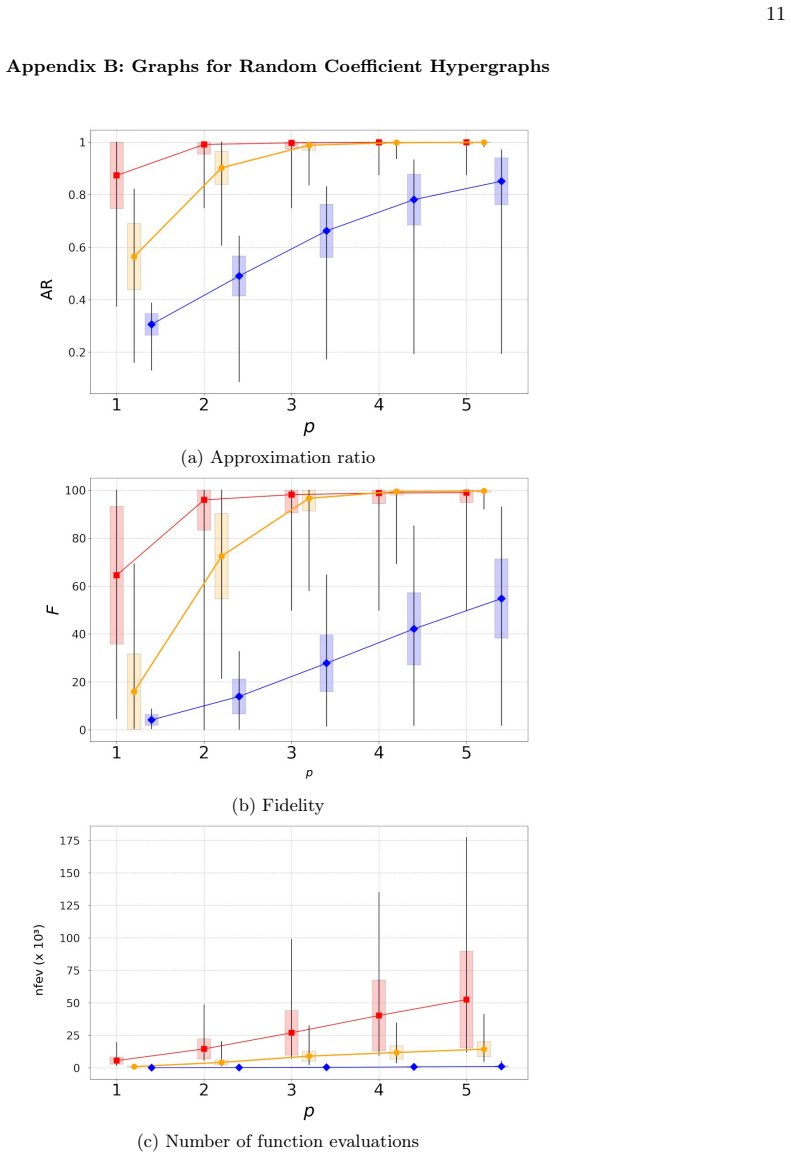
Our results demonstrate that kA-QAOA achieves approximation ratios comparable to MA-QAOA while requiring significantly fewer function evaluations, thereby reducing quantum resource consumption.
Load-bearing premise
That grouping parameters strictly by k-body interaction order remains effective and near-optimal for hypergraph problems beyond the two specific 3-uniform families benchmarked in the abstract.
Figures


read the original abstract
The quantum approximate optimization algorithm (QAOA) has emerged as a promising candidate for demonstrating quantum advantage on noisy intermediate-scale quantum (NISQ) devices. While various QAOA parameterization schemes exist, ranging from the original single-angle approach to the more expressive multi-angle quantum approximate optimization algorithm (MA-QAOA) and automorphic-angle quantum approximate optimization algorithm (AA-QAOA), each presents distinct trade-offs between expressiveness and classical optimization complexity. In this work, we introduce the $k$-interaction-angle quantum approximate optimization algorithm ($k$A-QAOA), a parameterization scheme that groups cost function terms by their $k$-body interaction order, providing a natural middle ground between parameter efficiency and solution quality. This approach is particularly well-suited for combinatorial optimization problems defined on hypergraphs, where multi-body interactions naturally arise in applications such as Boolean satisfiability and resource allocation with multi-party constraints. We benchmark $k$A-QAOA against standard single-angle quantum approximate optimization algorithm (SA-QAOA), MA-QAOA, and AA-QAOA on two problem classes: 3-uniform cyclic sign-alternating hypergraphs and random coefficient hypergraphs. Our results demonstrate that $k$A-QAOA achieves approximation ratios comparable to MA-QAOA while requiring significantly fewer function evaluations, thereby reducing quantum resource consumption.
Editorial analysis
A structured set of objections, weighed in public.
Referee Report
Summary. The paper introduces kA-QAOA, a QAOA parameterization that groups variational angles by the k-body interaction order of hypergraph cost terms. It positions this as an intermediate scheme between single-angle (SA-QAOA) and multi-angle (MA-QAOA) variants, and reports numerical benchmarks on two 3-uniform hypergraph families (cyclic sign-alternating and random-coefficient) claiming that kA-QAOA matches MA-QAOA approximation ratios while using far fewer classical function evaluations.
Significance. If the performance trade-off is substantiated on appropriate instances, the structured parameterization could reduce classical optimization overhead for QAOA on hypergraph problems arising in SAT and resource allocation, while the non-stabilizerness analysis (implied by the title) might provide additional theoretical grounding for the ansatz choice.
major comments (2)
- [Abstract] Abstract: The two benchmark classes are both strictly 3-uniform. Consequently every cost term has identical interaction order, so the k-body grouping collapses to a single angle (or one per symmetry class), rendering kA-QAOA formally identical to SA-QAOA on these instances. The reported reduction in function evaluations therefore cannot be attributed to the structured grouping; it is consistent with symmetry alone. This directly undermines the central claim that kA-QAOA supplies a middle ground for hypergraphs in general.
- [Numerical Experiments] Numerical Experiments (or equivalent results section): No benchmarks are presented on hypergraphs containing mixed interaction orders (e.g., 2-body plus 3-body terms). The paper's own motivation emphasizes that multi-body interactions arise naturally in applications, yet the experiments never probe the regime in which the k-grouping is supposed to deliver its advertised advantage over both SA-QAOA and MA-QAOA.
minor comments (2)
- [Abstract] The title references non-stabilizerness, but the abstract and claimed results focus exclusively on approximation ratios and function evaluations. A brief statement clarifying whether non-stabilizerness is used to motivate or analyze the parameterization would improve clarity.
- [Abstract] The abstract states that kA-QAOA requires 'significantly fewer function evaluations' without reporting error bars, number of independent runs, or statistical tests. Adding these details would strengthen the empirical comparison.
Simulated Author's Rebuttal
We thank the referee for the careful reading and constructive comments on our manuscript. We address the major comments point by point below, acknowledging where clarification and additional results are warranted.
read point-by-point responses
-
Referee: [Abstract] Abstract: The two benchmark classes are both strictly 3-uniform. Consequently every cost term has identical interaction order, so the k-body grouping collapses to a single angle (or one per symmetry class), rendering kA-QAOA formally identical to SA-QAOA on these instances. The reported reduction in function evaluations therefore cannot be attributed to the structured grouping; it is consistent with symmetry alone. This directly undermines the central claim that kA-QAOA supplies a middle ground for hypergraphs in general.
Authors: We agree that on strictly 3-uniform hypergraphs the k-interaction grouping reduces to a single parameter group (or per symmetry class), rendering kA-QAOA equivalent to SA-QAOA in parameterization structure. The reduction in function evaluations relative to MA-QAOA therefore stems from the smaller number of variational parameters rather than from a distinct grouping effect in these uniform instances. We will revise the abstract and introduction to clarify that the current benchmarks validate performance on uniform hypergraphs (where kA-QAOA coincides with SA-QAOA yet still matches MA-QAOA approximation ratios with fewer evaluations), while emphasizing that the middle-ground advantage is designed for and will be demonstrated on mixed-order hypergraphs. revision: yes
-
Referee: [Numerical Experiments] Numerical Experiments (or equivalent results section): No benchmarks are presented on hypergraphs containing mixed interaction orders (e.g., 2-body plus 3-body terms). The paper's own motivation emphasizes that multi-body interactions arise naturally in applications, yet the experiments never probe the regime in which the k-grouping is supposed to deliver its advertised advantage over both SA-QAOA and MA-QAOA.
Authors: We acknowledge that the presented numerical experiments are restricted to 3-uniform hypergraphs and do not include mixed-order instances, even though the motivation section highlights applications involving mixed multi-body terms. This limits the direct demonstration of kA-QAOA's advantage in the regime where the structured grouping is most distinct. In the revised manuscript we will add benchmarks on hypergraphs containing mixed interaction orders (e.g., combinations of 2-body and 3-body terms) to explicitly show the performance trade-off of kA-QAOA relative to both SA-QAOA and MA-QAOA in the intended setting. revision: yes
Circularity Check
No circularity: empirical benchmarks on explicit hypergraph instances
full rationale
The paper proposes kA-QAOA as a grouping of variational angles by interaction order k and reports numerical approximation ratios and function-evaluation counts on two families of 3-uniform hypergraphs. These outcomes are obtained by direct simulation against SA-QAOA, MA-QAOA and AA-QAOA baselines; no derivation, uniqueness theorem, or fitted-parameter renaming is invoked that would make the reported trade-off tautological by construction. The central claim therefore remains an independent empirical observation rather than a self-referential reduction.
Axiom & Free-Parameter Ledger
Reference graph
Works this paper leans on
-
[1]
2025301 UM MinED
metrics. The AR is the figure of merit that measures algorithm efficiency in approximation algorithms, it is defined as AR= Cmin Copt ,(8) whereC min is the minimum attained value of the cost function, andC opt is the true optimal value of the cost function (typically computed classically via brute force). Another figure of merit one can consider is the f...
-
[2]
Ezratty, Understanding quantum technologies 2025 (2025), arXiv:2111.15352 [quant-ph]
O. Ezratty, Understanding quantum technologies 2025 (2025), arXiv:2111.15352 [quant-ph]
-
[3]
R. T. Toledo,Industrial Applications of Combinatorial Optimization(Springer, Boston, MA, 1999)
1999
-
[4]
Lucas, Ising formulations of many np problems, Fron- tiers in Physics2, 5 (2014), review article, Section: In- terdisciplinary Physics
A. Lucas, Ising formulations of many np problems, Fron- tiers in Physics2, 5 (2014), review article, Section: In- terdisciplinary Physics
2014
-
[5]
Yarkoni, E
S. Yarkoni, E. Raponi, T. Bäck, and S. Schmitt, Quan- tum annealing for industry applications: introduction and review, Reports on Progress in Physics85, 104001 (2022)
2022
-
[6]
Wang, J.-H
P.-H. Wang, J.-H. Chen, Y.-Y. Yang, C. Lee, and Y. J. Tseng, Recent advances in quantum computing for drug discovery and development, IEEE Nanotechnology Mag- azine17, 26 (2023)
2023
-
[7]
Preskill, Quantum Computing in the NISQ era and beyond, Quantum2, 79 (2018)
J. Preskill, Quantum Computing in the NISQ era and beyond, Quantum2, 79 (2018)
2018
-
[8]
A Quantum Approximate Optimization Algorithm
E. Farhi, J. Goldstone, and S. Gutmann, A quan- tum approximate optimization algorithm (2014), arXiv:1411.4028 [quant-ph]
work page internal anchor Pith review Pith/arXiv arXiv 2014
-
[9]
Amico, R
L. Amico, R. Fazio, A. Osterloh, and V. Vedral, Entan- glement in many-body systems, Rev. Mod. Phys.80, 517 (2008)
2008
-
[10]
Eisert, M
J. Eisert, M. Cramer, and M. B. Plenio, Colloquium: Area laws for the entanglement entropy, Rev. Mod. Phys. 82, 277 (2010)
2010
-
[11]
Preskill, Quantum computing and the entanglement frontier, arXiv preprint arXiv:1203.5813 (2012)
J. Preskill, Quantum computing and the entanglement frontier (2012), arXiv:1203.5813 [quant-ph]
-
[12]
Aaronson and D
S. Aaronson and D. Gottesman, Improved simulation of stabilizer circuits, Phys. Rev. A70, 052328 (2004)
2004
-
[13]
S.BravyiandA.Kitaev,Universalquantumcomputation with ideal clifford gates and noisy ancillas, Phys. Rev. A 71, 022316 (2005)
2005
-
[14]
Feige, J
U. Feige, J. H. Kim, and E. Ofek, Witnesses for non- satisfiability of dense random 3cnf formulas, in2006 47th Annual IEEE Symposium on Foundations of Computer Science (FOCS’06)(2006) pp. 497–508
2006
-
[15]
N. Heydaribeni, X. Zhan, R. Zhang, T. Eliassi-Rad, and F. Koushanfar, Distributed constrained combinato- rial optimization leveraging hypergraph neural networks (2024), arXiv:2311.09375 [math.OC]
- [16]
-
[17]
arXiv preprint, 1901.04405 , year=
N. Dattani, Quadratization in discrete optimization and quantum annealing, arXiv preprint arXiv:1901.04405 (2019)
-
[18]
Guruswami and R
V. Guruswami and R. Saket, On the inapproximabil- ity of vertex cover on k-partite k-uniform hypergraphs, inAutomata, Languages and Programming, edited by S. Abramsky, C. Gavoille, C. Kirchner, F. Meyer auf der Heide, and P. G. Spirakis (Springer Berlin Heidelberg, Berlin, Heidelberg, 2010) pp. 360–371
2010
-
[19]
A. Giovagnoli, An introduction to the quantum approx- imate optimization algorithm (2025), arXiv:2511.18377 [quant-ph]
-
[20]
Cerezo, A
M. Cerezo, A. Sone, T. Volkoff, L. Cincio, and P. J. Coles, Cost function dependent barren plateaus in shal- low parametrized quantum circuits, Nature Communica- tions12, 1791 (2021)
2021
-
[21]
Herrman, P
R. Herrman, P. C. Lotshaw, J. Ostrowski, T. S. Humble, and G. Siopsis, Multi-angle quantum approximate opti- mization algorithm, Scientific Reports12, 6781 (2022)
2022
-
[22]
J. R. McClean, S. Boixo, V. N. Smelyanskiy, R. Bab- bush, and H. Neven, Barren plateaus in quantum neural network training landscapes, Nature Communications9, 4812 (2018)
2018
-
[23]
Larocca, S
M. Larocca, S. Thanasilp, S. Wang, K. Sharma, J. Bia- monte, P. J. Coles, L. Cincio, J. R. McClean, Z. Holmes, and M. Cerezo, Barren plateaus in variational quantum computing, Nature Reviews Physics7, 174 (2025)
2025
-
[24]
Bharti, A
K. Bharti, A. Cervera-Lierta, T. H. Kyaw, T. Haug, S. Alperin-Lea, A. Anand, M. Degroote, H. Heimonen, J. S. Kottmann, T. Menke, W.-K. Mok, S. Sim, L.-C. Kwek, and A. Aspuru-Guzik, Noisy intermediate-scale quantum algorithms, Rev. Mod. Phys.94, 015004 (2022)
2022
-
[25]
K. Shi, R. Herrman, R. Shaydulin, S. Chakrabarti, M. Pistoia, and J. Larson, Multiangle qaoa does not al- ways need all its angles, in2022 IEEE/ACM 7th Sympo- sium on Edge Computing (SEC)(2022) pp. 414–419
2022
-
[26]
Stein, F
J. Stein, F. Chamanian, M. Zorn, J. Nüßlein, S. Zielinski, M. Kölle, and C. Linnhoff-Popien, Evidence that pubo outperforms qubo when solving continuous optimization problems with the qaoa, inProceedings of the Compan- ion Conference on Genetic and Evolutionary Computa- tion, GECCO ’23 Companion (Association for Comput- ing Machinery, New York, NY, USA, 2...
2023
-
[27]
Leone, S
L. Leone, S. F. E. Oliviero, and A. Hamma, Stabilizer rényi entropy, Phys. Rev. Lett.128, 050402 (2022)
2022
-
[28]
Gross, S
D. Gross, S. Nezami, and M. Walter, Schur–weyl duality for the clifford group with applications: Property test- ing, a robust hudson theorem, and de finetti represen- tations, Communications in Mathematical Physics385, 1325 (2021)
2021
-
[29]
Haug and L
T. Haug and L. Piroli, Stabilizer entropies and nonstabi- lizerness monotones, Quantum7, 1092 (2023)
2023
-
[30]
C. Capecci, G. C. Santra, A. Bottarelli, E. Tirrito, and P. Hauke, Role of nonstabilizerness in quantum optimiza- tion (2025), arXiv:2505.17185 [quant-ph]
-
[31]
Garey and D
M. Garey and D. Johnson,Computers and Intractability: A Guide to the Theory of NP-completeness, Mathemati- cal Sciences Series (W. H. Freeman, 1979)
1979
-
[32]
Nocedal and S
J. Nocedal and S. J. Wright,Numerical Optimization, 2nd ed., Springer Series in Operations Research and Fi- nancial Engineering (Springer, New York, NY, 2006)
2006
-
[33]
M. J. D. Powell, An efficient method for finding the minimum of a function of several variables with- out calculating derivatives, The Computer Journal7, 155 (1964), https://academic.oup.com/comjnl/article- pdf/7/2/155/959784/070155.pdf
1964
-
[34]
Virtanen, R
P. Virtanen, R. Gommers, T. E. Oliphant, M. Haber- land, T. Reddy, D. Cournapeau, E. Burovski, P. Pe- terson, W. Weckesser, J. Bright, S. J. van der Walt, M. Brett, J. Wilson, K. J. Millman, N. Mayorov, A. R. J. Nelson, E. Jones, R. Kern, E. Larson, C. J. Carey, İ. Po- lat, Y. Feng, E. W. Moore, J. VanderPlas, D. Laxalde, J. Perktold, R. Cimrman, I. Henri...
2020
-
[35]
S. H. Sack and M. Serbyn, Quantum annealing initializa- tionofthequantumapproximateoptimizationalgorithm, Quantum5, 491 (2021)
2021
-
[36]
transition probability
A. Uhlmann, The “transition probability” in the state space of a∗-algebra, Rep. Math. Phys.9, 273 (1976)
1976
discussion (0)
Sign in with ORCID, Apple, or X to comment. Anyone can read and Pith papers without signing in.