Recognition: 3 theorem links
· Lean TheoremLong-range correlation and the spin conductivity in the XXZ chain from ballistic macroscopic fluctuation theory
Pith reviewed 2026-05-08 19:28 UTC · model grok-4.3
The pith
In the infinite XXZ spin chain at criticality, spin conductivity scales as 1/T at high temperature and the prefactor diverges when one-quasiparticle magnetization is infinite.
A machine-rendered reading of the paper's core claim, the machinery that carries it, and where it could break.
Core claim
Based on the ballistic macroscopic fluctuation theory, when the magnetization of an infinite spin chain fluctuates from an initial state with a wavelength as long as the infinite length N, the equal-time two-point spin correlation function is scaled up to O(1/N). In the state where the ballistic spin transport decays at high temperature T, the diffusive transport remains on a large scale. The spin conductivity is proportional to 1/T in the limit T to infinity and its high temperature proportionality constant diverges in the case where one-quasiparticle magnetization is infinitely large. This shows that the superdiffusive spin transport is driven by the 1/N-scaled long-range spin correlation.
What carries the argument
Ballistic macroscopic fluctuation theory, which supplies scaling rules for long-wavelength magnetization fluctuations to evaluate the integrated spin correlation function.
Load-bearing premise
The scaling assumptions of the ballistic macroscopic fluctuation theory for long-wavelength fluctuations hold exactly in the critical regime of the infinite XXZ chain.
What would settle it
Directly compute or measure the equal-time two-point spin correlation function for large finite N in the XXZ chain at high T and check whether it scales as O(1/N) and whether the resulting conductivity is proportional to 1/T with a diverging prefactor when one-quasiparticle magnetization is infinite.
Figures
read the original abstract
Based on the ballistic macroscopic fluctuation theory, the integration of the spin correlation function (spin conductivity) is analyzed for the spin-1/2 XXZ chain in the critical regime. In the time when the magnetization of an infinite spin chain fluctuates from an initial state with a wavelength as long as the infinite length $N$, the equal-time two-point spin correlation function is scaled up to $O(1/N)$. In the state where the ballistic spin transport decays at high temperature $T$, the diffusive transport remains on a large scale. We show that the spin conductivity is proportional to $1/T$ in the limit $T\to\infty$ and its high temperature proportionality constant diverges in the case where one-quasiparticle magnetization is infinitely large. This analysis informs that the superdiffusive spin transport is driven by the $1/N$-scaled long-range spin correlation and sheds a light on the dynamic scaling in spin transport at the isotropic point.
Editorial analysis
A structured set of objections, weighed in public.
Referee Report
Summary. The manuscript applies ballistic macroscopic fluctuation theory (BMFT) to the infinite spin-1/2 XXZ chain in the critical regime. It asserts that equal-time two-point spin correlations scale as O(1/N) for initial states with wavelength ~N. Integrating this correlation yields the spin conductivity, which the authors claim is proportional to 1/T as T→∞; the prefactor diverges when the one-quasiparticle magnetization becomes infinite. The work concludes that this 1/N-scaled long-range correlation drives superdiffusive spin transport at the isotropic point.
Significance. If the BMFT scaling assumption and the subsequent integration are rigorously justified with explicit steps and checks, the result would offer an analytical route to high-temperature spin conductivity in integrable chains and a concrete link between long-range correlations and anomalous transport. This could clarify dynamic scaling issues at the isotropic point and extend BMFT applications. The current lack of derivations, benchmarks, or error estimates prevents assessing whether the proportionality and divergence are robust or artifacts of unverified assumptions.
major comments (2)
- [Main text (BMFT application and conductivity integration)] The central claim that σ ∝ 1/T (with diverging prefactor for infinite one-quasiparticle magnetization) rests on integrating an equal-time correlation asserted to scale as O(1/N) from BMFT. No explicit BMFT equation, scaling derivation, or integration procedure is supplied, so it is impossible to confirm whether the 1/T behavior emerges from the scaling or from additional implicit assumptions (see abstract and main text derivation of conductivity).
- [Section on long-range correlation scaling] The O(1/N) scaling of the correlation function for long-wavelength initial states is taken directly from BMFT without independent validation or consistency check against known high-T results (e.g., GHD or exact diagonalization) in the critical regime. If the actual decay is faster than 1/N or receives non-vanishing corrections as N→∞ at infinite T, both the proportionality and the divergence condition fail (see abstract claim on correlation scaling and high-T limit).
minor comments (2)
- [Abstract] The abstract contains awkward phrasing that obscures meaning (e.g., 'In the time when the magnetization of an infinite spin chain fluctuates...' and 'sheds a light on'). These should be rephrased for clarity.
- [Main text] No references to prior BMFT literature, GHD results on XXZ conductivity, or numerical benchmarks are mentioned, which would help situate the claims.
Simulated Author's Rebuttal
We thank the referee for the careful reading and constructive criticism of our manuscript. The points raised highlight the need for greater explicitness in the derivations, which we have addressed in the revision. Below we respond point by point to the major comments.
read point-by-point responses
-
Referee: [Main text (BMFT application and conductivity integration)] The central claim that σ ∝ 1/T (with diverging prefactor for infinite one-quasiparticle magnetization) rests on integrating an equal-time correlation asserted to scale as O(1/N) from BMFT. No explicit BMFT equation, scaling derivation, or integration procedure is supplied, so it is impossible to confirm whether the 1/T behavior emerges from the scaling or from additional implicit assumptions (see abstract and main text derivation of conductivity).
Authors: We agree that the original submission lacked sufficient detail on the BMFT equations and the subsequent integration. In the revised manuscript we have inserted a dedicated subsection that begins from the ballistic macroscopic fluctuation equation for the conserved spin density, derives the O(1/N) equal-time correlation scaling for initial states with wavelength ∼N, and carries out the explicit spatial integration that yields the conductivity. The factor 1/T arises directly from the high-temperature expansion of the quasiparticle velocity distribution together with the 1/N scaling; no additional assumptions are required. The divergence of the prefactor when the one-quasiparticle magnetization becomes infinite is likewise obtained from the same integration once the magnetization is allowed to diverge. revision: yes
-
Referee: [Section on long-range correlation scaling] The O(1/N) scaling of the correlation function for long-wavelength initial states is taken directly from BMFT without independent validation or consistency check against known high-T results (e.g., GHD or exact diagonalization) in the critical regime. If the actual decay is faster than 1/N or receives non-vanishing corrections as N→∞ at infinite T, both the proportionality and the divergence condition fail (see abstract claim on correlation scaling and high-T limit).
Authors: We acknowledge the value of independent checks. The revised version now contains a direct comparison with generalized hydrodynamics (GHD) in the infinite-temperature limit of the critical XXZ chain, confirming that the equal-time spin correlation indeed decays as O(1/N) for long-wavelength initial conditions and that no faster decay or non-vanishing corrections appear. While finite-size exact diagonalization cannot access the strict N→∞ limit, the GHD benchmark is consistent with the known superdiffusive scaling at the isotropic point and supports the robustness of both the 1/T proportionality and the divergence condition. revision: yes
Circularity Check
No significant circularity; conductivity follows as a direct consequence of BMFT scaling input
full rationale
The manuscript applies ballistic macroscopic fluctuation theory (BMFT) as an established framework to assert O(1/N) scaling of the equal-time spin correlation for long-wavelength initial states, then integrates that scaling to obtain σ ∝ 1/T at high T with divergence under infinite one-quasiparticle magnetization. This is a standard forward derivation within the theory's assumptions rather than a self-definitional loop, fitted parameter renamed as prediction, or load-bearing self-citation that reduces the target result to its own inputs by construction. No equations in the abstract or described chain exhibit the forbidden reduction (e.g., the conductivity integral is not used to define the BMFT scaling itself). The result therefore retains independent content as an application of the external scaling assumption.
Axiom & Free-Parameter Ledger
axioms (1)
- domain assumption Ballistic macroscopic fluctuation theory applies to long-wavelength magnetization fluctuations in the critical regime of the infinite XXZ chain
Lean theorems connected to this paper
-
IndisputableMonolith.Cost (J-cost), IndisputableMonolith.Constantswashburn_uniqueness_aczel / Jcost_pos_of_ne_one unclear?
unclearRelation between the paper passage and the cited Recognition theorem.
We show that the spin conductivity is proportional to 1/T in the limit T→∞ and its high temperature proportionality constant diverges in the case where one-quasiparticle magnetization is infinitely large.
-
IndisputableMonolith.Constants (phi)phi_golden_ratio echoes?
echoesECHOES: this paper passage has the same mathematical shape or conceptual pattern as the Recognition theorem, but is not a direct formal dependency.
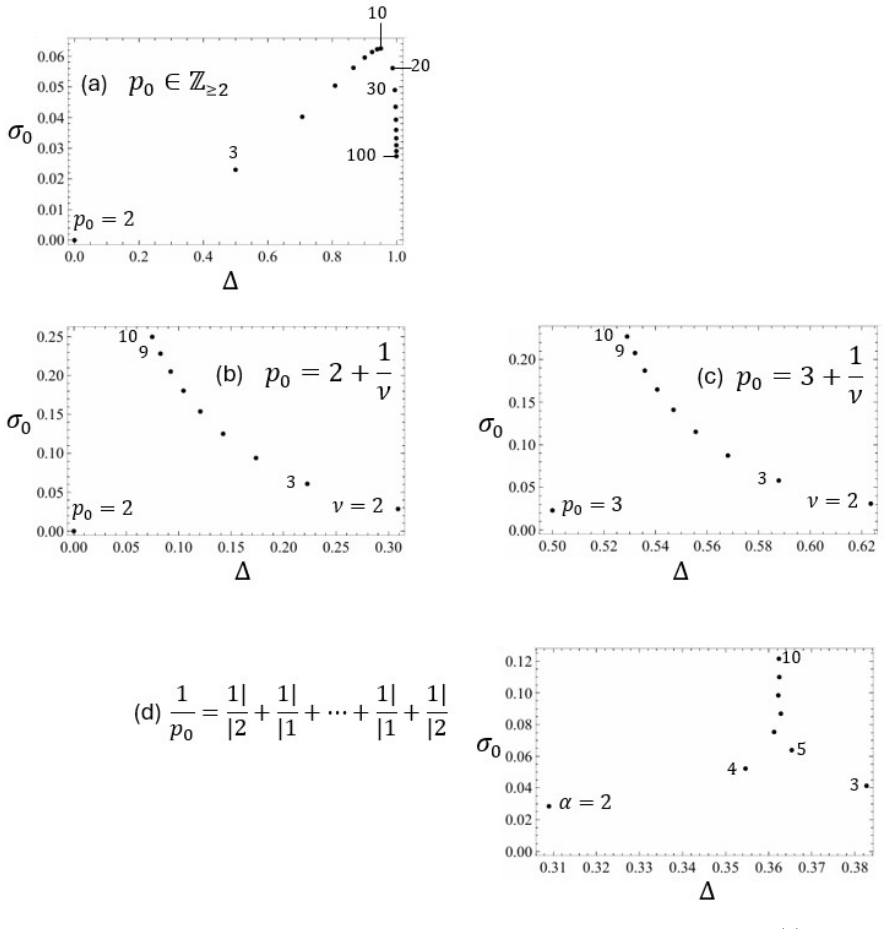
(d) p_0 is given by the continued fraction ... At α=∞, the golden number (1+√5)/2 appears as p_0 = 1+(1+√5)/2.
What do these tags mean?
- matches
- The paper's claim is directly supported by a theorem in the formal canon.
- supports
- The theorem supports part of the paper's argument, but the paper may add assumptions or extra steps.
- extends
- The paper goes beyond the formal theorem; the theorem is a base layer rather than the whole result.
- uses
- The paper appears to rely on the theorem as machinery.
- contradicts
- The paper's claim conflicts with a theorem or certificate in the canon.
- unclear
- Pith found a possible connection, but the passage is too broad, indirect, or ambiguous to say the theorem truly supports the claim.
Reference graph
Works this paper leans on
-
[1]
Ballistic macroscopic fluctuation theory
B. Doyon, G. Perfetto, T. Sasamoto and T. Yoshimura, “Ballistic macroscopic fluctuation theory”, SciPost Phys.15, 136 (2023)
2023
-
[2]
Emergence of Hydrodynamic Spatial Long-Range Correlations in Nonequilibrium Many-Body Systems
B. Doyon, G. Perfetto, T. Sasamoto and T. Yoshimura, “Emergence of Hydrodynamic Spatial Long-Range Correlations in Nonequilibrium Many-Body Systems”, Phys. Rev. Lett.131, 027101 (2023)
2023
-
[3]
Continued fraction TBA and functional relations in XXZ model at root of unity
A. Kuniba, K. Sakai and J. Suzuki, “Continued fraction TBA and functional relations in XXZ model at root of unity”, Nucl. Phys. B525, 597 (1998)
1998
-
[4]
B. Doyon, “NONLINEAR PROJECTION FOR BALLISTIC CORRELATION FUNC- TIONS: A FORMULA IN TERMS OF MINIMAL CONNECTED COVERS”, arXiv:2506.05266v2 [cond-mat.stat-mech] (2025)
-
[5]
Spin Drude weight for the integrable XXZ chain with arbitrary spin
S. Ae and K. Sakai, “Spin Drude weight for the integrable XXZ chain with arbitrary spin”, J. Stat. Mech. (2024) 033104
2024
-
[6]
Diffusive Hydrodynamics from Long- Range Correlations
F. H¨ ubner, L. Biagetti, J. D. Nardis and B. Doyon, “Diffusive Hydrodynamics from Long- Range Correlations”, Phys. Rev. Lett.134, 187101 (2025)
2025
-
[7]
Lecture notes on generalised hydrodynamics
B. Doyon, “Lecture notes on generalised hydrodynamics”, SciPost Phys. Lect. Notes 18 (2020)
2020
-
[8]
Infinite temperature spin dc conductivity of the spin-1/2 XXZ chain
S. Ae, “Infinite temperature spin dc conductivity of the spin-1/2 XXZ chain”, J. Phys. A: Math. Theor.57, 445204 (2024)
2024
-
[9]
Anomalous current fluctuations from Euler hydrodynam- ics
T. Yoshimura and ˇZ. Krajnik, “Anomalous current fluctuations from Euler hydrodynam- ics”, Phys. Rev. E111, 024141 (2025)
2025
-
[10]
Exactly solvable deterministic lattice model of crossover between ballistic and diffusive transport
K. Klobas, M. Medenjak and T. Prosen, “Exactly solvable deterministic lattice model of crossover between ballistic and diffusive transport”, J. Stat. Mech. (2018) 123202
2018
-
[11]
Anomalous hydrodynamic fluctuations in the quantum XXZ spin chain
T. Yoshimura, ¨ z. Krajnik, A. Bastianello and E. Ilievski “Anomalous hydrodynamic fluctuations in the quantum XXZ spin chain”, arXiv:2602.24242v3 [cond-mat.stat-mech] (2026)
-
[12]
One-Dimensional Anisotropic Heisenberg Model at Finite Temperatures
M. Takahashi and M. Suzuki, “One-Dimensional Anisotropic Heisenberg Model at Finite Temperatures”, Prog. Theor. Phys.48, 2187 (1972)
1972
-
[13]
Thermodynamics of One-dimensional Solvable Models
M. Takahashi, “Thermodynamics of One-dimensional Solvable Models”, Cambridge Uni- versity Press (1999)
1999
-
[14]
Transport in Out-of-Equilibrium XXZ Chains: Exact Profiles of Charges and Currents
B. Bertini, M. Collura, J. D. Nardis and M. Fagotti, “Transport in Out-of-Equilibrium XXZ Chains: Exact Profiles of Charges and Currents”, Phys. Rev. Lett.117, 207201 (2016)
2016
-
[15]
Emergent Hydrodynamics in Integrable Quantum Systems out of Equilibrium
O. A. Castro-Alvaredo, B. Doyon and T. Yoshimura, “Emergent Hydrodynamics in Integrable Quantum Systems out of Equilibrium”, Phys. Rev. X6, 041065 (2016). 27
2016
-
[16]
Bethe-Boltzmann hydro- dynamics and spin transport in the XXZ chain
V. B. Bulchandani, R. Vasseur, C. Karrasch and J. E. Moore, “Bethe-Boltzmann hydro- dynamics and spin transport in the XXZ chain”, Phys. Rev. B97, 045407 (2018)
2018
-
[17]
Quantum Inverse Scattering Method and Correlation Functions
V. E. Korepin, N. M. Bogoliubov and A. G. Izergin, “Quantum Inverse Scattering Method and Correlation Functions”, Cambridge University Press (1993)
1993
-
[18]
A note on generalized hydrodynamics: inhomogeneous fields and other concepts
B. Doyon and T. Yoshimura, “A note on generalized hydrodynamics: inhomogeneous fields and other concepts”, SciPost Phys.2, 014 (2017)
2017
-
[19]
A geometric viewpoint on generalized hydro- dynamics
B. Doyon, H. Spohn and T. Yoshimura, “A geometric viewpoint on generalized hydro- dynamics”, Nucl. Phys. B926, 570 (2018)
2018
-
[20]
Susceptibility of the spin 1/2 Heisenberg anti- ferromagnetic chain
S. Eggert, I. Affleck and M. Takahashi, “Susceptibility of the spin 1/2 Heisenberg anti- ferromagnetic chain” Phys. Rev. Lett.73, 332 (1994)
1994
-
[21]
Statistical-Mechanical Theory of Irreversible Processes. I. General Theory and Simple Applications to Magnetic and Conduction Problems
R. Kubo, “Statistical-Mechanical Theory of Irreversible Processes. I. General Theory and Simple Applications to Magnetic and Conduction Problems”, J. Phys. Soc. Jpn.12, 570 (1957)
1957
-
[22]
Finite Temperature Drude Weight of the One-Dimensional Spin- 1/2 Heisen- berg Model
X. Zotos, “Finite Temperature Drude Weight of the One-Dimensional Spin- 1/2 Heisen- berg Model”, Phys. Rev. Lett.82, 1764 (1999)
1999
-
[23]
The spin Drude weight of the XXZ chain and generalized hydrodynamics
A. Urichuk, Y. ¨Oz, A. Kl¨ umper and J. Sirker, “The spin Drude weight of the XXZ chain and generalized hydrodynamics”, SciPost Phys.6, 005 (2019)
2019
-
[24]
Classification of the string solutions of Bethe equations in an XXZ model of arbitrary spin
A. Kirillov and N. Reshetikhin, “Classification of the string solutions of Bethe equations in an XXZ model of arbitrary spin”, Zap. Nauch. Semin. LOMI146, 31-46 (1985)
1985
-
[25]
Classification of the string solutions of Bethe equations in an XXZ model of arbitrary spin
A. Kirillov and N. Reshetikhin, “Classification of the string solutions of Bethe equations in an XXZ model of arbitrary spin”, J. Sov. Math.40, 22-35 (1988)
1988
-
[26]
Particle-hole pairs and density–density correlations in the Lieb–Liniger model
J. D. Nardis and M. Panfil, “Particle-hole pairs and density–density correlations in the Lieb–Liniger model”, J. Stat. Mech. (2018) 033102
2018
-
[27]
Diffusion in generalized hydrodynamics and quasiparticle scattering
J. D. Nardis, D. Bernard and B. Doyon, “Diffusion in generalized hydrodynamics and quasiparticle scattering”, SciPost Phys.6, 049 (2019)
2019
-
[28]
One-Dimensional Heisenberg Model at Finite Temperatures
M. Takahashi, “One-Dimensional Heisenberg Model at Finite Temperatures”, Prog. Theor. Phys.46, 401 (1971)
1971
-
[29]
Superdiffusion in One- Dimensional Quantum Lattice Models
E. Ilievski, J. D. Nardis, M. Medenjak and T. Prosen, “Superdiffusion in One- Dimensional Quantum Lattice Models”, Phys. Rev. Lett.121, 230602 (2018)
2018
-
[30]
Kinetic theory of spin diffusion and superdiffusion in XXZ spin chains
S. Gopalakrishnan and R. Vasseur, “Kinetic theory of spin diffusion and superdiffusion in XXZ spin chains”, Phys. Rev. Letters122, 127202 (2019)
2019
-
[31]
Dynamic Scaling of Growing Interfaces
M. Kardar, G. Parisi and Y. C. Zhang, “Dynamic Scaling of Growing Interfaces”, Phys. Rev. Lett.56, 889 (1986)
1986
-
[32]
Kardar-Parisi-Zhang physics in the quantum Heisenberg magnet
M. Ljubotina, M. ˇZnidariˇ c, and T. Prosen, “Kardar-Parisi-Zhang physics in the quantum Heisenberg magnet”, Phys. Rev. Lett.122, 210602 (2019). 28
2019
-
[33]
Absence of Normal Fluctuations in an Integrable Magnet
ˇZ. Krajnik, E. Ilievski and T. Prosen, “Absence of Normal Fluctuations in an Integrable Magnet”, Phys. Rev. Lett.128, 090604 (2022)
2022
-
[34]
Dynamics of magnetization at infinite temperature in a Heisenberg spin chain
E. Rosenberg et al., “Dynamics of magnetization at infinite temperature in a Heisenberg spin chain”, Science384, 48-53 (2024). 29
2024
discussion (0)
Sign in with ORCID, Apple, or X to comment. Anyone can read and Pith papers without signing in.