Recognition: unknown
Production Rate of Glueball-like X(2370) in J/psi Radiative Decay
Pith reviewed 2026-05-09 17:16 UTC · model grok-4.3
The pith
Mixing with charmonium can make the glueball candidate X(2370) appear at much higher rates in J/ψ radiative decays.
A machine-rendered reading of the paper's core claim, the machinery that carries it, and where it could break.
Core claim
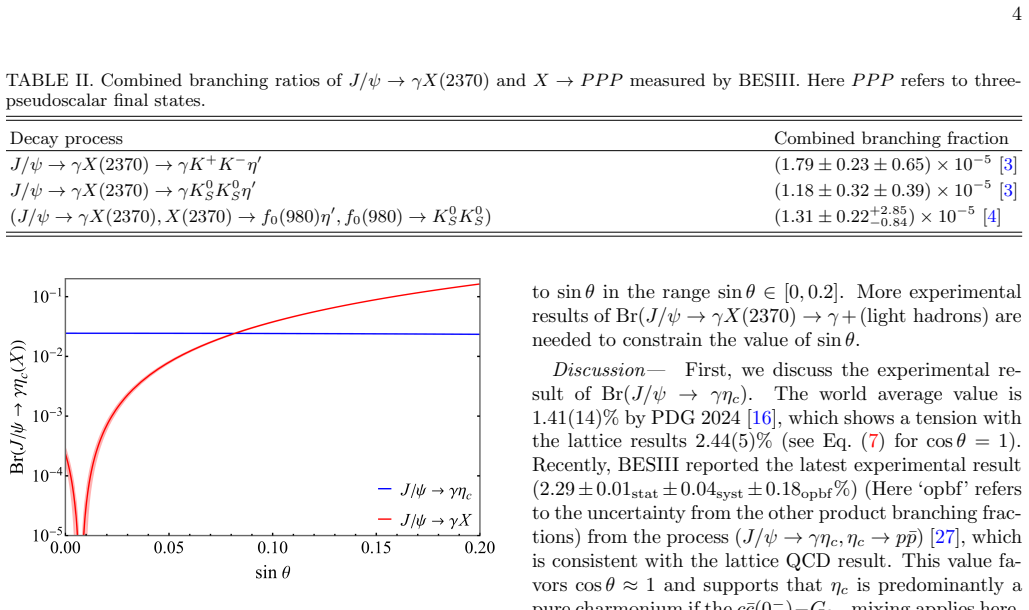
X(2370) and η_c are admixtures of the pseudoscalar glueball G_{0^-} and the charmonium state c c-bar (0^-) with a small mixing angle sinθ. Although Br(J/ψ → γ η_c) remains insensitive to this small angle, Br(J/ψ → γ X(2370)) is strongly enhanced by the larger kinematic factor for the lighter X(2370) and the large transition form factor of the charmonium component, so that the rate can exceed the pure-glueball prediction of 2.3(8)×10^{-4} depending on the value of sinθ.
What carries the argument
The small mixing angle sinθ between the pseudoscalar glueball and the charmonium state that transfers the large transition form factor of the charmonium component into the production amplitude for X(2370).
If this is right
- Br(J/ψ → γ X(2370)) can exceed the pure-glueball lattice value once sinθ is nonzero but still small.
- BESIII data currently prefer sinθ of order 1 degree.
- Further measurements of X(2370) decay modes can tighten the allowed range for sinθ under the mixing assumption.
- Br(J/ψ → γ η_c) shows little sensitivity to the same small mixing angle.
Where Pith is reading between the lines
- If the mixing picture holds, similar small admixtures may appear in other glueball candidates and alter how lattice results are compared with experiment.
- Precision studies of the relative rates to X(2370) and η_c could map out the mixing angle without needing new lattice runs.
- The mechanism suggests that observed 'glueball-like' states may routinely contain quarkonium fractions large enough to dominate certain production channels.
Load-bearing premise
That X(2370) really is a glueball-charmonium admixture with a mixing angle of order one degree and that the charmonium transition form factor stays large.
What would settle it
A measurement that finds Br(J/ψ → γ X(2370)) near or below 2.3×10^{-4} while other decay properties of X(2370) remain similar to those of η_c would remove the room for the mixing enhancement.
Figures


read the original abstract
$X(2370)$ falls in the mass region of the lowest pseudoscalar glueball predicted by lattice QCD studies and its decay properties are similar to those of $\eta_c$. A previous lattice QCD study finds that the pseudoscalar glueball ($G_{0^-}$) and the lowest pseudoscalar charmonium ($c\bar{c}(0^-)$) can mix with a small mixing angle $\sin\theta$. It is therefore possible that $X(2370)$ and $\eta_c$ are admixtures of $G_{0^-}$ and $c\bar{c}(0^-)$. In this picture, although $\mathrm{Br}(J/\psi\to\gamma\eta_c)$ is insensitive to the small $\sin\theta$, $\mathrm{Br}(J/\psi\to \gamma X(2370))$ can be enlarged drastically by the mixing due to the much larger kinematic factor for $J/\psi\to \gamma X(2370)$ and the much larger transition form factor for $J/\psi\to \gamma (c\bar{c}(0^{-}))$. Depending on the value of $\sin\theta$, $\mathrm{Br}(J/\psi\to \gamma X(2370))$ can be much larger than that of the pure pseudoscalar glueball, namely, $2.3(8)\times 10^{-4}$ that is predicted by a quenched lattice QCD calculation. Present results by BESIII favor a small mixing angle of $\mathcal{O}(1^\circ)$, which can be further constrained by more measurements of $X(2370)$ decays if the mixing picture applies here.
Editorial analysis
A structured set of objections, weighed in public.
Referee Report
Summary. The manuscript proposes that the X(2370) resonance is an admixture of the pseudoscalar glueball G_{0^-} and the charmonium state c c-bar(0^-) with a small mixing angle sinθ of O(1°). Under this mixing, Br(J/ψ → γ X(2370)) is enhanced relative to the pure-glueball baseline of 2.3(8)×10^{-4} from quenched lattice QCD because of the larger kinematic factor at the higher mass and the larger transition form factor inherited from the c c-bar component; BESIII data are said to favor the small mixing angle.
Significance. If the mixing picture and the form-factor scaling are valid, the work supplies a concrete, falsifiable link between the observed production rate of X(2370) and lattice glueball predictions, while offering a method to constrain the mixing angle through additional decay measurements. The use of an independent quenched-lattice baseline (rather than a fit to the same data) avoids circularity in the enhancement estimate and is a positive feature.
major comments (1)
- [Abstract and the paragraph introducing the mixing-enhanced branching ratio] The central claim that the branching ratio is 'enlarged drastically' rests on the statement that the transition form factor for J/ψ → γ (c c-bar(0^-)) 'remains large' at the X(2370) mass and is only rescaled by kinematics. No explicit evaluation or reference is supplied showing that the momentum-space overlap integral does not fall appreciably when the photon recoil increases from ~115 MeV (η_c) to ~640 MeV (X(2370)). This assumption is load-bearing for whether |sinθ|^2 times the kinematic ratio can exceed the pure-glueball value.
minor comments (2)
- [Abstract] The abstract states that 'present results by BESIII favor a small mixing angle of O(1°)' without quoting the specific observable, the fit procedure, or the resulting uncertainty on sinθ.
- [Abstract] Notation for the mixing angle alternates between θ and sinθ in the abstract; a single consistent symbol and a brief definition would improve clarity.
Simulated Author's Rebuttal
We thank the referee for the careful reading of our manuscript and for the constructive major comment. The positive assessment of the work's significance and the avoidance of circularity in using the quenched lattice baseline are appreciated. We address the major comment below.
read point-by-point responses
-
Referee: [Abstract and the paragraph introducing the mixing-enhanced branching ratio] The central claim that the branching ratio is 'enlarged drastically' rests on the statement that the transition form factor for J/ψ → γ (c c-bar(0^-)) 'remains large' at the X(2370) mass and is only rescaled by kinematics. No explicit evaluation or reference is supplied showing that the momentum-space overlap integral does not fall appreciably when the photon recoil increases from ~115 MeV (η_c) to ~640 MeV (X(2370)). This assumption is load-bearing for whether |sinθ|^2 times the kinematic ratio can exceed the pure-glueball value.
Authors: We agree that the assumption concerning the transition form factor for the charmonium component is central to the enhancement claim and that the manuscript would benefit from a more explicit justification. The reasoning in the paper is that the c c-bar wave-function overlap integral, governed by the compact size of the charmonium system, varies only mildly over the photon-energy range from ~115 MeV to ~640 MeV, so that the dominant effect remains the kinematic prefactor. However, we acknowledge that no dedicated evaluation or supporting reference was supplied. In the revised manuscript we will expand the relevant paragraph (both in the abstract and in the main text) to include a short discussion of this point, citing potential-model and lattice studies of radiative charmonium transitions that indicate only modest suppression of the form factor in this kinematic window. This addition will make the argument self-contained while leaving the overall conclusions unchanged. revision: yes
Circularity Check
No significant circularity; derivation uses independent lattice inputs and phenomenological mixing without self-referential reduction.
full rationale
The paper takes the pure-glueball branching ratio 2.3(8)×10^{-4} from an external quenched lattice QCD calculation and the small mixing angle sinθ from a prior lattice study as fixed inputs. The claimed enhancement of Br(J/ψ→γX(2370)) is then obtained by adding the ccbar admixture contribution scaled by the kinematic factor (p_γ ≈ 640 MeV) and the assumed transition form factor; neither quantity is fitted to the target branching ratio nor defined in terms of the output. BESIII data are invoked only to bound sinθ after the fact, not to force the prediction. No equation reduces to its own input by construction, no parameter is renamed as a prediction, and no uniqueness theorem or ansatz is smuggled via self-citation. The chain remains self-contained against the cited external benchmarks.
Axiom & Free-Parameter Ledger
free parameters (1)
- sinθ
axioms (2)
- domain assumption Quenched lattice QCD gives Br(J/ψ → γ G_{0^-}) = 2.3(8)×10^{-4}
- domain assumption The transition form factor for J/ψ → γ (c c-bar(0^-)) is much larger than for the pure glueball
Reference graph
Works this paper leans on
-
[1]
M. Ablikimet al.(BESIII), Confirmation of theX(1835) and observation of the resonancesX(2120) andX(2370) inJ/ψ→γπ +π−η′, Phys. Rev. Lett.106, 072002 (2011), arXiv:1012.3510 [hep-ex]
-
[2]
M. Ablikimet al.(BESIII), Observation of an anoma- lous line shape of theη ′π+π− mass spectrum near the p¯pmass threshold inJ/ψ→γη ′π+π−, Phys. Rev. Lett. 117, 042002 (2016), arXiv:1603.09653 [hep-ex]
-
[3]
Ablikimet al.(BESIII), Observation ofX(2370) and search for X(2120) inJ/ψ→γK ¯Kη ′, Eur
M. Ablikimet al.(BESIII), Observation ofX(2370) and search for X(2120) inJ/ψ→γK ¯Kη ′, Eur. Phys. J. C 80, 746 (2020), arXiv:1912.11253 [hep-ex]
-
[4]
M. Ablikimet al.(BESIII), Determination of Spin- Parity Quantum Numbers ofX(2370) as 0 −+ from J/ψ→γK 0 SK0 Sη′, Phys. Rev. Lett.132, 181901 (2024), arXiv:2312.05324 [hep-ex]
- [5]
- [6]
-
[7]
Chenet al., Glueball spectrum and matrix elements on anisotropic lattices, Phys
Y. Chenet al., Glueball spectrum and matrix elements on anisotropic lattices, Phys. Rev. D73, 014516 (2006), arXiv:hep-lat/0510074
- [8]
-
[9]
A. Athenodorou and M. Teper, The glueball spectrum of SU(3) gauge theory in 3 + 1 dimensions, JHEP11, 172, arXiv:2007.06422 [hep-lat]
- [10]
- [11]
-
[12]
A. Athenodorou, J. Finkenrath, A. Lantos, and M. Teper, Glueball Spectrum with four light dynamical fermions (2023), arXiv:2308.10054 [hep-lat]
-
[13]
Y.-D. Tsai, H.-n. Li, and Q. Zhao,η c mixing effects on charmonium andBmeson decays, Phys. Rev. D85, 034002 (2012), arXiv:1110.6235 [hep-ph]
- [14]
- [15]
-
[16]
Navaset al.(Particle Data Group), Review of particle physics, Phys
S. Navaset al.(Particle Data Group), Review of particle physics, Phys. Rev. D110, 030001 (2024)
2024
- [17]
-
[18]
B. Colquhoun, L. J. Cooper, C. T. H. Davies, and G. P. Lepage (Particle Data Group, HPQCD, (HPQCD Collaboration)‡), Precise determination of decay rates forη c →γγ,J/ψ→γη c, andJ/ψ→η ce+e− from lattice QCD, Phys. Rev. D108, 014513 (2023), arXiv:2305.06231 [hep-lat]. 6
-
[19]
Chenet al., Radiative transitions in charmonium from Nf = 2 twisted mass lattice QCD, Phys
Y. Chenet al., Radiative transitions in charmonium from Nf = 2 twisted mass lattice QCD, Phys. Rev. D84, 034503 (2011), arXiv:1104.2655 [hep-lat]
-
[20]
D. Becirevic and F. Sanfilippo, Lattice QCD study of the radiative decaysJ/ψ→η cγandh c →η cγ, JHEP 01, 028, arXiv:1206.1445 [hep-lat]
- [21]
- [22]
- [23]
- [24]
- [25]
- [26]
-
[27]
Study of the Magnetic Dipole Transition of $J/\psi\to\gamma\eta_c$ via $\eta_c\to p\bar{p}$
M. Ablikimet al.(BESIII), Study of the Magnetic Dipole Transition ofJ/ψ→γη c viaη c →p¯p, Phys. Rev. Lett. 136, 051901 (2026), arXiv:2510.15247 [hep-ex]
work page internal anchor Pith review Pith/arXiv arXiv 2026
- [28]
discussion (0)
Sign in with ORCID, Apple, or X to comment. Anyone can read and Pith papers without signing in.