Recognition: unknown
Hindered transport of spherical particles in cylindrical pores: The role of structural heterogeneity in rejection-permeability trade-offs
Pith reviewed 2026-05-09 16:46 UTC · model grok-4.3
The pith
Dual heterogeneity in particle and pore sizes shifts the rejection-permeability trade-off toward higher permeability at fixed rejection.
A machine-rendered reading of the paper's core claim, the machinery that carries it, and where it could break.
Core claim
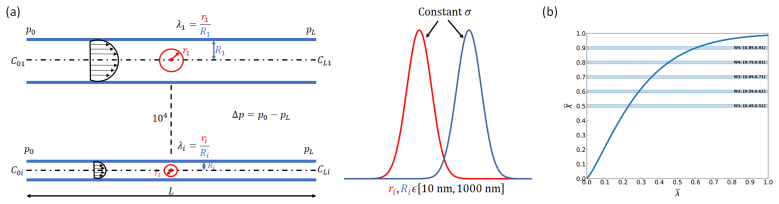
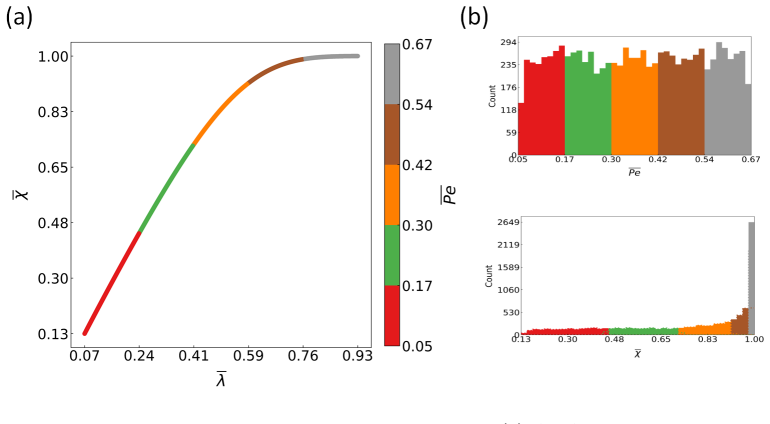
In a steric hindered-transport framework for spherical particles in cylindrical pores that explicitly resolves both single and coupled dual heterogeneity in size distributions, the ensemble-averaged rejection increases with the particle-pore aspect ratio λ and with the Péclet number Pe, while advection enhances steric exclusion by up to ∼20% at intermediate λ. Dual heterogeneity broadens the distribution of effective Pe, increases the variability and incidence of anomalous rejection trends, and systematically shifts the rejection-permeability trade-off toward higher permeability at fixed rejection.
What carries the argument
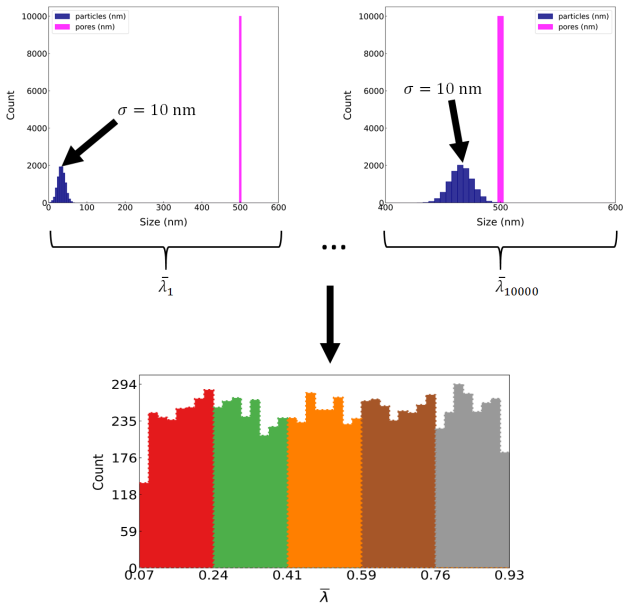
The steric hindered-transport framework that computes local advection-diffusion balances for each pore-particle pair and then performs ensemble averaging over coupled distributions of particle and pore sizes.
Load-bearing premise
The steric hindered-transport framework and ensemble averaging over size distributions fully capture the local advection-diffusion balance in real heterogeneous media without additional particle-pore interactions or non-spherical effects.
What would settle it
Direct measurement of rejection and permeability in membranes fabricated with independently controlled distributions of pore diameters and particle diameters, then comparison against the model's predictions for the same dual-heterogeneity statistics.
Figures



read the original abstract
Membrane separations rely on balancing rejection and permeability. Extensive work has clarified how pore structure and operating conditions control each quantity in idealized or weakly heterogeneous systems. However, it remains unclear how this trade-off emerges in strongly heterogeneous media, where coupled distributions of pore and particle sizes shape the local balance between advection and diffusion and generate substantial variability in performance among distribution realizations. Here we present a steric hindered-transport framework for spherical particles in cylindrical pores that explicitly resolves both single and coupled dual heterogeneity in size distributions. We show that the ensemble-averaged rejection increases with the particle-pore aspect ratio $\lambda$ and with the P\'eclet number $Pe$, while advection enhances steric exclusion by up to $\sim$20\% at intermediate $\lambda$. Dual heterogeneity broadens the distribution of effective $Pe$, increases the variability and incidence of anomalous rejection trends, while systematically shifting the rejection-permeability trade-off toward higher permeability at fixed rejection. These results suggest that controlled heterogeneity can serve as a design lever to expand the attainable operating space for simultaneous high selectivity and high throughput.
Editorial analysis
A structured set of objections, weighed in public.
Referee Report
Summary. The manuscript develops a steric hindered-transport framework for spherical particles in cylindrical pores that incorporates single and dual heterogeneity via distributions of particle and pore sizes. It computes ensemble-averaged rejection and permeability by resolving local advection-diffusion balance through size-based partitioning and Péclet number, reporting that rejection rises with aspect ratio λ and Pe, that advection enhances steric exclusion by up to ~20% at intermediate λ, and that dual heterogeneity broadens the effective-Pe distribution, increases anomalous-rejection variability, and shifts the rejection-permeability trade-off toward higher permeability at fixed rejection.
Significance. If the central results hold, the work demonstrates that controlled heterogeneity can expand the attainable membrane operating space beyond uniform-pore limits, providing a quantitative design lever for simultaneous selectivity and throughput. The explicit ensemble treatment of coupled size distributions and the resulting variability among realizations constitute a clear advance over idealized single-pore analyses.
major comments (3)
- [§2] §2 (Model formulation): The steric-only framework excludes hydrodynamic hindrance factors (e.g., Bungay-Brenner corrections) whose λ-dependence can couple to the same pore- and particle-size distributions used for the ensemble averages. Because the reported broadening of effective Pe and the systematic trade-off shift are generated entirely from these averages, the omission constitutes a load-bearing assumption whose quantitative impact on the claimed 20% enhancement and permeability shift must be bounded or shown to be negligible.
- [§4] §4 (Results, ensemble averages): The abstract states quantitative outcomes (20% advection enhancement, systematic shift) without accompanying error bars, sensitivity to distribution moments, or comparison against limiting cases (monodisperse, zero-Pe). These omissions make it impossible to assess whether the reported trends are robust or artifacts of particular distribution choices.
- [§3] §3 (Numerical implementation): No validation against known analytic limits (e.g., uniform pore, pure diffusion, or single-particle trajectory) or against existing hindered-transport literature is presented. Without such benchmarks, the reliability of the ensemble statistics that underpin the dual-heterogeneity claims cannot be verified.
minor comments (2)
- Notation for the local and effective Péclet numbers is introduced without a clear distinction in the text; a single equation or table defining both would improve readability.
- Figure captions should explicitly state the number of distribution realizations used for each ensemble average and the sampling method.
Simulated Author's Rebuttal
We thank the referee for the detailed and constructive report. The comments correctly identify areas where additional validation, sensitivity analysis, and discussion of assumptions will strengthen the manuscript. We will revise accordingly, as outlined in the point-by-point responses below.
read point-by-point responses
-
Referee: §2 (Model formulation): The steric-only framework excludes hydrodynamic hindrance factors (e.g., Bungay-Brenner corrections) whose λ-dependence can couple to the same pore- and particle-size distributions used for the ensemble averages. Because the reported broadening of effective Pe and the systematic trade-off shift are generated entirely from these averages, the omission constitutes a load-bearing assumption whose quantitative impact on the claimed 20% enhancement and permeability shift must be bounded or shown to be negligible.
Authors: We acknowledge that the steric-only framework is a deliberate modeling choice to isolate heterogeneity effects on partitioning and local Pe. Full hydrodynamic corrections are position-dependent within each pore and would require additional radial integration, substantially complicating the ensemble treatment. In the revision we will add a limitations subsection that (i) states the assumption explicitly, (ii) cites literature values for uniform-pore hydrodynamic factors, and (iii) provides order-of-magnitude bounds showing that the heterogeneity-induced broadening of effective Pe and the direction of the trade-off shift remain qualitatively robust even when hydrodynamic hindrance is approximated. Full quantitative incorporation lies beyond the present scope. revision: partial
-
Referee: §4 (Results, ensemble averages): The abstract states quantitative outcomes (20% advection enhancement, systematic shift) without accompanying error bars, sensitivity to distribution moments, or comparison against limiting cases (monodisperse, zero-Pe). These omissions make it impossible to assess whether the reported trends are robust or artifacts of particular distribution choices.
Authors: We agree that quantitative claims require supporting robustness checks. The revised manuscript will include: (i) error bars or shaded regions showing standard deviation across 200–500 independent realizations of each distribution, (ii) additional figures or panels varying the variance and shape parameters of the log-normal pore- and particle-size distributions, and (iii) explicit comparisons to the monodisperse limit and the pure-diffusion (Pe = 0) case. These additions will confirm that the reported ~20 % enhancement and permeability shift are consistent features rather than distribution-specific artifacts. revision: yes
-
Referee: §3 (Numerical implementation): No validation against known analytic limits (e.g., uniform pore, pure diffusion, or single-particle trajectory) or against existing hindered-transport literature is presented. Without such benchmarks, the reliability of the ensemble statistics that underpin the dual-heterogeneity claims cannot be verified.
Authors: We accept that explicit benchmarks were omitted from the initial submission. The numerical procedure samples size distributions and evaluates the exact analytic transmission probability for each realization under combined steric and advection-diffusion transport. In the revision we will add a dedicated validation subsection that recovers: (i) the classic steric rejection formula R = 1 − (1 − λ)^2 for uniform pores at Pe = 0, (ii) the single-pore hindered-transport curves from the literature (e.g., Deen 1987), and (iii) convergence of ensemble averages with increasing sample size. These checks will precede the heterogeneity results. revision: yes
Circularity Check
No significant circularity; derivation applies stated transport equations to input distributions
full rationale
The paper introduces a steric hindered-transport model based on advection-diffusion balance with size-based partitioning and local Peclet number, then computes ensemble averages over single and dual heterogeneity distributions. The reported trends (broadening of effective Pe, anomalous rejection variability, and shift in rejection-permeability trade-off) are generated outputs of these calculations rather than inputs or fitted parameters. No self-definitional loops, fitted inputs renamed as predictions, or load-bearing self-citations appear in the derivation chain; the framework remains independent of the target results.
Axiom & Free-Parameter Ledger
axioms (2)
- domain assumption Particle transport is governed by steric hindrance combined with advection and diffusion
- domain assumption Ensemble averages over independent or coupled size distributions represent effective media behavior
Reference graph
Works this paper leans on
-
[1]
M. A. Shannon, P. W. Bohn, M. Elimelech, J. G. Georgiadis, B. J. Mariñas, A. M. Mayes, Science and technology for water purification in the coming decades, Nature 452 (7185) (2008). URLhttps://www.nature.com/articles/nature06599
2008
-
[2]
J. R. Werber, C. O. Osuji, M. Elimelech, Materials for next-generation desalination and water purification membranes, Nature Reviews Mate- rials 1 (2016) 16018. URLhttps://doi.org/10.1038/natrevmats.2016.18
-
[3]
M. Elimelech, W. A. Phillip, The future of seawater desalination: En- ergy, technology, and the environment, Science 333 (6043) (2011). URLhttps://doi.org/10.1126/science.1200488
-
[4]
Charcosset, Membrane processes in biotechnology: An overview, Biotechnology Advances 24 (5) (2006)
C. Charcosset, Membrane processes in biotechnology: An overview, Biotechnology Advances 24 (5) (2006). URLhttps://doi.org/10.1016/j.biotechadv.2006.03.002
-
[5]
C. Charcosset, Classical and recent applications of membrane processes in the food industry, Food Engineering Reviews 13 (2) (2021). URLhttps://doi.org/10.1007/s12393-020-09262-9
-
[6]
S. Hube, M. Eskafi, K. F. Hrafnkelsdottir, B. Bjarnadottir, M. A. Bjar- nadottir, S. Axelsdottir, B. Wu, Direct membrane filtration for wastew- ater treatment and resource recovery: A review, Science of the Total Environment 710 (2020) 136375. URLhttps://doi.org/10.1016/j.scitotenv.2019.136375
-
[7]
S. H. Chang, Utilization of green organic solvents in solvent extraction and liquid membrane for sustainable wastewater treatment and resource recovery—a review, Environmental Science and Pollution Research 27 (26) (2020) 32371–32388. URLhttps://link.springer.com/article/10.1007/ s11356-020-09639-7
2020
-
[8]
R. Zhang, J. Tian, S. Gao, B. Van der Bruggen, How to coordi- nate the trade-off between water permeability and salt rejection in nanofiltration?, Journal of Materials Chemistry A 8 (2020) 8831–8847. 22 doi:10.1039/D0TA02510K. URLhttps://doi.org/10.1039/D0TA02510K
-
[9]
K.P.Lee, T.C.Arnot, D.Mattia, Areviewofreverseosmosismembrane materials for desalination—development to date and future potential, Journal of Membrane Science 370 (1–2) (2011) 1–22.doi:10.1016/j. memsci.2010.12.036. URLhttps://doi.org/10.1016/j.memsci.2010.12.036
work page doi:10.1016/j 2011
-
[10]
Y. J. Lim, K. Goh, M. Kurihara, R. Wang, Seawater desalination by re- verse osmosis: Current development and future challenges in membrane fabrication—a review, Journal of Membrane Science 629 (2021) 119292. doi:10.1016/j.memsci.2021.119292. URLhttps://doi.org/10.1016/j.memsci.2021.119292
-
[11]
G. M. Geise, H. B. Park, A. C. Sagle, B. D. Freeman, J. E. McGrath, Water permeability and water/salt selectivity tradeoff in polymers for desalination, Journal of Membrane Science 369 (1–2) (2011) 130–138. URLhttps://doi.org/10.1016/j.memsci.2010.11.054
-
[12]
Zhang, G
H. Zhang, G. M. Geise, Modeling the water permeability and water/salt selectivity tradeoff in polymer membranes, Journal of Membrane Science 520 (2016) 790–800. URLhttps://www.sciencedirect.com/science/article/pii/ S0376738816304057
2016
-
[13]
M. U. Siddiqui, A. F. M. Arif, S. Bashmal, Permeability-selectivity analysis of microfiltration and ultrafiltration membranes: Effect of pore size and shape distribution and membrane stretching, Membranes 6 (3) (2016) 40. URLhttps://doi.org/10.3390/membranes6030040
-
[14]
A. Mehta, A. L. Zydney, Permeability and selectivity analysis for ul- trafiltration membranes, Journal of Membrane Science 249 (1-2) (2005) 245–249.doi:10.1016/j.memsci.2004.09.040
-
[15]
D. M. Kanani, W. H. Fissell, S. Roy, A. Dubnisheva, A. Fleischman, A. L. Zydney, Permeability–selectivity analysis for ultrafiltration: Effect of pore geometry, Journal of Membrane Science 349 (1-2) (2010) 405– 410.doi:10.1016/j.memsci.2009.12.003. 23
-
[16]
S.Mochizuki, A.L. Zydney, Theoretical analysis ofporesize distribution effects on membrane transport, Journal of Membrane Science 82 (3) (1993) 211–227.doi:10.1016/0376-7388(93)85186-Z
-
[17]
W. M. Deen, Hindered transport of large molecules in liquid-filled pores, AIChE Journal 33 (9) (1987) 1409–1425.doi:10.1002/aic.690330902. URLhttps://doi.org/10.1002/aic.690330902
-
[18]
P. Dechadilok, W. M. Deen, Hindrance factors for diffusion and con- vection in pores, Industrial & Engineering Chemistry Research 45 (21) (2006) 6953–6959. URLhttps://doi.org/10.1021/ie051387n
-
[19]
E. M. Renkin, Filtration, diffusion, and molecular sieving through porouscellulosemembranes, JournalofGeneralPhysiology38(2)(1954) 225–243. URLhttps://doi.org/10.1085/jgp.38.2.225
-
[20]
J. L. Anderson, J. A. Quinn, Restricted transport in small pores: A model for steric exclusion and hindered particle motion, Biophysical Journal 14 (2) (1974) 130–150. URLhttps://doi.org/10.1016/S0006-3495(74)70005-4
-
[21]
M. G. Davidson, W. M. Deen, Hydrodynamic theory for the hindered transport of flexible macromolecules in porous membranes, Journal of Membrane Science 35 (2) (1988) 167–192. URLhttps://doi.org/10.1016/S0376-7388(00)82442-4
-
[22]
R. J. Phillips, W. M. Deen, J. F. Brady, Hindered transport in fibrous membranes and gels: Effect of solute size and fiber configuration, Jour- nal of Colloid and Interface Science 139 (2) (1990) 363–373. URLhttps://doi.org/10.1016/0021-9797(90)90110-A
-
[23]
P. M. Bungay, H. Brenner, The motion of a closely-fitting sphere in a fluid-filled tube, International Journal of Multiphase Flow 1 (1) (1973) 25–56. URLhttps://www.sciencedirect.com/science/article/pii/ 0301932273900037
1973
-
[24]
Aimar, M
P. Aimar, M. Meireles, V. Sanchez, A contribution to the translation of retention curves into pore size distributions for sieving membranes, 24 Journal of Membrane Science 54 (3) (1990) 321–338.doi:10.1016/ S0376-7388(00)80618-3
1990
-
[25]
Mochizuki, A
S. Mochizuki, A. L. Zydney, Dextran transport through asymmetric ultrafiltration membranes: Comparison with hydrodynamic models, Journal of Membrane Science 68 (1-2) (1992) 21–41.doi:10.1016/ 0376-7388(92)80147-C
1992
-
[26]
W. R. Bowen, H. Mukhtar, Characterisation and prediction of sepa- ration performance of nanofiltration membranes, Journal of Membrane Science 112 (2) (1996) 263–274.doi:10.1016/0376-7388(95)00302-9
-
[27]
W. R. Bowen, A. W. Mohammad, N. Hilal, Characterisation of nanofil- tration membranes for predictive purposes—use of salts, uncharged so- lutes and atomic force microscopy, Journal of Membrane Science 126 (1) (1997) 91–105.doi:10.1016/S0376-7388(96)00276-1
-
[28]
S. Mondal, I. M. Griffiths, G. Z. Ramon, Forefronts in structure– performance models of separation membranes, Journal of Membrane Science 588 (2019) 117166.doi:10.1016/j.memsci.2019.06.006
-
[29]
A. C. Habert, C. P. Borges, F. de Araujo Kronemberger, F. H. Con- ceição, R. Nobrega, Membrane separation processes, in: Purification of Biotechnological Products, CRC Press, 2024, pp. 82–126
2024
-
[30]
C. Tang, M. L. Bruening, Ion separations with membranes, Journal of Polymer Science 58 (20) (2020) 2831–2856. URLhttps://onlinelibrary.wiley.com/doi/full/10.1002/pol. 20200500
work page doi:10.1002/pol 2020
-
[31]
D. Yadav, M. Borpatra Gohain, S. Karki, P. G. Ingole, A novel ap- proach for the development of low-cost polymeric thin-film nanocompos- ite membranes for the biomacromolecule separation, ACS omega 7 (51) (2022) 47967–47985. URLhttps://pubs.acs.org/doi/full/10.1021/acsomega.2c05861
-
[32]
J. M. Dickhout, J. Moreno, P. Biesheuvel, L. Boels, R. Lammertink, W. De Vos, Produced water treatment by membranes: A review from a colloidal perspective, Journal of colloid and interface science 487 (2017) 523–534. 25 URLhttps://www.sciencedirect.com/science/article/pii/ S0021979716307652
2017
-
[33]
Shiohara, B
A. Shiohara, B. Prieto-Simon, N. H. Voelcker, Porous polymeric mem- branes: Fabrication techniques and biomedical applications, Journal of Materials Chemistry B 9 (9) (2021) 2129–2154. URLhttps://pubs.rsc.org/en/content/articlehtml/2020/tb/ d0tb01727b
2021
-
[34]
B. Gates, Y. Yin, Y. Xia, Fabrication and characterization of porous membranes with highly ordered three-dimensional periodic structures, Chemistry of Materials 11 (10) (1999) 2827–2836. URLhttps://pubs.acs.org/doi/full/10.1021/cm990195d
-
[35]
Nakao, Determination of pore size and pore size distribution: 3
S.-i. Nakao, Determination of pore size and pore size distribution: 3. filtration membranes, Journal of Membrane Science 96 (1–2) (1994) 131– 165. URLhttps://doi.org/10.1016/0376-7388(94)00128-6
-
[36]
W. R. Bowen, J. S. Welfoot, Modelling of membrane nanofiltration— poresizedistributioneffects, ChemicalEngineeringScience57(8)(2002) 1393–1407.doi:10.1016/S0009-2509(01)00412-2
-
[37]
B. Gu, L. Kondic, L. J. Cummings, Flow through pore-size graded mem- brane pore network, Physical Review Fluids 8 (2023) 044502. URLhttps://doi.org/10.1103/PhysRevFluids.8.044502
-
[38]
A. L. Zydney, P. Aimar, M. Meireles, J. M. Pimbley, G. Belfort, Use of the log-normal probability density function to analyze membrane pore size distributions: functional forms and discrepancies, Journal of Mem- brane Science 91 (3) (1994) 293–298.doi:10.1016/0376-7388(94) 80090-1
-
[39]
A. Dagan, Y. Edery, Bifurcating paths: the relation between preferential pathways, channel splitting, under sampled regions, and tortuosity on the Darcy scale, Advances in Water Resources 184 (2024) 104622.doi: 10.1016/j.advwatres.2024.104622
-
[40]
Y. Edery, A. Guadagnini, H. Scher, B. Berkowitz, Origins of anoma- lous transport in heterogeneous media: Structural and dynamic con- trols, WaterResourcesResearch50(2)(2014)1490–1505.doi:10.1002/ 26 2013WR015111. URLhttp://doi.wiley.com/10.1002/2013WR015111 27
discussion (0)
Sign in with ORCID, Apple, or X to comment. Anyone can read and Pith papers without signing in.