Recognition: unknown
Collusion Relations and their Applications to Balance Theory
Pith reviewed 2026-05-09 16:34 UTC · model grok-4.3
The pith
Balance in signed networks is equivalent to collusivity of attack relations, even without symmetry.
A machine-rendered reading of the paper's core claim, the machinery that carries it, and where it could break.
Core claim
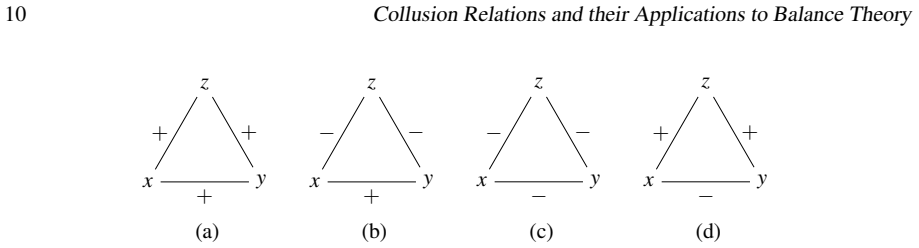
We characterize the balance property in signed frames in terms of a specific quadrangular property, namely collusivity. In this way, we generalize a classical result in balance theory by offering an alternative method for determining whether a network is polarized. That is, one can identify well-formed groups of agents that agree with one another within the same group (a set of allies) while disagreeing with, or attacking, agents outside the group. Furthermore, we extend the balance theorem to non-symmetric relations, thereby relaxing a condition required in standard balance theory. We conclude by giving a modal characterization of collusive frames, together with corresponding rules in a l
What carries the argument
Collusivity, the quadrangular property on binary attack relations that is necessary and sufficient for balance once the induced protection notion is consistent.
If this is right
- A network is polarized precisely when its attack relations satisfy collusivity on every four-element configuration.
- The classical balance theorem continues to hold after symmetry is dropped, provided protection remains consistent.
- Well-formed ally and attacker groups can be read off directly from the collusivity property.
- Previous modal axioms for balance are derivable inside the labeled sequent calculus for collusive frames.
Where Pith is reading between the lines
- The characterization may yield faster computational checks for polarization by scanning only local four-tuples rather than global partitions.
- Directed social or game-theoretic networks where alliances need not be mutual become directly amenable to balance analysis.
- Other quadrangular properties of relations may admit similar modal or sequent-calculus treatments.
Load-bearing premise
The notion of protection that arises from interpreting relations as attacks must be consistent for collusivity to coincide with the balance property.
What would settle it
A concrete signed frame in which collusivity holds yet the frame fails to be balanced (or the converse) while the protection consistency condition is satisfied.
Figures




read the original abstract
We study quadrangular properties of binary relations on a set $X$~--i.e., properties defined on configurations of four elements--~within an agonistic interpretation, where $xRy$ is interpreted as $x$ ``attacks''~$y$. Such relations induce a suitable notion of ``protection,'' and we provide necessary and sufficient conditions for this notion to be consistent. We characterize the balance property in signed frames in terms of a specific quadrangular property, namely collusivity. In this way, we generalize a classical result in balance theory by offering an alternative method for determining whether a network is polarized. That is, one can identify well-formed groups of agents that agree with one another within the same group (a set of allies) while disagreeing with, or attacking, agents outside the group. Furthermore, we extend the balance theorem to non-symmetric relations, thereby relaxing a condition required in standard balance theory. We conclude by giving a modal characterization of collusive frames, together with corresponding rules in a labeled sequent calculus, and we show that previous modal characterizations of balance are derivable within this system.
Editorial analysis
A structured set of objections, weighed in public.
Referee Report
Summary. The paper studies quadrangular properties of binary relations on a set X under an agonistic interpretation (xRy as x attacks y). These relations induce a protection notion, for which necessary and sufficient consistency conditions are supplied. The central claim is a characterization of the balance property in signed frames via collusivity (a specific quadrangular property), generalizing a classical result in balance theory. This yields an alternative method to determine network polarization and extends the balance theorem to non-symmetric relations. The paper concludes with a modal characterization of collusive frames, corresponding rules in a labeled sequent calculus, and a derivation showing that prior modal characterizations of balance are obtainable in this system.
Significance. If the derivations hold, the work supplies a new relational characterization of balance that relaxes the symmetry requirement standard in balance theory, together with a modal sequent calculus that derives earlier results. This could provide a formal tool for identifying polarized structures (allied groups that internally agree and externally attack) in networks without assuming symmetric relations. The explicit consistency conditions and modal rules constitute a verifiable contribution.
major comments (2)
- [section on consistency conditions and non-symmetric extension] The extension of the balance theorem to non-symmetric relations (abstract and the section stating the generalization) routes through the consistency of the induced protection relation. The manuscript supplies necessary and sufficient conditions for this consistency, yet it is unclear whether these conditions are automatically satisfied by the axioms of signed frames or whether they introduce restrictions absent from the classical symmetric case. An explicit check (e.g., that every signed frame satisfies the conditions, or a counter-example frame where they fail) is required to confirm that the claimed generalization preserves the original theorem without hidden constraints.
- [characterization theorem] The characterization theorem equating balance with collusivity is asserted to be necessary and sufficient. Because the non-symmetric direction depends on the consistency conditions, the proof must explicitly route through those conditions; without a small-frame verification or a derivation showing that collusivity implies balance once consistency holds, the load-bearing equivalence for the relaxed setting remains unconfirmed.
minor comments (2)
- Notation for signed frames and the protection relation should be introduced with an explicit definition before the consistency conditions are stated, to avoid forward references.
- The abstract refers to 'well-formed groups of agents'; if this is intended as a technical term, it should be defined or linked to the collusivity definition in the main text.
Simulated Author's Rebuttal
We thank the referee for the careful and constructive review. The comments on the consistency conditions and the characterization theorem are well-taken; we address them point by point below and will revise the manuscript accordingly to strengthen the presentation.
read point-by-point responses
-
Referee: [section on consistency conditions and non-symmetric extension] The extension of the balance theorem to non-symmetric relations (abstract and the section stating the generalization) routes through the consistency of the induced protection relation. The manuscript supplies necessary and sufficient conditions for this consistency, yet it is unclear whether these conditions are automatically satisfied by the axioms of signed frames or whether they introduce restrictions absent from the classical symmetric case. An explicit check (e.g., that every signed frame satisfies the conditions, or a counter-example frame where they fail) is required to confirm that the claimed generalization preserves the original theorem without hidden constraints.
Authors: We agree that an explicit verification is needed for clarity. The axioms of signed frames (irreflexivity of the attack relation together with the standard signed-frame closure properties) entail that the induced protection relation is always consistent; the necessary and sufficient conditions supplied in the paper are therefore satisfied by every signed frame. To make this transparent, we will insert a short lemma (new Lemma 3.3) proving that no signed frame can violate the consistency conditions, together with a brief argument that the non-symmetric generalization therefore carries no hidden restrictions beyond the classical symmetric case. revision: yes
-
Referee: [characterization theorem] The characterization theorem equating balance with collusivity is asserted to be necessary and sufficient. Because the non-symmetric direction depends on the consistency conditions, the proof must explicitly route through those conditions; without a small-frame verification or a derivation showing that collusivity implies balance once consistency holds, the load-bearing equivalence for the relaxed setting remains unconfirmed.
Authors: The existing proof of the characterization (Theorem 3.5) already proceeds in two steps: first collusivity is shown to imply consistency of protection (via the new Lemma 3.3 mentioned above), and only then is equivalence with balance established. We will revise the proof to make this routing fully explicit by adding forward references to the consistency lemma at each step. In addition, we will include a small four-element counter-example frame (new Example 3.6) that illustrates both the collusivity-to-consistency implication and the subsequent equivalence with balance, thereby confirming the non-symmetric direction. revision: yes
Circularity Check
No significant circularity; the collusivity characterization is an independent logical equivalence.
full rationale
The paper defines collusivity and the induced protection relation from first principles on signed frames, supplies necessary and sufficient conditions for consistency of protection, and proves the equivalence to the classical balance property. This is a direct theorem establishing an alternative characterization rather than any fitted parameter, self-referential equation, or load-bearing self-citation. The extension to non-symmetric relations is explicitly conditioned on the consistency property (which is analyzed rather than assumed to hold automatically), and the modal sequent calculus is constructed from the new definitions. No step reduces a claimed result to its own inputs by construction.
Axiom & Free-Parameter Ledger
axioms (2)
- standard math Standard properties of binary relations and signed frames from balance theory
- domain assumption Existence of a labeled sequent calculus for the modal fragment
invented entities (1)
-
collusivity
no independent evidence
Reference graph
Works this paper leans on
-
[1]
Patrick Blackburn, Maarten de Rijke & Yde Venema (2001):Modal Logic.Cambridge Tracts in Theoretical Computer Science53, Cambridge University Press, doi:10.1017/CBO9781107050884
-
[2]
Davis (1967):Clustering and Structural Balance in Graphs.Human Relations20(2), pp
James A. Davis (1967):Clustering and Structural Balance in Graphs.Human Relations20(2), pp. 181–187, doi:10.1177/001872676702000206
-
[3]
Fermüller (2024):Reasoning About Group Polarization: From Semantic Games to Sequent Systems
Robert Freiman, Carlos Olarte, Elaine Pimentel & Christian G. Fermüller (2024):Reasoning About Group Polarization: From Semantic Games to Sequent Systems. In Nikolaj S. Bjørner, Marijn Heule & An- drei V oronkov, editors:In Proc. of LPAR 2024,EPiC Series in Computing100, EasyChair, pp. 70–87, doi:10.29007/WPTZ
-
[4]
Frank Harary (1953):On the notion of balance of a signed graph.Michigan Mathematical Journal2, pp. 143–146, doi:10.1307/mmj/1028989917
-
[5]
Fritz Heider (1946):Attitudes and cognitive organization.Journal of Psychology21, pp. 107–112
1946
-
[6]
Daniel J Isenberg (1986):Group polarization: A critical review and meta-analysis.Journal of Personality and Social Psychology50(6), p. 1141
1986
-
[7]
Available athttps://hal.science/hal-02369662
Jean-Baptiste Joinet (2017):Collusions and quotients: generalizing equivalence relations and definitions by abstraction. Available athttps://hal.science/hal-02369662
2017
-
[8]
65–93, doi:10.4216/jpssj.53.2_65
Jean-Baptiste Joinet & Thomas Seiller (2021):From abstraction and indiscernibility to classification and types.Kagaku tetsugaku53(2), pp. 65–93, doi:10.4216/jpssj.53.2_65
-
[9]
Fenrong Liu, Jeremy Seligman & Patrick Girard (2014):Logical dynamics of belief change in the community. Synth.191(11), pp. 2403–2431, doi:10.1007/S11229-014-0432-3
-
[10]
Sonia Marin, Dale Miller, Elaine Pimentel & Marco V olpe (2022):From axioms to synthetic inference rules via focusing.Ann. Pure Appl. Log.173(5), p. 103091, doi:10.1016/J.APAL.2022.103091
-
[11]
David G Myers & Helmut Lamm (1976):The group polarization phenomenon.Psychological Bulletin83(4), p. 602
1976
-
[12]
Sara Negri (2005):Proof Analysis in Modal Logic.J. Philos. Log.34(5-6), pp. 507–544, doi:10.1007/S10992- 005-2267-3
-
[13]
Mina Young Pedersen, Sonja Smets & Thomas Ågotnes (2021):Modal Logics and Group Polarization.J. Log. Comput.31(8), pp. 2240–2269, doi:10.1093/LOGCOM/EXAB062
-
[14]
Fermüller (2025):Playing with Modalities (Invited Talk)
Elaine Pimentel, Carlos Olarte, Timo Lang, Robert Freiman & Christian G. Fermüller (2025):Playing with Modalities (Invited Talk). In Jörg Endrullis & Sylvain Schmitz, editors:In Proc. of CSL 2025, LIPIcs, Schloss Dagstuhl - Leibniz-Zentrum für Informatik, pp. 4:1–4:20, doi:10.4230/LIPICS.CSL.2025.4
-
[15]
In Burkhard C
Jeremy Seligman, Fenrong Liu & Patrick Girard (2013):Facebook and the epistemic logic of friendship. In Burkhard C. Schipper, editor:Proceedings of the 14th Conference on Theoretical Aspects of Rationality and Knowledge
2013
-
[16]
Olin Law & Economics Working Paper(91)
Cass R Sunstein (1999):The law of group polarization.University of Chicago Law School, John M. Olin Law & Economics Working Paper(91)
1999
-
[17]
Cass R Sunstein (2007):Group polarization and 12 angry men.Negotiation Journal23(4), pp. 443–447
2007
-
[18]
In Alexandru Baltag, Jeremy Seligman & Tomoyuki Yamada, editors:LORI,LNCS10455, Springer, pp
Zuojun Xiong, Thomas Ågotnes, Jeremy Seligman & Rui Zhu (2017):Towards a Logic of Tweeting. In Alexandru Baltag, Jeremy Seligman & Tomoyuki Yamada, editors:LORI,LNCS10455, Springer, pp. 49– 64, doi:10.1007/978-3-662-55665-8_4
discussion (0)
Sign in with ORCID, Apple, or X to comment. Anyone can read and Pith papers without signing in.