Recognition: unknown
Boost-invariant and cylindrically symmetric perfect spin hydrodynamics
Pith reviewed 2026-05-09 16:57 UTC · model grok-4.3
The pith
In boost-invariant cylindrically symmetric perfect spin hydrodynamics, the only nonzero total polarization comes from the longitudinal magnetic spin component coupled with the azimuthal electric component.
A machine-rendered reading of the paper's core claim, the machinery that carries it, and where it could break.
Core claim
For the assumed geometry the only nonzero total polarization may be induced by the longitudinal component of the magnetic part of the spin polarization tensor coupled with the azimuthal electric component. This coupling appears in the numerical solutions of the hydrodynamic equations for the chosen expansion symmetry.
What carries the argument
The spin polarization tensor decomposed into electric and magnetic components, whose coupling is induced by the boost-invariant cylindrical symmetry in the perfect fluid equations.
If this is right
- Numerical solutions exhibit coupling between azimuthal and longitudinal spin components.
- Total polarization is nonzero only from the longitudinal magnetic and azimuthal electric coupling.
- The approach allows more general initial conditions than previous Gubser-symmetric cases.
- Results can benchmark models including viscosity or different statistics.
Where Pith is reading between the lines
- This geometry-specific restriction might simplify polarization calculations in certain collision scenarios.
- Extending to viscous hydrodynamics could reveal additional polarization sources.
- The reference results may help interpret spin alignment data from heavy-ion experiments.
Load-bearing premise
Perfect non-viscous hydrodynamics with Boltzmann statistics on a constant-temperature freeze-out hypersurface captures the spin evolution for the wounded-nucleon initial conditions.
What would settle it
A numerical simulation with viscous corrections or different freeze-out conditions that produces total polarization from other spin tensor components would contradict the finding.
Figures




read the original abstract
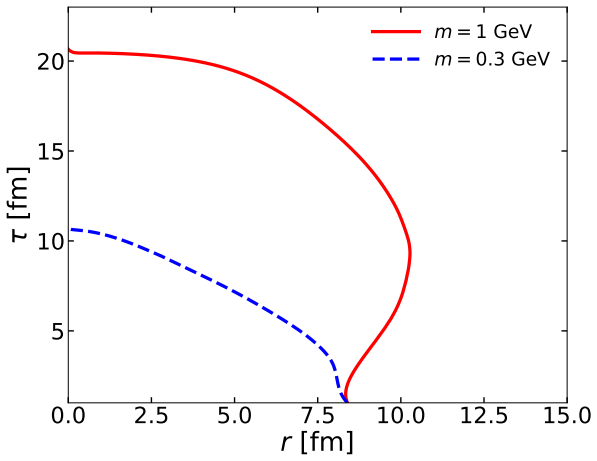
Equations of a boost-invariant and cylindrically symmetric perfect hydrodynamics are solved numerically for initial conditions inspired by the wounded nucleon model. The energy-momentum and spin tensors are used in the form that describes a relativistic massive gas governed by Boltzmann statistics. In contrast to one dimensional boost-invariant expansion, we find a coupling between the azimuthal and longitudinal components of the electric and magnetic components of the spin polarization tensor. This feature is similar to that found earlier for the Gubser symmetry, however, our treatment allows for a more general form of initial conditions and expansion geometry. Defining the freeze-out hypersurface by the constant temperature condition, we evaluate the Pauli-Luba\'nski four-vector and find that for the assumed geometry the only nonzero total polarization may be induced by the longitudinal component of the magnetic part of the spin polarization tensor coupled with the azimuthal electric component. The obtained results may serve as a reference point for more realistic models of hydrodynamic expansion.
Editorial analysis
A structured set of objections, weighed in public.
Referee Report
Summary. The manuscript numerically solves the equations of boost-invariant and cylindrically symmetric perfect spin hydrodynamics for a relativistic massive gas obeying Boltzmann statistics, with initial conditions inspired by the wounded nucleon model. It reports a coupling between the azimuthal and longitudinal components of the electric and magnetic parts of the spin polarization tensor. Defining freeze-out by a constant-temperature hypersurface, the Pauli-Lubański four-vector is evaluated, leading to the conclusion that the only nonzero total polarization is induced by the longitudinal magnetic component of the spin polarization tensor coupled to the azimuthal electric component. The results are positioned as a reference point for more realistic hydrodynamic models.
Significance. If the numerical results are robust, the work supplies a clear geometric benchmark for spin polarization in heavy-ion collisions under cylindrical symmetry. By extending the component-coupling analysis beyond the Gubser-symmetric case to more general initial conditions, it isolates the specific tensor contributions that survive the symmetry assumptions and can inform subsequent studies that include viscosity or dynamical freeze-out.
major comments (1)
- The abstract states that the hydrodynamic equations are solved numerically and a specific polarization result is obtained, yet no error estimates, convergence checks, grid-resolution studies, or validation against the one-dimensional boost-invariant limit are reported. Because the central claim rests on the outcome of this integration, the absence of these diagnostics is load-bearing for the reliability of the reported nonzero polarization component.
minor comments (1)
- The abstract refers to the 'Pauli-Lubański four-vector'; the main text should introduce its explicit definition and relation to the spin polarization tensor at the outset of the results section for clarity.
Simulated Author's Rebuttal
We thank the referee for the positive assessment of our work and the recommendation for minor revision. We address the single major comment below.
read point-by-point responses
-
Referee: The abstract states that the hydrodynamic equations are solved numerically and a specific polarization result is obtained, yet no error estimates, convergence checks, grid-resolution studies, or validation against the one-dimensional boost-invariant limit are reported. Because the central claim rests on the outcome of this integration, the absence of these diagnostics is load-bearing for the reliability of the reported nonzero polarization component.
Authors: We agree that the reliability of the numerical integration is central to the reported nonzero polarization and that the manuscript would benefit from explicit documentation of the numerical methods. In the revised version we will add a new subsection (placed after the description of the initial conditions) that reports: (i) convergence tests under successive grid refinements in the radial and proper-time directions, (ii) an estimate of the truncation error associated with the finite-difference scheme employed, and (iii) a direct validation of the code against the analytic one-dimensional boost-invariant limit obtained by suppressing all transverse gradients. These additions will be accompanied by a brief description of the numerical algorithm and the time-stepping method, thereby addressing the referee’s concern without changing the physical conclusions. revision: yes
Circularity Check
No significant circularity; derivation follows from symmetry and numerical integration
full rationale
The paper numerically solves the boost-invariant cylindrically symmetric perfect hydrodynamic equations using the standard energy-momentum and spin tensors for a massive Boltzmann gas. The identified coupling between azimuthal and longitudinal components of the electric and magnetic parts of the spin polarization tensor, and the subsequent evaluation of the Pauli-Lubański four-vector on the constant-temperature freeze-out hypersurface, are direct consequences of the imposed geometry, initial conditions inspired by the wounded nucleon model, and the explicit tensor forms. No parameters are fitted to force the polarization result, no self-citation chain supplies a load-bearing uniqueness theorem or ansatz, and the modeling premises (perfect hydrodynamics, Boltzmann statistics) are stated upfront rather than smuggled in. The central claim therefore reduces to the integration of the stated equations under the given symmetries, with no reduction by construction to the inputs.
Axiom & Free-Parameter Ledger
axioms (2)
- domain assumption Energy-momentum and spin tensors describe a relativistic massive gas governed by Boltzmann statistics
- domain assumption Boost invariance and cylindrical symmetry
Reference graph
Works this paper leans on
-
[1]
7 and Fig
Case (a) If only theC kr component is different from zero, one can check thatF ∗ µ = 0 andG ∗ µ = 0, which is confirmed by the numerical results presented in Fig. 7 and Fig. 8 (the top raws show that all the components of the Pauli–Luba´ nski four-vector vanish)
-
[2]
Case (b) In this case, the only nonzero component of the spin polarization tensor isC ωr. The boost to the particle rest frame gives F ∗ µ = 4πC ωrI1(p)(K0(m)mT +K 1(m)Tsechθ) m mT (0,−cosϕ p,−sinϕ p,0) (D1) and G∗ µ = 4πC ωrK1(m)(I2(p)pT +I 1(p)Tcschθ) m pT (0,−cosϕ p,−sinϕ p,0).(D2) For conciseness, the arguments of the Bessel functions use the notation...
-
[3]
Case (c) In this case the only nonzero components of the spin polarization tensor areC ωz andC kϕ. The boost to PRF gives F ∗ 0 =F ∗ 1 =F ∗ 2 = 0, F ∗ 3 = 2π[sinh(θ) (C ωz I1(p)κ pT −2C kϕI0(p)K1(m)mT ) + cosh(θ) (CkϕI1(p)κ pT −2C ωz I0(p)K1(m)mT )] (D3) and G∗ 0 =G ∗ 1 =G ∗ 2 = 0, G∗ 3 = 4πsinh(θ) [K 1(m)(Ckϕ coth(θ) +C ωz)(I1(p)Tcsch(θ) +I 2(p)pT ) −I1(...
-
[4]
Case (d) In this case, the only nonzero components areC kz andC ωϕ. A straightforward calculation gives F ∗ 0 = 0, F ∗ 1 = 4πsin(ϕ p) [I0(p)K1(m)pT [Ckz cosh(θ)−C ωϕ sinh(θ)] +I1(p)sech(θ) [Cωϕ cosh(θ)−C kz sinh(θ)] (K0(m)mT cosh(θ) +K 1(m)T)], F ∗ 2 = 4πcos(ϕ p)(I0(p)K1(m)pT (Cωϕ sinh(θ)−C kz cosh(θ)) −I1(p)(Cωϕ −C kz tanh(θ))(K0(m)mT cosh(θ) +K 1(m)T)),...
-
[5]
Global $\Lambda$ hyperon polarization in nuclear collisions: evidence for the most vortical fluid
L. Adamczyket al.(STAR), Nature548, 62 (2017), arXiv:1701.06657 [nucl-ex]
work page Pith review arXiv 2017
-
[6]
J. Adamet al.(STAR), Phys. Rev. C98, 014910 (2018), arXiv:1805.04400 [nucl-ex]
-
[7]
J. Adamet al.(STAR), Phys. Rev. Lett.123, 132301 (2019), arXiv:1905.11917 [nucl-ex]
-
[8]
S. Acharyaet al.(ALICE), Phys. Rev. C101, 044611 (2020), [Erratum: Phys.Rev.C 105, 029902 (2022)], arXiv:1909.01281 [nucl-ex]
-
[9]
J. Adamet al.(STAR), Phys. Rev. Lett.126, 162301 (2021), [Erratum: Phys.Rev.Lett. 131, 089901 (2023)], arXiv:2012.13601 [nucl-ex]
-
[10]
S. Acharyaet al.(ALICE), Phys. Rev. Lett.128, 172005 (2022), arXiv:2107.11183 [nucl-ex]
- [11]
-
[12]
Abou Yassineet al.(HADES), Phys
R. Abou Yassineet al.(HADES), Phys. Lett. B835, 137506 (2022), arXiv:2207.05160 [nucl-ex]
- [13]
-
[14]
S. Acharyaet al.(ALICE), Phys. Rev. Lett.125, 012301 (2020), arXiv:1910.14408 [nucl-ex]
- [15]
-
[16]
S. Acharyaet al.(ALICE), Phys. Rev. Lett.131, 042303 (2023), arXiv:2204.10171 [nucl-ex]
-
[17]
Spin polarization in relativistic heavy-ion collisions,
F. Becattini, M. Buzzegoli, T. Niida, S. Pu, A.-H. Tang, and Q. Wang, Int. J. Mod. Phys. E33, 2430006 (2024), arXiv:2402.04540 [nucl-th]
-
[18]
Polarization phenomenon in heavy-ion collisions,
T. Niida and S. A. Voloshin, Int. J. Mod. Phys. E33, 2430010 (2024), arXiv:2404.11042 [nucl-ex]
-
[19]
J.-H. Chen, Z.-T. Liang, Y.-G. Ma, X.-L. Sheng, and Q. Wang, Sci. China Phys. Mech. Astron.68, 211001 (2025), arXiv:2407.06480 [hep-ph]
-
[20]
Globally Polarized Quark-gluon Plasma in Non-central A+A Collisions
Z.-T. Liang and X.-N. Wang, Phys. Rev. Lett.94, 102301 (2005), [Erratum: Phys.Rev.Lett. 96, 039901 (2006)], arXiv:nucl-th/0410079
work page Pith review arXiv 2005
-
[21]
Spin Alignment of Vector Mesons in Non-central A+A Collisions
Z.-T. Liang and X.-N. Wang, Phys. Lett. B629, 20 (2005), arXiv:nucl-th/0411101
work page Pith review arXiv 2005
-
[22]
The ideal relativistic rotating gas as a perfect fluid with spin
F. Becattini and L. Tinti, Annals Phys.325, 1566 (2010), arXiv:0911.0864 [gr-qc]. 31
work page Pith review arXiv 2010
-
[23]
Relativistic distribution function for particles with spin at local thermodynamical equilibrium
F. Becattini, V. Chandra, L. Del Zanna, and E. Grossi, Annals Phys.338, 32 (2013), arXiv:1303.3431 [nucl-th]
work page Pith review arXiv 2013
-
[24]
Y.-G. Yang, R.-H. Fang, Q. Wang, and X.-N. Wang, Phys. Rev. C97, 034917 (2018), arXiv:1711.06008 [nucl-th]
-
[25]
The ideal relativistic fluid limit for a medium with polarization
D. Montenegro, L. Tinti, and G. Torrieri, Phys. Rev. D96, 056012 (2017), [Addendum: Phys.Rev.D 96, 079901 (2017)], arXiv:1701.08263 [hep-th]
work page Pith review arXiv 2017
-
[26]
Sound waves and vortices in a polarized relativistic fluid
D. Montenegro, L. Tinti, and G. Torrieri, Phys. Rev. D96, 076016 (2017), arXiv:1703.03079 [hep-th]
work page Pith review arXiv 2017
-
[27]
Relativistic fluid dynamics with spin
W. Florkowski, B. Friman, A. Jaiswal, and E. Speranza, Phys. Rev. C97, 041901 (2018), arXiv:1705.00587 [nucl-th]
work page Pith review arXiv 2018
-
[28]
Spin-dependent distribution functions for relativistic hydrodynamics of spin-1/2 particles
W. Florkowski, B. Friman, A. Jaiswal, R. Ryblewski, and E. Speranza, Phys. Rev. D97, 116017 (2018), arXiv:1712.07676 [nucl-th]
work page Pith review arXiv 2018
-
[29]
Collective longitudinal polarization in relativistic heavy-ion collisions at very high energy
F. Becattini and I. Karpenko, Phys. Rev. Lett.120, 012302 (2018), arXiv:1707.07984 [nucl-th]
work page Pith review arXiv 2018
-
[30]
Thermodynamic versus kinetic approach to polarization-vorticity coupling
W. Florkowski, A. Kumar, and R. Ryblewski, Phys. Rev. C98, 044906 (2018), arXiv:1806.02616 [hep-ph]
work page Pith review arXiv 2018
- [31]
- [32]
-
[33]
Fate of spin polarization in a relativistic fluid: An entropy-current analysis
K. Hattori, M. Hongo, X.-G. Huang, M. Matsuo, and H. Taya, Phys. Lett. B795, 100 (2019), arXiv:1901.06615 [hep-th]
work page Pith review arXiv 2019
- [34]
-
[35]
Kinetic theory for massive spin-1/2 particles from the Wigner-function formalism,
N. Weickgenannt, X.-L. Sheng, E. Speranza, Q. Wang, and D. H. Rischke, Phys. Rev. D100, 056018 (2019), arXiv:1902.06513 [hep-ph]
-
[36]
Longitudinal spin polarization in a thermal model,
W. Florkowski, A. Kumar, R. Ryblewski, and A. Mazeliauskas, Phys. Rev. C100, 054907 (2019), arXiv:1904.00002 [nucl-th]
-
[37]
Generating Spin Polarization from Vorticity through Nonlocal Collisions,
N. Weickgenannt, E. Speranza, X.-l. Sheng, Q. Wang, and D. H. Rischke, Phys. Rev. Lett.127, 052301 (2021), arXiv:2005.01506 [hep-ph]
-
[38]
Dissipative Spin Dynamics in Relativistic Matter,
S. Bhadury, W. Florkowski, A. Jaiswal, A. Kumar, and R. Ryblewski, Phys. Rev. D103, 014030 (2021), arXiv:2008.10976 [nucl-th]
- [39]
- [40]
-
[41]
Relativistic spin hydrodynamics with torsion and linear response theory for spin relaxation,
M. Hongo, X.-G. Huang, M. Kaminski, M. Stephanov, and H.-U. Yee, JHEP11, 150 (2021), arXiv:2107.14231 [hep-th]
-
[42]
D.-L. Wang, X.-Q. Xie, S. Fang, and S. Pu, Phys. Rev. D105, 114050 (2022), arXiv:2112.15535 [hep-ph]
- [43]
- [44]
-
[45]
Spin-thermal shear coupling in a relativistic fluid,
F. Becattini, M. Buzzegoli, and A. Palermo, Phys. Lett. B820, 136519 (2021), arXiv:2103.10917 [nucl-th]
-
[46]
Local Polarization and Isothermal Local Equilibrium in Relativistic Heavy Ion Collisions,
F. Becattini, M. Buzzegoli, G. Inghirami, I. Karpenko, and A. Palermo, Phys. Rev. Lett.127, 272302 (2021), arXiv:2103.14621 [nucl-th]
- [47]
- [48]
-
[49]
Spin relaxation rate for heavy quarks in weakly coupled QCD plasma,
M. Hongo, X.-G. Huang, M. Kaminski, M. Stephanov, and H.-U. Yee, JHEP08, 263 (2022), arXiv:2201.12390 [hep-th]
-
[50]
Relativistic second-order dissipative spin hydrodynamics from the method of moments,
N. Weickgenannt, D. Wagner, E. Speranza, and D. H. Rischke, Phys. Rev. D106, 096014 (2022), arXiv:2203.04766 [nucl-th]
- [51]
- [52]
- [53]
- [54]
-
[55]
Relativistic second-order spin hydrodynamics: An entropy-current analysis,
R. Biswas, A. Daher, A. Das, W. Florkowski, and R. Ryblewski, Phys. Rev. D108, 014024 (2023), arXiv:2304.01009 [nucl-th]
-
[56]
N. Weickgenannt, Phys. Rev. D108, 076011 (2023), arXiv:2307.13561 [nucl-th]
-
[57]
M. Kiamari, N. Sadooghi, and M. S. Jafari, Phys. Rev. D109, 036024 (2024), arXiv:2310.01874 [nucl-th]
- [58]
-
[59]
A. Palermo and F. Becattini, Eur. Phys. J. Plus138, 547 (2023), arXiv:2304.02276 [nucl-th]
-
[60]
Palermo, EPJ Web Conf.296, 04008 (2024), arXiv:2312.05380 [nucl-th]
A. Palermo, EPJ Web Conf.296, 04008 (2024), arXiv:2312.05380 [nucl-th]
-
[61]
A. Kumar, D.-L. Yang, and P. Gubler, Phys. Rev. D109, 054038 (2024), arXiv:2312.16900 [nucl-th]
- [62]
-
[63]
J. Chen, Z.-T. Liang, Y.-G. Ma, and Q. Wang, Sci. Bull.68, 874 (2023), arXiv:2305.09114 [nucl-th]
- [64]
- [65]
- [66]
- [67]
-
[68]
S. Banerjee, S. Bhadury, W. Florkowski, A. Jaiswal, and R. Ryblewski, Phys. Rev. C111, 064912 (2025), arXiv:2405.05089 [hep-ph]
- [69]
- [70]
-
[71]
In-plane transverse polarization in heavy-ion collisions,
A. Arslan, W.-B. Dong, C. Gale, S. Jeon, Q. Wang, and X.-Y. Wu, (2025), arXiv:2509.00796 [nucl-th]
- [72]
-
[73]
W. Florkowski, S. K. Kar, and V. Mykhaylova, (2026), arXiv:2602.00819 [nucl-th]
-
[74]
S. Bhadury, Z. Drogosz, W. Florkowski, and V. Mykhaylova, J. Subatomic Part. Cosmol.4, 100218 (2025), arXiv:2507.01864 [hep-ph]
-
[75]
S. R. De Groot,Relativistic Kinetic Theory. Principles and Applications, edited by W. A. Van Leeuwen and C. G. Van Weert (North-Holland Publishing Company, Amsterdam, 1980)
1980
-
[76]
Relativistic hydrodynamics for spin-polarized fluids,
W. Florkowski, A. Kumar, and R. Ryblewski, Prog. Part. Nucl. Phys.108, 103709 (2019), arXiv:1811.04409 [nucl-th]
-
[77]
Spin polarization evolution in a boost invariant hydrodynamical background
W. Florkowski, A. Kumar, R. Ryblewski, and R. Singh, Phys. Rev. C99, 044910 (2019), arXiv:1901.09655 [hep-ph]
work page Pith review arXiv 2019
-
[78]
Spin polarization dynamics in the non-boost-invariant background,
W. Florkowski, R. Ryblewski, R. Singh, and G. Sophys, Phys. Rev. D105, 054007 (2022), arXiv:2112.01856 [hep-ph]
- [79]
- [80]
discussion (0)
Sign in with ORCID, Apple, or X to comment. Anyone can read and Pith papers without signing in.