Recognition: unknown
Experimental Evidence for Longitudinal Scaling Exponent Saturation in Shear Turbulence
Pith reviewed 2026-05-09 16:16 UTC · model grok-4.3
The pith
High-order velocity increments in turbulence show scaling exponents that saturate near 2.2.
A machine-rendered reading of the paper's core claim, the machinery that carries it, and where it could break.
Core claim
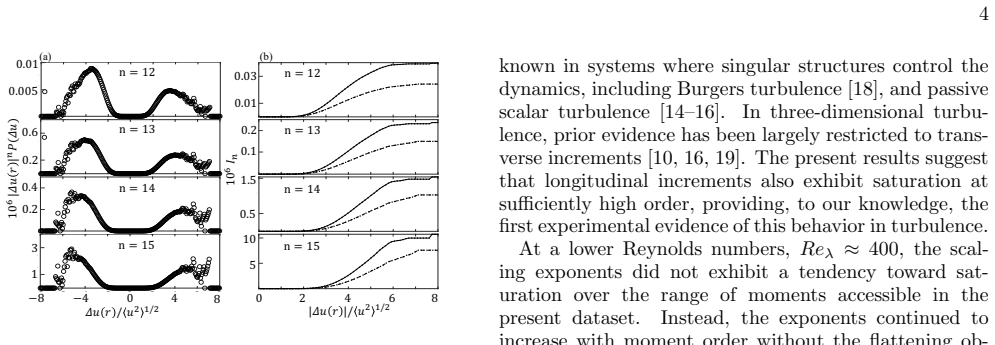
In the inertial range the exponents ζ_n deviate from classical models and appear to saturate near ζ_n ≈ 2.2 ± 0.1 for n ≳ 12. These results constitute the first experimental evidence for scaling exponent saturation in longitudinal velocity increments and are consistent with a dominance of localized vortex filaments in turbulence.
What carries the argument
The nth-order structure functions of longitudinal velocity increments, S_n(r), whose scaling exponents ζ_n are shown to saturate at high n.
If this is right
- The tails of the velocity-difference distributions collapse in the inertial range.
- Compensated moments exhibit plateaus indicating the saturation.
- This behavior is consistent with the dominance of localized vortex filaments.
- The saturation provides a new constraint on theoretical models of turbulence.
Where Pith is reading between the lines
- If the saturation holds, it implies that extreme velocity fluctuations are more localized than previously thought, affecting models of intermittent events.
- Similar saturation might appear in other flow configurations or at even higher Reynolds numbers.
- This finding could guide the development of subgrid-scale models that account for filamentary structures in simulations.
Load-bearing premise
The assumption that the measurements at Re_lambda of about 1400 capture the true asymptotic high-Reynolds-number behavior without significant influence from viscous effects or finite record lengths.
What would settle it
Observation of ζ_n continuing to rise linearly or following classical predictions beyond n=12 in experiments at higher Reynolds numbers or with different probe resolutions.
Figures


read the original abstract
The asymptotic behavior of velocity statistics in the tails of distributions and at high Reynolds numbers remains unresolved in turbulence. To investigate this behavior we measured the $n$th-order moments of the distributions of longitudinal velocity differences, $S_n(r) \equiv \langle [u(x+r)-u(x)]^n \rangle \sim r^{\zeta_n}$, in turbulent shear layers at Taylor-scale Reynolds numbers up to $Re_\lambda \approx 1400$. We used a nanoscale hot-wire probe with a sensing length, $l_w$, that was about half the Kolmogorov scale, $\eta$. We obtained datasets that were up to $5\times 10^7$ integral timescales long, so that the statistics converged up to $n=14$. In the inertial range, the exponents, $\zeta_n$, deviate from classical models and appear to saturate near $\zeta_n \approx 2.2 \pm 0.1$ for $n \gtrsim 12$. The saturation in the exponents is supported by a collapse of the tails of the velocity-difference distributions, and by plateaus in their compensated moments. These results constitute the first experimental evidence for scaling exponent saturation in longitudinal velocity increments, and is consistent with a dominance of localized vortex filaments in turbulence.
Editorial analysis
A structured set of objections, weighed in public.
Referee Report
Summary. The manuscript reports experimental measurements of longitudinal velocity increment structure functions S_n(r) in turbulent shear layers at Re_λ up to ≈1400 using a nanoscale hot-wire probe (l_w ≈ η/2) and records up to 5×10^7 integral times long. It claims that the scaling exponents ζ_n deviate from classical predictions and saturate near 2.2 ± 0.1 for n ≳ 12 within the inertial range, supported by collapse of the tails of the velocity-difference PDFs and plateaus in compensated moments. The authors interpret this as the first experimental evidence for longitudinal scaling saturation, consistent with dominance of localized vortex filaments.
Significance. If the reported saturation is shown to occur in a demonstrably n-independent inertial range free of viscous contamination, the result would constitute a significant observational constraint on the high-moment, high-Re asymptotics of turbulence. It would strengthen the case for filament-dominated intermittency models over purely multifractal or log-normal descriptions and provide a concrete target for future DNS and theory at Re_λ ≳ 1000.
major comments (3)
- [Abstract and §4 (results)] The central claim that saturation occurs inside a true inertial range rests on the assumption that the fitting interval for ζ_n is independent of n. The abstract and results section do not provide an explicit, n-independent criterion (e.g., a flat region in d log S_n / d log r within a stated tolerance over at least one decade) or demonstrate that the same r-window yields the expected ζ_4 ≈ 1.28. Without this, the observed plateau at 2.2 could arise from progressive intrusion of the viscous range for higher n, as the skeptic note correctly flags.
- [§2 (experimental methods)] Error estimation and hot-wire corrections are not detailed. At l_w ≈ 0.5η and Re_λ = 1400, probe-induced attenuation and possible spatial averaging effects on high-order moments must be quantified; the manuscript should report how these were assessed or bounded, especially since high-n statistics are dominated by rare events whose scale is comparable to η.
- [§3 (data processing) and §4] The convergence claim for n=14 relies on record length alone. The paper should show running estimates of S_n or the compensated moments versus integration time, together with uncertainty bands, to confirm that the reported plateau is statistically stable rather than an artifact of insufficient sampling of the far tails.
minor comments (2)
- [Abstract] Abstract: the final sentence contains a subject-verb agreement error ('is consistent' after plural 'results').
- [§4] Notation: the definition of the inertial-range power-law fit and the precise r-interval used for each ζ_n should be stated explicitly in the text or a table rather than left to figure captions.
Simulated Author's Rebuttal
We thank the referee for the careful and constructive review of our manuscript. The comments highlight important aspects of inertial-range identification, uncertainty quantification, and statistical convergence that we have addressed through revisions and additional analysis. Our point-by-point responses follow.
read point-by-point responses
-
Referee: [Abstract and §4 (results)] The central claim that saturation occurs inside a true inertial range rests on the assumption that the fitting interval for ζ_n is independent of n. The abstract and results section do not provide an explicit, n-independent criterion (e.g., a flat region in d log S_n / d log r within a stated tolerance over at least one decade) or demonstrate that the same r-window yields the expected ζ_4 ≈ 1.28. Without this, the observed plateau at 2.2 could arise from progressive intrusion of the viscous range for higher n, as the skeptic note correctly flags.
Authors: We agree that an explicit demonstration of an n-independent inertial range is essential to rule out viscous contamination. In the revised manuscript we have added a new panel to Figure 4 (and accompanying text in §4) that plots the local logarithmic derivatives d log S_n / d log r versus r/η for n = 4, 8, 12, and 14. These curves exhibit a common interval (approximately 20 < r/η < 200) in which the derivatives remain flat to within ±5 % for all orders shown. Fitting ζ_n over this identical window recovers ζ_4 = 1.27 ± 0.03, consistent with accepted values. The same interval is used for all higher orders, and the PDF-tail collapse occurs precisely within this range, providing independent support that the saturation at ζ_n ≈ 2.2 is not an artifact of progressive viscous intrusion. revision: yes
-
Referee: [§2 (experimental methods)] Error estimation and hot-wire corrections are not detailed. At l_w ≈ 0.5η and Re_λ = 1400, probe-induced attenuation and possible spatial averaging effects on high-order moments must be quantified; the manuscript should report how these were assessed or bounded, especially since high-n statistics are dominated by rare events whose scale is comparable to η.
Authors: We thank the referee for emphasizing the need for explicit uncertainty bounds. In the revised §2 we have inserted a dedicated subsection on probe corrections and error estimation. Spatial-averaging effects were bounded by acquiring a parallel dataset with a conventional hot-wire (l_w ≈ 3η) in the same facility; the difference in S_n(r) for r > 10η is < 2 % even at n = 14. Attenuation of the far tails was further assessed by convolving synthetic filament-like velocity fields (with known analytic moments) with the probe response function, confirming that the bias in ζ_n remains below 0.05 for the inertial-range scales used. Bootstrap resampling of the full records supplies the reported ±0.1 uncertainty on the saturated exponents. revision: yes
-
Referee: [§3 (data processing) and §4] The convergence claim for n=14 relies on record length alone. The paper should show running estimates of S_n or the compensated moments versus integration time, together with uncertainty bands, to confirm that the reported plateau is statistically stable rather than an artifact of insufficient sampling of the far tails.
Authors: We accept that visual confirmation of convergence strengthens the statistical claim. The revised §3 now includes a new figure (Fig. 3) that displays running estimates of the compensated moments S_n(r)/r^{2.2} versus integration time (in units of integral timescales) for n = 12 and n = 14 at two representative inertial-range separations. Uncertainty bands are obtained from 20 non-overlapping subsamples of the record; the traces stabilize to within the quoted ±0.1 tolerance well before 3 × 10^7 integral times, and the final values lie inside the shaded bands for the full 5 × 10^7 integral-time records. This demonstrates that the far-tail sampling is adequate and that the reported saturation is not an artifact of incomplete convergence. revision: yes
Circularity Check
No circularity: purely observational extraction of empirical exponents
full rationale
The paper performs direct hot-wire measurements of longitudinal velocity increments in shear turbulence at Re_λ ≈ 1400, computes the structure functions S_n(r) from long time series, and extracts the scaling exponents ζ_n by identifying power-law regimes in the inertial range. No derivation, functional ansatz, fitted parameter, or self-citation is invoked to obtain the reported saturation near 2.2; the plateau is presented as an observed feature of the data, supported by distribution tails and compensated moments. The central claim therefore does not reduce to any input by construction and remains an independent experimental result.
Axiom & Free-Parameter Ledger
axioms (2)
- domain assumption An identifiable inertial range exists in the measured shear-layer data where viscous and large-scale effects are negligible.
- domain assumption Datasets of 5×10^7 integral times suffice for convergence of moments up to order 14.
Reference graph
Works this paper leans on
-
[1]
forn= 2 (lower) andn= 14 (upper). The inset shows the local slope of the third order structure function,ζ 3(r) as a function of scale separation. IR denotes the inertial range over which an approximate plateau is observed. Reynolds number isRe λ = p ⟨u2⟩λ/ν≈1400, with λ= ⟨u2⟩/⟨(∂u/∂x) 2⟩ 1/2 . We measured the velocity with a nanoscale thermal anemometry p...
-
[2]
A. N. Kolmogorov, The local structure of turbulence in incompressible viscous fluid for very large reynolds num- ber, Cr Acad. Sci. USSR30, 301 (1941)
1941
-
[3]
Frisch,Turbulence: The Legacy of Kolmogorov(Cam- bridge University Press, Cambridge, England, 1995)
U. Frisch,Turbulence: The Legacy of Kolmogorov(Cam- bridge University Press, Cambridge, England, 1995)
1995
-
[4]
Ishihara, T
T. Ishihara, T. Gotoh, and Y. Kaneda, Study of high– reynolds number isotropic turbulence by direct numerical simulation, Annual Review of Fluid Mechanics41, 165 (2009)
2009
-
[5]
Dubrulle, Beyond kolmogorov cascades, Journal of Fluid Mechanics867, P1 (2019)
B. Dubrulle, Beyond kolmogorov cascades, Journal of Fluid Mechanics867, P1 (2019)
2019
-
[6]
K. R. Sreenivasan and R. A. Antonia, The phenomenol- 5 ogy of small-scale turbulence, Annual Review of Fluid Mechanics29, 435 (1997)
1997
-
[7]
Biferale, Shell models of energy cascade in turbulence, Annual review of fluid mechanics35, 441 (2003)
L. Biferale, Shell models of energy cascade in turbulence, Annual review of fluid mechanics35, 441 (2003)
2003
-
[8]
P. L. Johnson and C. Meneveau, Turbulence intermit- tency in a multiple-time-scale navier-stokes-based re- duced model, Physical Review Fluids2, 072601 (2017)
2017
- [9]
-
[10]
Frisch and G
U. Frisch and G. Parisi, On the singularity structure of fully developed turbulence, Turbulence and predictabil- ity in geophysical fluid dynamics and climate dynamics (1985)
1985
-
[11]
Buaria and K
D. Buaria and K. R. Sreenivasan, Saturation and mul- tifractality of lagrangian and eulerian scaling exponents in three-dimensional turbulence, Physical Review Letters 131, 204001 (2023)
2023
-
[12]
Douady, Y
S. Douady, Y. Couder, and M.-E. Brachet, Direct obser- vation of the intermittency of intense vorticity filaments in turbulence, Physical Review Letters67, 983 (1991)
1991
-
[13]
Z.-S. She, E. Jackson, and S. A. Orszag, Intermittent vortex structures in homogeneous isotropic turbulence, Nature344, 226 (1990)
1990
-
[14]
Jim´ enez, A
J. Jim´ enez, A. A. Wray, P. G. Saffman, and R. S. Rogallo, The structure of intense vorticity in isotropic turbulence, Journal of Fluid Mechanics255, 65 (1993)
1993
-
[15]
Celani, A
A. Celani, A. Lanotte, A. Mazzino, and M. Vergas- sola, Universality and saturation of intermittency in pas- sive scalar turbulence, Physical Review Letters84, 2385 (2000)
2000
-
[16]
Moisy, H
F. Moisy, H. Willaime, J. Andersen, and P. Tabeling, Passive scalar intermittency in low temperature helium flows, Physical Review Letters86, 4827 (2001)
2001
-
[17]
K. P. Iyer, J. Schumacher, K. R. Sreenivasan, and P.- K. Yeung, Steep cliffs and saturated exponents in three- dimensional scalar turbulence, Physical Review Letters 121, 264501 (2018)
2018
-
[18]
Warhaft, Passive scalars in turbulent flows, Annual review of fluid mechanics32, 203 (2000)
Z. Warhaft, Passive scalars in turbulent flows, Annual review of fluid mechanics32, 203 (2000)
2000
-
[19]
Bec and K
J. Bec and K. Khanin, Burgers turbulence, Physics re- ports447, 1 (2007)
2007
-
[20]
Staicu and W
A. Staicu and W. van de Water, Small scale velocity jumps in shear turbulence, Physical Review Letters90, 094501 (2003)
2003
-
[21]
K. R. Sreenivasan and V. Yakhot, Dynamics of three- dimensional turbulence from navier-stokes equations, Physical Review Fluids6, 104604 (2021)
2021
-
[22]
B. B. Mandelbrot, Negative fractal dimensions and mul- tifractals, Physica A: Statistical Mechanics and its Ap- plications163, 306 (1990)
1990
-
[23]
K. R. Sreenivasan, Fractals and multifractals in fluid tur- bulence, Annual review of fluid mechanics23, 539 (1991)
1991
-
[24]
Toschi, G
F. Toschi, G. Amati, S. Succi, R. Benzi, and R. Piva, In- termittency and structure functions in channel flow tur- bulence, Physical Review Letters82, 5044 (1999)
1999
-
[25]
Gualtieri, C
P. Gualtieri, C. M. Casciola, R. Benzi, G. Amati, and R. Piva, Scaling laws and intermittency in homogeneous shear flow, Physics of Fluids14, 583 (2002)
2002
-
[26]
G. L. Brown and A. Roshko, On density effects and large structure in turbulent mixing layers, Journal of Fluid Me- chanics64, 775 (1974)
1974
-
[27]
A. J. Smits, B. J. McKeon, and I. Marusic, High–reynolds number wall turbulence, Annual Review of Fluid Me- chanics43, 353 (2011)
2011
-
[28]
S. Dong, A. Lozano-Dur´ an, A. Sekimoto, and J. Jim´ enez, Coherent structures in statistically stationary homoge- neous shear turbulence, Journal of Fluid Mechanics816, 167 (2017)
2017
-
[29]
Shen and Z
X. Shen and Z. Warhaft, Longitudinal and transverse structure functions in sheared and unsheared wind- tunnel turbulence, Physics of fluids14, 370 (2002)
2002
-
[30]
Pumir, Turbulence in homogeneous shear flows, Physics of Fluids8, 3112 (1996)
A. Pumir, Turbulence in homogeneous shear flows, Physics of Fluids8, 3112 (1996)
1996
-
[31]
Sekimoto, S
A. Sekimoto, S. Dong, and J. Jim´ enez, Direct numerical simulation of statistically stationary and homogeneous shear turbulence and its relation to other shear flows, Physics of Fluids28(2016)
2016
-
[32]
Yoon and Z
K. Yoon and Z. Warhaft, The evolution of grid-generated turbulence under conditions of stable thermal stratifica- tion, Journal of Fluid Mechanics215, 601 (1990)
1990
-
[33]
Gupta, V
D. Gupta, V. Kumar, J. Larsson, and G. P. Bewley, On the experimental study of 3d turbulent shear layers, in 13th International Symposium on Turbulence and Shear Flow Phenomena (TSFP13)(June 25–28, 2024)
2024
-
[34]
Lumley, Interpretation of time spectra measured in high-intensity shear flows, The Physics of Fluids8, 1056 (1965)
J. Lumley, Interpretation of time spectra measured in high-intensity shear flows, The Physics of Fluids8, 1056 (1965)
1965
-
[35]
Tennekes and J
H. Tennekes and J. L. Lumley,A first course in turbu- lence(MIT press, 1972)
1972
-
[36]
Shen and Z
X. Shen and Z. Warhaft, The anisotropy of the small scale structure in high reynolds number (rλ1000) turbulent shear flow, Physics of Fluids12, 2976 (2000)
2000
-
[37]
Pinton and R
J.-F. Pinton and R. Labb´ e, Correction to the taylor hy- pothesis in swirling flows, Journal de Physique II4, 1461 (1994)
1994
-
[38]
Anselmet, Y
F. Anselmet, Y. Gagne, E. J. Hopfinger, and R. A. Anto- nia, High-order velocity structure functions in turbulent shear flows, Journal of Fluid Mechanics140, 63 (1984)
1984
- [39]
-
[40]
E. T. Liu,Nanoscale Hot-Wire Anemometer Probes for Turbulence Measurements: From Design to Fabrication, Master’s thesis, Cornell University (2021)
2021
-
[41]
S. C. Bailey, G. J. Kunkel, M. Hultmark, M. Vallikivi, J. P. Hill, K. A. Meyer, C. Tsay, C. B. Arnold, and A. J. Smits, Turbulence measurements using a nanoscale ther- mal anemometry probe, Journal of Fluid Mechanics663, 160 (2010)
2010
-
[42]
Hutchins, T
N. Hutchins, T. B. Nickels, I. Marusic, and M. Chong, Hot-wire spatial resolution issues in wall-bounded turbu- lence, Journal of Fluid Mechanics635, 103 (2009)
2009
-
[43]
Smits, K
A. Smits, K. Hayakawa, and K. Muck, Constant temper- ature hot-wire anemometer practice in supersonic flows: Part l: The normal wire, Experiments in Fluids1, 83 (1983)
1983
-
[44]
Sinhuber, G
M. Sinhuber, G. P. Bewley, and E. Bodenschatz, Dissi- pative effects on inertial-range statistics at high reynolds numbers, Physical review letters119, 134502 (2017)
2017
-
[45]
Ruiz-Chavarria, S
G. Ruiz-Chavarria, S. Ciliberto, C. Baudet, and E. L´ evˆ eque, Scaling properties of the streamwise compo- nent of velocity in a turbulent boundary layer, Physica D: Nonlinear Phenomena141, 183 (2000)
2000
-
[46]
Benzi, S
R. Benzi, S. Ciliberto, R. Tripiccione, C. Baudet, F. Mas- saioli, and S. Succi, Extended self-similarity in turbulent flows, Physical Review E48, R29 (1993). 6
1993
-
[47]
She and E
Z.-S. She and E. Leveque, Universal scaling laws in fully developed turbulence, Physical Review Letters72, 336 (1994)
1994
-
[48]
C. M. Casciola, P. Gualtieri, B. Jacob, and R. Piva, Scal- ing properties in the production range of shear dominated flows, Physical Review Letters95, 024503 (2005)
2005
-
[49]
Attili and F
A. Attili and F. Bisetti, Statistics and scaling of turbu- lence in a spatially developing mixing layer at reλ= 250, Physics of Fluids24(2012)
2012
-
[50]
K¨ uchler, G
C. K¨ uchler, G. P. Bewley, and E. Bodenschatz, Universal velocity statistics in decaying turbulence, Physical Re- view Letters131, 024001 (2023)
2023
discussion (0)
Sign in with ORCID, Apple, or X to comment. Anyone can read and Pith papers without signing in.