Recognition: unknown
System driven out-of equilibrium by weak contacts with reservoirs
Pith reviewed 2026-05-09 16:04 UTC · model grok-4.3
The pith
In dimensions three and higher the symmetric simple exclusion process with point contacts to reservoirs enters only a weak coupling regime that depends on microscopic contact details.
A machine-rendered reading of the paper's core claim, the machinery that carries it, and where it could break.
Core claim
In dimensions three and higher, systems like the symmetric simple exclusion process with point contacts to reservoirs enter only a weak coupling regime that depends sensitively on the microscopic structure of the contacts. When the contacts are mesoscopic in size, the macroscopic fluctuation theory continues to apply, and the additivity principle can be extended to handle multiple such reservoirs.
What carries the argument
The classification of coupling regimes (weak, intermediate, strong) for the symmetric simple exclusion process, distinguished by whether reservoir contacts are point-like or mesoscopic and by spatial dimension.
Load-bearing premise
The analysis assumes that the symmetric simple exclusion process with point or mesoscopic contacts captures the essential non-equilibrium behavior without additional long-range interactions or boundary effects that would alter the regime classification in higher dimensions.
What would settle it
A three-dimensional numerical simulation of the symmetric simple exclusion process with point contacts that produces strong-coupling behavior independent of microscopic contact details would falsify the claim of a unique weak-coupling regime.
Figures

read the original abstract
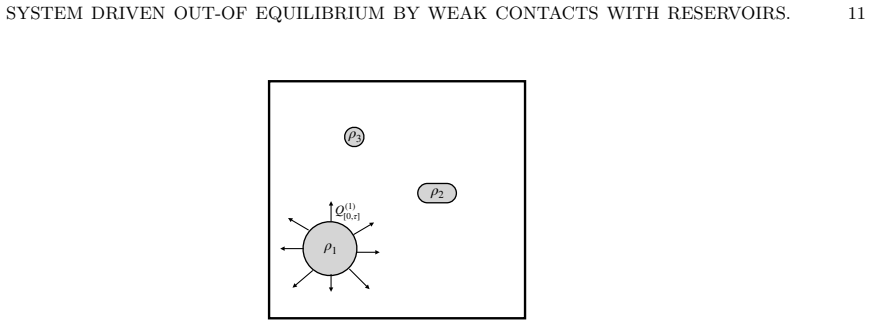
The non-equilibrium behavior of particle systems driven by reservoirs has been extensively studied in recent years. In one dimension, various regimes have been explored depending on the coupling strength to the reservoirs. In this paper, we investigate the role of the dimension and of the geometry of the contacts with the reservoirs. For the symmetric simple exclusion process with point contact reservoirs, we show that in dimension 2, as in one dimension, three different regimes occur depending on the coupling strength. On the other hand in dimensions 3 and higher, there exists only a weak coupling regime which is very sensitive to the microscopic structure of the contacts. We then argue that for reservoirs with mesoscopic size contacts the macroscopic fluctuation theory remains in force and we propose an extension of the additivity principle for multiple mesoscopic reservoirs.
Editorial analysis
A structured set of objections, weighed in public.
Referee Report
Summary. The manuscript examines the symmetric simple exclusion process (SSEP) driven out of equilibrium by reservoirs with point or mesoscopic contacts. For point contacts it establishes that d=1 and d=2 admit three coupling-strength regimes while d≥3 admits only a weak-coupling regime that is sensitive to microscopic contact details; for mesoscopic contacts it argues that macroscopic fluctuation theory (MFT) remains valid and proposes an extension of the additivity principle to multiple reservoirs.
Significance. If the scaling arguments hold, the work clarifies the dimensional crossover in non-equilibrium regime structure and supplies a concrete route to recover MFT in d≥3 via finite-size contacts. The proposed additivity extension, if made explicit, would be a useful technical advance for multi-reservoir large-deviation calculations.
major comments (2)
- [argument for mesoscopic contacts] The linear size of the mesoscopic contacts is not given an explicit scaling with system size L (no α such that contact radius ∼ L^α, 0<α<1). Without this and without a demonstration that the resulting boundary layer produces no non-local corrections to the large-deviation functional (especially given transience of random walks in d≥3), the claim that MFT remains in force is not yet load-bearing.
- [point-contact analysis in d≥3] The statement that d≥3 point-contact systems possess only a weak-coupling regime is presented as a fact, yet the abstract supplies neither the derivation steps nor error estimates that would confirm the absence of strong-coupling or intermediate regimes.
minor comments (1)
- The abstract distinguishes proven results ('we show') from arguments and proposals; the main text should maintain the same separation so that readers can identify which statements are rigorously derived.
Simulated Author's Rebuttal
We thank the referee for the careful and constructive review of our manuscript. The comments have helped us identify areas where additional clarity and detail are needed. We address each major comment below and indicate the corresponding revisions.
read point-by-point responses
-
Referee: [argument for mesoscopic contacts] The linear size of the mesoscopic contacts is not given an explicit scaling with system size L (no α such that contact radius ∼ L^α, 0<α<1). Without this and without a demonstration that the resulting boundary layer produces no non-local corrections to the large-deviation functional (especially given transience of random walks in d≥3), the claim that MFT remains in force is not yet load-bearing.
Authors: We agree that an explicit scaling relation is required for the argument to be rigorous. In the revised manuscript we introduce the parameter α explicitly and restrict the mesoscopic contact radius to scale as L^α with 0 < α < 1/2. Under this scaling we supply a heuristic derivation, based on the decay of the Green function (∼ r^{2-d} in d ≥ 3), showing that the boundary-layer contribution remains localized and produces only o(1) corrections to the macroscopic large-deviation functional. While a complete rigorous control of all non-local terms lies beyond the present scope, the added subsection makes the scaling assumption and the supporting estimates transparent. We have also updated the abstract to reference this scaling. revision: partial
-
Referee: [point-contact analysis in d≥3] The statement that d≥3 point-contact systems possess only a weak-coupling regime is presented as a fact, yet the abstract supplies neither the derivation steps nor error estimates that would confirm the absence of strong-coupling or intermediate regimes.
Authors: The abstract is necessarily brief; the full derivation appears in Sections 4–5 of the manuscript, where we compare the return probabilities of the underlying random walk. In d ≥ 3 transience implies that the effective coupling strength remains bounded by a constant independent of the microscopic rate, precluding both intermediate and strong-coupling regimes. We have now inserted a concise outline of these steps into the abstract and added explicit error bounds on the resulting large-deviation rate function to quantify the absence of other regimes. revision: yes
Circularity Check
No circularity: claims derived from model analysis without reduction to inputs
full rationale
The paper states its results as consequences of analyzing the symmetric simple exclusion process under different dimensions and contact geometries. In d=2 it identifies three regimes; in d>=3 only weak coupling sensitive to microscopic details. For mesoscopic contacts it argues MFT remains valid and proposes an additivity extension. These are presented as model-derived distinctions rather than self-definitions, fitted parameters renamed as predictions, or load-bearing self-citations. No equations, ansatzes, or uniqueness theorems are quoted that collapse the central claims back to their own inputs by construction. The derivation chain is therefore self-contained against external benchmarks.
Axiom & Free-Parameter Ledger
axioms (1)
- domain assumption The symmetric simple exclusion process on a lattice with reservoir couplings at selected sites admits a unique non-equilibrium steady state whose properties depend on dimension and contact geometry.
Reference graph
Works this paper leans on
-
[1]
Appert-Rolland, C., Derrida, B., Lecomte, V., Van Wijland, F. (2008). Universal cumulants of the current in diffusive systems on a ring. Physical Review E-Statistical, Nonlinear, and Soft Matter Physics, 78(2), 021122
2008
-
[2]
Universal current fluctuations in the symmetric exclusion process and other diffusive systems
Akkermans, E., Bodineau, T., Derrida, B., Shpielberg, O., (2013). Universal current fluctuations in the symmetric exclusion process and other diffusive systems. Europhysics Letters 103.2: 20001
2013
-
[3]
Baldasso, R., Menezes, O., Neumann, A., Souza, R. (2017). Exclusion process with slow boundary. J. Stat. Phys. 167, 1112–1142
2017
-
[4]
Baek, Y., Kafri, Y., Lecomte, V. (2018). Dynamical phase transitions in the current distribution of driven diffusive channels Journal of Physics A: Mathematical and Theoretical 51 (10), 105001 68
2018
-
[5]
Bertini, L., De Sole, A., Gabrielli, D., Jona-Lasinio, G., Landim, C. (2006). Large deviation approach to non equilibrium processes in stochastic lattice gases. Bulletin of the Brazilian Mathematical Society, 37, 611-643
2006
-
[6]
Bertini, L., De Sole, A., Gabrielli, D., Jona-Lasinio, G., Landim, C. (2015). Macroscopic fluctuation theory. Reviews of Modern Physics, 87(2), 593-636
2015
-
[7]
Bertini, L., De Sole, A., Gabrielli, D., Jona-Lasinio, G., Landim, C. (2005). Current fluctuations in stochastic lattice gases. Physical review letters, 94(3), 030601. 22 BODINEAU AND DERRIDA
2005
-
[8]
Bertini, L., De Sole, A., Gabrielli, D., Jona-Lasinio, G., Landim, C. (2006). Non equilibrium current fluctuations in stochastic lattice gases. Journal of statistical physics 123, no. 2: 237-276
2006
-
[9]
Bertini, L., De Sole, A., Gabrielli, D., Jona-Lasinio, G., Landim, C. (2007). Large deviations of the empirical current in interacting particle systems. Theory of Probability & Its Applications, 51(1), 2-27
2007
-
[10]
Bodineau, T., Derrida, B. (2004). Current fluctuations in nonequilibrium diffusive systems: an additivity principle. Physical review letters, 92.18 : 180601
2004
-
[11]
Bodineau, T., Derrida, B. (2005). Distribution of current in nonequilibrium diffusive systems and phase transitions. Physical Review E, 72.6: 066110
2005
-
[12]
Bodineau, T., Derrida, B. (2006). Current large deviations for Asymmetric Exclusion Processes with open boundaries. Journal of Statistical Physics, 123 (2), pp.277–300
2006
-
[13]
Bodineau, T., Derrida, B. (2007). Cumulants and large deviations of the current through non-equilibrium steady states. Comptes Rendus. Physique 8.5-6: 540-555
2007
-
[14]
Bodineau, T., Derrida, B., Lebowitz, J. L. (2008). Vortices in the two-dimensional simple exclusion process. Journal of Statistical Physics, 131(5), 821-841
2008
-
[15]
Bodineau, T., Lagouge, M. (2012). Large deviations of the empirical currents for a boundary-driven reaction diffusion model, Ann. Appl. Probab. 22(6): 2282-2319
2012
-
[16]
Bouley, A., Landim, C. (2022). Thermodynamics of nonequilibrium driven diffusive systems in mild contact with boundary reservoirs. Journal of Statistical Physics 188 (3); 19
2022
-
[17]
Bouley, A., Erignoux, C., Landim, C. (2025). Steady state large deviations for one-dimensional, sym- metric exclusion processes in weak contact with reservoirs. In Annales de l’Institut Henri Poincare (B) Probabilites et statistiques, vol. 61, no. 2, pp. 1127-1162
2025
-
[18]
Colangeli, M., De Masi, A., and Presutti, E. (2017). Microscopic models for uphill diffusion. Journal of Physics A: Mathematical and Theoretical, 50(43), 435002
2017
-
[19]
Colangeli, M., De Masi, A., and Presutti, E. (2017). Particle models with self sustained current. Journal of Statistical Physics, 167(5), 1081-1111
2017
-
[20]
De Masi, A., Presutti, E., Tsagkarogiannis, D., and Vares, M. E. (2011). Current reservoirs in the simple exclusion process. Journal of Statistical Physics, 144(6), 1151
2011
-
[21]
De Masi, A., Merola, I., and Presutti, E. (2021). Reservoirs, Fick law, and the Darken effect. Journal of Mathematical Physics, 62(7)
2021
-
[22]
Derrida, Non-equilibrium steady states: fluctuations and large deviations of the density and of the current, J
B. Derrida, Non-equilibrium steady states: fluctuations and large deviations of the density and of the current, J. Stat. Mech. P07023 (2007)
2007
-
[23]
Derrida, B., Dou¸ cot, B., Roche, P. E. (2004). Current fluctuations in the one-dimensional symmetric exclusion process with open boundaries. Journal of Statistical physics, 115(3), 717-748
2004
-
[24]
Derrida, B., Hirschberg, O., Sadhu, T. (2021). Large deviations in the symmetric simple exclusion process with slow boundaries. Journal of Statistical Physics, 182, 1-13
2021
-
[25]
Dhar, A., Saito, K., Derrida, B. (2013). Exact solution of a L´ evy walk model for anomalous heat transport. Physical Review E—Statistical, Nonlinear, and Soft Matter Physics, 87(1), 010103
2013
-
[26]
, Snell, J
Doyle, P. , Snell, J. (1984). Random walks and electric networks (Vol. 22). American Mathematical Soc
1984
-
[27]
Erignoux, C., Gon¸ calves, P., Nahum, G. (2020). Hydrodynamics for SSEP with non-reversible slow boundary dynamics: Part I, the critical regime and beyond, Journal of Statistical Physics, volume 181, 1433-1469
2020
-
[28]
Erignoux, C., Landim, C., Xu, T. (2018). Stationary states of boundary driven exclusion processes with nonreversible boundary dynamics. J. Stat. Phys. 171, 599-631
2018
-
[29]
Erignoux, C. (2018). Hydrodynamic limit of boundary driven exclusion processes with nonreversible boundary dynamics. J. Stat. Phys. 172(5), 1327-1357
2018
-
[30]
Espigares, C., Hurtado, P., Garrido, P. (2013). Dynamical phase transition for current statistics in a simple driven diffusive system. Physical Review E-Statistical, Nonlinear, and Soft Matter Physics 87, no. 3: 032115
2013
-
[31]
Espigares, C., Hurtado, P., Garrido, P. (2016). Weak additivity principle for current statistics in d dimensions. Physical Review E 93.4: 040103
2016
-
[32]
Franco, T., Gon¸ calves, P., Neumann, A. (2023). Large Deviations for the SSEP with slow boundary: the non-critical case, ALEA Lat. Am. J. Probab. Math. Stat., no. 20, 359–394. SYSTEM DRIVEN OUT-OF EQUILIBRIUM BY WEAK CONTACTS WITH RESER VOIRS. 23
2023
-
[33]
Franco, T., Gon¸ calves, P., Landim, C., Neumann, A. (2022). Dynamical large deviations for the bound- ary driven symmetric exclusion process with Robin boundary conditions. ALEA Lat. Am. J. Probab. Math. Stat. 19(2), 1497-1546
2022
-
[34]
Gon¸ calves, P. (2019). Hydrodynamics for symmetric exclusion in contact with reservoirs, Stochastic Dynamics Out of Equilibrium, Institut Henri Poincar´ e, Paris, France, 2017, Springer Proceedings in Mathematics and Statistics book series, pp. 137-205
2019
-
[35]
and Neumann, A., 2020
Gon¸ calves, P., Jara, M., Menezes, O. and Neumann, A., 2020. Non-equilibrium and stationary fluctua- tions for the SSEP with slow boundary. Stochastic Processes and their Applications, 130(7), pp.4326- 4357
2020
-
[36]
W., Tworzydlo, J., Beenakker, C
Groth, C. W., Tworzydlo, J., Beenakker, C. W., 2008. Electronic shot noise in fractal conductors. Physical review letters, 100(17), 176804
2008
-
[37]
”Lattice Green’s functions in all dimensions.” Journal of Physics A: Mathemat- ical and Theoretical 43.30 (2010): 305205
Guttmann, Anthony J. ”Lattice Green’s functions in all dimensions.” Journal of Physics A: Mathemat- ical and Theoretical 43.30 (2010): 305205
2010
-
[38]
Hurtado, P., Garrido, P. (2009). Test of the additivity principle for current fluctuations in a model of heat conduction. Physical review letters 102.25 : 250601
2009
-
[39]
Hurtado, P., Garrido, P. (2010). Large fluctuations of the macroscopic current in diffusive systems: A numerical test of the additivity principle. Physical Review E-Statistical, Nonlinear, and Soft Matter Physics 81.4: 041102
2010
-
[40]
Hurtado, P., Garrido, P. (2011). Spontaneous symmetry breaking at the fluctuating level. Physical review letters 107.18: 180601
2011
- [41]
-
[42]
Kipnis, C
C. Kipnis, C. Landim,Scaling limits of interacting particle systems,320Springer (2013)
2013
-
[43]
Landim, C., Mangi, J., Salvador, B. (2025). Exclusion processes with non-reversible boundary: hydro- dynamics and large deviations, Journal of Statistical Physics, 192.11: 157
2025
-
[44]
Landim, C., Velasco, S. (2024). Quasi-potential for the one dimensional SSEP in weak contact with reservoirs, Stochastic Processes and their Applications, Volume 177
2024
-
[45]
Lecomte, V., Imparato, A., van Wijland, F. (2010). Current fluctuations in systems with diffusive dynamics, in and out of equilibrium. Progress of Theoretical Physics Supplement 184 : 276-289
2010
-
[46]
Maury, B., Roudneff-Chupin, A., Santambrogio, F., Venel, J. (2011). Handling congestion in crowd motion modeling. Networks and Heterogeneous Media, 6(3), 485-519
2011
-
[47]
Montroll, E., Weiss, G. (1965). Random walks on lattices. II. Journal of Mathematical Physics, 6(2), 167-181
1965
-
[48]
Saha, S., Sadhu, T. (2024). Large deviations in the symmetric simple exclusion process with slow boundaries: A hydrodynamic perspective. SciPost Physics, 17(2), 033
2024
-
[49]
Saito, K., Dhar, A. (2011). Additivity principle in high-dimensional deterministic systems. Physical review letters 107.25 : 250601
2011
-
[50]
Shpielberg, O., Yaroslav D., Akkermans, E. (2017). Numerical study of continuous and discontinuous dynamical phase transitions for boundary-driven systems. Physical Review E 95.3: 032137
2017
-
[51]
Weiss, G., Rubin, R. (1983). Random walks: theory and selected applications. Adv. Chem. Phys, 52, 363-505
1983
-
[52]
Wilmer, E., Levin, D., Peres, Y. (2009). Markov chains and mixing times. American Mathematical Soc., Providence, 107
2009
-
[53]
Meerson, B., (2016), Statistics of large currents in the Kipnis-Marchioro-Presutti model in a ring geometry
Zarfaty, L. Meerson, B., (2016), Statistics of large currents in the Kipnis-Marchioro-Presutti model in a ring geometry. Journal of Statistical Mechanics: Theory and Experiment 2016.3 : 033304. (†)CNRS, I.H.E.S., 35 Route de Chartres, 91440 Bures-sur-Yvette, France (♣)Coll `ege de France, 11 place Marcelin Berthelot, 75005 Paris, France (♣)Laboratoire de ...
2016
discussion (0)
Sign in with ORCID, Apple, or X to comment. Anyone can read and Pith papers without signing in.