Recognition: unknown
Liquid-phase encapsulation of π-conjugated dyes in boron nitride nanotubes: Ensemble and single-nanotube optical characterization
Pith reviewed 2026-05-09 16:35 UTC · model grok-4.3
The pith
Oligothiophene dyes inside boron nitride nanotubes form ordered but heterogeneous emissive ensembles rather than bright J-aggregates.
A machine-rendered reading of the paper's core claim, the machinery that carries it, and where it could break.
Core claim
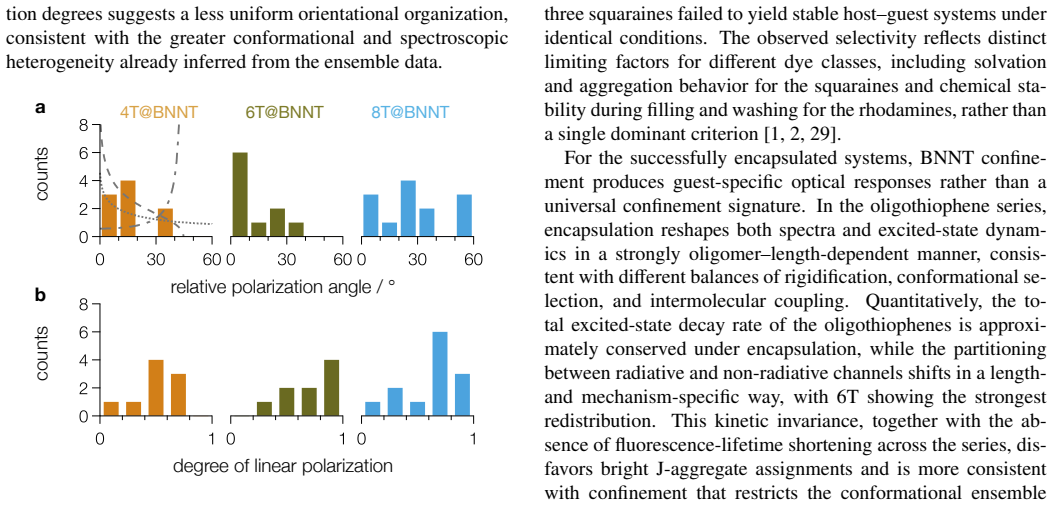
Confinement of oligothiophenes in BNNTs alters spectra and excited-state dynamics in a length-dependent way, yielding weakly emissive ensembles whose effective radiative rates are suppressed and whose lifetimes show no shortening; this combination disfavors bright J-aggregate assignments. Polarization-resolved single-nanotube imaging reveals strongly polarized yet tube-to-tube and intratube variable emission, establishing the systems as ordered but structurally heterogeneous confined ensembles. Nile Red provides the contrasting case in which dielectric tuning of a solvatochromic state dominates over aggregate formation.
What carries the argument
Ensemble extinction, photoluminescence, quantum-yield, and TCSPC rate measurements combined with polarization-resolved single-nanotube microscopy performed on oligothiophene- and Nile Red-filled BNNTs.
If this is right
- Oligothiophene@BNNTs serve as nanoconfined platforms where guest-guest coupling can be studied separately from host dielectric influence.
- Chain-length dependence of spectral and dynamic changes traces to variations in molecular packing inside the tubes.
- Strongly polarized emission that varies along and between tubes indicates persistent structural heterogeneity even in ordered encapsulation.
- Nile Red encapsulation isolates dielectric tuning of charge-transfer states as the dominant response when aggregation is weak.
- Combined ensemble and single-tube data allow experimental distinction among ordering, dielectric confinement, and intermolecular coupling.
Where Pith is reading between the lines
- Longer or shorter oligothiophene chains could map a crossover between packing-dominated and dielectric-dominated regimes.
- Protocols that improve filling uniformity would reduce intratube variations and test whether more homogeneous aggregates become accessible.
- The polarized yet variable emission points to possible use in nanoscale aligned emitters once heterogeneity is controlled.
- The same encapsulation and measurement strategy applied to other wide-bandgap nanotubes would test how host bandgap and dielectric constant modulate the observed packing effects.
Load-bearing premise
Observed spectral shifts, quantum-yield changes, and decay-rate alterations arise chiefly from confinement-driven packing and dielectric effects rather than from incomplete filling, solvent residues, or nanotube defects.
What would settle it
Observation of radiative-rate enhancement or fluorescence-lifetime shortening in any oligothiophene@BNNT sample would support a bright J-aggregate assignment instead of the heterogeneous-ensemble picture.
Figures


read the original abstract
Boron nitride nanotubes (BNNTs) provide wide-bandgap, optically transparent one-dimensional hosts for molecular dyes, limiting direct electronic participation of the host. Whether dye@BNNT systems produce bright, well-defined J- or H-aggregates or instead heterogeneous emissive ensembles whose character depends on chain length and local packing remains only partly resolved. We address this question using ensemble extinction, photoluminescence, quantum-yield measurements, and TCSPC-derived radiative and non-radiative rates, together with polarization-resolved single-nanotube microscopy on encapsulated quaterthiophene, sexithiophene, octithiophene, and Nile Red, selected from a ten-dye screening. In the oligothiophene series, confinement modifies spectra and excited-state dynamics in a length-dependent manner, with all three oligothiophenes forming weakly emissive ensembles with suppressed effective radiative rates and 6T showing the strongest redistribution between effective radiative and non-radiative decay. The absence of radiative-rate enhancement or fluorescence-lifetime shortening across the series disfavors bright J-aggregate assignments. Polarization-resolved single-nanotube microscopy reveals strongly polarized emission, but with tube-to-tube and intratube variations, identifying oligothiophene@BNNTs as ordered yet structurally heterogeneous confined ensembles. Nile Red provides a complementary case in which the dominant response is dielectric tuning of a solvatochromic charge-transfer state rather than oligothiophene-like aggregate formation. These findings establish dye-filled BNNTs as optically quiet nanoconfined systems in which molecular ordering, dielectric confinement, and guest-guest coupling can be distinguished through combined ensemble and single-nanotube spectroscopy.
Editorial analysis
A structured set of objections, weighed in public.
Referee Report
Summary. The paper reports ensemble extinction, PL, QY, and TCSPC measurements together with polarization-resolved single-nanotube microscopy on oligothiophenes (4T, 6T, 8T) and Nile Red encapsulated in BNNTs. It claims that the oligothiophenes form ordered yet structurally heterogeneous confined ensembles whose photophysics depend on chain length, with suppressed effective radiative rates (QY/τ) and no lifetime shortening that disfavors bright J-aggregate assignments; Nile Red instead shows dielectric tuning of its charge-transfer state. The combined data are used to argue that BNNTs provide an optically quiet host in which packing, dielectric confinement, and guest-guest coupling can be distinguished.
Significance. If the central interpretation holds after controls for filling fraction and artifacts, the work would be a useful addition to the literature on nanoconfined molecular dyes. The dual ensemble-plus-single-tube approach and the length-dependent trends across the oligothiophene series provide concrete observables that could help separate intrinsic confinement effects from extrinsic ones, with potential relevance for designing hybrid 1D optoelectronic materials.
major comments (2)
- [Abstract and ensemble optical characterization] The central claim that the absence of radiative-rate enhancement disfavors bright J-aggregates and that the systems are intrinsically heterogeneous confined ensembles depends on the measured QY, lifetimes, and spectral shifts arising predominantly from filled BNNTs. The manuscript does not report quantitative filling fractions, solvent-residue controls, or unfilled-tube baselines (see the description of ensemble measurements and rate extraction in the abstract and main text). Without these, the observed rate suppression and tube-to-tube variations could arise from mixtures of free dye, surface-adsorbed dye, or defective tubes, undermining the interpretation.
- [Single-nanotube microscopy section] The polarization-resolved single-nanotube results are used to establish intratube and tube-to-tube heterogeneity. However, the number of tubes examined, selection criteria, and any statistical analysis of the polarization variations are not specified, making it difficult to judge whether the reported heterogeneity is representative of the filled population or influenced by post-selection.
minor comments (2)
- [Rate extraction] Notation for effective radiative rate (QY/τ) should be defined explicitly the first time it appears, and any assumptions about the relationship between measured lifetime and radiative component should be stated.
- [Figures] Figure captions for the single-nanotube polarization data could usefully include the number of tubes or segments analyzed and the excitation wavelength used.
Simulated Author's Rebuttal
We thank the referee for their thorough review and valuable suggestions regarding experimental controls and statistical reporting. We have carefully considered each comment and revised the manuscript to provide the requested details and clarifications.
read point-by-point responses
-
Referee: [Abstract and ensemble optical characterization] The central claim that the absence of radiative-rate enhancement disfavors bright J-aggregates and that the systems are intrinsically heterogeneous confined ensembles depends on the measured QY, lifetimes, and spectral shifts arising predominantly from filled BNNTs. The manuscript does not report quantitative filling fractions, solvent-residue controls, or unfilled-tube baselines (see the description of ensemble measurements and rate extraction in the abstract and main text). Without these, the observed rate suppression and tube-to-tube variations could arise from mixtures of free dye, surface-adsorbed dye, or defective tubes, undermining the interpretation.
Authors: We agree that the interpretation relies on the signals originating from filled BNNTs. While the original manuscript included comparisons to free dyes in solution and noted the absence of emission from unfilled tubes, we acknowledge that quantitative filling fractions and explicit controls were not detailed. In the revised version, we have added quantitative estimates of the filling fraction based on the ratio of integrated extinction to expected values for complete filling, supported by TEM observations. We have also included additional control spectra for solvent residues and unfilled BNNTs to confirm that these do not contribute to the observed PL or rate suppressions. These additions strengthen the assignment to encapsulated species. revision: yes
-
Referee: [Single-nanotube microscopy section] The polarization-resolved single-nanotube results are used to establish intratube and tube-to-tube heterogeneity. However, the number of tubes examined, selection criteria, and any statistical analysis of the polarization variations are not specified, making it difficult to judge whether the reported heterogeneity is representative of the filled population or influenced by post-selection.
Authors: We appreciate this point on the need for transparency in the single-nanotube data. The revised manuscript now specifies the total number of nanotubes examined for each dye system, the criteria used for selecting tubes for analysis (such as isolation from bundles and sufficient signal-to-noise), and includes a statistical summary of the polarization degree variations, including mean values and distributions. This information indicates that the heterogeneity is a general feature rather than due to selection bias. revision: yes
Circularity Check
No significant circularity; claims rest on direct experimental measurements
full rationale
The paper presents an experimental study using ensemble extinction, photoluminescence, quantum-yield, TCSPC lifetime, and polarization-resolved single-nanotube microscopy data on dye@BNNT systems. Central interpretations (length-dependent spectral shifts, suppressed effective radiative rates k_r = QY/τ, absence of enhancement disfavoring bright J-aggregates, and intratube polarization heterogeneity) are reported as outcomes of these measurements rather than derived via equations or models that reduce to fitted inputs. No self-citations, ansatzes, or uniqueness theorems are invoked in the provided text to justify load-bearing steps. The derivation chain is self-contained against external benchmarks (direct spectroscopy), with no reductions of the form 'prediction equals input by construction'. This is the expected outcome for a measurement-driven manuscript.
Axiom & Free-Parameter Ledger
axioms (2)
- domain assumption TCSPC-derived rates accurately separate radiative and non-radiative contributions under the measured conditions
- domain assumption Polarization contrast reflects molecular alignment within individual nanotubes
Reference graph
Works this paper leans on
-
[1]
C. Allard, L. Schué, F. Fossard, G. Recher, R. Nasci- mento, E. Flahaut, A. Loiseau, P. Desjardins, R. Mar- tel, E. Gaufrès, Confinement of dyes inside boron nitride nanotubes: photostable and shifted fluorescence down to the near infrared, Adv. Mater. 32 (2020) 2001429.doi: 10.1002/adma.202001429
-
[2]
Badon, J.-B
A. Badon, J.-B. Marceau, C. Allard, F. Fossard, A. Loiseau, L. Cognet, E. Flahaut, G. Recher, N. Izard, R. Martel, E. Gaufrès, Fluorescence anisotropy using highly polarized emitting dyes confined inside BNNTs, Mater. Horiz. 10 (2023) 983–992.doi:10.1039/ D2MH01239A
2023
-
[3]
S. Juergensen, J.-B. Marceau, C. Mueller, E. B. Bar- ros, P. Kusch, A. Setaro, E. Gaufrès, S. Reich, Collec- tive states ofα-sexithiophene chains inside boron nitride nanotubes, J. Phys. Chem. Lett. 16 (2025) 2393–2400. doi:10.1021/acs.jpclett.4c02977
-
[5]
K. Yanagi, K. Iakoubovskii, H. Matsui, H. Matsuzaki, H. Okamoto, Y . Miyata, Y . Maniwa, S. Kazaoui, N. Mi- nami, H. Kataura, Photosensitive function of encapsulated dye in carbon nanotubes, J. Am. Chem. Soc. 129 (2007) 4992–4997.doi:10.1021/ja067351j
-
[6]
E. Gaufrès, J. Nygård, J.-P. Bourgoin, A. Loiseau, J.-S. Lauret, S. Hofmann, K. Hata, S. Heun, Encapsulation of molecules in carbon nanotubes: synthesis, properties and applications, Nat. Mater. 15 (10) (2016) 1017–1026.doi: 10.1038/nmat4712
-
[7]
A. M. Cadena, S. Sandoval, C. Fantini, Molecules con- fined in carbon nanotubes: synthesis, properties, and ap- plications, Adv. Mater. 33 (12) (2021) 2008068.doi: 10.1002/adma.202008068
-
[8]
Forel, H
S. Forel, H. Li, S. van Bezouw, J. Campo, L. Wieland, W. Wenseleers, B. S. Flavel, S. Cambré, Diameter- dependent single- and double-file stacking of squaraine dye molecules inside chirality-sorted single-wall carbon nanotubes, Nanoscale 14 (2022) 8385–8397.doi:10. 1039/D2NR01630C
2022
-
[9]
G. Calzaferri, S. Huber, H. Maas, C. Minkowski, Host– guest antenna materials, Angew. Chem. Int. Ed. 42 (2003) 3732–3758.doi:10.1002/anie.200300570
-
[10]
J.-B. Marceau, J. Le Balle, D.-M. Ta, A. Aguilar, A. Loiseau, R. Martel, P. Bon, R. V oituriez, G. Recher, E. Gaufrès, Activated diffusion of 1d j-aggregates in boron nitride nanotubes by curvature patterning, ACS Nano 19 (19) (2025) 18176–18187.doi:10.1021/acsnano. 4c16853
-
[11]
G. M. Milligan, D. L. M. Cordova, Z.-F. Yao, B. Y . Zhi, L. R. Scammell, T. Aoki, M. Arguilla, Encapsu- lation of crystalline and amorphous sb 2s3 within carbon and boron nitride nanotubes, Chem. Sci. 15 (27) (2024) 10464–10476.doi:10.1039/D4SC01477D
-
[12]
Qin, P.-Y
J.-K. Qin, P.-Y . Liao, M. Si, S. Gao, G. Qiu, J. Jian, Q. Wang, S.-Q. Zhang, S. Huang, A. Charnas, Y . Wang, M. J. Kim, W. Wu, X. Xu, H.-Y . Wang, L. Yang, Y . K. Yap, P. D. Ye, Raman response and transport prop- erties of tellurium atomic chains encapsulated in nan- otubes, Nat. Electron. 3 (2020) 141–147.doi:10.1038/ s41928-020-0365-4
2020
-
[13]
S.-H. Lee, M. J. Kim, S. Ahn, B. Koh, Purification of boron nitride nanotubes enhances biological application properties, Int. J. Mol. Sci. 21 (2020) 1529.doi:10. 3390/ijms21041529
2020
-
[14]
M. El Khalifi, J. Bentin, E. Duverger, T. Gharbi, H. Boulahdour, F. Picaud, Encapsulation capacity and nat- ural payload delivery of an anticancer drug from boron nitride nanotube, Phys. Chem. Chem. Phys. 18 (2016) 24994–25001.doi:10.1039/C6CP01387B. 14
-
[15]
M. A. Nejad, P. Umstätter, H. M. Urbassek, Boron nitride nanotubes as containers for targeted drug delivery of dox- orubicin, J. Mol. Model. 26 (2020) 54.doi:10.1007/ s00894-020-4305-z
2020
-
[16]
B. C. Das, P. Chokkalingam, P. Masilamani, S. Shukla, S. Das, Stimuli-responsive boron-based materials in drug delivery, Int. J. Mol. Sci. 24 (2023) 2757.doi:10.3390/ ijms24032757
2023
-
[17]
K. S. Kim, C. T. Kingston, A. Hrdina, M. B. Jakubinek, J. Guan, M. Plunkett, B. Simard, Hydrogen-catalyzed, pilot-scale production of small-diameter boron nitride nanotubes and their macroscopic assemblies, ACS Nano 8 (2014) 6211–6220.doi:10.1021/nn501661p
-
[18]
Y . Martinez-Rubi, Z. J. Jakubek, M. B. Jakubinek, K. S. Kim, F. Cheng, M. Couillard, C. T. Kingston, B. Simard, Self-assembly and visualization of poly(3- hexylthiophene) chain alignment along boron nitride nan- otubes, J. Phys. Chem. C 119 (2015) 26605–26610.doi: 10.1021/acs.jpcc.5b09049
-
[19]
A. Kaczmarek-Ke ¸dziera, M. Ziegler-Borowska, D. Chełminiak, P. Kuchnicki, H. Kaczmarek, Effect of UV-irradiation on spectral properties of squaraine dye in diluted solutions, J. Photochem. Photobiol. A 318 (2016) 77–89.doi:10.1016/j.jphotochem.2015.11.011
-
[20]
L. Fuhl, Photolumineszenzmikroskopie und - spektroskopie endohedraler farbstoffe in borni- tridnanoröhren, Ph.D. thesis, Julius-Maximilians- Universität Würzburg, Würzburg, Germany (2024). doi:10.25972/OPUS-37115
-
[21]
Oberndorfer, Photoluminescence and Raman spec- troscopy of doped nanomaterials, Ph.D
F. Oberndorfer, Photoluminescence and Raman spec- troscopy of doped nanomaterials, Ph.D. thesis, Julius- Maximilians-Universität Würzburg, Würzburg, Germany (2022).doi:10.25972/OPUS-27854
-
[22]
C. Würth, M. G. González, R. Niessner, U. Panne, C. Haisch, U. Resch-Genger, Determination of the abso- lute fluorescence quantum yield of rhodamine 6G with op- tical and photoacoustic methods – providing the basis for fluorescence quantum yield standards, Talanta 90 (2012) 30–37.doi:10.1016/j.talanta.2011.12.051
-
[23]
Allard, Études sur la synthèse et les propriétés optiques de nanohybrides composés de nanotubes et de colorants organiques encapsulés, Ph.D
C. Allard, Études sur la synthèse et les propriétés optiques de nanohybrides composés de nanotubes et de colorants organiques encapsulés, Ph.D. thesis, Polytechnique Mon- tréal, studies on the synthesis and optical properties of nanohybrids composed of nanotubes and encapsulated or- ganic dyes (2021)
2021
-
[24]
Martel, H
R. Martel, H. R. Shea, P. Avouris, Rings of single-walled carbon nanotubes, Nature 398 (1999) 299–299.doi:10. 1038/18589
1999
-
[25]
A. K. Singh, B. I. Yakobson, Probing the bending rigid- ity of boron nitride nanotubes from thin-sheet elastic- ity, Phys. Rev. B 87 (2013) 184106.doi:10.1103/ PhysRevB.87.184106
2013
-
[26]
C. Sevik, A. Kinaci, J. B. Haskins, T. Ça ˘gın, Charac- terization of thermal transport in low-dimensional boron nitride nanostructures, Phys. Rev. B 84 (2011) 085409. doi:10.1103/PhysRevB.84.085409
-
[27]
Björkman, A
T. Björkman, A. Gulans, A. V . Krasheninnikov, R. M. Nieminen, van der Waals bonding in layered compounds from advanced density-functional first-principles calcu- lations, Phys. Rev. Lett. 108 (2012) 235502.doi:10. 1103/PhysRevLett.108.235502
2012
-
[28]
I. Leven, I. Azuri, L. Kronik, O. Hod, Inter-layer potential for hexagonal boron nitride, J. Chem. Phys. 140 (2014) 104106.doi:10.1063/1.4867272
-
[29]
J. W. Jordan, A. I. Chernov, G. A. Rance, E. S. Davies, A. E. Lanterna, J. A. Fernandes, A. Grüneis, Q. Ramasse, G. N. Newton, A. N. Khlobystov, Host–guest chemistry in boron nitride nanotubes: interactions with polyoxometa- lates and mechanism of encapsulation, J. Am. Chem. Soc. 145 (2023) 1206–1215.doi:10.1021/jacs.2c10961
-
[30]
Kölle, T
P. Kölle, T. Schnappinger, R. de Vivie-Riedle, Deactiva- tion pathways of thiophene and oligothiophenes: inter- nal conversion versus intersystem crossing, Phys. Chem. Chem. Phys. 18 (2016) 7903–7915.doi:10.1039/ c5cp07634j
2016
-
[31]
J. Torras, Building a torsional potential between thiophene rings to illustrate the basics of molecular modeling, J. Chem. Educ. 100 (2023) 395–401.doi:10.1021/acs. jchemed.2c00733
work page doi:10.1021/acs 2023
-
[32]
J.-L. Brédas, J. Cornil, A. J. Heeger, The exciton binding energy in luminescent conjugated polymers, Adv. Mater. 8 (1996) 447–452.doi:10.1002/adma.19960080517
-
[33]
Barford, Electronic and optical properties of conju- gated polymers, 2nd Edition, Oxford University Press, Oxford, UK, 2013
W. Barford, Electronic and optical properties of conju- gated polymers, 2nd Edition, Oxford University Press, Oxford, UK, 2013
2013
-
[34]
G. D. Scholes, G. Rumbles, Excitons in nanoscale sys- tems, Nat. Mater. 5 (2006) 683–696.doi:10.1038/ nmat1710
2006
-
[35]
D. A. Kislitsyn, B. N. Taber, C. F. Gervasi, L. Zhang, S. C. B. Mannsfeld, J. S. Prell, A. L. Briseno, G. V . Nazin, Oligothiophene wires: impact of torsional conformation on the electronic structure, Phys. Chem. Chem. Phys. 18 (2016) 4842–4849.doi:10.1039/C5CP07092A
-
[36]
K. H. Park, W. Kim, J. Yang, D. Kim, Excited-state structural relaxation and exciton delocalization dynam- ics in linear and cyclicπ-conjugated oligothiophenes, Chem. Soc. Rev. 47 (2018) 4279–4294.doi:10.1039/ C7CS00605E
2018
-
[37]
H. Li, R. Nieman, A. J. A. Aquino, H. Lischka, S. Tre- tiak, Comparison of LC-TDDFT and ADC(2) methods in computations of bright and charge transfer states in stacked oligothiophenes, J. Chem. Theory Comput. 10 (2014) 3280–3289.doi:10.1021/ct500072f. 15
-
[38]
H. Yamashita, T. Yumura, The role of weak bonding in determining the structure of thiophene oligomers inside carbon nanotubes, J. Phys. Chem. C 116 (2012) 9681– 9690.doi:10.1021/jp301972e
-
[39]
M. Kasha, H. R. Rawls, M. A. El-Bayoumi, The exciton model in molecular spectroscopy, Pure Appl. Chem. 11 (1965) 371–392.doi:10.1351/pac196511030371
-
[40]
F. C. Spano, J. Clark, C. Silva, R. H. Friend, Determin- ing exciton coherence from the photoluminescence spec- tral line shape in poly(3-hexylthiophene) thin films, J. Chem. Phys. 130 (7) (2009) 074904.doi:10.1063/1. 3076079
work page doi:10.1063/1 2009
-
[41]
F. C. Spano, The spectral signatures of Frenkel polarons in H- and J-aggregates, Acc. Chem. Res. 43 (2010) 429–439. doi:10.1021/ar900233v
-
[42]
J. Clark, C. Silva, R. H. Friend, F. C. Spano, Role of inter- molecular coupling in the photophysics of disordered or- ganic semiconductors, Phys. Rev. Lett. 98 (2007) 206406. doi:10.1103/PhysRevLett.98.206406
-
[43]
Reichardt, T
C. Reichardt, T. Welton, Solvents and solvent effects in organic chemistry, 4th Edition, Wiley-VCH, Weinheim, 2011
2011
-
[44]
P. Greenspan, S. D. Fowler, Nile Red: a selective fluo- rescent stain for intracellular lipid droplets, J. Lipid Res. 26 (1985) 781–789.doi:10.1016/S0022-2275(20) 34307-8
-
[45]
S. T. Hess, W. W. Webb, Femtosecond dynamics of nile red in solution: Evidence for intramolecular charge trans- fer and solvent relaxation, J. Phys. Chem. B 107 (1) (2003) 103–110
2003
-
[46]
C. Gajo, D. Shchepanovska, J. F. Jones, G. Karras, P. Malakar, G. M. Greetham, O. A. Hawkins, C. J. C. Jor- dan, B. F. E. Curchod, T. A. A. Oliver, Nile Red fluores- cence: where’s the twist?, J. Phys. Chem. B 128 (2024) 11768–11775.doi:10.1021/acs.jpcb.4c06048
-
[47]
R. S. Becker, J. Seixas de Melo, A. L. Maçanita, F. Eli- sei, Comprehensive evaluation of the absorption, photo- physical, energy transfer, structural, and theoretical prop- erties ofα-oligothiophenes with one to seven rings, J. Phys. Chem. 100 (1996) 18683–18695.doi:10.1021/ jp960852e
1996
-
[48]
S. Rentsch, J. P. Yang, W. Paa, E. Birckner, J. Schiedt, R. Weinkauf, Size dependence of triplet and singlet states ofα-oligothiophenes, Phys. Chem. Chem. Phys. 1 (1999) 1707–1714.doi:10.1039/A808617F
-
[49]
D. V . Lap, D. Grebner, S. Rentsch, Femtosecond time- resolved spectroscopic studies on thiophene oligomers, J. Phys. Chem. A 101 (1997) 107–112.doi:10.1021/ jp961670n
1997
-
[50]
D. Beljonne, J. Cornil, R. H. Friend, R. A. J. Janssen, J.-L. Brédas, Influence of chain length and derivatization on the lowest singlet and triplet states and intersystem crossing in oligothiophenes, J. Am. Chem. Soc. 118 (1996) 6453– 6461.doi:10.1021/ja9531135
-
[51]
B. W. Smith, M. Monthioux, D. E. Luzzi, Encapsulated C60 in carbon nanotubes, Nature 396 (1998) 323–324. doi:10.1038/24521. 16
discussion (0)
Sign in with ORCID, Apple, or X to comment. Anyone can read and Pith papers without signing in.