Recognition: 2 theorem links
· Lean TheoremIsotopic effect on collisional widths and shifts of Hg clock transition induced by cold Rb atoms
Pith reviewed 2026-05-08 19:31 UTC · model grok-4.3
The pith
Collisional widths and shifts of the Hg clock transition vary strongly with isotopic masses of the colliding Rb atoms.
A machine-rendered reading of the paper's core claim, the machinery that carries it, and where it could break.
Core claim
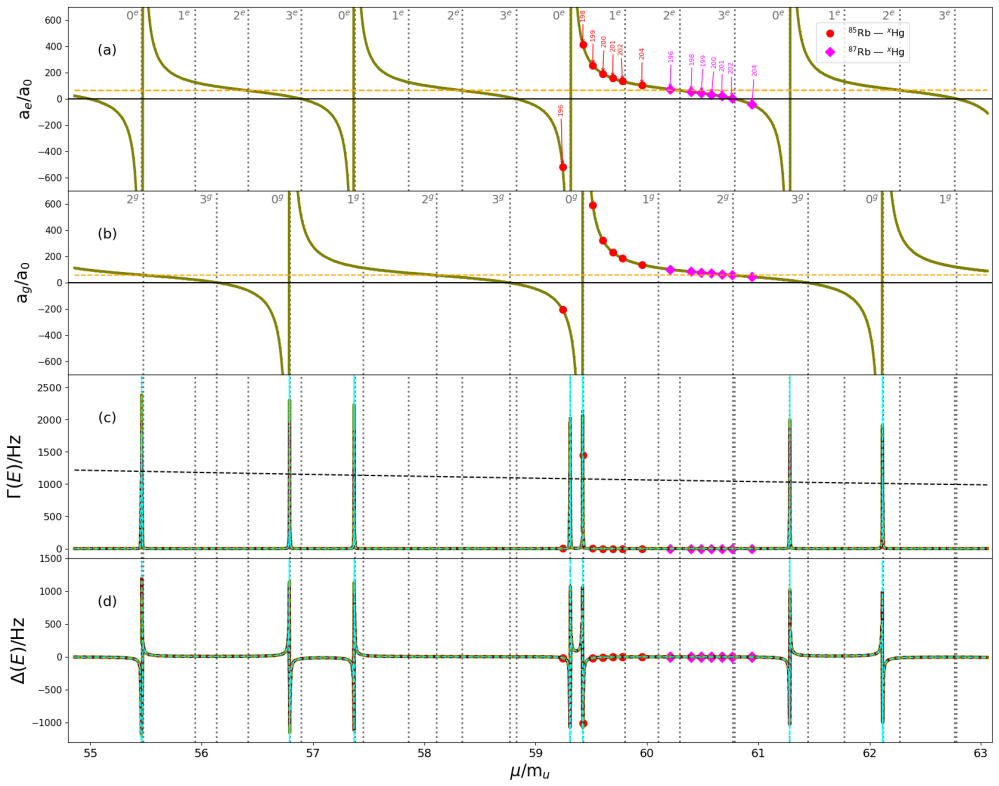
The shape resonances in excited and ground scattering states lead to significant variations of collisional line shape parameters with the change of the reduced mass of colliding atoms. For elastic collisions the dependence on reduced mass connects to the variation of the scattering length in the excited and ground states of the Hg-Rb system in the microkelvin range, while inelastic channels are indicated as a possible route to universal behavior that would alter the isotopic dependence of the broadening and shifting.
What carries the argument
The Born-Oppenheimer effective interaction potential constructed from leading long-range van der Waals coefficients, used in full quantum scattering calculations to obtain collisional widths and shifts for different isotopic combinations.
If this is right
- Collisional line shape parameters depend on reduced mass through changes in ground-state and excited-state scattering lengths at microkelvin temperatures.
- Shape resonances in the scattering states produce the dominant isotopic variations in the widths and shifts.
- Inelastic collisions can drive universal behavior that reduces the sensitivity of broadening and shifting to the specific isotopic combination.
Where Pith is reading between the lines
- Choosing particular isotopic pairs of Hg and Rb could be used to suppress or tune the size of collisional shifts in a mixed-species clock.
- The resonance locations found here supply concrete targets for temperature-dependent measurements that could confirm or refine the model.
- The same reduced-mass resonance mechanism may appear in other clock-perturber pairs and affect buffer-gas choices in precision spectroscopy.
Load-bearing premise
The effective interaction potential that includes only the leading long-range van der Waals coefficients captures the essential physics of the collisions across the full temperature range and for all isotopic combinations.
What would settle it
An experiment measuring the collisional widths and shifts for several Hg-Rb isotopic pairs that finds little or no variation with reduced mass, or a calculation with higher-order potential terms that removes the shape resonances.
Figures


read the original abstract
We study the isotopic dependence of collisional widths and shifts of the Hg clock transition $^1$S$_0$-$^3$P$_0$ perturbed by the Rb atoms in the temperature range from 1 nK to 1 K. For this purpose, we model the Born-Oppenheimer effective interaction potential by including the leading long-range van der Waals coefficients. For elastic collisions, we show the connection between the dependence of collision line shape parameters on the reduced mass of colliding partners as well as the variation of the scattering length in the excited and ground states of the Hg-Rb system in the $\upmu$K temperature range. We confront the full quantum scattering calculations with a semi-classical approximation for collisional widths and shifts. We show that the shape resonances in excited and ground scattering states lead to significant variations of collisional line shape parameters with the change of the reduced mass of colliding atoms. We also indicate the possible influence of inelastic collisions, which could lead to universal behavior and significantly affect the dependence of collisional broadening and shifting on the isotopic combination of colliding atoms.
Editorial analysis
A structured set of objections, weighed in public.
Referee Report
Summary. The manuscript examines the isotopic dependence of collisional widths and shifts of the Hg clock transition (^1S_0 - ^3P_0) perturbed by Rb atoms from 1 nK to 1 K. It models Born-Oppenheimer potentials with only leading long-range van der Waals coefficients, performs full quantum scattering calculations, compares them to semi-classical approximations, links reduced-mass dependence to scattering-length variations in the μK regime, and attributes large isotopic variations to shape resonances in ground and excited states while noting possible inelastic effects that could induce universal behavior.
Significance. If the central results hold, the work demonstrates how shape resonances can produce pronounced isotopic sensitivity in ultracold collisional line shapes, offering testable predictions for precision metrology and cold-atom mixtures. The explicit quantum-versus-semi-classical comparison and the emphasis on reduced-mass effects constitute clear strengths.
major comments (2)
- [Abstract / potential model] The central claim that shape resonances produce significant isotopic variations in collisional parameters rests on the accuracy of resonance locations. The Born-Oppenheimer potentials are constructed from only the leading C6 coefficients (as stated in the abstract), omitting C8, C10, short-range repulsion, spin-orbit, and hyperfine structure. Because resonances shift by many partial waves under ~1% potential changes and the isotopic reduced-mass differences are only a few percent, this truncation risks mislocating the resonances and reversing or erasing the reported mass dependence. No sensitivity analysis or comparison to ab-initio potentials is described.
- [Abstract] The abstract indicates that inelastic collisions 'could lead to universal behavior and significantly affect' the isotopic dependence, yet no quantitative treatment, rate estimates, or coupled-channel results for inelastic channels are provided. If inelastic processes are non-negligible, they may dominate the elastic resonance effects that underpin the main isotopic-variation claim.
minor comments (2)
- Clarify the temperature sub-ranges in which the scattering-length connection versus the resonance-driven variations are expected to dominate; the μK regime is singled out for the former while the full 1 nK–1 K interval is studied.
- Explicitly cite the sources of the van der Waals coefficients employed, as the calculations rely on these literature values rather than fitting to the target line shapes.
Simulated Author's Rebuttal
We thank the referee for the careful reading of our manuscript and the constructive major comments. We address each point below, indicating the revisions we will incorporate.
read point-by-point responses
-
Referee: The central claim that shape resonances produce significant isotopic variations in collisional parameters rests on the accuracy of resonance locations. The Born-Oppenheimer potentials are constructed from only the leading C6 coefficients (as stated in the abstract), omitting C8, C10, short-range repulsion, spin-orbit, and hyperfine structure. Because resonances shift by many partial waves under ~1% potential changes and the isotopic reduced-mass differences are only a few percent, this truncation risks mislocating the resonances and reversing or erasing the reported mass dependence. No sensitivity analysis or comparison to ab-initio potentials is described.
Authors: We acknowledge that the use of only the leading C6 coefficient represents a significant simplification of the interaction potential. Our model was chosen to isolate and demonstrate the physical mechanism linking reduced-mass variations to shape-resonance positions and the resulting isotopic sensitivity in the elastic scattering regime. To directly address the absence of a sensitivity analysis, the revised manuscript will include a new subsection in which the C6 coefficient is scaled by small amounts (e.g., ±2 % and ±5 %) while keeping all other aspects of the calculation fixed; we will show that, although individual resonance locations shift, the qualitative pattern of large isotopic variations in the μK regime persists. We agree that a more complete potential including C8, C10, short-range repulsion, spin-orbit, and hyperfine terms would be desirable for quantitative predictions. No ab initio potentials for the Hg–Rb system are available in the literature, which is why the present model was adopted; this limitation will be stated explicitly in the revised text. revision: partial
-
Referee: The abstract indicates that inelastic collisions 'could lead to universal behavior and significantly affect' the isotopic dependence, yet no quantitative treatment, rate estimates, or coupled-channel results for inelastic channels are provided. If inelastic processes are non-negligible, they may dominate the elastic resonance effects that underpin the main isotopic-variation claim.
Authors: We agree that inelastic channels constitute an important caveat that could alter or even supersede the elastic resonance effects we report. The manuscript already notes this possibility, but without quantitative estimates. A full treatment would require multi-channel calculations that incorporate spin-orbit coupling, hyperfine structure, and inelastic loss channels; such an extension lies beyond the scope of the present work, which is focused on elastic scattering. In the revision we will modify the abstract and the final discussion section to state more clearly that the reported isotopic variations refer to the elastic case and that inelastic processes may induce universal behavior, thereby changing the mass dependence. We will also identify this as an important topic for future investigation. revision: partial
Circularity Check
No significant circularity; results follow from standard scattering theory on external potentials
full rationale
The derivation applies quantum scattering theory to solve the radial Schrödinger equation for Hg-Rb collisions using a model Born-Oppenheimer potential constructed from leading long-range van der Waals coefficients taken from prior literature. Collisional widths and shifts are computed directly from the resulting phase shifts and cross sections for different isotopic reduced masses; no parameters are fitted to the target line-shape observables, and the isotopic variations emerge from the explicit mass dependence in the scattering solutions rather than by redefinition or self-referential fitting. The semi-classical approximation serves as an independent comparison, not a source of the quantum results. No self-definitional loops, load-bearing self-citations, or renamings of known results appear in the core chain.
Axiom & Free-Parameter Ledger
axioms (2)
- domain assumption Born-Oppenheimer approximation holds for modeling the Hg-Rb effective interaction potential
- standard math Quantum mechanical scattering theory accurately describes collisional line shapes at the stated temperatures
Lean theorems connected to this paper
-
Cost.FunctionalEquation (J-cost is unrelated to Gribakin-Flambaum scattering length formula)washburn_uniqueness_aczel unclear?
unclearRelation between the paper passage and the cited Recognition theorem.
a=¯a[1−tan(Φ−π/8)] ... ¯a=2^{-3/2} Γ(3/4)/Γ(5/4) (2µC6/¯h²)^{1/4}
What do these tags mean?
- matches
- The paper's claim is directly supported by a theorem in the formal canon.
- supports
- The theorem supports part of the paper's argument, but the paper may add assumptions or extra steps.
- extends
- The paper goes beyond the formal theorem; the theorem is a base layer rather than the whole result.
- uses
- The paper appears to rely on the theorem as machinery.
- contradicts
- The paper's claim conflicts with a theorem or certificate in the canon.
- unclear
- Pith found a possible connection, but the passage is too broad, indirect, or ambiguous to say the theorem truly supports the claim.
Reference graph
Works this paper leans on
-
[1]
Science319, 1808–1812, DOI: 10.1126/science.1154622 (2008)
Rosenband, T.et al.Frequency ratio of Al + and Hg+ single-ion optical clocks; Metrology at the 17th decimal place. Science319, 1808–1812, DOI: 10.1126/science.1154622 (2008)
-
[2]
Boyd, M. M.et al. 87Sr lattice clock with inaccuracy below 10−15.Phys. Rev. Lett.98, 083002, DOI: 10.1103/PhysRevLett. 98.083002 (2007)
-
[3]
Ludlow, A. D.et al.Ultracold strontium clock: Applications to the measurement of fundamental constant variations.EPJ ST163, 9–18, DOI: 10.1140/epjst/e2008-00806-8 (2008)
-
[4]
Schneider, T., Peik, E. & Tamm, C. Sub-hertz optical frequency comparisons between two trapped 171Yb+ ions.Phys. Rev. Lett.94, 230801, DOI: 10.1103/PhysRevLett.94.230801 (2005)
-
[5]
Ludlow, A. D., Boyd, M. M., Ye, J., Peik, E. & Schmidt, P. O. Optical atomic clocks.Rev. Mod. Phys.87, 637–701, DOI: 10.1103/RevModPhys.87.637 (2015)
-
[6]
Marion, H.et al.Search for variations of fundamental constants using atomic fountain clocks.Phys. Rev. Lett.90, 150801, DOI: 10.1103/PhysRevLett.90.150801 (2003)
-
[7]
Fischer, M.et al.New limits on the drift of fundamental constants from laboratory measurements.Phys. Rev. Lett.92, 230802, DOI: 10.1103/PhysRevLett.92.230802 (2004)
-
[8]
Blatt, S.et al.New limits on coupling of fundamental constants to gravity using 87Sr optical lattice clocks.Phys. Rev. Lett. 100, 140801, DOI: 10.1103/PhysRevLett.100.140801 (2008)
-
[9]
Fortier, T. M.et al.Precision atomic spectroscopy for improved limits on variation of the fine structure constant and local position invariance.Phys. Rev. Lett.98, 070801, DOI: 10.1103/PhysRevLett.98.070801 (2007)
-
[10]
Peik, E.et al.Limit on the present temporal variation of the fine structure constant.Phys. Rev. Lett.93, 170801, DOI: 10.1103/PhysRevLett.93.170801 (2004)
-
[11]
Astron1, 0009, DOI: 10.1038/s41550-016-0009 (2016)
Wcisło, P.et al.Experimental constraint on dark matter detection with optical atomic clocks.Nat. Astron1, 0009, DOI: 10.1038/s41550-016-0009 (2016)
-
[12]
Hunting for topological dark matter with atomic clocks
Derevianko, A. & Pospelov, M. Hunting for topological dark matter with atomic clocks.Nat. Phys10, 933–936, DOI: 10.1038/nphys3137 (2014)
-
[13]
Martin, M. J.et al.A quantum many-body spin system in an optical lattice clock.Science341, 632–636, DOI: 10.1126/science.1236929 (2013)
-
[14]
F.et al.Synthetic dimensions and spin-orbit coupling with an optical clock transition.Phys
Livi, L. F.et al.Synthetic dimensions and spin-orbit coupling with an optical clock transition.Phys. Rev. Lett.117, 220401, DOI: 10.1103/PhysRevLett.117.220401 (2016)
-
[15]
L.et al.Dynamics of interacting fermions under spin–orbit coupling in an optical lattice clock.Nat
Bromley, S. L.et al.Dynamics of interacting fermions under spin–orbit coupling in an optical lattice clock.Nat. Phys14, 399–404, DOI: 10.1038/s41567-017-0029-0 (2018)
-
[16]
Cooper, N. R. & Rey, A. M. Adiabatic control of atomic dressed states for transport and sensing.Phys. Rev. A92, 021401, DOI: 10.1103/PhysRevA.92.021401 (2015). 11/15
-
[17]
Covey, J. P., Madjarov, I. S., Cooper, A. & Endres, M. 2000-times repeated imaging of strontium atoms in clock-magic tweezer arrays.Phys. Rev. Lett.122, 173201, DOI: 10.1103/PhysRevLett.122.173201 (2019)
-
[18]
Daley, A. J., Boyd, M. M., Ye, J. & Zoller, P. Quantum computing with alkaline-earth-metal atoms.Phys. Rev. Lett.101, 170504, DOI: 10.1103/PhysRevLett.101.170504 (2008)
-
[19]
Shibata, K., Kato, S., Yamaguchi, A., Uetake, S. & Takahashi, Y . A scalable quantum computer with ultranarrow optical transition of ultracold neutral atoms in an optical lattice.Appl. Phys. B97, 753–758, DOI: 10.1007/s00340-009-3696-4 (2009)
-
[20]
V .et al.Alkaline-earth-metal atoms as few-qubit quantum registers.Phys
Gorshkov, A. V .et al.Alkaline-earth-metal atoms as few-qubit quantum registers.Phys. Rev. Lett.102, 110503, DOI: 10.1103/PhysRevLett.102.110503 (2009)
-
[21]
Norcia, M. A.et al.Iterative assembly of 171Yb atom arrays with cavity-enhanced optical lattices.PRX Quantum5, 030316, DOI: 10.1103/PRXQuantum.5.030316 (2024)
-
[22]
Yu, N. & Tinto, M. Gravitational wave detection with single-laser atom interferometers.Gen. Relativ. Gravit.43, 1943–1952, DOI: 10.1007/s10714-010-1055-8 (2011)
-
[23]
Graham, P. W., Hogan, J. M., Kasevich, M. A. & Rajendran, S. New method for gravitational wave detection with atomic sensors.Phys. Rev. Lett.110, 171102, DOI: 10.1103/PhysRevLett.110.171102 (2013)
-
[24]
Kolkowitz, S.et al.Gravitational wave detection with optical lattice atomic clocks.Phys. Rev. D94, 124043, DOI: 10.1103/PhysRevD.94.124043 (2016)
-
[25]
Commun.10, 1724, DOI: 10.1038/s41467-019-09706-9 (2019)
Golovizin, A.et al.Inner-shell clock transition in atomic thulium with a small blackbody radiation shift.Nat. Commun.10, 1724, DOI: 10.1038/s41467-019-09706-9 (2019)
-
[27]
Yi, L., Mejri, S., McFerran, J. J., Le Coq, Y . & Bize, S. Optical lattice trapping of199Hg and determination of the magic wavelength for the ultraviolet 1S0↔3P0.Phys. Rev. Lett.106, 073005, DOI: 10.1103/PhysRevLett.106.073005 (2011)
-
[28]
Gravina, S.et al.Comb-referenced doppler-free spectrometry of the 200Hg and 202Hg intercombination line at 254 nm. Phys. Rev. Lett.132, 213001, DOI: 10.1103/PhysRevLett.132.213001 (2024)
-
[29]
Express27, 11069–11083, DOI: 10.1364/OE.27.011069 (2019)
Witkowski, M.et al.Absolute frequency and isotope shift measurements of mercury 1S0-3P1 transition.Opt. Express27, 11069–11083, DOI: 10.1364/OE.27.011069 (2019)
-
[30]
Linek, A., Morzy´nski, P. & Witkowski, M. Absolute frequency measurement of the 6s2 1 S0 → 6s6p 3P1 F=3/2 → F’=5/2 201Hg transition with background-free saturation spectroscopy.Opt. Express30, 44103–44117, DOI: 10.1364/OE.475986 (2022)
-
[31]
Express25, 3165–3179, DOI: 10.1364/OE.25.003165 (2017)
Witkowski, M.et al.Dual Hg-Rb magneto-optical trap.Opt. Express25, 3165–3179, DOI: 10.1364/OE.25.003165 (2017)
-
[32]
Guo, C.et al.Exploiting the two-dimensional magneto-optical trapping of 199Hg for a mercury optical lattice clock.Phys. Rev. A107, 033116, DOI: 10.1103/PhysRevA.107.033116 (2023)
-
[33]
Lavigne, Q., Groh, T. & Stellmer, S. Magneto-optical trapping of mercury at high phase-space density.Phys. Rev. A105, 033106, DOI: 10.1103/PhysRevA.105.033106 (2022)
-
[34]
Hachisu, H.et al.Trapping of neutral mercury atoms and prospects for optical lattice clocks.Phys. Rev. Lett.100, 053001, DOI: 10.1103/PhysRevLett.100.053001 (2008)
-
[35]
Petersen, M.et al.Doppler-free spectroscopy of the 1S0-3P0 optical clock transition in laser-cooled fermionic isotopes of neutral mercury.Phys. Rev. Lett.101, 183004, DOI: 10.1103/PhysRevLett.101.183004 (2008). 36.King, W. H.Isotope Shifts in Atomic Spectra. Physics of Atoms and Molecules (Springer, Boston, MA, 1984)
-
[36]
Ono, K.et al.Observation of nonlinearity of generalized King plot in the search for new boson.Phys. Rev. X12, 021033, DOI: 10.1103/PhysRevX.12.021033 (2022)
-
[37]
Solaro, C.et al.Improved isotope-shift-based bounds on bosons beyond the standard model through measurements of the 2D3/2 − 2D5/2 interval in Ca+.Phys. Rev. Lett.125, 123003, DOI: 10.1103/PhysRevLett.125.123003 (2020). 39.McGrew, W. F.et al.Atomic clock performance enabling geodesy below the centimeter level.Nature564, 87 (2018)
-
[38]
Margolis, H. S.et al.The CIPM list ‘Recommended values of standard frequencies’: 2021 update.Metrologia61, 035005, DOI: 10.1088/1681-7575/ad3afc (2024). 12/15
-
[39]
M.et al.Measurements of 27Al+ and 25Mg+ magnetic constants for improved ion-clock accuracy.Phys
Brewer, S. M.et al.Measurements of 27Al+ and 25Mg+ magnetic constants for improved ion-clock accuracy.Phys. Rev. A 100, 013409, DOI: 10.1103/PhysRevA.100.013409 (2019)
-
[40]
Lett.38, 4581–4584, DOI: 10.1364/OL.38.004581 (2013)
Morzy´nski, P.et al.Absolute frequency measurement of rubidium 5S-7S two-photon transitions.Opt. Lett.38, 4581–4584, DOI: 10.1364/OL.38.004581 (2013)
-
[41]
Nishiyama, A., Nakajima, Y ., Nakagawa, K. & Minoshima, K. Precise and highly-sensitive doppler-free two-photon absorption dual-comb spectroscopy using pulse shaping and coherent averaging for fluorescence signal detection.Opt. Express26, 8957–8967, DOI: 10.1364/OE.26.008957 (2018)
-
[42]
Siska, P. E. Molecular-beam studies of penning ionization.Rev. Mod. Phys.65, 337–412, DOI: 10.1103/RevModPhys.65. 337 (1993)
-
[43]
Chin, C., Grimm, R., Julienne, P. & Tiesinga, E. Feshbach resonances in ultracold gases.Rev. Mod. Phys.82, 1225–1286, DOI: 10.1103/RevModPhys.82.1225 (2010)
-
[44]
Ciuryło, R., Tiesinga, E., Kotochigova, S. & Julienne, P. S. Photoassociation spectroscopy of cold alkaline-earth-metal atoms near the intercombination line.Phys. Rev. A70, 062710, DOI: 10.1103/PhysRevA.70.062710 (2004)
-
[45]
Simplified quantum-mechanical theory of pressure broadening.Phys
Baranger, M. Simplified quantum-mechanical theory of pressure broadening.Phys. Rev.111, 481–493, DOI: 10.1103/ PhysRev.111.481 (1958)
1958
-
[46]
Julienne, P. S. & Mies, F. H. Nonadiabatic theory of atomic line broadening: Redistribution calculations for Sr(1P←1S)+Ar. Phys. Rev. A34, 3792–3808, DOI: 10.1103/PhysRevA.34.3792 (1986)
-
[47]
Burnett, K., Julienne, P. S., Lett, P. D., Tiesinga, E. & Williams, C. J. Quantum encounters of the cold kind.Nature416, 225–232, DOI: 10.1038/416225a (2002)
-
[48]
Bohn, J. L. & Julienne, P. S. Prospects for influencing scattering lengths with far-off-resonant light.Phys. Rev. A56, 1486–1491, DOI: 10.1103/PhysRevA.56.1486 (1997)
-
[49]
Ciuryło, R., Tiesinga, E. & Julienne, P. S. Optical tuning of the scattering length of cold alkaline-earth-metal atoms.Phys. Rev. A71, 030701, DOI: 10.1103/PhysRevA.71.030701 (2005)
-
[50]
Leo, P. J., Julienne, P. S., Mies, F. H. & Williams, C. J. Collisional frequency shifts in133Cs fountain clocks.Phys. Rev. Lett.86, 3743–3746, DOI: 10.1103/PhysRevLett.86.3743 (2001)
-
[51]
Kokkelmans, S. J. J. M. F., Verhaar, B. J., Gibble, K. & Heinzen, D. J. Predictions for laser-cooled Rb clocks.Phys. Rev. A 56, R4389–R4392, DOI: 10.1103/PhysRevA.56.R4389 (1997)
-
[52]
Allard, N. & Kielkopf, J. The effect of neutral nonresonant collisions on atomic spectral lines.Rev. Mod. Phys.54, 1103–1182, DOI: 10.1103/RevModPhys.54.1103 (1982)
-
[53]
Nienhuis, G. Effects of the radiator motion in the classical and quantum-mechanical theories of collisional spectral-line broadening.J. Quant. Spectrosc. Radiat. Transf.20, 275–290, DOI: https://doi.org/10.1016/0022-4073(78)90133-4 (1978)
-
[54]
Ward, J., Cooper, J. & Smith, E. W. Correlation effects in the theory of combined doppler and pressure broadening-I. classical theory.J. Quant. Spectrosc. Radiat. Transf.14, 555–590, DOI: https://doi.org/10.1016/0022-4073(74)90036-3 (1974)
-
[55]
Gribakin, G. F. & Flambaum, V . V . Calculation of the scattering length in atomic collisions using the semiclassical approximation.Phys. Rev. A48, 546–553, DOI: 10.1103/PhysRevA.48.546 (1993)
-
[56]
Flambaum, V . V ., Gribakin, G. F. & Harabati, C. Analytical calculation of cold-atom scattering.Phys. Rev. A59, 1998–2005, DOI: 10.1103/PhysRevA.59.1998 (1999)
-
[57]
Idziaszek, Z. & Julienne, P. S. Universal rate constants for reactive collisions of ultracold molecules.Phys. Rev. Lett.104, 113202, DOI: 10.1103/PhysRevLett.104.113202 (2010)
-
[58]
Kitagawa, M.et al.Two-color photoassociation spectroscopy of ytterbium atoms and the precise determinations of s-wave scattering lengths.Phys. Rev. A77, 012719, DOI: 10.1103/PhysRevA.77.012719 (2008)
-
[59]
Borkowski, M.et al.Scattering lengths in isotopologues of the RbYb system.Phys. Rev. A88, 052708, DOI: 10.1103/ PhysRevA.88.052708 (2013)
2013
-
[60]
Przybytek, M. & Jeziorski, B. Bounds for the scattering length of spin-polarized helium from high-accuracy electronic structure calculations.The J. Chem. Phys.123, 134315, DOI: 10.1063/1.2042453 (2005). https://pubs.aip.org/aip/jcp/ article-pdf/doi/10.1063/1.2042453/13222526/134315_1_online.pdf
-
[61]
Moal, S.et al.Accurate determination of the scattering length of metastable helium atoms using dark resonances between atoms and exotic molecules.Phys. Rev. Lett.96, 023203, DOI: 10.1103/PhysRevLett.96.023203 (2006). 13/15
-
[62]
Knoop, S.et al.Ultracold mixtures of metastable He and Rb: Scattering lengths from ab initio calculations and thermalization measurements.Phys. Rev. A90, 022709, DOI: 10.1103/PhysRevA.90.022709 (2014)
-
[63]
Gronowski, M., Koza, A. M. & Tomza, M. Ab initio properties of the NaLi molecule in the a3Σ+ electronic state.Phys. Rev. A102, 020801, DOI: 10.1103/PhysRevA.102.020801 (2020)
-
[65]
CODATA recommended values of the fundamental physical constants: 2018
Mohr, P., Newell, D., Taylor, B. & Tiesinga, E. Codata recommended values of the fundamental physical constants: 2022, DOI: 10.1103/RevModPhys.93.025010 (2024). 2409.03787
-
[66]
Borkowski, M., Muñoz Rodriguez, R., Kosicki, M. B., Ciuryło, R. &˙Zuchowski, P. S. Optical feshbach resonances and ground-state-molecule production in the RbHg system.Phys. Rev. A96, 063411, DOI: 10.1103/PhysRevA.96.063411 (2017)
-
[67]
Mies, F. H. A multichannel quantum defect analysis of diatomic predissociation and inelastic atomic scattering.The J. Chem. Phys.80, 2514–2525, DOI: 10.1063/1.447000 (1984). https://pubs.aip.org/aip/jcp/article-pdf/80/6/2514/18947027/ 2514_1_online.pdf
-
[68]
Mies, F. H. & Julienne, P. S. A multichannel quantum defect analysis of two-state couplings in diatomic molecules.The J. Chem. Phys.80, 2526–2536, DOI: 10.1063/1.447046 (1984). https://pubs.aip.org/aip/jcp/article-pdf/80/6/2526/18947727/ 2526_1_online.pdf
-
[69]
Ciamei, A.et al.The RbSr 2Σ+ ground state investigated via spectroscopy of hot and ultracold molecules.Phys. Chem. Chem. Phys.20, 26221, DOI: 10.1039/C8CP03919D (2018)
-
[70]
˙Zuchowski, P. S., Guérout, R. & Dulieu, O. Ground- and excited-state properties of the polar and paramagnetic RbSr molecule: A comparative study.Phys. Rev. A90, 012507, DOI: 10.1103/PhysRevA.90.012507 (2014)
-
[71]
Schwerdtfeger, P. & Nagle, J. K. 2018 table of static dipole polarizabilities of the neutral elements in the periodic table*. Mol. Phys.117, 1200–1225, DOI: 10.1080/00268976.2018.1535143 (2019)
-
[72]
Cohen, J. S. & Derevianko, A. Long-range forces between two excited mercury atoms and associative ionization.Phys. Rev. A76, 012706, DOI: 10.1103/PhysRevA.76.012706 (2007)
-
[73]
Guo, K., Wang, G. & Ye, A. Dipole polarizabilities and magic wavelengths for a Sr and Yb atomic optical lattice clock.J. Phys. B: At. Mol. Opt. Phys.43, 135004, DOI: 10.1088/0953-4075/43/13/135004 (2010)
-
[74]
Tang, K. T. & Toennies, P. The dynamical polarisability and van der waals dimer potential of mercury.Mol. Phys.106, 1645–1653, DOI: 10.1080/00268970802270059 (2008). 77.https://www.nist.gov/pml/atomic-spectra-database
-
[75]
Slater, J. C. & Kirkwood, J. G. The van der waals forces in gases.Phys. Rev.37, 682–697, DOI: 10.1103/PhysRev.37.682 (1931)
-
[76]
Johnson, B. R. New numerical methods applied to solving the one-dimensional eigenvalue problem.The J. Chem. Phys. 67, 4086–4093 (1977)
1977
-
[77]
Johnson, B. R. The renormalized Numerov method applied to calculating bound states of the coupled-channel Schroedinger equation.The J. Chem. Phys.69, 4678–4688, DOI: 10.1063/1.436421 (1978)
-
[78]
A scattering theory of diatomic molecules.Mol
Mies, F. A scattering theory of diatomic molecules.Mol. Phys.41, 953–972, DOI: 10.1080/00268978000103711 (1980)
-
[79]
Bohn, J. L. & Wang, R. R. Probability distributions of atomic scattering lengths.Can. J. Phys.103, 81–88, DOI: 10.1139/cjp-2023-0263 (2025). https://doi.org/10.1139/cjp-2023-0263
-
[80]
Gao, B. Zero-energy bound or quasibound states and their implications for diatomic systems with an asymptotic van der waals interaction.Phys. Rev. A62, 050702(R), DOI: 10.1103/PhysRevA.62.050702 (2000)
-
[81]
Angular-momentum-insensitive quantum-defect theory for diatomic systems.Phys
Gao, B. Angular-momentum-insensitive quantum-defect theory for diatomic systems.Phys. Rev. A64, 010701(R), DOI: 10.1103/PhysRevA.64.010701 (2001)
-
[82]
Borkowski, M.et al.Line shapes of optical feshbach resonances near the intercombination transition of bosonic ytterbium. Phys. Rev. A80, 012715, DOI: 10.1103/PhysRevA.80.012715 (2009)
discussion (0)
Sign in with ORCID, Apple, or X to comment. Anyone can read and Pith papers without signing in.