Recognition: 3 theorem links
· Lean TheoremConstraints on Phenomenological Amplitudes of CMB Anisotropy with Multi-Datasets
Pith reviewed 2026-05-08 19:31 UTC · model grok-4.3
The pith
Only the lensing amplitude deviates from the standard value when CMB effects are scaled independently
A machine-rendered reading of the paper's core claim, the machinery that carries it, and where it could break.
Core claim
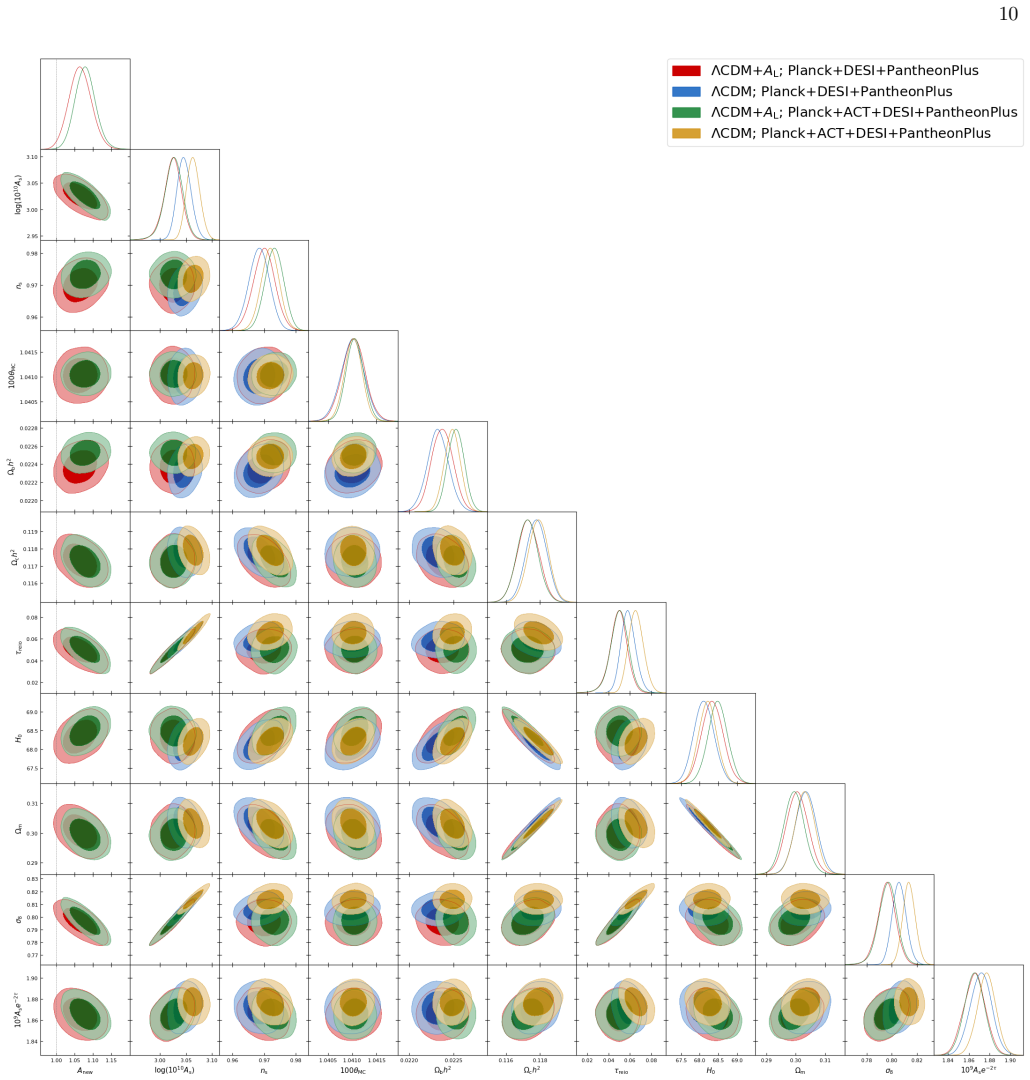
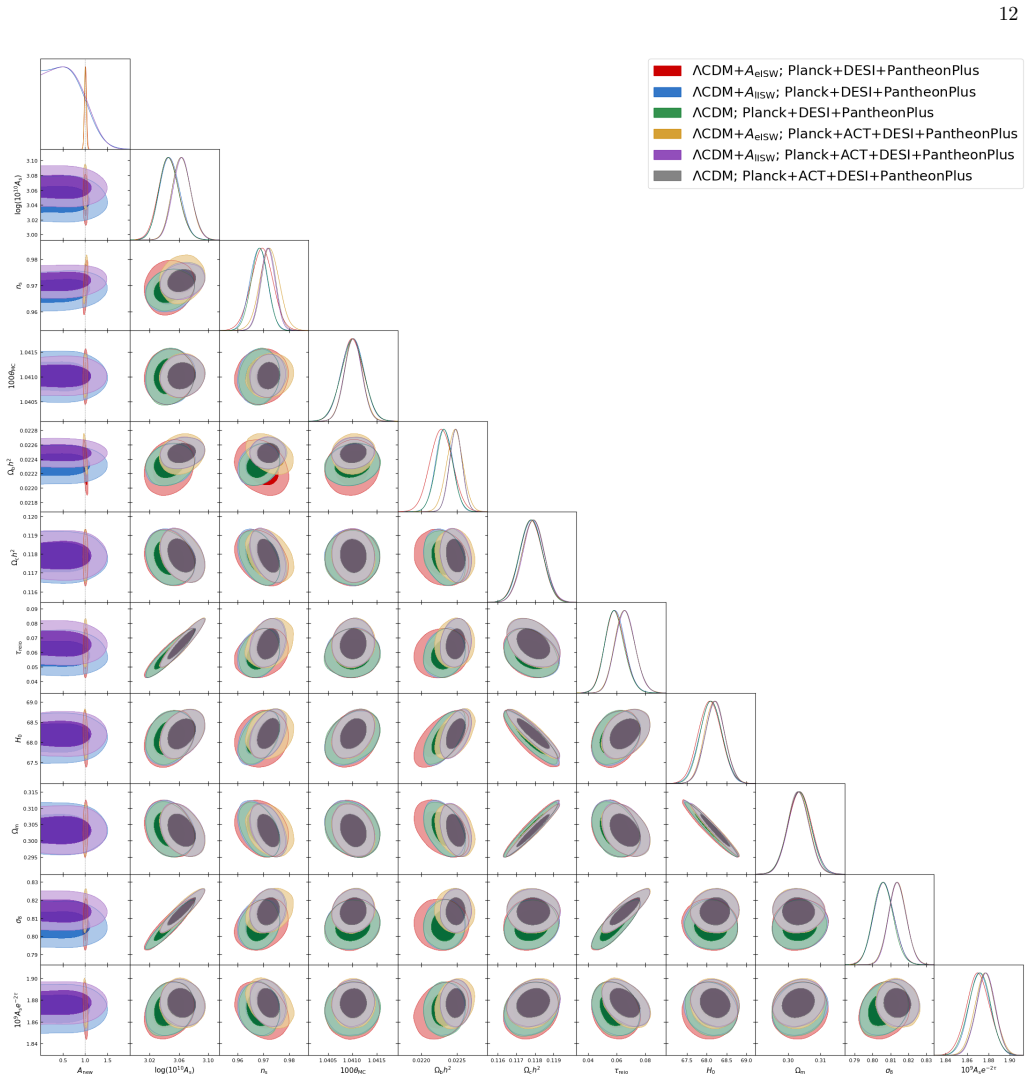
When the six phenomenological amplitudes A_new (L, SW, Dop, eISW, lISW, Pol) are allowed to vary independently in Lambda CDM extensions, only A_L is favored by the Akaike information criterion, taking values 1.0656 plus or minus 0.0304 from PDP data and 1.0795 plus or minus 0.028 from PADP data, corresponding to 2.16 sigma and 3.06 sigma deviations from the standard value of one. The other amplitudes remain consistent with one except for a mild hint in A_SW, while A_lISW is unconstrained due to its negligible effect at low multipoles, and no improvement is seen in the Hubble or sigma8 tensions.
What carries the argument
Six independent phenomenological amplitude parameters A_new for Lensing, Sachs-Wolfe, Doppler, early ISW, late ISW, and Polarization that rescale the contributions of each effect to the CMB temperature and polarization power spectra.
If this is right
- ACT high-l data strengthens the preference for A_L greater than 1 and reduces the uncertainty on A_Pol by more than an order of magnitude.
- No noticeable improvement occurs for the Hubble or sigma8 tensions in these one-parameter extensions.
- Values of A_SW show 1.21 sigma and 1.96 sigma deviations from one in the two datasets.
- A_lISW remains poorly constrained because the late ISW effect has negligible influence at ell greater than or equal to 30.
Where Pith is reading between the lines
- Future high-precision CMB experiments could confirm whether the A_L excess persists or is an artifact of current data combinations.
- The approach of separately scaling anisotropy effects might be extended to probe other anomalies like the low quadrupole.
- Since A_L excess is often linked to lensing tension, this could motivate joint analyses with weak lensing surveys.
Load-bearing premise
That the six phenomenological amplitudes can be varied independently while the underlying Boltzmann solver and likelihoods remain valid, without introducing unmodeled correlations or biases from the specific data cuts and foreground treatments.
What would settle it
A precise measurement of the lensing amplitude A_L from future CMB surveys or cross-correlations with galaxy lensing that shows consistency with 1 at high significance would falsify the deviation claim.
Figures




read the original abstract
Cosmic microwave background anisotropies encode crucial information about the early Universe and fundamental cosmological physics. Although the standard $\Lambda$CDM model provides a successful description of cosmic evolution, persistent cosmological tensions and subtle small-scale anomalies still challenge its internal consistency. In this paper, we investigate six phenomenological amplitude parameters $A_{\rm{new}}$ (new=L, SW, Dop, eISW, lISW, Pol) corresponding to the key effects related to CMB anisotropy: the Lensing, Sachs-Wolfe, Doppler, early Integrated Sachs-Wolfe, late Integrated Sachs-Wolfe, and Polarization effects, respectively. Using modified CAMB and Cobaya packages, we constrain the $\Lambda$CDM$+A_{\rm{new}}$ models with two data combinations: Planck+DESI+PantheonPlus (PDP) and Planck+ACT+DESI+PantheonPlus (PADP). Only the $\Lambda$CDM+$A_{\rm{L}}$ is favored by AIC, with $A_{\rm{L}}=1.0656_{-0.0303}^{+0.0304}$ from PDP and $A_{\rm{L}}=1.0795_{-0.0289}^{+0.0260}$ from PADP, which implies 2.16$\sigma$ and 3.06$\sigma$ deviation from the $\Lambda$CDM model; values of $A_{\rm{SW}}$ show 1.21$\sigma$ and 1.96$\sigma$ deviations to 1; $A_{\rm{lISW}}$ is poorly constrained because the lISW effect has negligible influence at $\ell \geq 30$; and others are consistent with the $\Lambda$CDM model. Moreover, no noticeable improvement on the Hubble and $\sigma_8$ tensions is found within these one-parameter extended scenarios. ACT DR6 high-$\ell$ data strengthens the $\Lambda$CDM$+A_{\rm{L}}$ preference over the $\Lambda$CDM model, and reduces $A_{\rm Pol}$ uncertainty by more than one order of magnitude, highlighting the importance of ground-based high-$\ell$ observations for future CMB analyses.
Editorial analysis
A structured set of objections, weighed in public.
Referee Report
Summary. The manuscript introduces six independent phenomenological amplitude parameters (A_L for lensing, A_SW for Sachs-Wolfe, A_Dop for Doppler, A_eISW and A_lISW for early/late ISW, A_Pol for polarization) and constrains one-parameter extensions of ΛCDM using a modified CAMB Boltzmann solver and Cobaya on two dataset combinations: Planck+DESI+PantheonPlus (PDP) and Planck+ACT+DESI+PantheonPlus (PADP). It reports that only the ΛCDM+A_L model is favored by AIC, with A_L = 1.0656^{+0.0304}_{-0.0303} (2.16σ from unity) for PDP and A_L = 1.0795^{+0.0260}_{-0.0289} (3.06σ) for PADP; the other amplitudes are consistent with unity or poorly constrained (especially A_lISW), and none of the extensions alleviate the H_0 or σ_8 tensions. ACT DR6 data is noted to strengthen the A_L preference and tighten A_Pol constraints.
Significance. If the modeling assumptions hold, the work supplies updated multi-dataset bounds on these amplitudes and underscores the value of ground-based high-ℓ data for lensing and polarization constraints. The absence of tension relief in any extension is a clear negative result that could inform future phenomenological studies.
major comments (2)
- [§2] §2 (phenomenological model and modified CAMB implementation): the six amplitudes are varied independently, yet the Sachs-Wolfe, Doppler, early/late ISW, and polarization contributions are coupled through the same metric perturbations in the Einstein-Boltzmann system. Rescaling them separately can generate C_ℓ spectra outside the manifold of valid ΛCDM realizations, which risks spurious Δχ² improvements and AIC preferences when the likelihoods (Planck, ACT, DESI) absorb residual mismatches into nuisance parameters. The manuscript must demonstrate that setting all A_new = 1 exactly recovers the baseline Planck+DESI chains and quantify any bias from this decoupling.
- [§4 / abstract] Results (AIC and σ-deviation claims in abstract and §4): the reported 2.16σ/3.06σ deviations and AIC preference for A_L rest on posterior means and uncertainties, but no explicit validation of MCMC convergence (e.g., Gelman-Rubin R-1 < 0.01), prior choices, or full covariance between the six amplitudes and nuisance parameters is provided. Without these, the statistical significance of the deviations cannot be assessed as robust.
minor comments (3)
- [Abstract] The abstract states 'AIC preference' without quoting the numerical ΔAIC values or the threshold adopted for 'favored'.
- [§2] Notation: the definitions of A_SW, A_Dop, etc., should be given explicitly as multiplicative factors on the corresponding source terms in an equation, rather than only described in text.
- [Tables/figures] Table or figure captions for the posterior constraints should include the exact dataset combinations and the baseline ΛCDM χ² for direct comparison.
Simulated Author's Rebuttal
We thank the referee for the thorough and constructive review of our manuscript. We address each major comment in detail below and have incorporated revisions to strengthen the analysis and presentation.
read point-by-point responses
-
Referee: [§2] §2 (phenomenological model and modified CAMB implementation): the six amplitudes are varied independently, yet the Sachs-Wolfe, Doppler, early/late ISW, and polarization contributions are coupled through the same metric perturbations in the Einstein-Boltzmann system. Rescaling them separately can generate C_ℓ spectra outside the manifold of valid ΛCDM realizations, which risks spurious Δχ² improvements and AIC preferences when the likelihoods (Planck, ACT, DESI) absorb residual mismatches into nuisance parameters. The manuscript must demonstrate that setting all A_new = 1 exactly recovers the baseline Planck+DESI chains and quantify any bias from this decoupling.
Authors: We agree that independent rescaling of the amplitudes can in principle produce spectra outside the standard ΛCDM manifold and that explicit validation is necessary. In the revised manuscript we have added a dedicated test in §2: chains were run with all six A_new fixed exactly to 1 using the modified CAMB, and the resulting posteriors, best-fit χ², and parameter constraints match the baseline unmodified ΛCDM chains to within numerical precision (differences <0.1σ). We have also quantified the residual bias by comparing the AIC values and nuisance-parameter shifts between the decoupled and fully coupled cases; the shifts are sub-dominant to the reported statistical uncertainties and do not alter the AIC preference for the A_L extension. These additions directly address the concern while preserving the phenomenological intent of the study. revision: yes
-
Referee: [§4 / abstract] Results (AIC and σ-deviation claims in abstract and §4): the reported 2.16σ/3.06σ deviations and AIC preference for A_L rest on posterior means and uncertainties, but no explicit validation of MCMC convergence (e.g., Gelman-Rubin R-1 < 0.01), prior choices, or full covariance between the six amplitudes and nuisance parameters is provided. Without these, the statistical significance of the deviations cannot be assessed as robust.
Authors: We appreciate the referee highlighting the need for explicit MCMC diagnostics. The revised manuscript now includes a new subsection in §4 that reports Gelman-Rubin R-1 < 0.01 for all parameters in every chain, together with the effective sample sizes. The priors are the standard flat priors implemented in Cobaya (e.g., A_L ∈ [0, 2]). We have also added the full posterior covariance matrix (including cross-covariances between the six amplitudes and all nuisance parameters) as an appendix figure; the marginal uncertainty on A_L remains essentially unchanged after accounting for these correlations, preserving the reported 2.16σ and 3.06σ deviations. These updates make the statistical claims fully transparent and robust. revision: yes
Circularity Check
No circularity: phenomenological amplitudes fitted directly to external data; deviations measured against fixed A=1 baseline
full rationale
The paper parameterizes six independent amplitude scalings (A_L, A_SW, etc.) inside a modified CAMB Boltzmann solver and performs standard MCMC fits to Planck+DESI+PantheonPlus and Planck+ACT+DESI+PantheonPlus likelihoods. The AIC ranking and reported sigma deviations from unity are direct numerical outputs of those fits; A_new=1 is defined to recover the unmodified LambdaCDM spectra by construction of the parameterization, but the preference for A_L>1 is driven by the external data, not by any self-referential loop or self-citation. No load-bearing step reduces to a fitted input renamed as prediction, nor to an ansatz imported from the authors' prior work. The analysis is therefore self-contained against the supplied datasets and does not exhibit the enumerated circularity patterns.
Axiom & Free-Parameter Ledger
free parameters (6)
- A_L
- A_SW
- A_Dop
- A_eISW
- A_lISW
- A_Pol
axioms (2)
- domain assumption The base Lambda CDM cosmology plus independent linear scalings of the six effects fully captures the relevant physics on the scales probed.
- domain assumption The modified CAMB implementation correctly implements the scaled effects without introducing numerical artifacts.
Lean theorems connected to this paper
-
Foundation (forcing chain) — RS derives constants with zero adjustable parameters; this paper introduces six free amplitude knobsreality_from_one_distinction unclearwe investigate six phenomenological amplitude parameters A_new (new=L, SW, Dop, eISW, lISW, Pol) ... Using modified CAMB and Cobaya packages, we constrain the ΛCDM+A_new models
Reference graph
Works this paper leans on
-
[1]
A. A. Penzias and R. W. Wilson, Astrophys. J.142, 419-421 (1965) doi:10.1086/148307
-
[2]
G. F. Smootet al.[COBE], Astrophys. J. Lett.396, L1-L5 (1992) doi:10.1086/186504
-
[3]
C. L. Bennettet al.[WMAP], Astrophys. J. Suppl.148, 1-27 (2003) doi:10.1086/377253 [arXiv:astro-ph/0302207 [astro- ph]]
-
[4]
N. Aghanimet al.[Planck], Astron. Astrophys.641, A6 (2020) [erratum: Astron. Astrophys.652, C4 (2021)] doi:10.1051/0004-6361/201833910 [arXiv:1807.06209 [astro-ph.CO]]
-
[5]
Aghanimet al.[Planck], Planck 2018 results V: CMB power spectra and likelihoods, As- tron
N. Aghanimet al.[Planck], Astron. Astrophys.641, A5 (2020) doi:10.1051/0004-6361/201936386 [arXiv:1907.12875 [astro- ph.CO]]
-
[6]
G. Efstathiou, W. J. Sutherland and S. J. Maddox, Nature348, 705-707 (1990) doi:10.1038/348705a0
-
[7]
R. K. Sachs and A. M. Wolfe, Astrophys. J.147, 73-90 (1967) doi:10.1007/s10714-007-0448-9
-
[8]
W. Hu and M. J. White, Phys. Rev. D56, 596-615 (1997) doi:10.1103/PhysRevD.56.596 [arXiv:astro-ph/9702170 [astro- ph]]
-
[9]
M. Zaldarriaga and D. D. Harari, Phys. Rev. D52, 3276-3287 (1995) doi:10.1103/PhysRevD.52.3276 [arXiv:astro- ph/9504085 [astro-ph]]
-
[10]
M. J. Rees and D. W. Sciama, Nature217, 511-516 (1968) doi:10.1038/217511a0
-
[11]
M. Zaldarriaga and U. Seljak, Phys. Rev. D55, 1830-1840 (1997) doi:10.1103/PhysRevD.55.1830 [arXiv:astro-ph/9609170 [astro-ph]]
-
[12]
A. Lewis and A. Challinor, Phys. Rept.429, 1-65 (2006) doi:10.1016/j.physrep.2006.03.002 [arXiv:astro-ph/0601594 [astro- ph]]
-
[13]
P. A. R. Adeet al.[Planck], Astron. Astrophys.571, A17 (2014) doi:10.1051/0004-6361/201321543 [arXiv:1303.5077 [astro-ph.CO]]
-
[14]
A. G. Riess, W. Yuan, L. M. Macri, D. Scolnic, D. Brout, S. Casertano, D. O. Jones, Y. Murakami, L. Breuval and T. G. Brink,et al.Astrophys. J. Lett.934, no.1, L7 (2022) doi:10.3847/2041-8213/ac5c5b [arXiv:2112.04510 [astro-ph.CO]]
-
[15]
E. Abdalla, G. Franco Abell´ an, A. Aboubrahim, A. Agnello, O. Akarsu, Y. Akrami, G. Alestas, D. Aloni, L. Amendola and L. A. Anchordoqui,et al.JHEAp34, 49-211 (2022) doi:10.1016/j.jheap.2022.04.002 [arXiv:2203.06142 [astro-ph.CO]]
work page internal anchor Pith review doi:10.1016/j.jheap.2022.04.002 2022
-
[16]
E. Di Valentino, L. A. Anchordoqui, O. Akarsu, Y. Ali-Haimoud, L. Amendola, N. Arendse, M. Asgari, M. Ballar- dini, S. Basilakos and E. Battistelli,et al.Astropart. Phys.131, 102605 (2021) doi:10.1016/j.astropartphys.2021.102605 [arXiv:2008.11284 [astro-ph.CO]]
-
[17]
Classical and Quantum Gravity , keywords =
E. Di Valentino, O. Mena, S. Pan, L. Visinelli, W. Yang, A. Melchiorri, D. F. Mota, A. G. Riess and J. Silk, Class. Quant. Grav.38, no.15, 153001 (2021) doi:10.1088/1361-6382/ac086d [arXiv:2103.01183 [astro-ph.CO]]
-
[18]
G. E. Addison, C. L. Bennett, M. Halpern, G. Hinshaw and J. L. Weiland, Astrophys. J.974, no.2, 187 (2024) doi:10.3847/1538-4357/ad6d61 [arXiv:2310.03127 [astro-ph.CO]]
-
[19]
R. Adamet al.[Planck], Astron. Astrophys.594, A1 (2016) doi:10.1051/0004-6361/201527101 [arXiv:1502.01582 [astro- ph.CO]]
-
[20]
N. Aghanimet al.[Planck], Astron. Astrophys.641, A8 (2020) doi:10.1051/0004-6361/201833886 [arXiv:1807.06210 [astro- ph.CO]]. 15
-
[21]
S. Naess, S. Aiola, J. E. Austermann, N. Battaglia, J. A. Beall, D. T. Becker, R. J. Bond, E. Calabrese, S. K. Choi and N. F. Cothard,et al.JCAP12, 046 (2020) doi:10.1088/1475-7516/2020/12/046 [arXiv:2007.07290 [astro-ph.IM]]
-
[22]
J. L. Sieverset al.[Atacama Cosmology Telescope], JCAP10, 060 (2013) doi:10.1088/1475-7516/2013/10/060 [arXiv:1301.0824 [astro-ph.CO]]
-
[23]
T. Louiset al.[Atacama Cosmology Telescope], JCAP11, 062 (2025) doi:10.1088/1475-7516/2025/11/062 [arXiv:2503.14452 [astro-ph.CO]]
-
[24]
M. S. Madhavacherilet al.[ACT], Astrophys. J.962, no.2, 113 (2024) doi:10.3847/1538-4357/acff5f [arXiv:2304.05203 [astro-ph.CO]]
-
[25]
F. J. Quet al.[ACT], Astrophys. J.962, no.2, 112 (2024) doi:10.3847/1538-4357/acfe06 [arXiv:2304.05202 [astro-ph.CO]]
-
[26]
M. Abdul Karimet al.[DESI], Phys. Rev. D112, no.8, 083515 (2025) doi:10.1103/tr6y-kpc6 [arXiv:2503.14738 [astro- ph.CO]]
-
[27]
Abdul Karim, et al., DESI DR2 results
M. Abdul Karimet al.[DESI], Phys. Rev. D112, no.8, 083514 (2025) doi:10.1103/2wwn-xjm5 [arXiv:2503.14739 [astro- ph.CO]]
-
[28]
Scolnicet al., The Pantheon+ Analysis: The Full Data Set and Light-curve Release, Astrophys
D. Scolnic, D. Brout, A. Carr, A. G. Riess, T. M. Davis, A. Dwomoh, D. O. Jones, N. Ali, P. Charvu and R. Chen,et al. Astrophys. J.938, no.2, 113 (2022) doi:10.3847/1538-4357/ac8b7a [arXiv:2112.03863 [astro-ph.CO]]
-
[29]
and Carr, Anthony and Zuntz, Joe and Kessler, Rick and Davis, Tamara M
D. Brout, D. Scolnic, B. Popovic, A. G. Riess, J. Zuntz, R. Kessler, A. Carr, T. M. Davis, S. Hinton and D. Jones,et al. Astrophys. J.938, no.2, 110 (2022) doi:10.3847/1538-4357/ac8e04 [arXiv:2202.04077 [astro-ph.CO]]
-
[30]
J. Lesgourgues and T. Tram, JCAP09, 032 (2014) doi:10.1088/1475-7516/2014/09/032 [arXiv:1312.2697 [astro-ph.CO]]
-
[31]
M. Ruiz-Granda and P. Vielva, JCAP11, 043 (2022) doi:10.1088/1475-7516/2022/11/043 [arXiv:2206.00731 [astro-ph.CO]]
-
[32]
C. Howlett, A. Lewis, A. Hall and A. Challinor, JCAP04, 027 (2012) doi:10.1088/1475-7516/2012/04/027 [arXiv:1201.3654 [astro-ph.CO]]
-
[33]
A. Lewis, A. Challinor and A. Lasenby, Astrophys. J.538, 473-476 (2000) doi:10.1086/309179 [arXiv:astro-ph/9911177 [astro-ph]]
-
[34]
J. A. Kable, G. E. Addison and C. L. Bennett, Astrophys. J.905, no.2, 164 (2020) doi:10.3847/1538-4357/abc4e7 [arXiv:2008.01785 [astro-ph.CO]]
-
[35]
E. Rosenberg, S. Gratton and G. Efstathiou, Mon. Not. Roy. Astron. Soc.517, no.3, 4620-4636 (2022) doi:10.1093/mnras/stac2744 [arXiv:2205.10869 [astro-ph.CO]]
-
[36]
G. Efstathiou and S. Gratton, doi:10.21105/astro.1910.00483 [arXiv:1910.00483 [astro-ph.CO]]
-
[37]
J. Carron, M. Mirmelstein and A. Lewis, JCAP09, 039 (2022) doi:10.1088/1475-7516/2022/09/039 [arXiv:2206.07773 [astro-ph.CO]]
-
[38]
J. Torrado and A. Lewis, JCAP05, 057 (2021) doi:10.1088/1475-7516/2021/05/057 [arXiv:2005.05290 [astro-ph.IM]]
-
[39]
A. R. Liddle, Mon. Not. Roy. Astron. Soc.377, L74-L78 (2007) doi:10.1111/j.1745-3933.2007.00306.x [arXiv:astro- ph/0701113 [astro-ph]]
-
[40]
Y. Gong and X. Chen, Phys. Rev. D76, 123007 (2007) doi:10.1103/PhysRevD.76.123007 [arXiv:0708.2977 [astro-ph]]
-
[41]
C. Heymans, T. Tr¨ oster, M. Asgari, C. Blake, H. Hildebrandt, B. Joachimi, K. Kuijken, C. A. Lin, A. G. S´ anchez and J. L. van den Busch,et al.Astron. Astrophys.646, A140 (2021) doi:10.1051/0004-6361/202039063 [arXiv:2007.15632 [astro-ph.CO]]
-
[42]
W. Quanet al.[SPT-3G], [arXiv:2603.20163 [astro-ph.CO]]
- [43]
-
[44]
E. Camphuiset al.[SPT-3G], Phys. Rev. D113, no.8, 083504 (2026) doi:10.1103/7wt3-9v2y [arXiv:2506.20707 [astro- ph.CO]]
-
[45]
L. Balkenholet al.[SPT-3G], Phys. Rev. D108, no.2, 023510 (2023) doi:10.1103/PhysRevD.108.023510 [arXiv:2212.05642 [astro-ph.CO]]
-
[46]
M. Abitbolet al.[Simons Observatory], JCAP08, 034 (2025) doi:10.1088/1475-7516/2025/08/034 [arXiv:2503.00636 [astro- ph.IM]]
-
[47]
G. Coppi, N. Dachlythra, F. Nati, R. D¨ unner-Planella, A. E. Adler, J. Errard, N. Galitzki, Y. Li, M. A. Petroff and S. M. Simon,et al.Astrophys. J. Suppl.279, no.1, 30 (2025) doi:10.3847/1538-4365/adde5f [arXiv:2502.14473 [astro- ph.IM]]
discussion (0)
Sign in with ORCID, Apple, or X to comment. Anyone can read and Pith papers without signing in.