Recognition: unknown
Twist-3 transverse momentum dependent gluon distributions in a spectator model
Pith reviewed 2026-05-09 16:18 UTC · model grok-4.3
The pith
A spectator model shows that twist-3 gluon TMDs satisfy the equation of motion relation to good accuracy.
A machine-rendered reading of the paper's core claim, the machinery that carries it, and where it could break.
Core claim
Within the spectator model the nucleon emits a time-like virtual gluon and leaves behind an on-shell spectator whose mass is integrated over a continuous spectral function. The two independent twist-3 gluon-gluon correlators are parameterized by complex functions whose real parts give T-even distributions and imaginary parts give T-odd distributions. Direct numerical integration confirms that the equation of motion relation among these distributions is satisfied to a good approximation across the relevant kinematic range.
What carries the argument
The gluon-gluon correlators Φ^{+i;+-} and Φ^{ij;l+} parameterized by complex functions that separate T-even and T-odd components, evaluated inside a spectator model with continuous spectator-mass spectral function.
If this is right
- The T-even and T-odd twist-3 gluon distributions can be computed directly from the same complex functions without independent model inputs.
- The relation allows any one twist-3 function to be expressed in terms of others, reducing the number of independent non-perturbative inputs needed for phenomenology.
- Because the model respects the equation of motion, it can be used to generate consistent predictions for gluon-induced spin asymmetries in Drell-Yan or heavy-quark production.
- The continuous spectator mass smooths the distributions and produces finite results even at small transverse momentum.
Where Pith is reading between the lines
- If the relation continues to hold in more elaborate models or on the lattice, it would justify using spectator-model results as benchmarks for global fits of twist-3 TMDs.
- The same framework could be extended to calculate twist-3 distributions for quarks or for other hadrons, testing whether the EOM consistency is a general feature of spectator constructions.
- Experimental programs that extract gluon TMDs from azimuthal asymmetries could adopt the model’s functional forms as a simple parametrization before more data-driven approaches become available.
Load-bearing premise
The spectator model with a continuous spectral function for the spectator mass supplies a realistic description of non-perturbative gluon dynamics inside the nucleon.
What would settle it
A precision measurement of a twist-3 observable, such as a single-spin asymmetry in gluon-fusion processes, that clearly violates the numerical size or sign predicted by the model’s distributions would falsify the claim that the equation of motion relation holds in nature.
Figures




read the original abstract
We study the twist-3 transverse momentum dependent distributions of gluons in a nucleon within a spectator model framework. In this model, the nucleon is described as emitting a virtual (time-like) gluon and an on-shell spectator particle, with the spectator mass treated continuously via a spectral function. The twist-3 gluon-gluon correlators, $\Phi^{+i;+-}$ and $\Phi^{ij;l+}$, are parameterized by a set of complex functions, whose real and imaginary parts correspond to T-even and T-odd components, respectively. We numerically check the equation of motion relation for these distributions and find that relation holds fairly well in the spectator model.
Editorial analysis
A structured set of objections, weighed in public.
Referee Report
Summary. The paper studies twist-3 TMD gluon distributions in a nucleon spectator model where the nucleon emits a virtual gluon and an on-shell spectator whose mass is distributed continuously via a spectral function. The twist-3 gluon-gluon correlators Φ^{+i;+-} and Φ^{ij;l+} are parameterized by complex functions (real/imaginary parts for T-even/T-odd components), and the central result is a numerical verification that the equation-of-motion relation among these distributions holds fairly well inside the model.
Significance. If the numerical verification can be made reproducible and quantitative, the result would usefully confirm internal consistency of the spectator model with QCD-derived EOM relations for twist-3 gluon TMDs. The continuous spectral function for spectator mass is a methodological strength that improves upon fixed-mass approximations for non-perturbative modeling. No machine-checked proofs, reproducible code, or data-driven fits are reported, so the work remains a self-contained model consistency test rather than a direct phenomenological prediction.
major comments (1)
- [§5] §5 (numerical verification of the EOM relation): the claim that the relation 'holds fairly well' is not supported by any quantitative detail. No explicit parametrization or plot of the spectral function is given, no values or ranges for the free parameters are stated, no integration method or kinematic cuts are described, and no measure of deviation (relative error, maximum deviation, or comparison plot) is provided. This information is load-bearing for evaluating the central numerical claim.
minor comments (2)
- [Abstract] Abstract and §2: the statement that the correlators are 'parameterized by a set of complex functions' is imprecise; listing the number and explicit names of these functions (or referencing the relevant equations) would improve clarity.
- [§3] §3: the notation for the twist-3 correlators Φ^{+i;+-} and Φ^{ij;l+} is introduced without a compact summary table of their T-even/T-odd components; adding such a table would aid readers.
Simulated Author's Rebuttal
We thank the referee for the careful reading of our manuscript and the constructive feedback. We address the major comment below and will revise the manuscript to incorporate the requested details.
read point-by-point responses
-
Referee: [§5] §5 (numerical verification of the EOM relation): the claim that the relation 'holds fairly well' is not supported by any quantitative detail. No explicit parametrization or plot of the spectral function is given, no values or ranges for the free parameters are stated, no integration method or kinematic cuts are described, and no measure of deviation (relative error, maximum deviation, or comparison plot) is provided. This information is load-bearing for evaluating the central numerical claim.
Authors: We agree that the numerical verification presented in §5 lacks the quantitative details needed to substantiate the claim that the equation-of-motion relation holds 'fairly well.' The manuscript currently states the result qualitatively without providing an explicit parametrization of the spectral function, the values or ranges of the free parameters, a description of the numerical integration method or kinematic cuts, or any measure of deviation such as relative error or a comparison plot. These omissions limit the ability to assess the verification rigorously. In the revised manuscript we will add: (i) the explicit parametrization (including a plot if appropriate) of the spectral function, (ii) the specific values or ranges used for the free parameters, (iii) details of the integration method and any kinematic cuts applied, and (iv) a quantitative measure of the deviation, for example the maximum relative error between the two sides of the EOM relation or an additional plot comparing them. This will make the central numerical result reproducible and allow a clearer evaluation of its accuracy within the model. revision: yes
Circularity Check
No significant circularity; verification is independent of model inputs
full rationale
The paper defines a spectator model with a continuous spectral function for spectator mass, computes the twist-3 gluon TMDs from the gluon-spectator correlators, and performs a numerical check that an external QCD equation-of-motion relation holds. This is a consistency test of the model against an independent theoretical constraint rather than a derivation that reduces to its own definitions or fitted parameters. No self-citations, ansatze, or renamings are load-bearing; the parameterization into T-even/T-odd components is general and the EOM check is not imposed by construction.
Axiom & Free-Parameter Ledger
free parameters (1)
- spectator mass spectral function
axioms (1)
- domain assumption The nucleon can be described as emitting a virtual time-like gluon and an on-shell spectator particle.
Reference graph
Works this paper leans on
-
[1]
We perform the calculation within the spectator approximation, in which the nucleon in the state |P, S ⟩ can split into a gluon with momentum k and a single on-shell spectator particle in the state |P − k⟩ with momentum P − k and mass MX . Within the twist-3 formalism, the tree-level spectator model expressions for the gluon-gluon correlator take the form...
-
[2]
with the two independent Dirac structures γµ and σµν allows us to mimic the conserved electromagnetic current of a nucleon obtained from the Gordon decomposition, given that the spectator is an on-shell spin-1/2 particle. Following previous spectator model studies of twist-2 gluon TMDs [ 59, 60], we adopt the dipolar form factors g1, 2 ( k2) = κ 1, 2 k2 |...
-
[3]
(29) This relation is model-dependent and holds only within the specific model considered here
and ( 28), one obtains a relation between ∆ H ℜ 3T ( x, k2 T ) and ∆ H ⊥ℜ 3T ( x, k2 T ) : ∆ H ℜ 3T ( x, k2 T ) = k2 T 2M 2 ∆ H ⊥ℜ 3T ( x, k2 T ) . (29) This relation is model-dependent and holds only within the specific model considered here. B. The imaginary parts of twist-3 TMDs In this section, we compute the imaginary parts of the twist-3 gluon TMDs b...
-
[4]
We therefore present our results exclusively for the f -type gluon TMDs
and ( 7). We therefore present our results exclusively for the f -type gluon TMDs. To extract the imaginary parts for twist-3 gluon TMDs, we consider the cuts through the eikonal line and the spectator line inside the loop diagram. Applying the Cutkosky rules, we can make the following replacement 1 l+ + iǫ → − 2πiδ(l+) , (34) 1 (P − k − l)2 − M 2 X + iǫ ...
-
[5]
4, we present the integrated results for the full set of twist-3 gluon TMDs
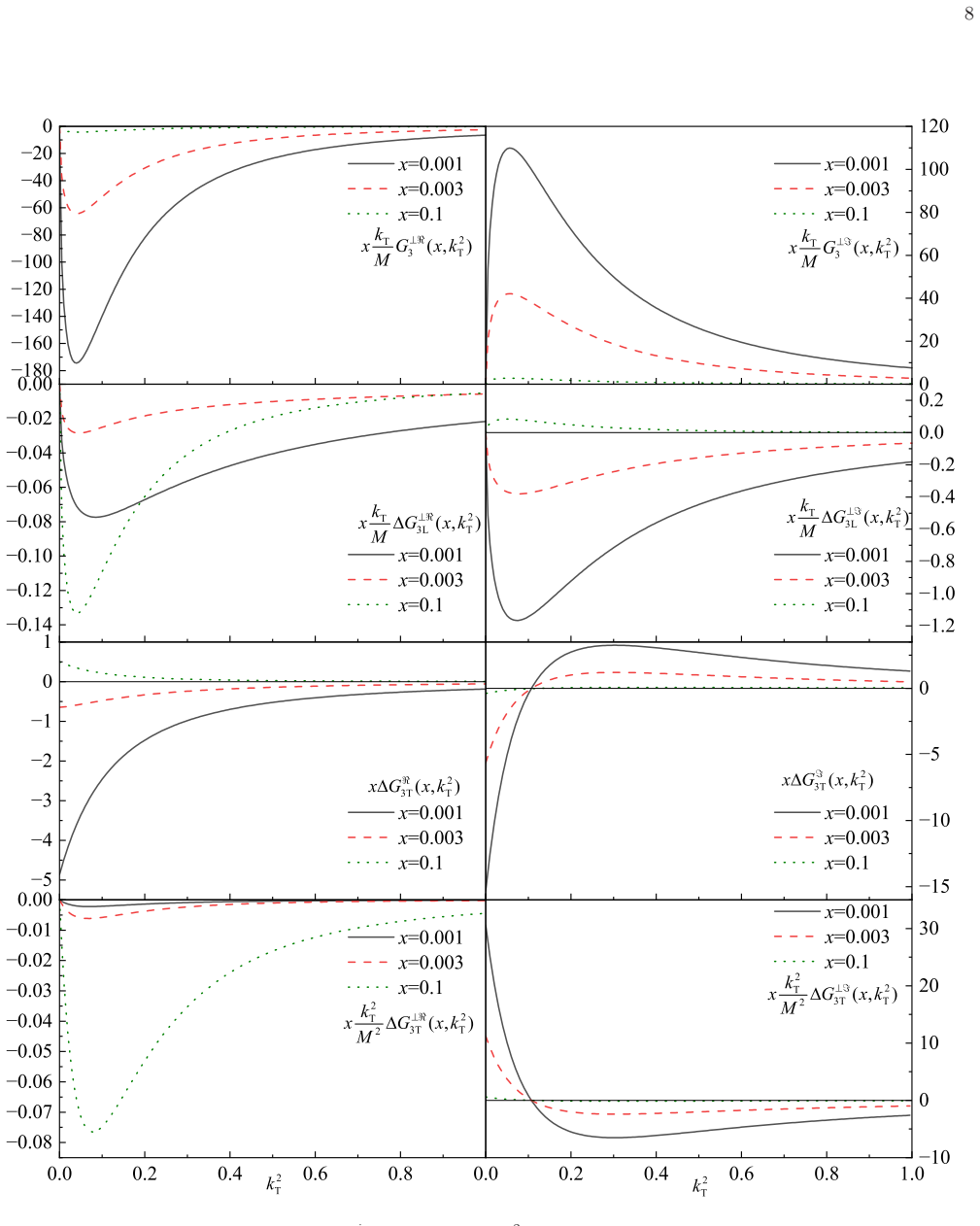
1 Parameter Mean Replica 11 κ 1 1.51± 0.16 1.46 κ 2 0.414± 0.036 0.414 Λ X 0.472± 0.058 0.448 a 0.82± 0.21 0.78 b 1.43± 0.23 1.38 A 6.1± 2.3 6.0 C 371± 58 346 D 0.548± 0.081 0.548 σ 0.52± 0.14 0.50 In Fig. 4, we present the integrated results for the full set of twist-3 gluon TMDs. The distributions ∆ G⊥ 3T and ∆ H ⊥ 3T are shown as their first moment F (1...
-
[6]
003(dashed), and x = 0
001(solid), x = 0 . 003(dashed), and x = 0 . 1(dotted). These distributions also fall off rapidly with increasing k2 T . While xkT /M H ⊥ℜ 3 and xkT /M ∆ H ⊥ℜ 3L remain positive over the whole k2 T range, xkT /M H ⊥ℑ 3 and xkT /M ∆ H ⊥ℑ 3L change sign as k2 T increases. Interest- ingly, at x = 0 . 001, both x∆ H ℑ 3T and xk2 T /M 2 ∆ H ⊥ℑ 3T change sign, e...
-
[7]
We note that i, j , and k correspond to gi(k2), gj(l2), and gk((k + l)2), respectively
and ( 45) for each twist-3 gluon TMDs F ℑ and ˜N , and for l = 1 , ..., 8, i, j, k = 1 , 2. We note that i, j , and k correspond to gi(k2), gj(l2), and gk((k + l)2), respectively
-
[8]
Coefficients functions of G⊥ 3 for ijk = {111, 112}
G⊥ 3 TABLE II. Coefficients functions of G⊥ 3 for ijk = {111, 112}. C [G⊥ 3 ],l ijk ijk = 111 ijk = 112 l = 1 0 0 l = 2 − 24 x [ k2 T (x − 2) + M 2(x3 − 2x2 + 3x − 2) +2xM MX − M 2 X (x − 2) ] 12 M (x− 1) [ k2 T MX x + 2M 3(x − 1)2 + M 2MX (x3 − 2x2 + 3x − 2) +2M M2 X (x − 1) − M 3 X (x − 2)] l = 3 0 24MX M (x− 1) k2 T l = 4 24(2− x) x k2 T 12(M +MX ) M k2 ...
-
[9]
Coefficients functions of ∆ G⊥ 3L for ijk = {111, 112}
∆ G⊥ 3L TABLE VI. Coefficients functions of ∆ G⊥ 3L for ijk = {111, 112}. C [∆ G⊥ 3L],l ijk ijk = 111 ijk = 112 l = 1 0 24(k2 T − M 2(x − 1)2 + M 2 X ) l = 2 24(k2 T − M 2(x2 − 1) − 2M MX x − M 2 X ) 12 M (x− 1) [k2 T (4M (x − 1) − MX (x − 2)) +(M (x − 1) + MX )(2M 2(x − 1) + M MX (x2 + x − 2) + M 2 X x)] l = 3 0 24k2 T (2M (x− 1)+MX ) M (x− 1) l = 4 24k2 T...
-
[10]
Coefficients functions of ∆ G3T for ijk = {111, 112}
∆ G3T TABLE X. Coefficients functions of ∆ G3T for ijk = {111, 112}. C [∆ G3T ],l ijk ijk = 111 ijk = 112 l = 1 0 12 M 2(x− 1)x [k4 T (2 − x) + 2k2 T (M 2 X − M 2(x − 1)2(x + 1)) + x(M 2 X + M 2(x − 1)2)2] l = 2 − 48k2 T (M (x− 1)+MX ) M 12k2 T M 2(1− x)x [k2 T (2x − 5) + (x − 1)(M 2(x − 1)(x + 3) +M MX (1 − 2x)x − 2M 2 X x) − 3M 2 X ] l = 3 0 6k2 T M 2(x− ...
-
[11]
Coefficients functions of ∆ G⊥ 3T for ijk = {111, 112}
∆ G⊥ 3T TABLE XIV. Coefficients functions of ∆ G⊥ 3T for ijk = {111, 112}. C [∆ G⊥ 3T ],l ijk ijk = 111 ijk = 112 l = 1 0 48(k2 T +M 2(x− 1)+M 2 X ) x l = 2 0 24(5k2 T +3M 2(x− 1)+M MX x+3M 2 X ) x l = 3 0 24(3k2 T +(M +MX )(M (x− 1)+MX )) x l = 4 0 24k2 T x l = 5 0 24k2 T x l = 6 0 0 l = 7 0 0 l = 8 0 0 TABLE XV. Coefficients functions of ∆ G⊥ 3T for ijk = {...
-
[12]
Coefficients functions of H ⊥ 3 for ijk = {111, 112}
H ⊥ 3 TABLE XVIII. Coefficients functions of H ⊥ 3 for ijk = {111, 112}. C [H ⊥ 3 ],l ijk ijk = 111 ijk = 112 l = 1 0 0 l = 2 24(k2 T (x− 2)− x(M (x− 1)+MX )2) x 12(M +MX )(k2 T +(M (x− 1)+MX )2) M l = 3 − 48k2 T x 24k2 T (M +MX ) M l = 4 24k2 T 12(x − 2)k2 T l = 5 0 12k2 T (M (x− 1)+MX ) M l = 6 0 0 l = 7 0 0 l = 8 0 0 TABLE XIX. Coefficients functions of H ...
-
[13]
Coefficients functions of ∆ H ⊥ 3L for ijk = {111, 112}
∆ H ⊥ 3L TABLE XXII. Coefficients functions of ∆ H ⊥ 3L for ijk = {111, 112}. C [∆ H ⊥ 3L],l ijk ijk = 111 ijk = 112 l = 1 0 48k2 T (x− 1) x l = 2 − 12(k2 T (5x− 6)− x(M (x− 1)+MX )2) x 6 xM [k2 T (5x(M + MX ) − 2(5M + MX ) + 4M x2) − x(M + MX )(M (x − 1) + MX )2] l = 3 0 18k2 T (M (x− 1)+MX ) M l = 4 12(2− x)k2 T x − 6k2 T (M (x2− 2x+2)+2MX ) xM l = 5 0 0 ...
-
[14]
Coefficients functions of ∆ H3T for ijk = {111, 112}
∆ H3T TABLE XXVI. Coefficients functions of ∆ H3T for ijk = {111, 112}. C [∆ H3T ],l ijk ijk = 111 ijk = 112 l = 1 0 12k2 T (k2 T − M 2(x− 1)2+M 2 X ) xM 2 l = 2 12k2 T (5x− 1)(M (x− 1)+MX ) xM 6k2 T xM 2 [k2 T (x + 2) − M 2(x3 + 3x2 − 5x + 1) +M MX (1 − 5x)x + M 2 X (1 − 4x)] l = 3 12k2 T (M (x− 1)+MX ) M 3k4 T (3x− 4) 2xM 2 l = 4 0 3k2 T (k2 T (x+4)− 4x(M...
-
[15]
Coefficients functions of ∆ H ⊥ 3T for ijk = {111, 112}
∆ H ⊥ 3T TABLE XXX. Coefficients functions of ∆ H ⊥ 3T for ijk = {111, 112}. C [∆ H ⊥ 3T ],l ijk ijk = 111 ijk = 112 l = 1 0 24(k2 T − M 2(x− 1)2+M 2 X ) x l = 2 24M (x− 1)(M (x− 1)+MX ) x 12 x [k2 T (x + 2) − M 2(x − 1)2(x + 1) − M MX (x − 1)x + M 2 X ] l = 3 0 3k2 T (9x− 4) x l = 4 0 3k2 T (4− 5x) x l = 5 0 0 l = 6 0 0 l = 7 0 0 l = 8 0 0 TABLE XXXI. Coeffi...
-
[16]
Coefficients functions of ˜N for ijk = {111, 112}
Dynamical TMD ˜N TABLE XXXIV. Coefficients functions of ˜N for ijk = {111, 112}. C [ ˜N ],l ijk ijk = 111 ijk = 112 l = 1 0 0 l = 2 0 0 l = 3 12k2 T (1− x)(M (x− 1)+MX ) M 3k2 T 4M 2(x− 1)x [k2 T (x3 − 10x2 + 24x − 16) +x2(M 2(x − 1)2(3x − 2) + 8M MX (x − 1)2 + M 2 X (7x − 8))] l = 4 12k2 T (x− 1)(M (x− 1)+MX ) M − 3k2 T 4M 2(x− 1)x [k2 T (x3 − 10x2 + 24x −...
-
[17]
A. V. Efremov and O. V. Teryaev, Sov. J. Nucl. Phys. 36, 140 (1982) JINR-P2-81-485
1982
-
[18]
J. w. Qiu and G. F. Sterman, Nucl. Phys. B 378, 52-78 (1992) doi:10.1016/0550-3213(92)90003-T
-
[19]
J. w. Qiu and G. F. Sterman, Phys. Rev. D 59, 014004 (1999) doi:10.1103/PhysRevD.59.014004 [arXiv:hep-ph/9806356 [hep-ph]]
-
[20]
R. L. Jaffe, Comments Nucl. Part. Phys. 19 (1990) no.5, 239-257 MIT-CTP-1798
1990
-
[21]
A. V. Belitsky, X. D. Ji, W. Lu and J. Os- borne, Phys. Rev. D 63 (2001), 094012 doi:10.1103/PhysRevD.63.094012 [arXiv:hep- ph/0007305 [hep-ph]]
-
[22]
Y. Kanazawa and Y. Koike, Phys. Lett. B 478 (2000), 121-126 doi:10.1016/S0370-2693(00)00261-6 [arXiv:hep- ph/0001021 [hep-ph]]
-
[23]
Y. Kanazawa and Y. Koike, Phys. Lett. B 490 (2000), 99-105 doi:10.1016/S0370-2693(00)00969-2 [arXiv:hep- ph/0007272 [hep-ph]]
-
[24]
X. Ji, J. w. Qiu, W. Vogelsang and F. Yuan, Phys. Rev. D 73 (2006), 094017 doi:10.1103/PhysRevD.73.094017 [arXiv:hep-ph/0604023 [hep-ph]]
-
[25]
C. Kouvaris, J. W. Qiu, W. Vogelsang and F. Yuan, Phys. Rev. D 74 (2006), 114013 doi:10.1103/PhysRevD.74.114013 [arXiv:hep- ph/0609238 [hep-ph]]
-
[26]
Y. Koike and K. Tanaka, Phys. Rev. D 76 (2007), 011502 doi:10.1103/PhysRevD.76.011502 [arXiv:hep- ph/0703169 [hep-ph]]
-
[27]
Y. Koike and T. Tomita, Phys. Lett. B 675 (2009), 181- 189 doi:10.1016/j.physletb.2009.04.017 [arXiv:0903.19 23 [hep-ph]]
-
[28]
W. Vogelsang and F. Yuan, Phys. Rev. D 79 (2009), 094010 doi:10.1103/PhysRevD.79.094010 [arXiv:0904.0410 [hep-ph]]
-
[29]
Y. Koike and S. Yoshida, Phys. Rev. D 84 (2011), 014026 doi:10.1103/PhysRevD.84.014026 [arXiv:1104.3943 [hep- ph]]. 33
-
[30]
Y. Koike and S. Yoshida, Phys. Rev. D 85 (2012), 034030 doi:10.1103/PhysRevD.85.034030 [arXiv:1112.1161 [hep- ph]]
-
[31]
Z. B. Kang, F. Yuan and J. Zhou, Phys. Lett. B 691 (2010), 243-248 doi:10.1016/j.physletb.2010.07.003 [arXiv:1002.0399 [hep-ph]]
-
[32]
K. Kanazawa and Y. Koike, Phys. Lett. B 701 (2011), 576-580 doi:10.1016/j.physletb.2011.06.021 [arXiv:1105.1036 [hep-ph]]
-
[33]
A. Metz and D. Pitonyak, Phys. Lett. B 723 (2013), 365-370 [erratum: Phys. Lett. B 762 (2016), 549- 549] doi:10.1016/j.physletb.2013.05.043 [arXiv:1212.5 037 [hep-ph]]
-
[34]
H. Beppu, K. Kanazawa, Y. Koike and S. Yoshida, Phys. Rev. D 89 (2014) no.3, 034029 doi:10.1103/PhysRevD.89.034029 [arXiv:1312.6862 [hep-ph]]
-
[35]
K. Kanazawa, Y. Koike, A. Metz and D. Pitonyak, Phys. Rev. D 91 (2015) no.1, 014013 doi:10.1103/PhysRevD.91.014013 [arXiv:1410.3448 [hep-ph]]
-
[36]
Z. B. Kang and F. Yuan, Phys. Rev. D 84 (2011), 034019 doi:10.1103/PhysRevD.84.034019 [arXiv:1106.1375 [hep- ph]]
-
[37]
Y. Hatta, B. W. Xiao, S. Yoshida and F. Yuan, Phys. Rev. D 94 (2016) no.5, 054013 doi:10.1103/PhysRevD.94.054013 [arXiv:1606.08640 [hep-ph]]
-
[38]
Y. Hatta, B. W. Xiao, S. Yoshida and F. Yuan, Phys. Rev. D 95 (2017) no.1, 014008 doi:10.1103/PhysRevD.95.014008 [arXiv:1611.04746 [hep-ph]]
-
[39]
S. Beni´ c and Y. Hatta, Phys. Rev. D 98 (2018) no.9, 094025 doi:10.1103/PhysRevD.98.094025 [arXiv:1806.10901 [hep-ph]]
-
[40]
S. Beni´ c and Y. Hatta, Phys. Rev. D 99 (2019) no.9, 094012 doi:10.1103/PhysRevD.99.094012 [arXiv:1811.10589 [hep-ph]]
-
[41]
X. Ji, J. W. Qiu, W. Vogelsang and F. Yuan, Phys. Lett. B 638 (2006), 178-186 doi:10.1016/j.physletb.2006.05.044 [arXiv:hep- ph/0604128 [hep-ph]]
-
[42]
H. Eguchi, Y. Koike and K. Tanaka, Nucl. Phys. B 752 (2006), 1-17 doi:10.1016/j.nuclphysb.2006.05.036 [arXiv:hep-ph/0604003 [hep-ph]]
-
[43]
H. Eguchi, Y. Koike and K. Tanaka, Nucl. Phys. B 763 (2007), 198-227 doi:10.1016/j.nuclphysb.2006.11.016 [arXiv:hep-ph/0610314 [hep-ph]]
-
[44]
F. Yuan and J. Zhou, Phys. Rev. Lett. 103 (2009), 052001 doi:10.1103/PhysRevLett.103.052001 [arXiv:0903.4680 [hep-ph]]
-
[45]
H. Beppu, Y. Koike, K. Tanaka and S. Yoshida, Phys. Rev. D 82 (2010), 054005 doi:10.1103/PhysRevD.82.054005 [arXiv:1007.2034 [hep-ph]]
-
[46]
Y. Koike, K. Tanaka and S. Yoshida, Phys. Rev. D 83 (2011), 114014 doi:10.1103/PhysRevD.83.114014 [arXiv:1104.0798 [hep-ph]]
-
[47]
K. Kanazawa and Y. Koike, Phys. Rev. D 88 (2013), 074022 doi:10.1103/PhysRevD.88.074022 [arXiv:1309.1215 [hep-ph]]
-
[48]
S. Yoshida, Phys. Rev. D 93 (2016) no.5, 054048 doi:10.1103/PhysRevD.93.054048 [arXiv:1601.07737 [hep-ph]]
-
[49]
H. Xing and S. Yoshida, Phys. Rev. D 100 (2019) no.5, 054024 doi:10.1103/PhysRevD.100.054024 [arXiv:1904.02287 [hep-ph]]
-
[50]
S. Benic, Y. Hatta, H. n. Li and D. J. Yang, Phys. Rev. D 100 (2019) no.9, 094027 doi:10.1103/PhysRevD.100.094027 [arXiv:1909.10684 [hep-ph]]
-
[51]
Y. Kanazawa and Y. Koike, Phys. Rev. D 64 (2001), 034019 doi:10.1103/PhysRevD.64.034019 [arXiv:hep- ph/0012225 [hep-ph]]
-
[52]
J. Zhou, F. Yuan and Z. T. Liang, Phys. Rev. D 78 (2008), 114008 doi:10.1103/PhysRevD.78.114008 [arXiv:0808.3629 [hep-ph]]
-
[53]
Y. Koike, K. Yabe and S. Yoshida, Phys. Rev. D 92 (2015) no.9, 094011 doi:10.1103/PhysRevD.92.094011 [arXiv:1509.06830 [hep-ph]]
-
[54]
Y. Koike, A. Metz, D. Pitonyak, K. Yabe and S. Yoshida, Phys. Rev. D 95 (2017) no.11, 114013 doi:10.1103/PhysRevD.95.114013 [arXiv:1703.09399 [hep-ph]]
-
[55]
K. Yabe, Y. Koike, A. Metz, D. Pitonyak and S. Yoshida, JPS Conf. Proc. 26 (2019), 021016 doi:10.7566/JPSCP.26.021016
-
[56]
Y. Kenta, Y. Koike, A. Metz, D. Pitonyak and S. Yoshida, PoS SPIN2018 (2019), 192 doi:10.22323/1.346.0192
-
[57]
L. Gamberg, Z. B. Kang, D. Pitonyak, M. Schlegel and S. Yoshida, JHEP 01 (2019), 111 doi:10.1007/JHEP01(2019)111 [arXiv:1810.08645 [hep- ph]]
-
[58]
R. L. Jaffe and X. D. Ji, Nucl. Phys. B 375 (1992), 527- 560 doi:10.1016/0550-3213(92)90110-W
-
[59]
Z. T. Liang, A. Metz, D. Pitonyak, A. Sch¨ afer, Y. K. Song and J. Zhou, Phys. Lett. B 712 (2012), 235- 239 doi:10.1016/j.physletb.2012.04.072 [arXiv:1203.39 56 [hep-ph]]
-
[60]
Y. Hatta, K. Kanazawa and S. Yoshida, Phys. Rev. D 88 (2013) no.1, 014037 doi:10.1103/PhysRevD.88.014037 [arXiv:1305.7001 [hep-ph]]
-
[61]
Y. Koike, D. Pitonyak, Y. Takagi and S. Yoshida, Phys. Lett. B 752 (2016), 95-101 doi:10.1016/j.physletb.2015.11.014 [arXiv:1508.06499 [hep-ph]]
-
[62]
Y. Koike, D. Pitonyak and S. Yoshida, Phys. Lett. B 759 (2016), 75-81 doi:10.1016/j.physletb.2016.05.043 [arXiv:1603.07908 [hep-ph]]
-
[63]
K. Kanazawa, Y. Koike, A. Metz, D. Pitonyak and M. Schlegel, Phys. Rev. D 93 (2016) no.5, 054024 doi:10.1103/PhysRevD.93.054024 [arXiv:1512.07233 [hep-ph]]
-
[64]
A. Bacchetta, P. J. Mulders and F. Pijl- man, Phys. Lett. B 595 (2004), 309-317 doi:10.1016/j.physletb.2004.06.052 [arXiv:hep- ph/0405154 [hep-ph]]
-
[65]
A. Bacchetta, M. Diehl, K. Goeke, A. Metz, P. J. Mulders and M. Schlegel, JHEP 02 (2007), 093 doi:10.1088/1126- 6708/2007/02/093 [arXiv:hep-ph/0611265 [hep-ph]]
-
[66]
L. Gamberg, Z. B. Kang, D. Y. Shao, J. Terry and F. Zhao, [arXiv:2211.13209 [hep-ph]]
-
[67]
M. A. Ebert, A. Gao and I. W. Stewart, JHEP 06 (2022), 007 [erratum: JHEP 07 (2023), 096] doi:10.1007/JHEP06(2022)007 [arXiv:2112.07680 [hep- ph]]
-
[68]
Y. Koike, K. Yabe and S. Yoshida, Phys. Rev. D 101 34 (2020) no.5, 054017 doi:10.1103/PhysRevD.101.054017 [arXiv:1912.11199 [hep-ph]]
-
[69]
P. J. Mulders and J. Rodrigues, Phys. Rev. D 63 (2001), 094021 doi:10.1103/PhysRevD.63.094021 [arXiv:hep-ph/0009343 [hep-ph]]
-
[70]
D. Boer, P. J. Mulders, C. Pisano and J. Zhou, JHEP 08 (2016), 001 doi:10.1007/JHEP08(2016)001 [arXiv:1605.07934 [hep-ph]]
-
[71]
C. J. Bomhof, P. J. Mulders and F. Pijlman, Eur. Phys. J. C 47 (2006), 147-162 doi:10.1140/epjc/s2006-02554-2 [arXiv:hep-ph/0601171 [hep-ph]]
-
[72]
M. G. A. Buffing, A. Mukherjee and P. J. Mul- ders, Phys. Rev. D 88 (2013), 054027 doi:10.1103/PhysRevD.88.054027 [arXiv:1306.5897 [hep-ph]]
-
[73]
K. Goeke, S. Meissner, A. Metz and M. Schlegel, Phys. Lett. B 637 (2006), 241- 244 doi:10.1016/j.physletb.2006.05.004 [arXiv:hep- ph/0601133 [hep-ph]]
-
[74]
J. Collins, Camb. Monogr. Part. Phys. Nucl. Phys. Cos- mol. 32 (2011), 1-624 Cambridge University Press, 2011, ISBN 978-1-009-40184-5, 978-1-009-40183-8, 978-1-009- 40182-1 doi:10.1017/9781009401845
-
[75]
A. Bacchetta, F. G. Celiberto, M. Radici and P. Taels, Eur. Phys. J. C 80 (2020) no.8, 733 doi:10.1140/epjc/s10052-020-8327-6 [arXiv:2005.02288 [hep-ph]]
-
[76]
A. Bacchetta, F. G. Celiberto and M. Radici, Eur. Phys. J. C 84 (2024) no.6, 576 doi:10.1140/epjc/s10052-024- 12927-y [arXiv:2402.17556 [hep-ph]]
-
[77]
X. D. Ji, Phys. Lett. B 289 (1992), 137-142 doi:10.1016/0370-2693(92)91375-J
-
[78]
Z. Lu and I. Schmidt, Phys. Lett. B 747 (2015), 357-364 doi:10.1016/j.physletb.2015.06.011 [arXiv:1501.04379 [hep-ph]]
-
[79]
Y. Yang, Z. Lu and I. Schmidt, Phys. Lett. B 761 (2016), 333-339 doi:10.1016/j.physletb.2016.08.053 [arXiv:1607.01638 [hep-ph]]
discussion (0)
Sign in with ORCID, Apple, or X to comment. Anyone can read and Pith papers without signing in.