Recognition: 2 theorem links
· Lean TheoremOn the Dust Substructures Triggered by Two Super-Earths Migrating in Low-viscosity Disks
Pith reviewed 2026-05-08 19:29 UTC · model grok-4.3
The pith
Two super-Earths migrating near a 2:1 resonance in a low-viscosity disk accumulate dust into a narrow ring between their orbits and a broad, time-evolving multiple-ring structure outside the outer planet, with local dust-to-gas ratios often
A machine-rendered reading of the paper's core claim, the machinery that carries it, and where it could break.
Core claim
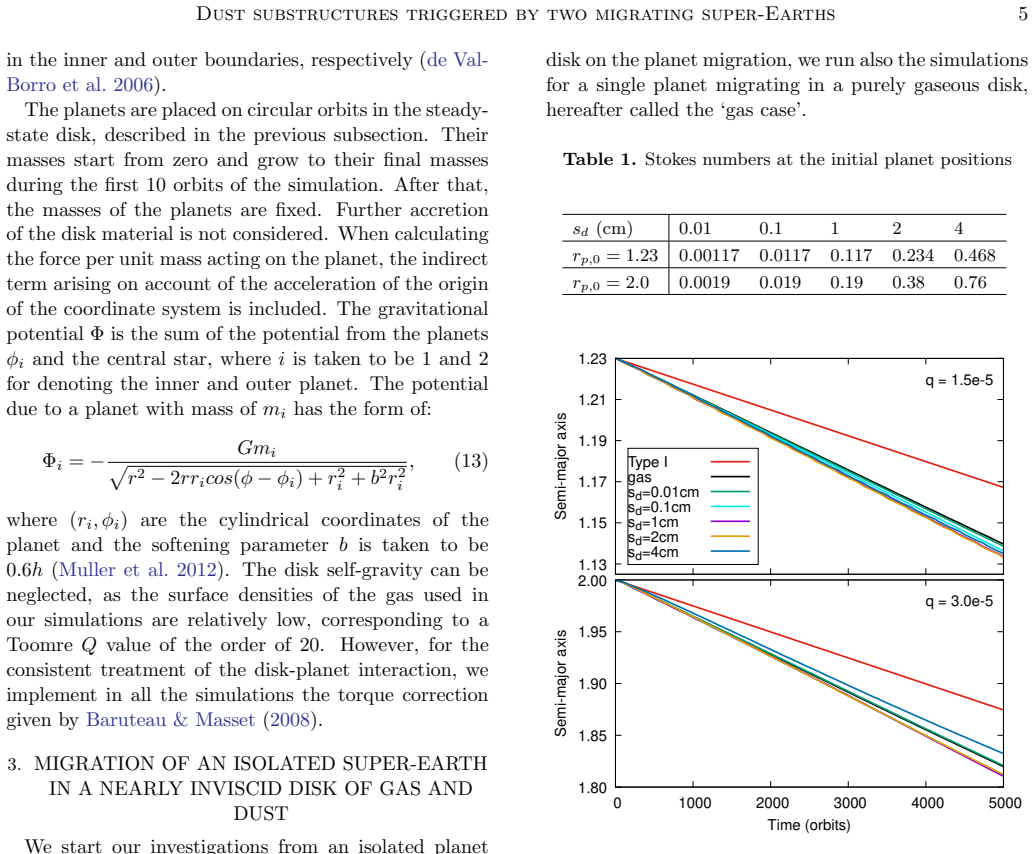
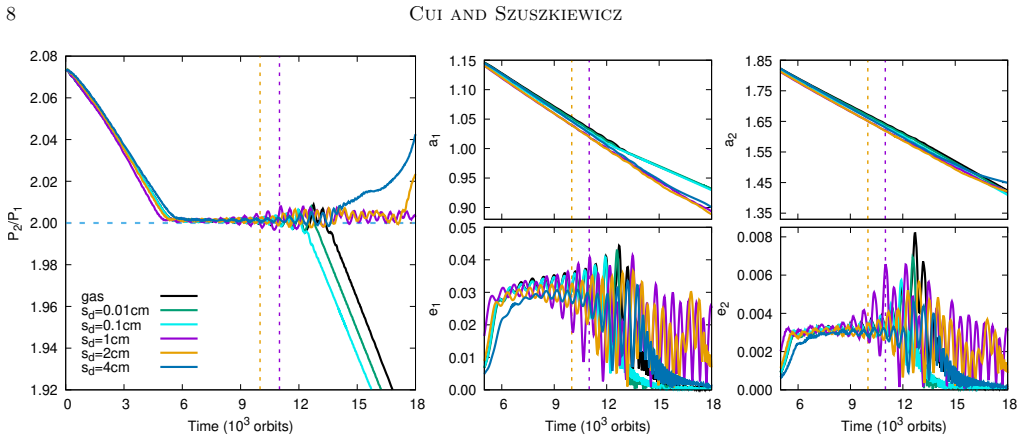
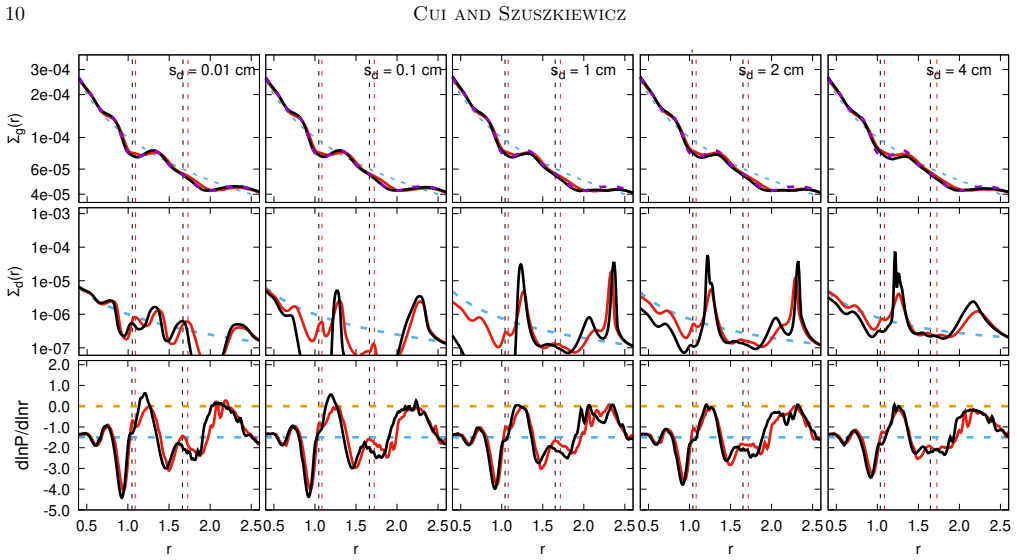
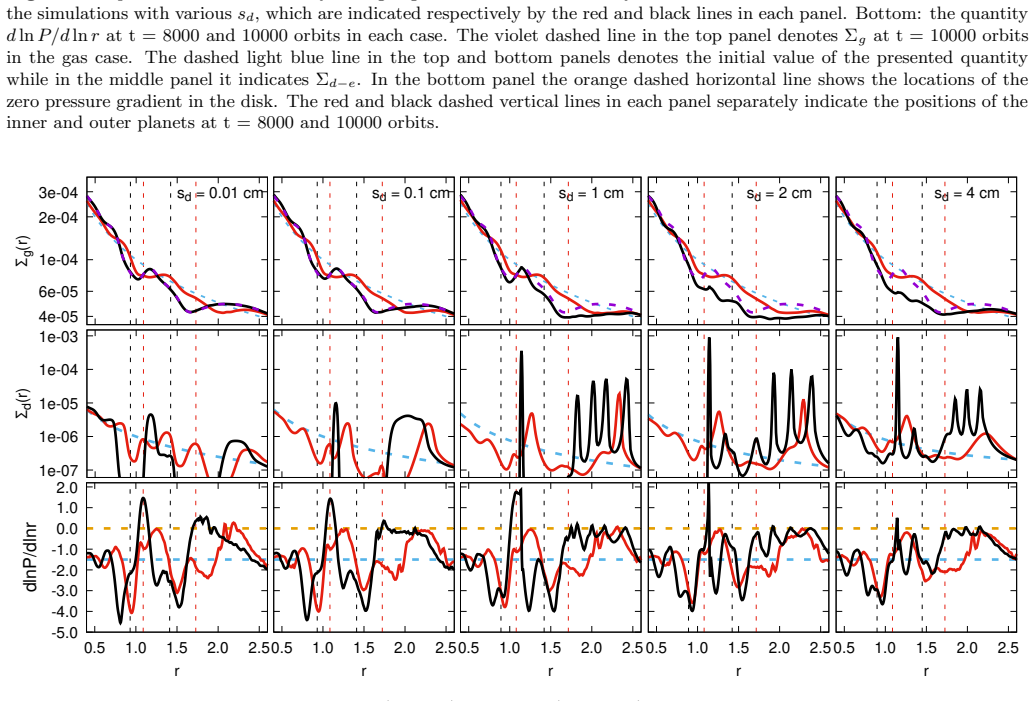
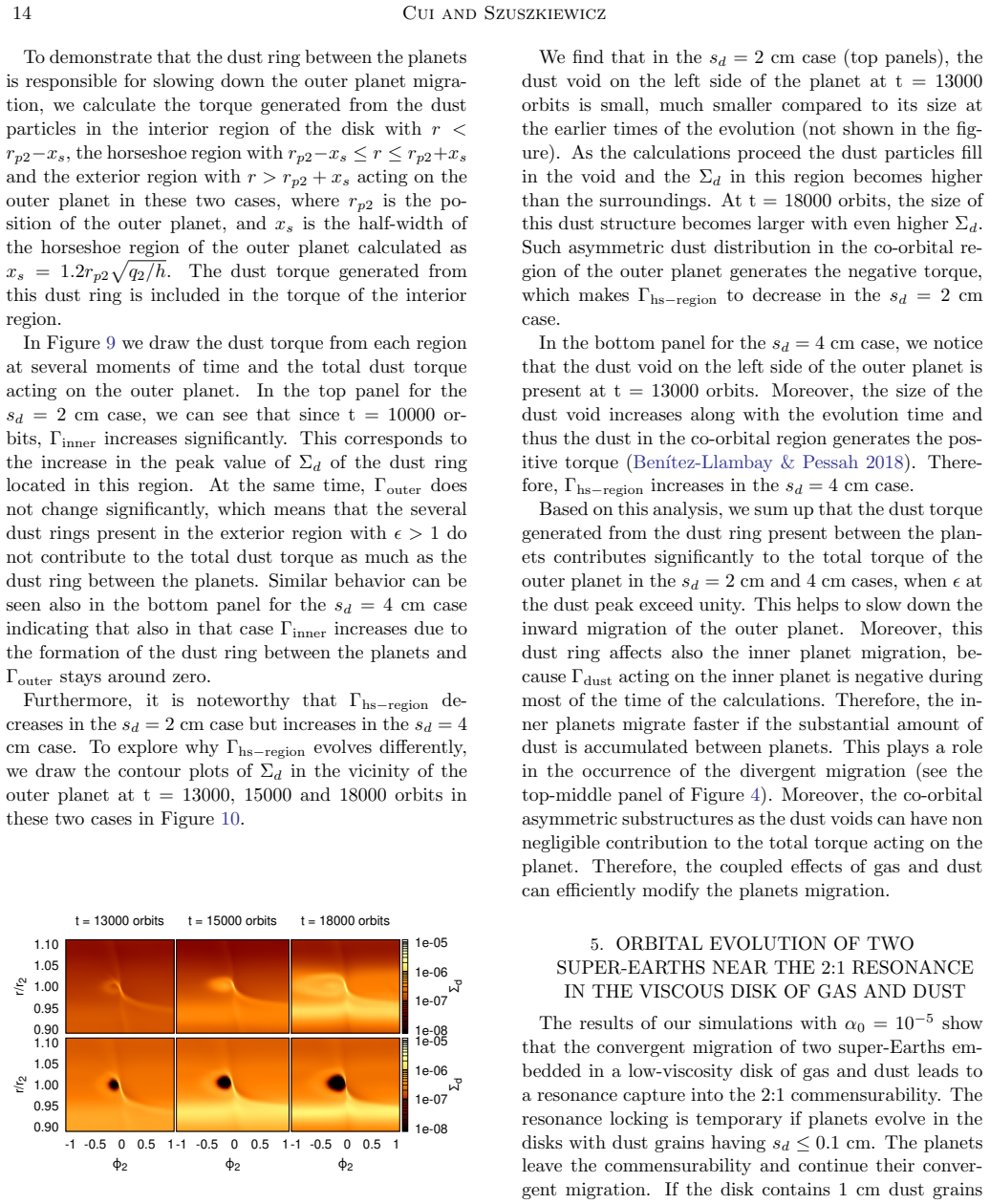
In two-dimensional two-fluid hydrodynamic simulations of two super-Earths migrating in a low-viscosity disk near 2:1 commensurability, using single-size dust grains from submillimeter to centimeter scales together with dust feedback and diffusion, significant particle accumulation occurs in a narrow dust ring located between the two planetary orbits and in a broad feature outside the orbit of the outer planet that develops over time into multiple ring substructures, reaching dust-to-gas ratios close to or exceeding unity for the largest grains examined.
What carries the argument
Two-dimensional two-fluid hydrodynamic simulations that incorporate dust feedback and diffusion for single-size grains while the planets migrate near 2:1 commensurability.
If this is right
- The two identified dust concentrations are favorable sites for planetesimal formation.
- Dust feedback modifies the rate of planetary migration and the stability of the 2:1 commensurability.
- The broad outer dust feature evolves temporally into a multiple-ring substructure.
- The outcome of resonance passage and libration overstability can be altered by the presence of dust.
Where Pith is reading between the lines
- These specific dust-ring patterns could be searched for in ALMA images of disks that host pairs of planets with near-resonant orbits.
- If planetesimals form at these sites, the resulting debris might later influence the final spacing and masses of the observed planets.
- Varying the disk viscosity or dust size distribution in follow-up simulations would test how robust the two accumulation zones remain.
- Vertical settling in three dimensions could further increase the local dust densities beyond the values found in the 2D runs.
Load-bearing premise
Two-dimensional simulations that treat one dust grain size at a time with included diffusion and feedback can accurately represent the three-dimensional behavior of disks containing a full range of particle sizes.
What would settle it
High-resolution submillimeter observations of a protoplanetary disk containing two planets near 2:1 orbital spacing that show dust-to-gas ratios remaining well below one in both the inter-planet region and the zone exterior to the outer planet.
Figures






read the original abstract
We investigate dust substructure formation induced by two super-Earths migrating in a low-viscosity disk with single-size dust grains selected from the submillimeter to centimeter range of sizes. The orbital evolution of planets takes place in the vicinity of the 2:1 commensurability, which allows to determine, in addition to the dust substructure properties, the dust impact on the rate of migration, the resonance capture, the libration overstability and the outcome of passage through the commensurability. Using two-dimensional two-fluid hydrodynamic simulations with dust feedback and dust diffusion taken into account, we identify two specific regions in the disk where the accumulation of dust particles is significant, leading to dust substructure formation with the dust-to-gas ratio values close to or even higher than 1 for large grains. The first region, with a narrow dust ring, is located between the planetary orbits and the second one, with a broad feature, evolving in time in a multiple ring substructure, is situated outside the orbit of the outer planet. Our results indicate that these two locations are favorable for planetesimal formation. We discuss the properties of the dust substructures formed in our simulations and outline possible consequences of their evolution for the observed architectures of multi-planetary systems.
Editorial analysis
A structured set of objections, weighed in public.
Referee Report
Summary. The manuscript presents 2D two-fluid hydrodynamic simulations of two super-Earths migrating near the 2:1 commensurability in a low-viscosity protoplanetary disk, incorporating single-size dust grains (submillimeter to centimeter), dust feedback, and diffusion. It identifies two dust accumulation regions—a narrow ring between the planetary orbits and a broad, time-evolving multiple-ring feature outside the outer planet—where dust-to-gas ratios reach or exceed unity for larger grains, concluding these sites are favorable for planetesimal formation. The work also examines dust effects on migration rates, resonance capture, libration overstability, and passage through the commensurability.
Significance. If the numerical findings hold, the results offer concrete predictions for dust substructures induced by migrating planets in low-viscosity disks, with direct implications for planetesimal formation and the architectures of observed multi-planet systems. The inclusion of dust feedback on migration and resonance dynamics adds value beyond static planet cases.
major comments (2)
- [Numerical Methods] Numerical Methods section: The setup description provides no grid resolution, convergence tests, or validation against analytic limits (e.g., dust trapping in fixed-planet cases). This is load-bearing because the central claims of dust-to-gas ratios ≳1 and specific substructure morphologies rest entirely on these unverified runs.
- [Results] Results section (discussion of 2D two-fluid runs): The single-size dust treatment omits vertical settling (which concentrates large grains near the midplane in 3D) and coagulation/fragmentation (which alters effective diffusion and feedback). A minimal test—e.g., one 3D or multi-size comparison run near 2:1—would be required to confirm that the reported narrow inter-planet ring and outer broad feature persist.
minor comments (2)
- [Abstract] Abstract: The phrase 'single-size dust grains selected from the submillimeter to centimeter range' should list the exact sizes simulated and the criterion for selection to aid reproducibility.
- [Figures] Figure captions: Several panels showing dust surface density lack explicit color-bar scales or time stamps, making it hard to track the evolution of the outer multiple-ring feature.
Simulated Author's Rebuttal
We thank the referee for their positive assessment of the work and for the constructive major comments. We have revised the manuscript to address the concerns on numerical details and model limitations. Our point-by-point responses follow.
read point-by-point responses
-
Referee: Numerical Methods section: The setup description provides no grid resolution, convergence tests, or validation against analytic limits (e.g., dust trapping in fixed-planet cases). This is load-bearing because the central claims of dust-to-gas ratios ≳1 and specific substructure morphologies rest entirely on these unverified runs.
Authors: We agree that these details are essential. We have updated the Numerical Methods section to specify the grid resolution employed. We have also added a discussion of convergence, based on resolution studies performed as part of the project, showing that the dust substructures and dust-to-gas ratios remain consistent. In addition, we have included a brief validation against the expected dust trapping behavior for fixed planets, which matches analytic predictions for pressure bumps. revision: yes
-
Referee: Results section (discussion of 2D two-fluid runs): The single-size dust treatment omits vertical settling (which concentrates large grains near the midplane in 3D) and coagulation/fragmentation (which alters effective diffusion and feedback). A minimal test—e.g., one 3D or multi-size comparison run near 2:1—would be required to confirm that the reported narrow inter-planet ring and outer broad feature persist.
Authors: We acknowledge the limitations of the 2D single-size dust model, including the absence of vertical settling and grain evolution processes. We have expanded the discussion in the revised Results section to explicitly address these caveats and their possible influence on quantitative dust-to-gas ratios. While we agree that 3D or multi-size runs would provide additional confirmation, such simulations are computationally intensive and lie outside the scope of the present study. We maintain that the qualitative locations of the narrow inter-planet ring and broad outer feature are robust, being driven primarily by the gas dynamics and planetary perturbations captured in our two-fluid runs, and we have added references to related 3D work for context. revision: partial
Circularity Check
No circularity: results are direct outputs of stated 2D hydrodynamic simulations
full rationale
The paper presents results from two-dimensional two-fluid hydrodynamic simulations with dust feedback and diffusion for single-size grains. The identified dust accumulation regions (narrow ring between planets, broad evolving feature outside outer planet) with dust-to-gas ratios ≳1 are reported as simulation outcomes, not derived via equations that reduce to inputs by construction. No self-definitional relations, fitted parameters renamed as predictions, or load-bearing self-citations appear in the abstract or method description. The work is self-contained against its numerical benchmarks with explicitly stated physics; external 3D/multi-grain concerns are separate from circularity analysis.
Axiom & Free-Parameter Ledger
free parameters (3)
- disk viscosity
- dust grain size
- planet masses
axioms (2)
- domain assumption Dust treated as a pressureless fluid in 2D hydrodynamics
- domain assumption Orbital evolution occurs near 2:1 commensurability
Reference graph
Works this paper leans on
-
[1]
2024, A&A, 686, 277, 10.1051/0004-6361/202348826
Afkanpour , Z., Ataiee , S., Ziampras , A., et al. 2024, A&A, 686, 277, 10.1051/0004-6361/202348826
-
[2]
ALMA Partnership , Brogan , C., P \'e rez , L., et al. 2015, , 808, L3, 10.1088/2041-8205/808/1/L3
-
[3]
Andrews , S. M. 2020, ARA&A, 58, 483, 10.1146/annurev-astro-031220-010302
-
[4]
The Astrophysical Journal , author =
Andrews , S. M., Huang , J., P \'e rez , L., et al. 2018, , 869, L41, 10.3847/2041-8213/aaf741
-
[5]
The Astrophysical Journal , author =
Auddy , S., Dey , R., Lin , M. K., Carrera , D., & Simon , J. B. 2022, , 936, 93, 10.3847/1538-4357/ac7a3c
-
[6]
Protostars and Planets VII , year = 2023, editor =
Bae , J., Isella , A., Zhu , Z., et al. 2023, Protostars and Planets VII, ASP Conference Series, 534, 423, 10.48550/arXiv.2210.13314
-
[7]
The Astrophysical Journal , author =
Baruteau , C., & Masset , F. 2008, , 678, 483, 10.1086/529487
-
[8]
2024, , 167, 70, 10.3847/1538-3881/ad1330
Beard , C., Robertson , P., Dai , F., et al. 2024, , 167, 70, 10.3847/1538-3881/ad1330
-
[9]
Protostars and Planets VII , year = 2023, editor =
Benisty , M., Dominik , C., Follette , K., et al. 2023, Protostars and Planets VII, ASP Conference Series, 534, 605, 10.48550/arXiv.2203.09991
-
[10]
2019, , 241, 25, 10.3847/1538-4365/ab0a0e
Ben \'i tez-Llambay , P., Krapp , L., & Pessah , M. 2019, , 241, 25, 10.3847/1538-4365/ab0a0e
-
[11]
arXiv , author =:1801.07913 , journal =
Ben \'i tez-Llambay , P., & Pessah , M. 2018, , 855, L28, 10.3847/2041-8213/aab2ae
-
[12]
2024, ARA&A, 62, 157, doi: 10.1146/annurev-astro-071221-052705 Cañas, M
Birnstiel , T. 2024, ARA&A, 62, 157, 10.1146/annurev-astro-071221-052705
-
[13]
Carrera , D., Simon , J., Li , R., Kretke , K., & Klahr , H. 2021, , 161, 96, 10.3847/1538-3881/abd4d9
-
[14]
2025, A&A, 698, A21, 10.1051/0004-6361/202451869
Chametla , R., Chrenko , O., Masset , F., D'Angelo , G., & Nesvorn \'y , D. 2025, A&A, 698, A21, 10.1051/0004-6361/202451869
-
[15]
2024, A&A, 690, A41, 10.1051/0004-6361/202450922
Chrenko , O., Chametla , R., Masset , F., Baruteau , C., & Broz , M. 2024, A&A, 690, A41, 10.1051/0004-6361/202450922
-
[16]
de Val-Borro , M., Edgar , R. G., Artymowicz , P., et al. 2006, MNRAS, 370, 529, 10.1111/j.1365-2966.2006.10488.x
-
[17]
2017, The Astrophysical Journal, 843, 127, doi: 10.3847/1538-4357/aa72f2
Dong , R., Li , S., Chiang , E., & Li , H. 2017, , 843, 127, 10.3847/1538-4357/aa72f2
-
[18]
The Astrophysical Journal , author =
---. 2018, , 866, 110, 10.3847/1538-4357/aadadd
-
[19]
2015, , 809, 93, 10.1088/0004-637X/809/1/93
Dong , R., Zhu , Z., & Whitney , B. 2015, , 809, 93, 10.1088/0004-637X/809/1/93
-
[20]
Protostars and Planets VII , year = 2023, editor =
Drazkowska , J., Bitsch , B., Lambrechts , M., et al. 2023, Protostars and Planets VII, ASP Conference Series, 534, 717, 10.48550/arXiv.2203.09759
-
[21]
The Astrophysical Journal , author =
Dullemond , C., Birnstiel , T., Huang , J., et al. 2018, , 869, L46, 10.3847/2041-8213/aaf742
-
[22]
Fabrycky , D., Lissauer , J., Ragozzine , D., et al. 2014, , 790, 146, 10.1088/0004-637X/790/2/146
-
[23]
The full census of planet-forming disks with GTO and DESTINYS programs
Garufi , A., Ginski , C., van Holstein , R., et al. 2024, A&A, 685, A53, 10.1051/0004-6361/202347586
-
[24]
2025, A&A, 694, A290, 10.1051/0004-6361/202452496
Garufi , A., Carrasco-Gonz \'a lez , C., Mac \'i as , E., et al. 2025, A&A, 694, A290, 10.1051/0004-6361/202452496
-
[25]
Goldreich , P., & Schlichting , H. E. 2014, , 147, 32, 10.1088/0004-6256/147/2/32
-
[26]
Goldreich , P., & Ward , W. R. 1973, , 183, 1051, 10.1086/152291
-
[27]
2023, , 953, 97, 10.3847/1538-4357/acd2cb
Guilera , O., Benitez-Llambay , P., Miller Bertolami , M., & Pessah , M. 2023, , 953, 97, 10.3847/1538-4357/acd2cb
-
[28]
2025, , 986, 199, 10.3847/1538-4357/add92a
---. 2025, , 986, 199, 10.3847/1538-4357/add92a
-
[29]
2012, , 758, L19, 10.1088/2041-8205/758/1/L19
Hashimoto , J., Dong , R., Kudo , T., et al. 2012, , 758, L19, 10.1088/2041-8205/758/1/L19
-
[30]
Progress of Theoretical Physics Supplement , year = 1981, month = jan, volume =
Hayashi , C. 1981, Progress of Theoretical Physics Supplement, 70, 35, 10.1143/PTPS.70.35
-
[31]
2009, A&A, 502, 385, 110.1051/0004-6361/200911865
Hersant , F. 2009, A&A, 502, 385, 110.1051/0004-6361/200911865
2009
-
[32]
doi:10.1093/mnras/staa2115 , eprint =
Hsieh , H. F., & Lin , M. K. 2020, MNRAS, 497, 2425, 10.1093/mnras/staa2115
-
[33]
Kanagawa , K. D. 2019, , 879, L19, 10.3847/2041-8213/ab2a0f
-
[34]
D., Takayuki , M., Satoshi , O., et al
Kanagawa , K. D., Takayuki , M., Satoshi , O., et al. 2018, , 868, 48, 10.3847/1538-4357/aae837
-
[35]
D., Ueda , T., Muto , T., & Okuzumi , S
Kanagawa , K. D., Ueda , T., Muto , T., & Okuzumi , S. 2017, , 844, 142, 10.3847/1538-4357/aa7ca1
-
[36]
2022, Astronomy & Astrophysics, 665, A122, doi: 10.1051/0004-6361/202243849
Kuwahara , A., Kurokawa , H., Tanigawa , T., & Ida , S. 2022, A&A, 665, A122, 10.1051/0004-6361/202243849
-
[37]
Astronomy & Astrophysics , author =
Kuwahara , A., Lambrechts , M., Kurokawa , H., Okuzumi , S., & Tanigawa , T. 2024, A&A, 692, A45, 10.1051/0004-6361/202451159
-
[38]
2024, A&A, 688, A22, 10.1051/0004-6361/202450464
Lau , T., Birnstiel , T., Drazkowska , J., & Stammler , S. 2024, A&A, 688, A22, 10.1051/0004-6361/202450464
-
[39]
J., Ragozzine, D., Fabrycky, D
Lissauer , J., Ragozzine , D., Fabrycky , D., et al. 2011, , 197, 8, 10.1088/0067-0049/197/1/8
-
[40]
2013, , 770, 131, 10.1088/0004-637X/770/2/131
Lissauer , J., Jontof-Hutter , D., Rowe , J., et al. 2013, , 770, 131, 10.1088/0004-637X/770/2/131
-
[41]
2026, Nature, 649, 310, 10.1038/s41586-025-09840-z
Livingston , J., Petigura , E., David , T., et al. 2026, Nature, 649, 310, 10.1038/s41586-025-09840-z
-
[42]
2020, A&A, 641, A125, 10.1051/0004-6361/202038297
Marzari , F., & D'Angelo , G. 2020, A&A, 641, A125, 10.1051/0004-6361/202038297
-
[43]
2023, MNRAS, 520, 2913, 10.1093/mnras/stad313
---. 2023, MNRAS, 520, 2913, 10.1093/mnras/stad313
-
[44]
2012, A&A, 541, A123, 10.1051/0004-6361/201118737
Muller , T., Kley , W., & Meru , F. 2012, A&A, 541, A123, 10.1051/0004-6361/201118737
-
[45]
2009, MNRAS, 396, 1383, doi:10.1111/j.1365-2966.2009.14843.x
Paardekooper , S.-J., Baruteau , C., Crida , A., & Kley , W. 2010, MNRAS, 401, 1950, 10.1111/j.1365-2966.2009.15782.x
-
[46]
and Ogilvie, Gordon and Tanaka, Hidekazu , month = mar, year =
Paardekooper , S.-J., Dong , R., Duffell , P., et al. 2023, Protostars and Planets VII, ASP Conference Series, 534, 685, 10.48550/arXiv.2203.09595
-
[47]
Astronomy & Astrophysics , author =
Paardekooper , S.-J., & Mellema , G. 2004, A&A, 425, L9, 10.1051/0004-6361:200400053
-
[48]
2006, A&A, 453, 1129, 10.1051/0004-6361:20054449
---. 2006, A&A, 453, 1129, 10.1051/0004-6361:20054449
-
[49]
Pinilla , P., Pascucci , I., & Marino , S. 2020, A&A, 635, A105, 10.1051/0004-6361/201937003
-
[50]
2024, MNRAS, 528, 6538, 10.1093/mnras/stad3163
Pritchard , M., Meru , F., Rowther , S., Armstrong , D., & Randall , K. 2024, MNRAS, 528, 6538, 10.1093/mnras/stad3163
-
[51]
2020, , 497, 5540, 10.1093/mnras/staa2181
Regaly , Z. 2020, , 497, 5540, 10.1093/mnras/staa2181
-
[52]
2025, A&A, 694, 279, 10.1051/0004-6361/202452806
Regaly , Z., N \'e meth , A., Krup \'a nszky , G., & S \'a ndor , Z. 2025, A&A, 694, 279, 10.1051/0004-6361/202452806
-
[53]
2022, , 164, 109, 10.3847/1538-3881/ac7be4
Rich , E., Monnier , J., Aarnio , A., et al. 2022, , 164, 109, 10.3847/1538-3881/ac7be4
-
[54]
2025, A&A, 703, 270, 10.1051/0004-6361/202556463
Roatti , V., Picogna , G., & Marzari , F. 2025, A&A, 703, 270, 10.1051/0004-6361/202556463
-
[55]
I., & Sunyaev , R
Shakura , N. I., & Sunyaev , R. A. 1973, A&A, 24, 337
1973
-
[56]
The Astrophysical Journal , author =
Sierra , A., Lizano , S., Mac \'i as , E., et al. 2019, , 876, 7, 10.3847/1538-4357/ab1265
-
[57]
Steffen , J., & Hwang , J. 2015, MNRAS, 448, 1956, 10.1093/mnras/stv104
-
[58]
Takeuchi , T., & Lin , D. N. C. 2005, , 623, 482, 10.1086/428378
-
[59]
2016, A&A, 591, A86, 10.1051/0004-6361/201527732
Taki , T., Fujimoto , M., & Ida , S. 2016, A&A, 591, A86, 10.1051/0004-6361/201527732
-
[60]
Tanaka , H., Takeuchi , T., & Ward , W. R. 2002, , 565, 1257, 10.1086/324713
-
[61]
2018, , 854, 153, 10.3847/1538-4357/aaab63
Weber , P., Ben \'i tez-Llambay , P., Gressel , O., Krapp , L., & Pessah , M. 2018, , 854, 153, 10.3847/1538-4357/aaab63
-
[62]
2019, , 884, 178, 10.3847/1538-4357/ab412f
Weber , P., P \'e rez , S., Ben \'i tez-Llambay , P., et al. 2019, , 884, 178, 10.3847/1538-4357/ab412f
-
[63]
Youdin , A., & Goodman , J. 2005, , 620, 459, 10.1086/426895
-
[64]
2002, , 580, 494, 10.1086/343109
Youdin , A., & Shu , F. 2002, , 580, 494, 10.1086/343109
discussion (0)
Sign in with ORCID, Apple, or X to comment. Anyone can read and Pith papers without signing in.