Recognition: 2 theorem links
· Lean TheoremErgosphere Geometry and Thermodynamic Properties of Boosted Kerr-Taub-NUT Solutions in Kaluza-Klein Theory
Pith reviewed 2026-05-12 04:35 UTC · model grok-4.3
The pith
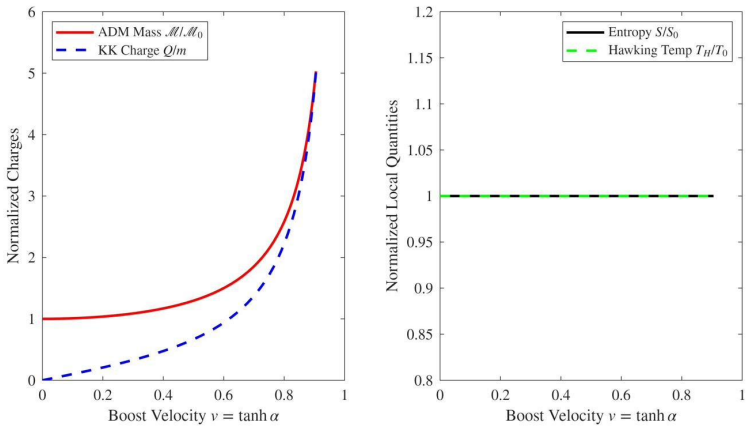
A Kaluza-Klein boost applied to Kerr-Taub-NUT black holes leaves horizon radius, entropy, and temperature unchanged while enlarging the physical ergoregion through higher-dimensional momentum.
A machine-rendered reading of the paper's core claim, the machinery that carries it, and where it could break.
Core claim
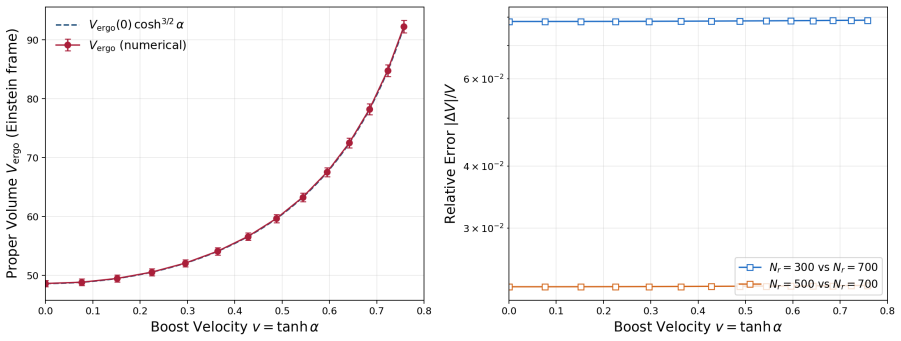
The Kaluza-Klein boost generates an Einstein-Maxwell-Dilaton black hole whose electric charge originates from higher-dimensional momentum. The coordinate location of the stationary limit surface defined by g_tt = 0 remains invariant, but the proper spatial volume of the ergoregion enlarges through modification of the induced spatial metric. Horizon radius, entropy, and temperature stay fixed while the effective inertial-frame rotation measured by ZAMOs grows. The first law is verified with both electric and magnetic Kaluza-Klein work terms, and the seed mass is distinguished from the asymptotic ADM mass and the horizon Komar mass.
What carries the argument
The Kaluza-Klein boost along the compact direction, which converts higher-dimensional momentum into an effective electric charge and modifies the induced spatial metric after reduction, thereby separating boost-invariant horizon quantities from boost-dependent global geometry.
If this is right
- The first law of black-hole thermodynamics holds after inclusion of both the electric charge work term and the magnetic Kaluza-Klein work term generated by the boost-NUT interplay.
- The seed mass parameter used in the construction differs from both the asymptotic ADM mass and the horizon Komar mass.
- Higher-dimensional momentum increases the effective rotation measured by ZAMOs and the ergoregion volume without changing horizon radius, entropy, or temperature.
- Global geometric properties such as ergoregion size provide a signature of extra dimensions that is independent of local horizon thermodynamics.
Where Pith is reading between the lines
- The separation suggests that superradiant instabilities or Penrose-process efficiency in such spacetimes could be tuned by the boost parameter while leaving Hawking temperature fixed.
- Similar volume enhancements might appear in other Kaluza-Klein reductions of rotating solutions, offering a geometric probe for hidden dimensions that could be checked against numerical five-dimensional evolutions.
- Observers confined to the reduced four-dimensional theory might detect extra-dimensional effects through modified frame-dragging and ergoregion extent without any change in black-hole evaporation rates.
Load-bearing premise
The physical ergoregion is correctly quantified by the proper spatial volume on constant-time hypersurfaces in the Einstein frame, which depends on the choice of slicing and the induced spatial metric after reduction.
What would settle it
Explicit integration of the proper volume over the ergoregion for a sequence of increasing boost parameters that shows no enlargement, or direct computation of the horizon surface gravity that changes with boost strength, would falsify the separation between invariant horizon thermodynamics and dependent global geometry.
Figures


read the original abstract
We investigate rotating black holes obtained by applying a Kaluza-Klein boost to the Kerr-Taub-NUT spacetime and study the resulting four-dimensional geometry and thermodynamics after dimensional reduction. The boost along the compact direction generates an Einstein-Maxwell-Dilaton black hole in which the electric charge originates purely from higher-dimensional momentum rather than from an independent matter source. We demonstrate that the coordinate location of the stationary limit surface, defined by the condition $g_{tt}=0$ in the Einstein frame, is invariant under the Kaluza-Klein boost. Nevertheless, the boost induces a substantial enlargement of the \emph{physical} ergoregion, as measured by the proper spatial volume on constant-time hypersurfaces, through its modification of the induced spatial metric. We further verify the first law of black-hole thermodynamics with both the electric and magnetic Kaluza-Klein work terms included -- the latter being a genuinely dyonic feature generated by the interplay of the boost with the NUT charge -- and carefully distinguish the seed mass parameter from the asymptotic ADM mass and from the horizon Komar mass. Our results establish a clear separation between boost-invariant horizon thermodynamics and boost-dependent global geometric properties. In particular, higher-dimensional momentum enhances the effective inertial-frame rotation measured by ZAMOs and ergoregion volume without altering the horizon radius, entropy, or temperature, providing a clean geometric signature of extra dimensions in rotating black hole spacetimes.
Editorial analysis
A structured set of objections, weighed in public.
Referee Report
Summary. The manuscript investigates rotating black holes obtained by applying a Kaluza-Klein boost to the Kerr-Taub-NUT spacetime, followed by dimensional reduction to four dimensions. This yields an Einstein-Maxwell-Dilaton black hole in which the electric charge arises purely from higher-dimensional momentum. The paper claims that the coordinate location of the stationary limit surface (defined by g_tt=0 in the Einstein frame) is invariant under the boost, while the physical ergoregion enlarges substantially as quantified by the proper spatial volume on constant-time hypersurfaces due to modifications of the induced spatial metric. It further asserts verification of the first law of black-hole thermodynamics including both electric and magnetic Kaluza-Klein work terms (with the magnetic term generated by the boost-NUT interplay), careful distinction among the seed mass parameter, asymptotic ADM mass, and horizon Komar mass, and a separation between boost-invariant horizon thermodynamics (radius, entropy, temperature) and boost-dependent global geometric properties (ergoregion volume and ZAMO-measured rotation).
Significance. If the derivations hold, the work would provide a useful illustration of how extra-dimensional momentum can modify global geometric features of rotating black holes (such as ergoregion volume) while leaving horizon thermodynamics unchanged, offering a potential geometric signature of Kaluza-Klein theory. The explicit separation of mass definitions and the generation of dyonic terms from the boost interacting with NUT charge are constructive elements that support the thermodynamic analysis.
major comments (2)
- The central claim that the physical ergoregion enlarges (while the stationary limit surface location remains invariant) rests on quantifying the ergoregion via the proper spatial volume on constant-time hypersurfaces in the Einstein frame after reduction. This measure is sensitive to the choice of time slicing and the precise definition of the induced spatial metric; without explicit justification or comparison to alternative frames or volume definitions, it is unclear whether this uniquely captures the intended physical enlargement or introduces slicing dependence that could affect the claimed separation between invariant and dependent properties.
- The assertion that the first law is verified with both electric and magnetic Kaluza-Klein work terms, together with the distinctions among seed mass, ADM mass, and Komar mass, cannot be assessed for consistency or absence of post-hoc adjustments because the abstract provides no explicit metric components, thermodynamic potentials, charge expressions, or derivation steps for the mass variations.
Simulated Author's Rebuttal
We thank the referee for their careful reading of our manuscript and for the constructive comments. We address each major comment below.
read point-by-point responses
-
Referee: The central claim that the physical ergoregion enlarges (while the stationary limit surface location remains invariant) rests on quantifying the ergoregion via the proper spatial volume on constant-time hypersurfaces in the Einstein frame after reduction. This measure is sensitive to the choice of time slicing and the precise definition of the induced spatial metric; without explicit justification or comparison to alternative frames or volume definitions, it is unclear whether this uniquely captures the intended physical enlargement or introduces slicing dependence that could affect the claimed separation between invariant and dependent properties.
Authors: We thank the referee for this observation. The proper spatial volume is computed from the determinant of the induced three-metric on t=constant hypersurfaces in the Einstein frame, which is the natural slicing for the dimensionally reduced theory. The Kaluza-Klein boost leaves the g_tt=0 surface fixed while altering the spatial metric components, thereby increasing the volume element inside the ergoregion. This choice is consistent with the ZAMO-measured rotation discussed in the paper and preserves the separation between boost-invariant horizon quantities and boost-dependent global geometry. We agree that a brief justification of the slicing and a note on its relation to other possible measures would strengthen the presentation, and we will add this discussion in the revised manuscript. revision: partial
-
Referee: The assertion that the first law is verified with both electric and magnetic Kaluza-Klein work terms, together with the distinctions among seed mass, ADM mass, and Komar mass, cannot be assessed for consistency or absence of post-hoc adjustments because the abstract provides no explicit metric components, thermodynamic potentials, charge expressions, or derivation steps for the mass variations.
Authors: The abstract is a concise summary and therefore omits explicit expressions. The full manuscript derives the boosted and reduced metric, defines the seed mass parameter, computes the asymptotic ADM mass and horizon Komar mass, obtains the electric charge from the higher-dimensional momentum and the magnetic charge from the boost-NUT interplay, and verifies the first law by direct variation of the thermodynamic potentials including both work terms. These steps follow from the geometry without post-hoc adjustments. We can expand the abstract with key expressions or add them to a dedicated section if the referee considers it helpful. revision: no
Circularity Check
No significant circularity
full rationale
The abstract describes applying a Kaluza-Klein boost to the known Kerr-Taub-NUT metric, performing dimensional reduction to obtain an Einstein-Maxwell-Dilaton solution, and then computing horizon thermodynamics and ergoregion properties. No equations or derivation steps are supplied that reduce by construction to self-definition, fitted inputs renamed as predictions, or load-bearing self-citations. The claimed separation between boost-invariant horizon quantities (radius, entropy, temperature) and boost-dependent global quantities (ergoregion volume, ZAMO rotation) is asserted as the outcome of explicit calculations on the boosted metric, without any internal reduction to the input assumptions.
Axiom & Free-Parameter Ledger
free parameters (1)
- Kaluza-Klein boost parameter
axioms (1)
- domain assumption Five-dimensional Kerr-Taub-NUT spacetime reduces via Kaluza-Klein compactification to a consistent four-dimensional Einstein-Maxwell-Dilaton black hole.
Lean theorems connected to this paper
-
IndisputableMonolith/Foundation/AlexanderDuality.leanalexander_duality_circle_linking unclearOur results establish a clear separation between boost-invariant horizon thermodynamics and boost-dependent global geometric properties. In particular, higher-dimensional momentum enhances the effective inertial-frame rotation measured by ZAMOs and ergoregion volume without altering the horizon radius, entropy, or temperature.
-
IndisputableMonolith/Cost/FunctionalEquation.leanwashburn_uniqueness_aczel unclearWe further verify the first law of black-hole thermodynamics with both the electric and magnetic Kaluza-Klein work terms included
discussion (0)
Sign in with ORCID, Apple, or X to comment. Anyone can read and Pith papers without signing in.