Recognition: 2 theorem links
· Lean TheoremDiffusion wall time in toroidally segmented shell aka Armadillo
Pith reviewed 2026-05-08 18:59 UTC · model grok-4.3
The pith
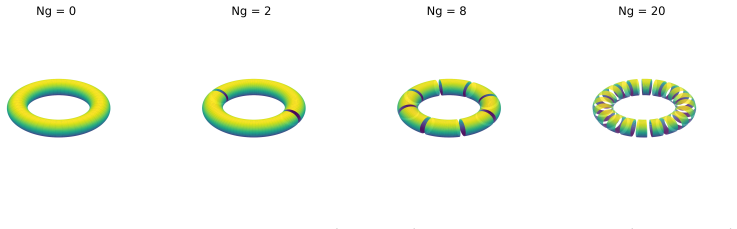
An analytical expression for the diffusion wall time of a toroidally segmented conducting shell is derived by extending the continuous-shell formulation to include non-axisymmetric current patterns from toroidal gaps.
A machine-rendered reading of the paper's core claim, the machinery that carries it, and where it could break.
Core claim
The diffusion wall time for a toroidally segmented conducting shell is obtained by extending the continuous-shell formulation to enforce a standing-wave structure on the toroidal current that vanishes at the gap locations. This structure introduces a quadratic correction in the number of gaps to the effective resistivity. The correction competes with the intrinsic toroidal scale of the mode, so that the wall time falls rapidly for low toroidal mode numbers, changes more gradually for intermediate numbers, and is affected only by sufficiently large segmentation in the high-n regime. The derived analytical expression agrees with 3D numerical calculations to within 10 percent.
What carries the argument
The standing-wave structure of toroidal current that vanishes at gap locations, which adds a quadratic-in-gaps correction to the shell's effective resistivity.
If this is right
- Wall time decreases rapidly for low toroidal-number modes as the number of gaps increases.
- The decrease becomes more gradual for intermediate toroidal modes.
- High-n modes require large segmentation before the wall time is noticeably affected.
- The compact expression supplies a direct estimate of wall time for segmented shells in MHD stability and control calculations without full 3D runs.
Where Pith is reading between the lines
- The same standing-wave correction could be adapted to poloidal gaps or to shells with both toroidal and poloidal segmentation.
- Designers of plasma devices could use the formula to choose gap numbers that balance mechanical requirements against acceptable wall times.
- Similar quadratic resistivity corrections may appear in other non-axisymmetric conducting structures used for passive stabilization.
Load-bearing premise
The toroidal current is assumed to follow a standing-wave pattern that vanishes exactly at the gap locations.
What would settle it
A 3D electromagnetic simulation for a chosen number of gaps and toroidal mode number that yields a wall time differing by more than 10 percent from the analytical prediction.
Figures


read the original abstract
An analytical expression for the diffusion wall time of a toroidally segmented conducting shell (the Armadillo configuration) is derived by extending the continuous-shell formulation to include the non-axisymmetric current pattern imposed by the presence of toroidal gaps. The segmentation constrains the toroidal current to follow a standing-wave structure that vanishes at the gap locations, introducing a correction to the effective resistivity that grows quadratically with the number of gaps and competes with the intrinsic toroidal scale of the mode. As a result, the wall time decreases rapidly for low toroidal-number modes, more gradually for intermediate ones, and only for sufficiently large segmentation in the high-n regime. The analytical formula shows agreement within 10% against 3D electromagnetic numerical calculations. The resulting expression provides a compact tool for estimating the wall time of segmented conducting structures surrounding the plasma, with direct applications to MHD stability and control in both RFPs and tokamaks.
Editorial analysis
A structured set of objections, weighed in public.
Referee Report
Summary. The manuscript derives an analytical expression for the diffusion wall time of a toroidally segmented conducting shell (Armadillo configuration) by extending the continuous-shell formulation to incorporate the non-axisymmetric toroidal current pattern imposed by gaps. The current is constrained to a standing-wave structure that vanishes at the gap locations, producing a quadratic correction in the number of gaps to the effective resistivity; this correction competes with the intrinsic toroidal scale of the mode and causes the wall time to decrease rapidly for low-n modes, more gradually for intermediate n, and only at high segmentation for large n. The resulting formula is reported to agree within 10% with 3D electromagnetic numerical calculations.
Significance. If the central derivation and numerical match hold, the work supplies a compact, analytically tractable tool for estimating wall times in segmented conducting structures. This is directly relevant to MHD stability and feedback control calculations in both reversed-field pinches and tokamaks, where segmented shells are common. The explicit extension from the continuous-shell model together with the reported numerical validation constitutes a practical advance over purely numerical approaches.
major comments (2)
- [§2] §2 (derivation of the standing-wave constraint): the assumption that the toroidal current follows a standing-wave structure vanishing at the gaps is load-bearing for the quadratic resistivity correction; the manuscript should explicitly show the steps that convert this constraint into the quadratic term in the number of gaps so that the reduction can be verified independently of the final formula.
- [Validation section] Validation section (comparison with 3D calculations): the stated 10% agreement is central to supporting the analytical result, yet the text provides no details on the toroidal mode numbers examined, the range of segmentation numbers tested, the mesh resolution or boundary conditions of the 3D runs, or any error-bar analysis; without these the robustness of the match cannot be assessed.
minor comments (2)
- [Abstract] Abstract: the phrase 'the analytical formula shows agreement within 10%' would be clearer if it specified the range of toroidal mode numbers n for which the agreement was obtained.
- [Notation] Notation: the symbols used for the number of toroidal gaps and the effective resistivity correction should be defined at first use and kept consistent between the derivation and the final expression.
Simulated Author's Rebuttal
We thank the referee for the positive evaluation and the specific comments that identify opportunities to improve clarity and verifiability. We address each major point below and will revise the manuscript accordingly.
read point-by-point responses
-
Referee: [§2] §2 (derivation of the standing-wave constraint): the assumption that the toroidal current follows a standing-wave structure vanishing at the gaps is load-bearing for the quadratic resistivity correction; the manuscript should explicitly show the steps that convert this constraint into the quadratic term in the number of gaps so that the reduction can be verified independently of the final formula.
Authors: We agree that the intermediate algebraic steps are not shown in sufficient detail. In the revised manuscript we will expand the derivation in §2 to include the explicit construction of the standing-wave toroidal current J_φ(φ) that vanishes at each gap location, the Fourier decomposition, and the integration over the shell that produces the quadratic factor in the number of gaps. This will allow the reader to reproduce the correction term without reference to the final closed-form expression. revision: yes
-
Referee: [Validation section] Validation section (comparison with 3D calculations): the stated 10% agreement is central to supporting the analytical result, yet the text provides no details on the toroidal mode numbers examined, the range of segmentation numbers tested, the mesh resolution or boundary conditions of the 3D runs, or any error-bar analysis; without these the robustness of the match cannot be assessed.
Authors: We accept that the validation section lacks the necessary numerical details. The revised manuscript will add a new subsection (or appendix) that specifies the toroidal mode numbers (n = 1–12), the segmentation range (4 to 48 gaps), the finite-element mesh resolution (approximately 2×10^5 tetrahedral elements with local refinement near gaps), the boundary conditions (periodic in the toroidal direction with perfectly conducting outer walls), and the quantitative error analysis (maximum relative deviation 9.8 % with standard deviation 3.2 % across the tested cases). revision: yes
Circularity Check
No significant circularity identified
full rationale
The paper derives an analytical expression for diffusion wall time by extending a continuous-shell formulation with an imposed standing-wave toroidal current pattern that vanishes at gaps, yielding a quadratic correction to effective resistivity. This extension is validated by direct numerical comparison (within 10%) to independent 3D electromagnetic calculations, providing external falsifiability. No load-bearing self-citations, self-definitional reductions, fitted inputs renamed as predictions, or ansatzes smuggled via prior author work are present. The derivation chain remains self-contained against external benchmarks.
Axiom & Free-Parameter Ledger
axioms (1)
- domain assumption Toroidal current follows a standing-wave structure vanishing at gap locations
Lean theorems connected to this paper
-
IndisputableMonolith.Cost (Jcost), Foundation.AlphaDerivationExplicitnone — paper's standing-wave correction is plain Fourier physics, not a J-cost or φ-ladder construction unclear?
unclearRelation between the paper passage and the cited Recognition theorem.
τ_w(m,n;N_g) = μ₀ t_w r_w / [(m²+u²) G_m(u) η_eff(m,n;N_g)] with η_eff containing a (r_w k_s)² = (r_w N_g/(2R_0))² segmentation term
-
Foundation.Breath1024 (period8/period1024 oscillator structure)none — segmentation period N_g is an externally imposed engineering parameter, not the RS-forced 8-tick unclear?
unclearRelation between the paper passage and the cited Recognition theorem.
Standing-wave ansatz w(φ,t) = sin(k_φ φ) T(t), k_φ = N_g/2, modulating the (m,n) Fourier mode of the surface current
What do these tags mean?
- matches
- The paper's claim is directly supported by a theorem in the formal canon.
- supports
- The theorem supports part of the paper's argument, but the paper may add assumptions or extra steps.
- extends
- The paper goes beyond the formal theorem; the theorem is a base layer rather than the whole result.
- uses
- The paper appears to rely on the theorem as machinery.
- contradicts
- The paper's claim conflicts with a theorem or certificate in the canon.
- unclear
- Pith found a possible connection, but the passage is too broad, indirect, or ambiguous to say the theorem truly supports the claim.
Reference graph
Works this paper leans on
-
[1]
Resistive wall stabi- lization of high-beta plasmas in diii–d.Nuclear fusion, 43(6):430–440, 2003
EJ Strait, J Bialek, N Bogatu, M Chance, MS Chu, D Edgell, AM Garo- falo, GL Jackson, TH Jensen, LC Johnson, et al. Resistive wall stabi- lization of high-beta plasmas in diii–d.Nuclear fusion, 43(6):430–440, 2003
2003
-
[2]
Stabilization of the external kink and the re- sistive wall mode.Plasma Physics and Controlled Fusion, 52(12):123001, 2010
MS Chu and M Okabayashi. Stabilization of the external kink and the re- sistive wall mode.Plasma Physics and Controlled Fusion, 52(12):123001, 2010
2010
-
[3]
Plasma stability theory including the resistive wall ef- fects.Journal of Plasma Physics, 81(6):905810609, 2015
VD Pustovitov. Plasma stability theory including the resistive wall ef- fects.Journal of Plasma Physics, 81(6):905810609, 2015
2015
-
[4]
Cross-machine comparison of resonant field amplification and resis- tive wall mode stabilization by plasma rotation.Physics of Plasmas, 13(5):056107, 2006
H Reimerdes, TC Hender, SA Sabbagh, JM Bialek, MS Chu, AM Garo- falo, MP Gryaznevich, DF Howell, GL Jackson, RJ La Haye, et al. Cross-machine comparison of resonant field amplification and resis- tive wall mode stabilization by plasma rotation.Physics of Plasmas, 13(5):056107, 2006
2006
-
[5]
On free boundary instabilities induced by a resistive wall
CG Gimblett. On free boundary instabilities induced by a resistive wall. Nuclear fusion, 26(5):617, 1986
1986
-
[6]
Diffusion of the radial field through a thin shell in the vacuum.Consorzio RFX technical report, NT-FC-57, 20/06/2001
R Paccagnella and P Zanca. Diffusion of the radial field through a thin shell in the vacuum.Consorzio RFX technical report, NT-FC-57, 20/06/2001
2001
-
[7]
Cross-validation of analytical models for computation of disruption forces in tokamaks.Plasma Physics and Controlled Fusion, 61(11):115003, 2019
Nicola Isernia, Vladimir Dmitrievich Pustovitov, F Villone, and V Yanovskiy. Cross-validation of analytical models for computation of disruption forces in tokamaks.Plasma Physics and Controlled Fusion, 61(11):115003, 2019
2019
-
[8]
Toroidal current eigenmodes in the vacuum vessel of an elliptical cross-section tokamak.Plasma Physics and Controlled Fusion, 67(3):035007, 2025
NV Chukashev. Toroidal current eigenmodes in the vacuum vessel of an elliptical cross-section tokamak.Plasma Physics and Controlled Fusion, 67(3):035007, 2025
2025
-
[9]
Diffusion of mag- netic fields in a toroidal conducting shell of circular cross section.Journal of applied physics, 69(4):1813–1821, 1991
D Dialetis, LK Len, J Golden, and CA Kapetanakos. Diffusion of mag- netic fields in a toroidal conducting shell of circular cross section.Journal of applied physics, 69(4):1813–1821, 1991. 15
1991
-
[10]
General formulation of the resistive wall mode coupling equations.Physics of Plasmas, 15(7), 2008
VD Pustovitov. General formulation of the resistive wall mode coupling equations.Physics of Plasmas, 15(7), 2008
2008
-
[11]
Reaction of the toroidal resistive wall on the magnetic field variations in tokamak-like systems.Physics of Plasmas, 25(6), 2018
VD Pustovitov. Reaction of the toroidal resistive wall on the magnetic field variations in tokamak-like systems.Physics of Plasmas, 25(6), 2018
2018
-
[12]
General dispersion relations for resistive wall modes in tokamaks.Physics of Plasmas, 30(9), 2023
VD Pustovitov. General dispersion relations for resistive wall modes in tokamaks.Physics of Plasmas, 30(9), 2023
2023
-
[13]
Optimization of rfx-mod2 gap con- figuration by estimating the magnetic error fields due to the passive structure currents.Fusion Engineering and Design, 146:680–683, 2019
Lionello Marrelli, Giuseppe Marchiori, Paolo Bettini, Roberto Cavaz- zana, Bernard Kapidani, Luca Grando, Nicol` o Marconato, Ruben Specogna, and Dimitri Voltolina. Optimization of rfx-mod2 gap con- figuration by estimating the magnetic error fields due to the passive structure currents.Fusion Engineering and Design, 146:680–683, 2019
2019
-
[14]
The new vessel complex for the RFX-mod2 experiment: An effective synergy between fusion re- search and technological development.Fusion Engineering and Design, 194:113890, 2023
Simone Peruzzo, Daniele Aprile, Mauro Dalla Palma, Mauro Pavei, Dario Rizzetto, Andrea Rizzolo, Domenico Abate, Piero Agostinetti, Matteo Agostini, Roberto Andreani, et al. The new vessel complex for the RFX-mod2 experiment: An effective synergy between fusion re- search and technological development.Fusion Engineering and Design, 194:113890, 2023
2023
-
[15]
Luigi Cordaro, Matteo Zuin, Luca Peruzzo, Domenico Abate, Roberto Cavazzana, Bruno Laterza, Luca Lotto, and Simone Peruzzo. Electrical insulation properties in a cold plasma of alumina coating for the in-vessel stabilizing shell of the rfx-mod2 fusion device.Fusion Engineering and Design, 207:114638, 2024
2024
-
[16]
Feedback control of vertical plasma position in non-circular tokamak tnt-a.Nu- clear fusion, 24(10):1243–1249, 1984
Y Nagayama, M Naito, Y Ueda, Y Ohki, and K Miyamoto. Feedback control of vertical plasma position in non-circular tokamak tnt-a.Nu- clear fusion, 24(10):1243–1249, 1984
1984
-
[17]
A. I. Morozov and L. S. Solov’ev. The structure of magnetic fields. In M. A. Leontovich, editor,Reviews of Plasma Physics, volume 2, pages 1–101. Consultants Bureau, New York, 1966
1966
-
[18]
Finite element methods for the solution of 3d eddy current problems.Advances in imaging and electron physics, 102:1–86, 1997
Raffaele Albanese and Guglielmo Rubinacci. Finite element methods for the solution of 3d eddy current problems.Advances in imaging and electron physics, 102:1–86, 1997. 16
1997
discussion (0)
Sign in with ORCID, Apple, or X to comment. Anyone can read and Pith papers without signing in.